The Wench is Dead by Colin Dexter

An Inspector Morse book, The Wench is Dead is the 8th in the series, first published in 1989. This is a bit different from the other Morse books in that it is historical crime fiction – no current cases are investigated.
The wench is dead


Morse is in hospital being treated for a perforated ulcer. Whilst recovering he is given a book called Murder on the Oxford Canal by the wife of a recently deceased patient at the hospital. It’s an account of the investigation and trial that followed the death of Joanna Franks in 1859. She had been found at Duke’s Cut on the Oxford Canal. As he reads, Morse becomes convinced that the two boatmen hanged for her murder and a third man who had been transported to Australia were innocent.

Dexter based his book on an account of a Victorian murder in 1839, that of 37-year-old Christina Collins as she travelled the Trent and Mersey Canal atRugeley, Staffordshire, on the Staffordshire Knot en route to London. It reminded me of Josephine Tey’s novel, The Daughter of Time in which Inspector Alan Grant, also recovering in hospital, investigates the murder of the Princes in the Tower.

Morse enlists the help of Sergeant Lewis as well as that of Christine Greenaway, the beautiful daughter of one of the other patients. She works as a librarian at the Bodleian Library. So he is able to study original source material as well as the account in the published book. Morse finds it an absorbing puzzle, like a tricky cryptic crossword, and the more he read and thought about it the more questions came to his mind. He was not satisfied that the conclusions drawn at the trial about the forensic and pathological evidence were right. He felt uneasy about reported conversations between the various people involved:

… all of it was wrong somehow. Wrong if they were guilty. It was if some inexperienced playwright had been given a murder-plot, and then had proceeded to write page after page of inappropriate, misleading and occasionally contradictory dialogue. (page 133)

I thought it was ingenious and compelling reading, very well constructed and very clever. By the time he leaves the hospital Morse is convinced that he has solved the mystery. It’s a tale of  intrigue, lust and deception, with more than a few twists and turns.

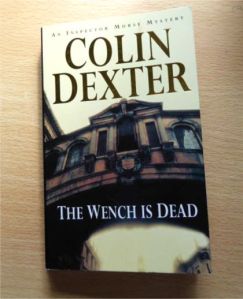
Reading Challenges: Mount TBR Reading Challenge, 20 Books of Summer 2016 , Vintage Cover Silver Age Scavenger Hunt: in the category of a Building (not a house) – the front cover of my copy shows the Hertford Bridge, popularly known as the Bridge of Sighs, which joins two parts of Hertford College over New College Lane in Oxford.

First Chapter, First Paragraph:

First chapterEvery Tuesday Diane at Bibliophile by the Sea hosts First Chapter First Paragraph Tuesday Intros to share the first paragraph sometimes two, of a book that she’s reading or planning to read soon.

The Wench is Dead by Colin Dexter is one of those books I’ve been meaning to read for some time and it’s one of my 20 Books of Summer. It’s an Inspector Morse book.

It begins:

Intermittently, on the Tuesday, he felt sick. Frequently, on the Wednesday, he was sick. In the Thursday, he felt sick frequently, but was actually sick only intermittently. With difficulty, early on the Friday morning – drained, listless, and infinitely weary – he found the energy to drag himself from his bed to the telephone, and seek to apologise to his superiors at Kidlington Police HQ for what was going to be an odds-on non-appearance at the office that late November day.

Blurb:

That night he dreamed in Technicolor. He saw the ochre-skinned, scantily clad siren in her black, arrowed stockings. And in Morse’s muddled computer of a mind, that siren took the name of one Joanna Franks . . .

The body of Joanna Franks was found at Duke’s Cut on the Oxford Canal at about 5.30 a.m. on Wednesday, 22nd June 1859.

At around 10.15 a.m. on a Saturday morning in 1989 the body of Chief Inspector Morse – though very much alive – was removed to Oxford’s John Radcliffe Hospital. Treatment for a perforated ulcer was later pronounced successful.

As Morse begins his recovery he comes across an account of the investigation and the trial that followed Joanna Franks’ death . . . and becomes convinced that the two men hanged for her murder were innocent . . .

What do you think? Would you keep reading? I’m predisposed to like this book, because I loved the Morse TV series and also because I’m a fan of cold case investigations – especially one this old.

New-To-Me Books August 2015

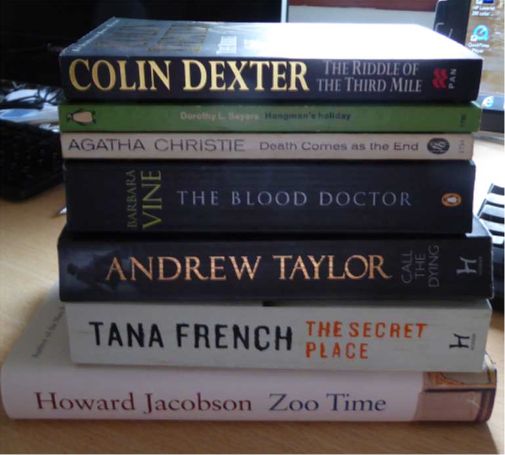
Another visit to Barter Books in Alnwick resulted in another pile of books to add to my TBR shelves.

From top to bottom they are:

  • The Riddle of the Third Mile by Colin Dexter – to fill in my gaps in reading his Inspector Morse books. This is the 6th in the series – Inspector Morse isn’t sure what to make of the truncated body found dumped in the Oxford Canal. He suspects it may be all that’s left of an elderly Oxford don last seen boarding a London train days before.
  • Hangman’s Holiday and Other Stories by Dorothy L Sayers – the ninth in her Lord Peter Wimsey series, this includes  four Wimsey stories, six stories featuring Montague Egg (travelling salesman for Plummet & Rose, Wine & Spirits), and two more separate stories.
  • Death Comes as the End by Agatha Christie – this is one of the last few books of hers I have yet to read. It’s historical crime fiction set in Egypt 4,000 years ago, written drawing on her experience of several  expeditions to the Middle East with her husband, Max Malloran, an eminent archaeologist.
  • The Blood Doctor by Barbara Vine (Ruth Rendell) – one of her psychological thrillers, described on the back cover as ‘a chilling tale of ambition, obsession and bad blood.‘ I still have a lot of Barbara Vine/Ruth Rendell books to read.
  • Call the Dying by Andrew Taylor – I’m jumping into a series with this book as this is the 7th in the Lydmouth mysteries and I haven’t read any of the others. They are all are set in and around a fictional town on the Anglo-Welsh borders in the years after World War II.
  • The Secret Place by Tana French – the 5th in the Dublin Murder Mystery series. I read the first,  In the Woods a few years ago and liked its psychological elements and the twists and turns.  In this book Detective Stephen Moran investigates the murder of handsome, popular Chris Harper when sixteen-year-old Holly Mackey brings him a photo of Chris with the caption, I KNOW WHO KILLED HIM.
  • Zoo Time by Howard Jacobson – a complete change from crime fiction – a book I bought in Tescos for £1. It’s described on the book cover as  ‘a novel about love – love of women, love of literature, love of laughter. It shows our funniest writer at his brilliant best.‘ I felt like reading something different.

If you’ve read any of these books I’d love to know what you think about them.

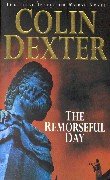
The Remorseful Day by Colin Dexter

Chief Inspector Morse is one of my favourite fictional detectives (maybe even the favourite). I first ‘met’ him years ago in the ITV series Inspector Morse and so, just as Joan Hickson is forever in my mind as Miss Marple and David Suchet is Poirot, John Thaw is Morse. The series was first broadcast in 1987, but I don’t intend to write about the books versus the TV adaptations – I’ve enjoyed both. This post is just about the last book in the series – The Remorseful Day.

I’ve delayed reading this for so long (I watched the TV version when it was first broadcast, which was 15 years ago!) because it’s the last of the Morse books and sadly the end of Morse too. So if you’ve not read any of the Morse books I suggest that you don’t start with this one.

Needless to say that I loved it. The plot is detailed, complex and as usual with Morse a puzzle type murder mystery with plenty of challenging clues. Sergeant Lewis is left to investigate the murder of nurse Yvonne Harrison that had remained unsolved for a year – Morse initially refused to work on the case, despite Chief Superintendent Strange’s wishes. Sergeant Lewis is concerned as this looks just the sort of puzzle Morse excels in solving … and Morse’s behaviour has been worrying Lewis recently.  Lewis can’t believe that Morse could have a personal reason to keep out of the investigation. And when Morse phones to say he is feeling unwell Lewis is most concerned – Morse seldom mentioned his health, what is wrong with him?

The plot is complex, but the real focus of the book is on Morse and how he copes with his illness and his drinking habits and it becomes obvious just how alone he is in the world and how devastating his situation is to Lewis. The novel also reveals more about Strange’s character and also about his understanding of Morse. I found it both a most satisfying book and a very sad one.

There are only 13 Morse books. The links are to my posts on the books – I read some before I began to write this blog and I’m hoping to re-read those in due course.

  1. Last Bus to Woodstock (1975)
  2. Last Seen Wearing (1976)
  3. The Silent World of Nicholas Quinn (1977)
  4. Service of All the Dead (1979)
  5. The Dead of Jericho (1981)
  6. The Riddle of the Third Mile (1983)
  7. The Secret of Annexe 3 (1986)
  8. The Wench is Dead (1989)
  9. The Jewel That Was Ours (1991)
  10. The Way Through the Woods (1992)
  11. The Daughters of Cain (1994)
  12. Death is Now My Neighbour (1996)
  13. The Remorseful Day (1999)

As The Remorseful Day has sat unread on my shelves for so long it obviously qualifies for the Mount TBR Challenge 2015. I also included it as one of My 10 Books of Summer, which brings my total to 5.

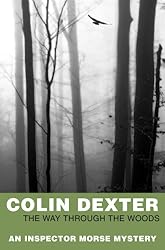
The Way Through The Woods by Colin Dexter: Mini Review

I really enjoyed reading Colin Dexter’s The Way Through The Woods, the tenth book in his Inspector Morse series. It’s nicely complicated and full of puzzles as Morse aided by Sergeant Lewis investigate the case of a beautiful young Swedish tourist who had disappeared on a hot summer’s day somewhere near Oxford twelve months earlier. After unsuccessfully searching the woods of the nearby Blenheim Estate the case was unsolved, and Karin Eriksson had been recorded as a missing person.

A year later Morse is on holiday at Lyme Regis when The Times published an article on the missing woman together with an anonymous poem that had been sent in that the police thought could help pinpoint the whereabouts of her body. This sets in motion more letters to The Times and ultimately to Morse being assigned to re-open the case.

I was completely engrossed in this book, trying to follow all the possible interpretations of the poem and the witness statements as Morse and Lewis go over the old evidence and turn up new information. This involves a trip to Wales for Morse and one to Sweden for Lewis, Wytham Woods is searched and a body is found – but whose is it? This book sees the first appearance of forensic pathologist, Dr Laura Hobson. But it’s not just the mystery, the crossword type clues, the characterisation and all the twist and turns that make this book so enjoyable, it’s the writing, the descriptions of the scenery and locations bringing them vividly to my mind.

This book has been sitting unread on my shelves for three years and is the last of my to-be-read books of 2014. An excellent book!

Service of All the Dead by Colin Dexter

Colin Dexter 001

A question on the TV show Pointless about the novels of Colin Dexter reminded me I have a few of his books to read, Service of All the Dead being one of them – and it was one of the pointless answers too! So that gave me the push to read it.  My copy is a secondhand book – an Omnibus containing  The Silent World of Nicholas Quinn as well as Service of All the Dead.

It really is one of the most puzzling crime fiction books I’ve read – if not the most puzzling! CI Morse sums it up himself:

There are some extremely odd points in this case, Lewis – or rather there were – each of them in itself suggestive but also puzzling. They puzzled all of us, and perhaps still do to some extent, because by the time we’d finished we’d got no less than five bodies on our hands and we were never in a position to learn what any of the five could have told us. (page 295)

Morse was on holiday, bored and at a loose end, when, stepping off a bus near St Frideswide’s Church in Oxford, he saw a notice advertising a jumble sale at the church – it seemed to him pre-ordained that he should enter the church. This set in motion his fascination with the death of the churchwarden, killed in the church the previous year and his subsequent discovery of the deaths of four more people. His interest is enhanced by the attraction he feels for Ruth Rawlinson, who cleans the church.

Aided by Sergeant Lewis, he digs into the history of the churchwarden, the vicar and members of the church and uncovers an intricate web of lies and deceit. Morse acts on instinct and consequently both Lewis and myself were in the dark for a great part of this book. He proposes several motives for the murders and alternate scenarios of what had happened before untangling the complex mess. There are plenty of red herrings and twists and turns.

Even though I was lost in the plot I found the book compelling reading – it’s a superbly constructed puzzle. This is certainly not a police procedural in the normal sense – there is little account of forensic evidence for example. It is strong on character and on place. The scene of the murders is St Frideswide’s, a fictional church, possibly based a couple of Oxford churches, St Michael-by-the-North-Gate with a Saxon tower and St Mary Magdalen and it is there in the tower that Morse suffers from his great fear of heights.

Service of All the Dead was first published in 1979. I suppose I must have seen the TV version of this book, as I watched all the episodes and this one was shown in 1987 – I don’t remember it! Inevitably as I read it I could see John Thaw as Morse and Kevin Whately as Lewis.