It’s time again for Six Degrees of Separation, a monthly link-up hosted by Kate at Books Are My Favourite and Best. Each month a book is chosen as a starting point and linked to six other books to form a chain. A book doesn’t need to be connected to all the other books on the list, only to the one next to it in the chain.
This month we start with The Safekeep by Yael Van Der Wouden, the Women’s Prize Winner for Fiction 2025. This is Amazon’s description:

It is fifteen years after the Second World War, and Isabel has built herself a solitary life of discipline and strict routine in her late mother’s country home, with not a fork or a word out of place. But all is upended when her brother Louis delivers his graceless new girlfriend, Eva, at Isabel’s doorstep – as a guest, there to stay for the season…
In the sweltering heat of summer, Isabel’s desperate need for control reaches boiling point. What happens between the two women leads to a revelation which threatens to unravel all she has ever known.
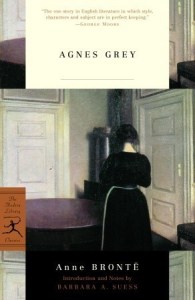
First link: I really didn’t know how to start this chain, until I remembered that the cover of Agnes Grey by Anne Bronte also has doors, although they are closed doors as opposed to the open doors on The Safekeep. This is a novel about a young woman, a governess and her experiences working for two families in Victorian England. Agnes is the younger daughter of an impoverished clergyman. Her parents had married against her mother’s family’s wishes and when their fortune was wrecked Agnes determines to help out by working as a governess. It gives a very clear picture of the life of a governess, with all its loneliness, frustrations, insecurities and depressions.
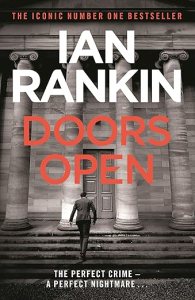
I am staying with doors for the second link, although they are not shown not on the cover, but in the title, with Doors Open by Ian Rankin. This was the first Rankin book wrote after he retired John Rebus in Exit Music. It’s about an art heist – planned by Mike Mackenzie, a self-made man, rich and bored with life, Robert Gissing, the head of Edinburgh’s College of Art and Allan Crickshank a banker with a passion for art that he cannot afford to buy on his salary. Between them they devise a plan to steal some of the most valuable paintings from the National Gallery of Scotland on the day that buildings normally closed to the public throw open their doors and invite them in.
My Third link is Exit Music by Ian Rankin, the 17th Inspector Rebus novel. The Crime Thriller Award for Author of the Year 2008 was awarded to Ian Rankin for this book. It marked the end of an era as Rebus came to the end of his career. At the beginning of this book Rebus is 10 days from his retirement and is anxious to tie up all the loose ends in his current cases, trying to get DS Siobhan Clarke interested in them. So when the body of the dissident Russian poet Alexander Todorov is found dead this is Rebus’s last case. He throws himself into the investigation, desperate to take his mind off the end of his career.
Which brings me rather obviously to my fourth link Exit Lines by Reginald Hill, a Dalziel and Pascoe murder mystery. In this one there are three elderly victims who all died violently one cold and storm-racked November night. A drunken Dalziel is a suspect in one as it seems he was driving the car that hit an elderly cyclist. The plot is intricate, with each separate case being linked together. I thought it was an excellent crime fiction novel which kept me guessing until the end.

My Fifth link is also about a murder that took place during a stormy night. It’s The Redemption of Alexander Seaton by Shona MacLean. Alexander Seaton is a schoolteacher in Banff. It’s set in 17th century Scotland, mainly in the town of Banff, where on a stormy night Patrick Davidson, the local apothecary’s assistant collapses in the street. The next morning he is found dead in the school house of Alexander Seaton, a failed minister, now a schoolteacher
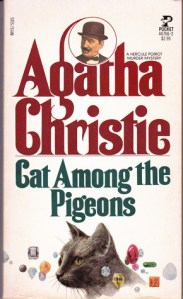
My sixth link is about another schoolteacher, this time a headmistress, Miss Bulstrode in Agatha Christie’s novel Cat Among the Pigeons. She is the head of an exclusive and expensive girls’ school, Meadowbank, in England, said to be based on her daughter Rosalind’s school. Like Miss Brodie, Miss Bulstrode has built a reputation for excellence. But disaster strikes when two of the teachers, Miss Springer, the new Games Mistress and the History and German teacher, Miss Vansittart are murdered. Rather late in the day Hercules Poirot is called in to investigate their deaths.
My chain is mostly made up of two of my favourite genres, historical fiction and crime fiction. It went from a governess to a headmistress with murder mysteries in between. What is in your chain?
Next month (September 6, 2025), we’ll start with the winner of the 2025 Miles Franklin Literary Award, Ghost Cities by Siang Lu.
 BooksPlease