Another short post as I’m catching up with the backlog of books I haven’t reviewed.
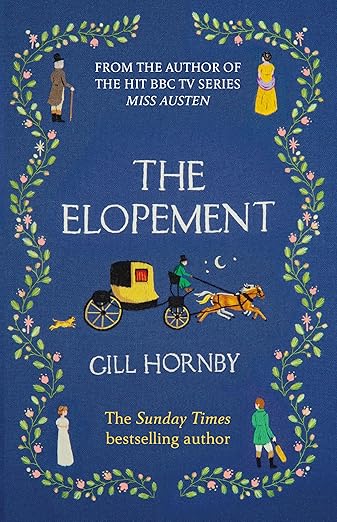
Penguin |22 May 2025| 469 pages| e-book| Review book| 3*
1820. Mary Dorothea Knatchbull is living under the sole charge of her widowed father, Sir Edward – a man of strict principles and high Christian values. But when her father marries Miss Fanny Knight of Godmersham Park, Mary’s life is suddenly changed. Her new stepmother comes from a large, happy and sociable family and Fanny’s sisters become Mary’s first friends. Her aunt, Miss Cassandra Austen of Chawton, is especially kind. Her brothers are not only amusing, but handsome and charming.
And as Mary Dorothea starts to bloom into a beautiful young woman, she forms an especial bond with one Mr Knight in particular. Soon, they are deeply in love and determined to marry. They expect no opposition. After all, each is from a good family and has known the other for some years.
It promises to be the most perfect match. Who would want to stand in their way?
The Elopement by Gill Hornby is historical fiction about the life of Jane Austen’s niece Fanny Knight and Mary Dorothea Knatchbull, Fanny’s stepdaughter. I wanted to read it because I loved her earlier books about Jane Austen’s extended family, Miss Austen and Godmersham Park. However, I was a bit disappointed as I think it fails to capture that flavour of Jane Austen’s novels that I have loved ever since I first read Pride and Prejudice as a young teenager.
There are many characters listed at the beginning of the book – there are the Knights of Godmersham Park; the Knatchbulls of Mersham-le-Hatch and the Austens of Chawton Cottage, where Cassandra, Jane Austen’s elder sister, and her mother lived. Cassandra Austen only has a cameo role.
Fanny’s father was Edward Austen, who was adopted by the wealthy Knight family (Thomas Knight was a cousin), taking their name in 1812. In 1820 Fanny married Sir Edward Knatchbull, a widower, with six children. Fanny and Mary Dorothea, the only daughter, had a difficult relationship right from the start, unable to break through their natural reserve. Fanny is not a warm character and Mary is reluctant to accept her as a substitute mother – neither of them are willing to be open with each other and maintain an icy politeness. However, Mary and Fanny’s brothers and sisters get on well; very well with one brother in particular.
I didn’t find it evenly paced, beginning very slowly with a rushed ending. I found the first part of the book was too drawn out (even boring in parts) and I thought I’d have to abandon it, but I read on and the second part held my interest and I finished the book. I liked the insight into the wider Austen family and the social context – family relationships, attitudes towards duty, marriage, the position of women and the dangers of childbirth.
The Author’s Note is very interesting, explaining that the narrative exactly follows Fanny Knight’s record of events she recorded in her daily journals that she kept from 1804, when she was eleven years old until she was eighty. Gill Hornby highlights:
‘ … the perilous nature of the lives of the married women. The birth of every child is a moment of danger. The loved ones of expectant mothers are on high alert. … If you married young and were happily fertile, then it was a game of Russian roulette, year after year.
Many thanks to the publishers for a review copy via NetGalley.
 BooksPlease