A Caribbean Mystery by Agatha Christie: Book Review

In Agatha Christie’s A Caribbean Mystery, published in 1964  Miss Marple is on holiday, arranged for her by her nephew Raymond West after her doctor had prescribed sunshine. Whilst staying at the Golden Palm Hotel on the fictitious island of  St Honoré, she is listening to Major Palgrave droning on about his life, reliving days when he’d been happy. He was about to show her a photo of a murderer when he stares over her shoulder and sees someone, stops his story and hastily returns the photo to his wallet. Then hours later he is found dead. Miss Marple suspects he didn’t just die in his sleep and investigates his death, involving old Mr Rafiel, a man who looked on the point of death himself, and who delighted in contradicting anything anyone else said.

She also wants to find out about the murderer the Major had mentioned. The question she needs answered was who was it the Major saw that disturbed him so much. Once again it is her knowledge of human nature, gleaned from living in peaceful St Mary Mead that leads her to uncover the truth. She considers the other guests at the hotel in turn, and not sure whether the murderer was a man or a woman everyone is a suspect, from the elderly Canon Prescott and his sister, a thin severe-looking woman to the hotel owners, a young couple, Molly and Tim Kendal. There are plenty of misleading false trails and hidden relationships to discover before the murderer is revealed.

This is not my favourite Agatha Christie but it’s still an entertaining book, which I enjoyed. I didn’t guess who the murderer was until quite near the end, but that is not a bad point. I liked the descriptions of the island and Miss Marple’s thoughts and observations on human nature. At the beginning Raymond mistakenly thinks his Aunt Jane has her head buried in the sand, living in an idyllic rural life when it is real life that matters. Jane silently disagrees:

People like Raymond were so ignorant. In the course of her duties in a country parish, Jane Marple had acquired quite a comprehensive knowledge of the facts of rural life. She had no urge to talk about them, far less to write about them – but she knew them. Plenty of sex, natural and unnatural. Rape, incest, perversion of all kinds. (Some kinds, indeed, that even the clever young men from Oxford who wrote books didn’t seem to have heard about. (page 9)
Agatha Christie on …

I’ve been reading Agatha Christie’s Autobiography for a while now – just a chapter or so each day. Instead of writing about the details of her life I thought I’d do a few posts now and then on things she drops into the narrative. Ideas she had, thoughts on various things, books she liked and so on.

Today, I’ve chosen to focus on her joy in being alive and happiness.

She’s writing about the time in her life when she was thirteen or fourteen:

Always when I woke up, I had the feeling which I am sure must be natural to all of us, a joy in being alive. I don’t say you feel it consciously – you don’t – but there you are, you are alive, and you open your eyes, and here is another day; another step as it were, on your journey to an unknown place. That very exciting journey which is your life. Not that it is necessarily going to be exciting as a life, but it will be exciting to you because it is your life. That is one of the great secrets of existence, enjoying the gift of life that has been given to you.(page 133)

She goes on to say that not every day will be enjoyable, for example if you remember you’re going to the dentist. However, she thinks it does depend upon your temperament – whether you’re a happy person or melancholic:

Naturally happy people can be unhappy and melancholic people enjoy themselves. But if I were taking a gift to a child at a christening that is what I would choose: a naturally happy frame of mind. (page 133)

I like that.

The ABC Murders by Agatha Christie: Book Review

As I’ve written an ABC of Agatha Christie for the Agatha Christie Blog tour and found the ABC Wednesday site, I thought I’d carried on with the alphabet theme and read Agatha Christie’s The ABC Murders. I’m so glad I did because it’s one of her best, or at least I think it is.

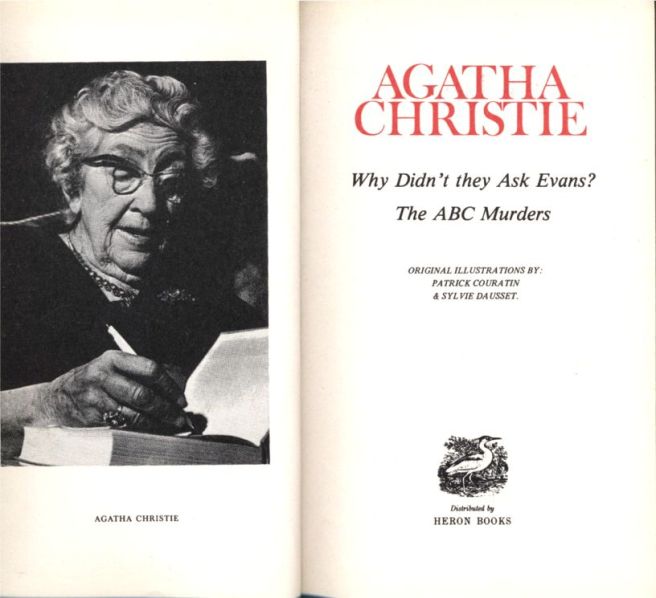
My copy is in a compilation volume along with Why Didn’t They Ask Evans. The ABC Murders was first published in 1936.

It’s narrated by Captain Hastings, for the most part, interspersed by chapters written in the third person, which Hastings assures us are accurate and have been ‘vetted’ by Poirot himself. I thought that was interesting and it alerted me to read those chapters carefully. What follows is a series of murders advertised in advance by letters to Poirot, and signed by an anonymous ‘ABC’. An ABC Railway is left next to each of the bodies. So the first murder is in Andover, the victim a Mrs Alice Ascher; the second in Bexhill, where Betty Barnard was murdered; and then Sir Carmichael Clarke in Churston is found dead. The police are completely puzzled and Poirot gets the victims’ relatives together to see what links if any can be found.

The only thing that seems to link them is that they were killed by the same person and that in each case there is a person who be the obvious suspect as the murderer if it hadn’t been for the ABC murderer. Poirot was convinced that one or possibly all of the relatives ‘knows something that they do not know they know.’ And indeed that was so. In Poirot’s final explanation of the case he admitted that all along he had been worried over the why? Why did ABC commit the murders and why did he select Poirot as his adversary?

Quite early on the book I had my suspicions about the identity of ABC but Agatha Christie was an expert at providing plenty of red herrings and twist and turns, and of course I was actually just as baffled as the police (quite an array of police, including a Chief Constable and an Assistant Commissioner, were involved from different forces around the country as well as Inspector Japp) and Doctor Thompson, a ‘famous alienist’. It was only right at the end that I worked out this ingenious mystery.

4.50 from Paddington by Agatha Christie: Book Review

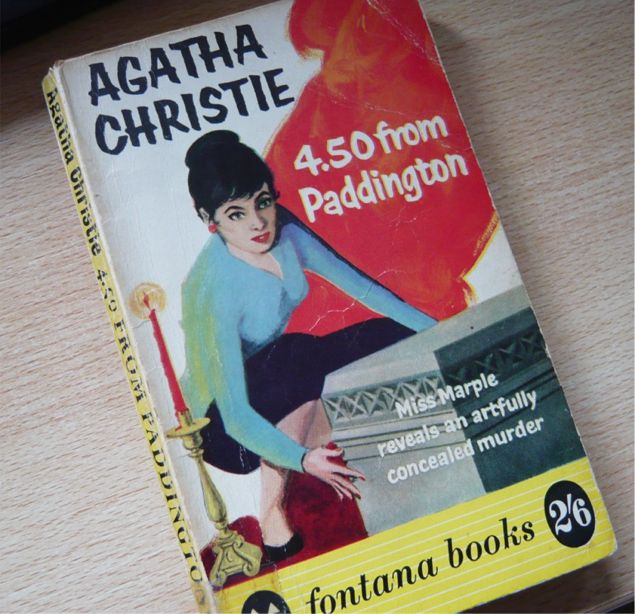
4.50 from Paddington 1

I’d expected the 4.50 from Paddington (first published in 1957) to be set on a train going by its title, but actually it just begins on the train. Train timetables and routes feature quite highly though. Mrs McGillicuddy was going home from Christmas shopping in London when she saw from the window of her train a murder being committed in a train travelling on a parallel line. But nobody believes her because there is no trace of a body and no one is reported missing. Nobody, that is except for her friend Miss Marple.

Miss Marple is getting older and more feeble and she hasn’t got the physical strength to get about and do things as she would like. But she has a theory about the whereabouts of the woman’s body, having worked out the most likely place that a body could have been pushed or thrown out of the train and she enlists the help of Lucy Eyelesbarrow to find it. This takes Lucy to Rutherford Hall, the home of the Crackenthorpe family, a family with many secrets and full of tension.

It’s an intriguing puzzle because you know there has been a murder, that the victim was a woman but her identity is not known, until much later in the book. You also know that the murderer is a man and there are plenty of male suspects to consider. Even though Miss Marple explains it all at the end of the book and says that it was very, very simple – the simplest kind of crime, I didn’t find it simple at all and had no idea who the killer was or even the victim. How Miss Marple worked it out is down to intuition and she tricks the murderer into confessing his crime.

Sunday Salon – Current Books

I finished reading The Fall by Simon Mawer yesterday. It is the story of Rob Dewar and Jamie Matthewson from their childhood up to Jamie’s death 40 years later. But it’s also the story of their parents and how their lives are interlinked. I found it enthralling, one of those books that make me want to look at the ending to see how it all turns out. I managed to stop myself, however, and read impatiently to the end anxious to know what actually happened between them all.

It moves between the two generations beginning in the present day, when Rob hears on the news that Jamie, a renowned mountaineer has fallen to his death in Snowdonia. No one is sure whether it was an accident or suicide. Then it moves  back 40 years to the time when the two boys met, both fatherless – Jamie’s dad, Guy went missing when climbing Kangchenjunga and Rob’s parents are divorced, and back yet further again to 1940 when Guy Matthewson met the boys’ mothers – Meg (later calling herself Caroline) and Diana. And so  the drama unfolds in the mountains of Wales and the Alps, culminating on the North Face of the Eiger.

The Fall is not just a gripping account of the dangers of rock climbing and mountaineering, but it’s also a love story, with the intricacies of relationships, and love, loss and betrayal at its core. The love stories and the climbing scenes are both shown through the imagery of falling with all its ambiguities – actual falls, falling in love, falling pregnant and falling from grace. It’s beautifully written, capturing not only the mountain landscape but also London during the Blitz. This is the second excellent book by Mawer that I’ve read, even though it has a rather predictable ending.

I’m still reading Agatha Christie’s  An Autobiography and will be for some time as it is long and detailed – 550 pages printed in a very small font, which makes it impossible for me to read it in bed. But it is fascinating. It’s not just an account of her life but is full of her thoughts and questions about the nature of life and memory:

I am today the same person as that solemn little girl with pale flaxen sausage-curls. the house in which the spirit dwells, grows, develops instincts and tastes and emotions and intellectual capacities, but I myself, the true Agatha, am the same. I do not know the whole Agatha. The whole Agatha, so I believe, is known only to God.

So there we are, all of us, little Agatha Miller, and big Agatha Miller, and Agatha Christie and Agatha Mallowan proceeding on our way – where? That one doesn’t know – which of course makes life exciting. I have always thought life exciting and I still do. (page 11)

I’ll be writing more about Agatha Christie on Wednesday for my contribution to the Agatha Christie Blog Tour.

Agatha Christie Blog Tour

On 15 September 2010 Agatha Christie would have been 120 years old.

Over at the ACRC Blog Carnival we are taking part in world wide celebrations with a blog carnival tour from 1-30 September 2010.

My contribution will be on 22 September. The schedule for the blog tour is at the Agatha Christie Reading Challenge site, where you can check out what the other participants write each day.