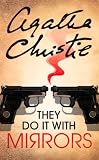
They Do It With Mirrors by Agatha Christie

I’m slowly reading my way through Agatha Christie’s books, not in chronological order, but just as I come across them and this month I’ve read They Do It With Mirrors which was first published in 1952.

I don’t think it’s one of her best, but I did like it. It begins with Miss Marple reminiscing with an old friend, Mrs Ruth Van Rydock, an American. Miss Marple has known her and her sister, Carrie Louise since they had been together at a pensionnat in Florence. Ruth is worried about Carrie Louise, who is now living in a country house in the south of England with her husband, Lewis Serrocold, which he has turned into a home for delinquent boys. She can’t put her finger on what is wrong, she just felt the atmosphere wasn’t right, whether it was the boys’ home – ‘those dreadful young delinquents‘ or something else and she asks Miss Marple to visit Carrie Louise to see if her fears are justified.
Miss Marple finds an unhappy household, including Mildred, Carrie Louise’s widowed daughter, Stephen and Alex, her stepsons, and Gina, her adopted daughter’s daughter, married to an American, Wally Hudd. Lewis Serrocold is Carrie’s third husband, described by Ruth as a

‘crank’, a ‘man with ideals’, ‘bitten by the bug of wanting to improve everybody’s lives for them. And, really you know, nobody can do that but yourself.’

All is not well with the boys either – one of them, Edgar Lawson is suffering from delusions, saying his father is Churchill and then that he is Montgomery. He loses control and Lewis takes him into his office, but their raised voices are heard by the others, culminating in the sound of gunshots. But it is not Lewis or Edgar who is killed, but one of the trustees of the home, Christian Gulbrandsen, the brother of Carrie Louise’s first husband who was alone in his study. So Ruth’s fears materialise when Christian is found shot dead and it seems that someone is trying to poison Carrie Louise.

As I expected from the title not everything is as it appears.  The layout of the house is of importance and there is a plan showing how the rooms are connected, but even so I was still in the dark. I hadn’t worked out who the murderer is and had even ruled out the person in question quite early on in the book. Miss Marple, however, was not deceived and had sorted out the reality from the illusion and seen through the misdirection.

… all the things that seemed to be true were only illusions. Illusions created for a definite purpose – in the same way that conjurers create illusions to deceive an audience.

There are a number of points that struck me as interesting as I read the book, not essential to the plot, but maybe revealing Agatha Christie’s opinions and her views of post-war society. There is the subject of self-help and the issue of expecting things to be granted as a right, focussing on providing education for the juvenile delinquents by men crazy with enthusiasm like Lewis Serrocold:

One of those men of enormous will power who like living on a banana and a piece of toast and put all their energies into a Cause.


She makes the point that just because a person comes from a deprived background doesn’t mean they’re going to turn into criminals and it is the honest ones who could do with a start in life – ‘But there, honesty has to be its own reward – millionaires don’t leave trust funds to help the worthwhile.’

There are comments on the oddness of the English, being prouder of defeats and retreats than of their victories, using Dunkirk as an example and the Charge of the Light Brigade. At the same time as I was reading this I was also reading Jeremy Paxman’s The English: a Portrait of a People, in which he also comments on this trait – turning the consequence of catastrophe into a ‘victorious retreat’.

On a more personal level there are her views on the vulnerability of women:

Women have a much worse time of it in the world than men do. They’re more vulnerable. They have children and they mind – terribly – about their children. As soon as they lose their looks, the men they love don’t love them any more. They’re betrayed and deserted and pushed aside.


I can’t help thinking that really was Agatha Christie speaking from experience.

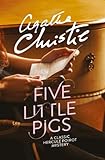
Five Little Pigs by Agatha Christie

There are many things I like about Five Little Pigs, a Poirot mystery first published in 1943. I like the plot and the way it’s structured, the characterisation, the dialogue, and Agatha Christie’s fluent style of writing. In addition the solution is convincing and satisfying.

Caroline Crale was convicted of the murder of her husband, Amyas and died in prison. Sixteen years later, her daughter, a child of five at the time of the murder, asks Poirot to clear her mother’s name, convinced that she was innocent.

Poirot checks the police records, talks to the lawyers who conducted the trial and to the five eyewitnesses, persuading them to write down their versions of events. He finds that she had ample motive for the crime, at no time had she protested her innocence, although she contended that he had committed suicide, and all the eyewitnesses thought she was guilty.

Inevitably there are different versions of the events and conflicting views of Caroline’s character, all very clearly set out. So what did actually happen? Was Caroline innocent or guilty?

Poirot, in his usual methodical manner, goes through the sequence of events, and having gathered together all the people involved, using logic and psychology to detect the incongruous he makes his denouement.

The description of Amyas Crale’s house, Alderbury appears to have been modelled on Agatha Christie’s own house, Greenway, complete with a Battery overlooking the river, just as at Greenway. The book was written in 1943, making it 16 years after 1926, the year of her disappearance before her divorce from her first husband, Archie Christie, so I don’t think that it’s a coincidence that Amyas Crale, a womaniser who was proposing to leave his wife for another woman has the same initials as Archie Christie!

I think the nursery rhyme theme of the title and the chapter headings is rather forced, as it doesn’t really throw any light on the mystery. It seems that Agatha Christie was a bit carried away with her ‘crimes of rhymes’, just as Poirot was obsessed with the jingle:

A jingle ran through Poirot’s head. He repressed it. He must not always be thinking of nursery rhymes. It seemed an obsession with him lately. And yet the jingle persisted.

This little pig went to market, this little pig stayed at home…’ (page 33)

This is the first Agatha Christie book I’ve read this year and I’m pleased it was such a good one!

Five Little Pigs is my 8th TBR book I’ve read this year in the Mount TBR Challenge, and the TBR Triple Dog Dare, the 2nd for the My Kind of Mystery Challenge and the 2nd for the What’s in a Name 7 Challenge (in the category, a book with a number written in letters in the title). And last, but by no means least, it’s the 56th Agatha Christie book I’ve read in the Agatha Christie Reading Challenge.

A Year of Reading Agatha Christie: 2013

Agatha ChristieThe Agatha Christie Reading Challenge is run by Kerrie at Mysteries in Paradise. I don’t think of it as a Challenge €“ it’s really a reading project, as it is quite simply to read Agatha Christie’s books. I’m not reading them in order of publication but as I come across them.

As I wrote in a guest post on Alyce’s blog for her series of Best and Worst earlier this year, Agatha Christie has long been one of my favourite writers. I first read some of her books as a teenager, but over the last four years or so I’ve been reading as many of her books that I can find.

She wrote over 100 novels, short story collections and plays and she is one of the best-selling (if not the best-selling) novelists of all time, well known for her crime fiction featuring Hercule Poirot and Miss Marple and other detectives, both amateur and police.

I like many things about her writing. Her style is light, humorous at times, but her writing can be dark creating a tense and menacing atmosphere. Her plots are often ingenious, intricate, complicated puzzles, with the clues scattered throughout the texts. Some of her characters are clearly defined and fully rounded, some are lightly sketched, and others are comic characters, caricatures presented satirically or even farcically. Her settings are often country houses in idyllic English villages, but also in exotic locations in the Middle East as in her archaeological mysteries.

The full list of the 55 novels and short stories that I’ve read is on my Agatha Christie Reading Challenge page. This year I’ve read 9 of her books:

My favourite this year is Cards on the Table, but they all make fascinating reading.

Cards on the Table

  1. Cat Among the Pigeons  (Poirot)
  2. Mrs McGinty’s Dead (Poirot and Ariadne Oliver)
  3. Murder in the Mews (Poirot 4 short stories)
  4. Cards on the Table (Poirot)
  5. Third Girl (Poirot)
  6. Ten Little Niggers aka And Then There Were None
  7. A Murder is Announced (Miss Marple)
  8. N or M? (Tommy and Tuppence)
  9. Ordeal by Innocence

I’ve also read two biographies:

  1. Agatha Christie: an English Mystery by Laura Thompson
  2. Agatha Christie at Home by Hilary Macaskill

There are still plenty of Agatha Christie’s books for me to read. The following books are the ones I own and will be reading next year (not necessarily in this order):

  • They Do It With Mirrors (Miss Marple)
  • The Moving Finger (Miss Marple)
  • Miss Marple and Mystery: Complete Short Stories
  • Poirot Investigates (short stories)
  • The Golden Ball (short stories)
  • Complete Parker Pyne (short stories)
  • The Adventure of the Christmas Pudding (short stories)

Ordeal by Innocence by Agatha Christie

Agatha Christie wrote in An Autobiography that Ordeal by Innocence and Crooked House were the two books she’d written that satisfied her the best. Neither book features Poirot or Miss Marple, so maybe she had become rather tired of them and had enjoyed introducing completely new characters.

Ordeal by Innocence (The Christie€¦Summary from the back cover of my copy:

According to the courts, Jacko Argyle bludgeoned his mother to death with a poker. Sentenced to life imprisonment, he died behind bars following a bout of pneumonia. Tragically, it was not until two years later that Dr Arthur Calgary came forward with the testimony that could have acquitted Jacko. Worse the doctor’s revelations were about to re-open old wounds in the family, increasing the likelihood that the real murderer would strike again.

My view:

Ordeal by Innocence is thus a stand-alone novel, first published in 1958, unlike the TV adaptation that had Miss Marple (in the form of Geraldine McEwan), solving the mystery.

Dr Calgary was surprised by the reception he received from the family when he visited them to tell them that Jacko was innocent and why he hadn’t come forward at the time to confirm his alibi. Instead of relief he was met with wariness and suspicion as the family members realised that one of them could be the murderer. This is a cold case that they wish had never been re-opened; they had been happy to accept that Jacko, a thoroughly nasty character, was guilty. Only Philip the eldest daughter’s wheelchair-bound husband is keen to discover the murderer’s identity. So, it is up to him, Doctor Calgary, helped by the family solicitor and Superintendent Huish to carry out fresh investigations.

What I liked about Ordeal by Innocence was the way Agatha Christie delved into the family relationships and their characters. Mrs Argyle was one of those mothers who was always right and thought she knew best and at times all her children had rebelled or wanted to rebel against her authority, so all were suspects, along with her long-suffering husband, who since her death was planning to marry his secretary.

The novel is as much about protecting the innocent as punishing the guilty, and the fact that stating your innocence is not proof of it. Calgary has to find the murderer so that the innocent will not suffer from the taint of guilt. Without knowing who was guilty they would have all come under suspicion, destroying their love and trust.

I swung from believing first one, then another character, was the guilty person and was quite taken in by all the red herrings Agatha Christie threw into the book. All is made clear in the last chapter when Dr Calgary presents his findings and reveals the killer. Although I don’t think it is one of Agatha Christie’s best books, I still enjoyed its complexity and admired her skill in plotting this novel.

N or M? by Agatha Christie

N or M? is the third of the Tommy and Tuppence stories, set in 1940 and first published in 1941.  Agatha Christie wrote this at the same time as writing The Body in the Library. She explained the reason in her Autobiography:

I had decided to write two books at once, since one of the difficulties of writing a book is that it suddenly goes stale on you. Then you have to put it by, and do other things – but I believed that if  I wrote two books, and alternated the writing of them, it would keep me fresh at the task. One was The Body in the Library, which I had been thinking of writing for some time, and the other one was N or M?, a spy story, which was in a way a continuation of the second book of mine, The Secret Adversary, featuring Tommy and Tuppence. Now with a grown-up son and daughter, Tommy and Tuppence were bored by finding that nobody wanted them in wartime. However, they made a splendid come-back as a middle-aged pair, and tracked down spies with all their old enthusiasm. (An Autobiography by Agatha Christie page 506)

Tommy is asked to go under cover to track down members of the Fifth Column, two of the most important and trusted German agents, whose mission is to infiltrate British society, like the Trojan wooden horse. All that is known is that N is a man and M a woman and they are thought to be at Leahampton on the south coast. He tells Tuppence that he is being sent to Scotland and that she can’t go with him, but she surprises him by being at Sans Souci, a seaside guesthouse in Leahampton, when he arrives. So there they are, both under cover, Tommy as Mr Meadowes and Tuppence as Mrs Blenkensop.

There is definitely something not right about the guesthouse, it has the feel of something sinister, something evil. And it’s not long before Tommy and Tuppence are embroiled in a series of dangerous near-disasters, involving German spies, and Smuggler’s Rest, a cottage with a secret room, set on a cliff overlooking a little cove and ideal for enemy action.

N or M? is an easy book to read and not too demanding. Agatha Christie makes use, as in some of her other books, of nursery rhymes, in this one it’s ‘Goosey goosey gander’, which comes from a Mother Goose picture book Tuppence reads to little Betty Sprot. Of all the characters in the book (apart from Tommy and Tuppence) Betty, a toddler, who speaks her own baby language, is the most well-drawn, so much so that at one point I even found myself wondering if she could be M!!!

One of its attractions for me is its historical setting, although when Agatha Christie wrote this book it was very current, she did not know how the war would end. It is interesting to see how she portrays the general public’s attitude towards the war, about patriotism, and the fear of Fifth Columnists, of spies, and Fascists and Communists. Also of note is that whilst most of the characters thought the war would be over very quickly, which is what I thought was the general consensus at the time, one of them thought it would last at least six years.

Following the publication of N or M? Agatha Christie was investigated by MI5 because she had named one of the characters ‘Major Bletchley’ and MI5 suspected she had a spy in Britain’s undercover code breaking centre, Bletchley Park.

A Murder is Announced by Agatha Christie

A Murder is Announced was first published in 1950. My copy is in a collection of four Miss Marple stories – A Miss Marple Quartet. I particularly like this cover, showing Joan Hickson as Miss Marple.

Synopsis from Amazon:

The villagers of Chipping Cleghorn, including Jane Marple, are agog with curiosity over an advertisement in the local gazette which reads: ‘A murder is announced and will take place on Friday October 29th, at Little Paddocks at 6.30 p.m.’ A childish practical joke? Or a hoax intended to scare poor Letitia Blacklock? Unable to resist the mysterious invitation, a crowd begins to gather at Little Paddocks at the appointed time when, without warning, the lights go out.

Of course it isn’t a practical joke and someone is murdered. But the mystery is to identify the victim – it’s not as straight forward as it first appears and there are plenty of red herrings. I vaguely remembered seeing the TV version (with Joan Hickson, perfect as Miss Marple) years ago and although I couldn’t remember who did it knew that I had to pay close attention to the detail of where people were sitting or standing in the room at the Little Paddocks when the lights went out. But even though I read it very carefully I was still baffled. It all hinges on family relationships and details of the characters’ identities which are so skilfully hidden that I was kept guessing until very near the end.

It’s not without flaws, some of the characters are a bit sketchy, and some of the novel borders on farce, with Miss Marple imitating a dead person’s voice whilst hiding in a broom cupboard and Mitzi, the highly strung and paranoid cook, a refugee from Germany, screaming like a siren and insisting that the police will take her away and torture her. Still, I wish her recipe for the chocolate cake ‘Delicious Death’ had been revealed.

What I really like about A Murder is Announced is the picture it paints of life in post-war Britain, showing how society was in the process of change. Miss Marple is her usual brilliant self, now seeming very old with ‘snow white hair and a pink crinkled face and very soft innocent blue eyes’, chattering and fluttering, but still as sharp and observant as ever. As she explains the world has changed since the war when everyone knew who everybody was. But now people come and settle in a village and all you know of them is what they say of themselves – you don’t know who they really are! And so, she compares them to the people she does know, people in her village of St Mary Mead, which helps to throw light on the mystery. It’s a layered mystery involving past illness, identities, and questions of inheritance.