Top Ten Tuesday: Books that Feature Travel

Top Ten Tuesday is a weekly meme created by The Broke and the Bookish and now hosted by Jana at That Artsy Reader Girl. For the rules see her blog.

The topic today is Books that Feature Travel and the books I’ve chosen feature different types of travelling in a variety of countries – on a bicycle, on boats and ocean liners, as well as on foot. I’ve read all of them except for Sea Change, which is still sat on my bookshelves.
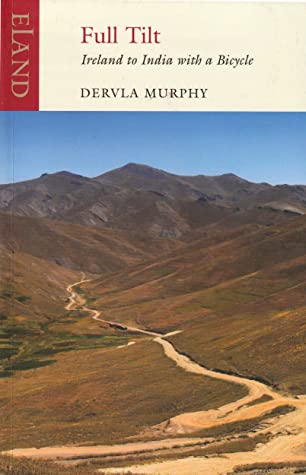
  1. Full Tilt: Dunkirk to Delhi on a Bicycle, first published in 1965  by Dervla Murphy this is an account of her journey in 1963, which took her through Europe, Persia (Iran), Afghanistan, over the Himalayas to Pakistan and into India.
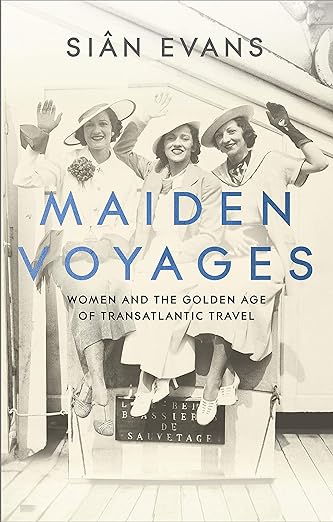
  2. Maiden Voyages by Siân Evans – transatlantic travel between the two World Wars on magnificent ocean liners undertaken by many women. Some travelled for leisure, some for work; others to find a new life, marriage, to reinvent themselves or find new opportunities. 
  3. Eat, Pray, Love by Elizabeth Gilbert. She travelled to Italy (Eat), India (Pray) and Indonesia (Love) spending four months in each place, searching for pleasure in Italy, mainly through food, God in India at an ashram, and balance in Indonesia.
  4. A Walk in the Woods by Bill Bryson about his hike along the Appalachian Trail, the longest continuous footpath in the world.
  5. Three Men in a Boat by Jerome K Jerome, first published in 1889. He intended it to be a serious travel book about the Thames, its scenery and history, but, as he wrote it turned into a funny book. It’s a story of a journey, comparing their trip to Stanley’s expedition to Africa searching for Dr Livingstone. 
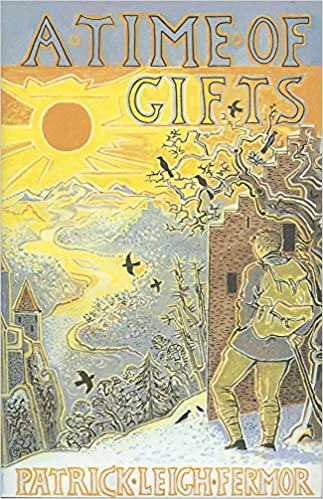
  6. A Time of Gifts by Patrick Leigh Fermor in which he describes his travels on foot in 1933 from the Hook of Holland through Germany, to Austria, Slovakia and Hungary, on his way to Constantinople.
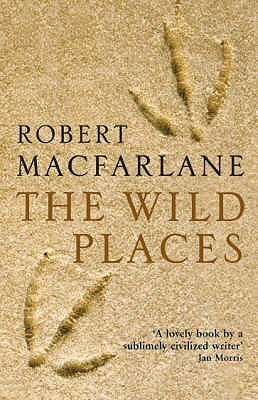
  7. The Wild Places by Robert Macfarlane, with a map showing the places he visited from the cliffs of Cape Wrath, to the holloways of Dorset, the storm-beaches of Norfolk, the saltmarshes and estuaries of Essex, and the moors of Rannoch and the Pennines.
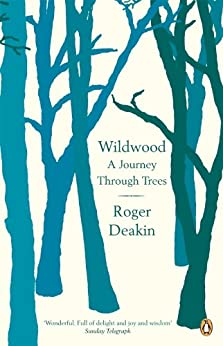
  8. Wildwood: a Journey Through Trees by Roger Deakin about his journeys through a wide variety of trees and woods in various parts of the world. It’s a memoir, a travelogue and also it’s about the interdependence of human beings and trees
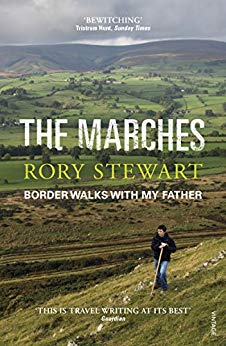
  9. The Marches Border Walks With My Father by Rory Stewart walking in the borderlands between England and Scotland, along Hadrian’s Wall and his coast to coast walk from Cunbria Cumbria to Berwick-upon-Tweed.
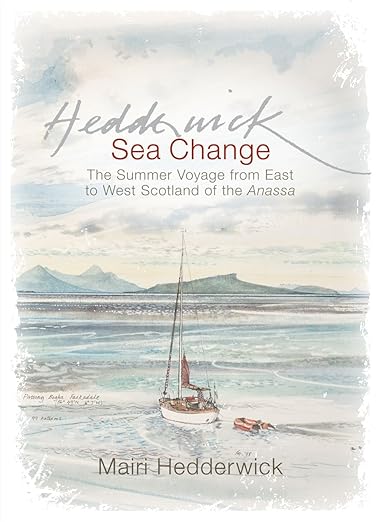
  10. Sea Change: The Summer Voyage from East to West Scotland of the Anassa by Mairi Hedderwick, describing her journey in an antiquated 26-foot long yacht through the Caledonian Canal to the fjords of the west: Lochs Linnhe, Etive, Ailort, Moidart, Nevis and Leven.

A Time of Gifts by Patrick Leigh Fermor

I read A Time of Gifts by Patrick Leigh Fermor a few weeks ago and have been mulling it over ever since. It began so well and I thought it was one of those books I was going to love. And then there are later passages which are so tedious and hard work to read, so full of dry facts and arcane words that I began to wonder why I was reading any further. But I did and then the writing swept me away and I became engrossed in the book again.

My reaction, I think, is to the two sides of this book, in which Patrick Leigh Fermor describes his travels on foot in 1933 from the Hook of Holland through Germany, to Austria, Slovakia and Hungary, on his way to Constantinople. (He continued his journey in Between the Woods and the Water, which describes his experiences up to the Iron Gates border between Rumania and Bulgaria.) The two sides are because he wrote this book in later life so his direct experiences and reactions are intermingled with the results of his later research and with the benefit of hindsight. I prefer the immediacy of his earlier writings taken from the diaries he kept along the way, bringing the countryside to life and recounting his encounters with the local people.

There are passages like the one below where he linked his journey to painting:

When no buildings were in sight, I was back in the Dark Ages. But the moment a farmhouse, or a village impinged, I was in the world of Peter Brueghel. The white flakes falling beside the Waal – or the Rhine or the Neckar or the Danube – and the zigzag gables and the muffled roofs, were all his. The icicles, too, and the trampled snow, the logs piled on the sledges and the peasants stooped double under loads of faggots. … When the wintry light crept dimly from slits close to the horizon or an orange sun was setting through the branches of a frozen osier-bed, the identity was complete.

In the end I scan read page after page of detailed descriptions of churches, of sociological, political or historical people and places.  I was too impatient to read all those details and I was reading the book too quickly. It’s a book to take your time with, to read a section, put the book down and come back to it later – and I didn’t do that, I swallowed it down with the result that parts were indigestible.

In a way his journey was a gilded experience as he had introductions to people in different places – people who gave him a bed for the night, or longer stays. There were also people who didn’t know him who welcomed him into their homes as a guest – as the title says it was a time of gifts. It was the period when Hitler came to power in Germany:

Appalling things had happened since Hitler had come into power ten months earlier: but the range of horror was not yet fully unfolded. In the country the prevailing mood was a bewildered acquiescence. Occasionally it rose to fanaticism.

But whereas not everyone liked the English there were some who did:

I answered many earnest questions about England: how lucky and enviable I was, they said, to belong to that fortunate kingdom where all was so just and sensible. The allied occupation of the Rhineland had come to an end less than ten years before, and the British, she said, had left an excellent impression.

Overall, I did enjoy this book. There are many passages so vividly described that I can remember them now weeks later – the vision of this young man, nearly nineteen years old striding through the German countryside reciting Shakespeare, in a loud voice and accompanied with gestures, sword thrusts, a staggering gait and with his arms upflung, looking as though he was drunk, or a lunatic. Then there was the time in Vienna when the money he was expecting hadn’t arrived and Konrad, a Don Quixote type character, took him round to a block of flats and encouraged him to knock on doors asking if the occupants wanted to pay him for a sketch of themselves.

In fact even with the dull passages, I liked this book well enough to buy the second book by Fermor Leigh, Between the Woods and the Water and I see that a third book is to be published later this year – The Broken Road, completing the account of his journey to Constantinople.

Following his walk across Europe, Patrick Leigh Fermor (1915-2011) lived and travelled in the Balkans and Greek Archipelago. He joined the Irish Guards and during the occupation of Crete led the party that captured the German commander. He was awarded the DSO and OBE.

Wondrous Words Wednesday

wondrous2Wondrous Words Wednesday is a weekly meme hosted by Kathy at Bermuda Onion where you can share new words that you’ve encountered or spotlight words you love.

I’ve recently read A Time of Gifts by Patrick Leigh Fermor, a book that I’ll be writing about in more detail. It’s his account of his journey in 1933/4 walking  to Constantinople. He uses many words that either were completely new to me or words that I wasn’t quite sure what they mean. As I was reading it on Kindle I was able to look up their meaning without too much distraction. Most of the words I didn’t know are described as ‘archaic’ and some of the words aren’t in the Kindle dictionary.

Here are just two:

  • imberb – ‘The figure of St John the Divine –  imberb, quizzically smiling, quill in hand and at ease in a dressing-gown with his hair flowing loose like an undress-wig …’

This isn’t in the Kindle dictionary and my guess was that it meant he had a beard. I was nearly right, but also completely wrong – the online Oxford English Dictionary has this definition: adjective from the French imberbe,  Latin imberbis – a rare word meaning beardless.

  •  flocculent – ‘Ragged and flocculent, fading to grey, scattered with specks of pink from the declining sun, varying in width as random fragments were dropping away and recohering and agitated with motion as though its whole length were a single thread, a thick white line of crowding storks stretched from one side of the heavens to the other.’
I like this sentence, which draws a clear picture for me of the storks flying across the scene in front of the setting sun, but wasn’t sure about ‘flocculent’ – a flock of storks?
It means having or resembling tufts of wool, having a loosely clumped texture from the Latin floccus.