My Blog Break is over & The Man With No Face

I’m back home and looking forward to getting back into blogging. I was in hospital for three weeks – but now I’m recovering, trying to get back to ‘normal’.

It has been very odd as I lacked the desire to read, or concentrate on anything really. I’ve read just one book so far this month – The Man With No Face by Peter May, which I’d started before I went into hospital. This was first published in 1981. May made ‘some very minor changes’, before it was republished in 2018.

Rating: 5 out of 5.

Description from Goodreads:

A POWERFUL AND PRESCIENT THRILLER FROM THE MILLION-SELLING AUTHOR OF I’LL KEEP YOU SAFECOFFIN ROAD AND THE BLACKHOUSE.

A REPORTER WITH NO FEAR

Jaded Edinburgh journalist Neil Bannerman is sent to Brussels, intent on digging up dirt. Yet it is danger he discovers, when two British men are found murdered.

A CHILD WITH NO FATHER

One victim is a journalist, the other a Cabinet Minister: the double-assassination witnessed by the former’s autistic daughter. This girl recalls every detail about her father’s killer – except for one.

THE MAN WITH NO FACE

With the city rocked by the tragedy, Bannerman is compelled to follow his instincts. He is now fighting to expose a murderous conspiracy, protect a helpless child, and unmask a remorseless killer.

I did find it a bit repetitive, which for once was good as it kept reminding me what was going on. It’s a complex plot told mainly from Bannerman’s perspective with insights into the hired assassin’s and daughter’s viewpoints. It’s called ‘The Man with no Face’ because Tania, the daughter is a talented artist and she draws the scene with the assassin’s face left blank.

There’s a lot more I could say about the book. It’s a thriller with some violence but nothing I couldn’t cope with – and I’m squeamish! I thoroughly enjoyed it with all its twists and turns and increasing level of danger right up to the climax. Highly recommended!

Book Beginnings on Friday & The Friday 56: The Man With No Face by Peter May

Every Friday Book Beginnings on Friday is hosted by Gillion at Rose City Reader where you can share the first sentence (or so) of the book you are reading. You can also share from a book you want to highlight just because it caught your fancy.

I’m featuring another book by Peter May this week – The Man With No Face. This was first published in 1981. He made ‘some very minor changes’, before it was republished in 2018.

Kale watched the train through the rain-spattered glass and thought, this time will be the last. But even as the thought formed in his mind it clotted and he knew he would kill again.

Also every Friday there is The Friday 56, hosted by Freda at Freda’s Voice, where you grab a book and turn to page 56 (or 56% of an eBook), find one or more interesting sentences (no spoilers), and post them.

Page 56:

They took their first sips in silence before Bannerman said, ‘Tell me about yourself.’

‘There’s not much to tell.

‘Now why do people always say that?

‘Maybe because it’s true.’

He shook his head. ‘No. Everyone’s got a story to tell.’

Description from Goodreads:

A POWERFUL AND PRESCIENT THRILLER FROM THE MILLION-SELLING AUTHOR OF I’LL KEEP YOU SAFECOFFIN ROAD AND THE BLACKHOUSE.

A REPORTER WITH NO FEAR

Jaded Edinburgh journalist Neil Bannerman is sent to Brussels, intent on digging up dirt. Yet it is danger he discovers, when two British men are found murdered.

A CHILD WITH NO FATHER

One victim is a journalist, the other a Cabinet Minister: the double-assassination witnessed by the former’s autistic daughter. This girl recalls every detail about her father’s killer – except for one.

THE MAN WITH NO FACE

With the city rocked by the tragedy, Bannerman is compelled to follow his instincts. He is now fighting to expose a murderous conspiracy, protect a helpless child, and unmask a remorseless killer.

~~~

What do you think, does it appeal to you? What are you currently reading?

Elizabeth Macarthur by Michelle Scott Tucker

In 1788 a young gentlewoman raised in the vicarage of an English village married a handsome, haughty and penniless army officer. In any Austen novel that would be the end of the story, but for the real-life woman who became an Australian farming entrepreneur, it was just the beginning.

John Macarthur took credit for establishing the Australian wool industry and would feature on the two-dollar note, but it was practical Elizabeth who managed their holdings—while dealing with the results of John’s manias: duels, quarrels, court cases, a military coup, long absences overseas, grandiose construction projects and, finally, his descent into certified insanity.

Michelle Scott Tucker shines a light on an often-overlooked aspect of Australia’s history in this fascinating story of a remarkable woman.

My thoughts

Two years ago I read A Room Made of Leaves by Kate Grenville, historical fiction telling the story of Elizabeth and John Macarthur, who settled in Australia at the end of the eighteenth century, which made me keen to find out more about them. In particular it was the epigraph ‘ Believe not too quickly‘, which is a quotation from one of Elizabeth’s letters, that highlighted for me that A Room Made of Leaves is a work of fiction. And then I came across Michelle Scott Tucker’s biography: Elizabeth Macarthur: A Life at the Edge of the World and I was delighted to see that Kate Grenville references this book as the standard biography in her Acknowledgements. So I bought a copy.

Elizabeth was born on 14 August 1766 in Devon, England and she married John Macarthur in October 1788. In June 1789 they sailed with their first child, Edward, initially on the Neptune, and then on the convict ship Scarborough to New South Wales where John joined his regiment, the New South Wales Corps, in the recently established colony of New South Wales. They went on to have four more sons, James (1793-1794), John (1794-1831), James (1798-1867) and William (1800-1882), and three daughters, Elizabeth (1792-1842), Mary (Mrs Bowman, b.1795) and Emmeline (b.1808).

For sixty years, Elizabeth ran the family farm in Parramatta, west of Sydney town – on her own during her husband’s long absences abroad, four years during her husband’s first absence, and nine years during the second, when she was responsible for the care of their valuable merino flocks, as well as the Camden Park estate and the direction of its convict labourers. By the time Macarthur came back from that second absence, he was overwhelmed by mental illness, and they spent the last few years of his life apart. He died in 1834. The house and gardens of her farm, aptly named ‘Elizabeth Farm’ is now an ‘access all areas’ museum. In 1850, she died in her daughter and son-in-law’s house at Watson’s Bay outside Sydney, overlooking the Pacific Ocean.

I was interested to see how the biography differed from Kate Grenville’s novel. Both interpret the facts, based on Elizabeth Macarthur’s letters, journals and official documents of the early years of the New South Wales colony, trying to explain what happened and why, dependent on the available evidence. However, fiction is more flexible than a biography and can fill in the gaps where the documentary evidence is lacking. And Kate Grenville has used her storytelling imagination in filling in the gaps in the records, in particular about her relationship with William Dawes, an astronomer with the Corps, who was mapping the night sky. He had an observatory near Elizabeth’s farm and it was there that she attempted to learn from him about astronomy. However, in A Room Made of Leaves, Kate Grenville embellishes the basic facts, whilst exploring what it could have been that made Elizabeth ‘blush at my error‘, as she described it in a letter to her friend, Bridget, claiming she had mistaken her abilities and she ended her astronomical studies. Michelle Scott Tucker comments that the evening visits to Dawes’ observatory were open to misinterpretation, whereas Kate Grenville’s version is much more explicit as she imagines what might have happened. Her book, whilst it is based on history is fiction, as she makes clear in her Author’s Note at the end of the book.

I have only just skimmed the surface of this book – there is so much more detail about the landscape, the indigenous population, the disputes between various sections of the colony, about farming and the establishment of the wool industry, not forgetting the details of the Macarthur family members, illnesses, and the position of the women within the community – Elizabeth wasn’t the only colonial woman who was responsible for her family farm. She was resourceful, a good farm manager and business woman, was respected within the colony, and was loved by her family. There are a number of reasons I recommend this book. There is a ‘Select Bibliography’ which looks comprehensive to me, copious notes citing sources and a family tree. It is thorough, well researched and It provides an insight into the early years of Australia’s colonial history and it is an extremely readable biography of a fascinating woman.

Book Beginnings on Friday and The Friday 56: A Winter Grave by Peter May

Every Friday Book Beginnings on Friday is hosted by Gillion at Rose City Reader where you can share the first sentence (or so) of the book you are reading. You can also share from a book you want to highlight just because it caught your fancy.

A Winter Grave is the last book I bought and is Peter May’s latest novel. I’ve enjoyed the other books of his I’ve read, so I’m hoping this one will be just as good. It is cli-fi, about the effects of climate change on human society, set in 2051.

Cli-fi, short for climate fiction, is  a form of fiction literature that features a changed or changing climate. It is rooted in science fiction, but also draws on realism and the supernatural.


Little will heighten your sense of mortality more than a confrontation with death. But right now such an encounter is the furthest thing from Addie’s mind, and so she is unprepared for what is to come.

Also every Friday there is The Friday 56, hosted by Freda at Freda’s Voice, where you grab a book and turn to page 56 (or 56% of an eBook), find one or more interesting sentences (no spoilers), and post them.

Page 56:

In the early photos, when Addie was just a baby, Mel had been happy and radiant, and he lingered over them. But the increasingly haunted face she presented to the world in later years made him scroll more quickly by.

Description from Amazon:

A TOMB OF ICE

A young meteorologist checking a mountain top weather station in Kinlochleven discovers the body of a missing man entombed in ice.

A DYING DETECTIVE

Cameron Brodie, a Glasgow detective, sets out on a hazardous journey to the isolated and ice-bound village. He has his own reasons for wanting to investigate a murder case so far from his beat.

AN AGONIZING RECKONING

Brodie must face up to the ghosts of his past and to a killer determined to bury forever the chilling secret that his investigation threatens to expose.

Set against a backdrop of a frighteningly plausible near-future, A WINTER GRAVE is Peter May at his page-turning, passionate and provocative best.

~~~

What do you think, does it appeal to you? What are you currently reading?

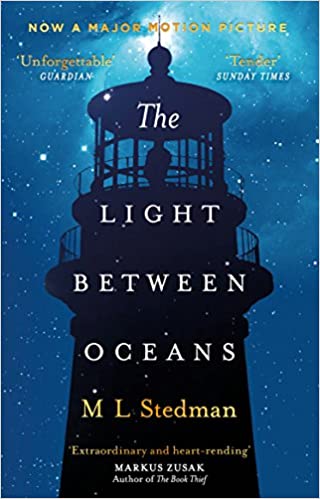
The Light Between Oceans by M L Stedman

Please be aware that there are spoilers in my post. I couldn’t write it any other way without it ending up just a mere outline. And in any case the description on Goodreads tells you as much if not more than this.

Rating: 4 out of 5.

The Light Between Oceans is the story of Tom, a lighthouse keeper on an isolated island, Janus Rock, and his wife Isabel. Janus Rock is nearly half a day’s journey from the coast of Australia, where the Indian Ocean washes into the Great Southern Ocean. When a boat washes up on the shore of the island it holds a dead man – and a crying baby. Tom and his wife have a devastating decision to make.

Tom is a veteran of World War One and a man of high moral principles. He loves his job, meticulously and accurately recording all the daily details of his work on the lighthouse, keeping it all according to the rules and regulations. From his time during the war he had realised that rules are what separate a man from a savage. He wants to report the man and infant immediately. But Isabel has had two miscarriages and a still birth and is desperate to keep the baby. So he is torn, he loves Isabel and although he is not happy about the ease with which she made her decision, against his own judgement, they claim her as their own and name her Lucy. When she is two, Tom and Isabel return to the mainland and are reminded that there are other people in the world. Their choice has devastated one of them, but by then there is no right answer – justice for one person is another’s tragic loss.

As for the dilemma that Tom and Isabel faced I’ve never been in Isabel’s position, but initially I did take sides, agreeing with Tom. But as time went on and Lucy grew older it became more difficult and as M L Stedman explores all the emotions all the characters are experiencing I could understand Isabel’s position a bit more. But then there’s the birth mother not knowing if her husband and baby are dead, but convinced they will return to her. It was heart breaking to read. An impossible situation.

I enjoyed the setting on Janus Rock, thinking it was a real island. But I was surprised to find it is entirely fictitious. In this interview M L Stedman explains that the region where the Great Southern Ocean and the Indian Ocean meet is real, and the climate, weather and the landscape are more or less as she has described them. She wrote some of the book there and describes as a very beautiful, if sometimes fierce, part of the world. I thought the ending was rushed, condensed into a few pages and I wondered if the story was based on fact. But there are no Historical Notes, so I’m assuming it is purely fictional. And this is borne out by the interview in which she says:

I write fairly instinctively, just seeing what comes up when I sit down at the page. For this story, it was a lighthouse, then a woman and a man. Before long, a boat washed up on the beach, and in it I could see a dead man, and then a crying baby. Everything that happens in the book stems from this initiating image—a bit like the idea of ‘Big Bang’—an initial point that seems tiny turns out to be incredibly dense, and just expanded outward further and further. 

It’s set mainly in 1926, but does that make it historical fiction – I can’t decide, what do you think?