The Invisible Man by H G Wells

The Invisible Man is my Classics Club spin book The rules of the Spin are that this was the book for me to read by 3rd March 2024 and I did. In fact I finished it about two weeks early and only got round to writing about it a few days ago. The Invisible Man was first published in 1897, a science fiction novel, originating in Pearson’s Weekly. But it was not quite what I expected. And I certainly didn’t expect it to turn into slapstick comedy.

Synopsis from Amazon

‘The man’s become inhuman … He has cut himself off from his kind. His blood be upon his own head.’

One night in the depths of winter, a bizarre and sinister stranger wrapped in bandages and eccentric clothing arrives in a remote English village. His peculiar, secretive activities in the room he rents spook the locals. Speculation about his identity becomes horror and disbelief when the villagers discover that, beneath his disguise, he is invisible.

Griffin, as the man is called, is an embittered scientist who is determined to exploit his extraordinary gifts, developed in the course of brutal self-experimentation, in order to conduct a Reign of Terror on the sleepy inhabitants of England. As the police close in on him, he becomes ever more desperate and violent.

In this pioneering novella, subtitled ‘A Grotesque Romance’, Wells combines comedy, both farcical and satirical, and tragedy – to superbly unsettling effect. Since its publication in 1897, The Invisible Man has haunted not only popular culture (in particular cinema) but also the greatest and most experimental novels of the twentieth century.

My thoughts

Griffin, a scientist, is a stranger to the village of Iping in West Sussex, staying at the Coach and Horses Inn. His story is a sad one. Whilst experimenting he has managed to make himself invisible, and dresses from top to toe in clothes, which even in winter makes him stand out from the crowd. Everything he does leads everyone to wonder what is wrong with him and draws attention to himself. What follows grows in intensity, as Griffin causes first confusion, then panic and finally madness. There’s a lot of shouting, pushing and fighting and surprisingly (to me at any rate) quite a lot of comedy – after all the invisible man is as naked as a new born baby.

I enjoyed it. There’s not much to the plot, it’s mainly a character study really, but what an amazing personality. And being invisible is not what he had thought – having to walk around with no shoes or socks on, especially in winter is not funny, neither is the sight of undigested food floating around mid-air. But it is worse than that because Griffin is only at the start of his escapade. By the end he is stark staring bonkers. Wells demonstrates the dangers of using science beyond control. Griffin has succeeded in lowering the refractive index of his body to make it invisible – ‘Either a body absorbs light or reflects it, or refracts it, or does all these things. If it neither refracts nor absorbs light, it cannot of itself be visible.’

Sadly, the end is all violence and drama!

Spell the Month in Books – March 2024

Spell the Month in Books is a linkup hosted by Jana on Reviews From the Stacks on the first Saturday of each month. The goal is to spell the current month with the first letter of book titles, excluding articles such as ‘the’ and ‘a’ as needed. That’s all there is to it! Some months there are optional theme challenges, such as “books with an orange cover” or books of a particular genre, but for the most part, any book you want to use is fair game!

This month’s theme is National Caffeine Month – Books with a beverage on the cover or in the title.

M is for Milkman by Anna Burns

Synopsis:

In an unnamed city, where to be interesting is dangerous, an eighteen-year-old woman has attracted the unwanted and unavoidable attention of a powerful and frightening older man, ‘Milkman’. In this community, where suggestions quickly become fact, where gossip and hearsay can lead to terrible consequences, what can she do to stop a rumour once it has started? Milkman is persistent, the word is spreading, and she is no longer in control . . .

A is for Cakes and Ale by W Somerset Maugham

I read this book back in 2008 and wrote very briefly about it, see this post. The description below is from Goodreads.

Cakes and Ale is both a wickedly satirical novel about contemporary literary poseurs and a skilfully crafted study of freedom. As he traces the fortunes of Edward Driffield and his extraordinary wife Rosie, one of the most delightful heroines of twentieth-century literature, Maugham’s sardonic wit and lyrical warmth expertly combine in this accomplished and unforgettable novel.

C is for The Various Flavours of Coffee by Anthony Capella

This is one of my oldest TBRs, a book I bought in 2008. I’ve started reading it several times, only to put it back on the shelf unread. If you have read it I’d love to know what you think about it.

Synopsis:

London,1895. Robert Wallis, would-be poet, bohemian and impoverished dandy, accepts a commission from coffee merchant Samuel Pinker to categorise the different tastes of coffee – and encounters Pinker’s free-thinking daughters, Philomenia, Ada and Emily. As romance blossoms with Emily, Robert realises that the Muse and marriage may not be incompatible after all.

Sent to Abyssinia to make his fortune in the coffee trade, he becomes obsessed with a negro slave girl, Fikre. He decides to use the money he has saved to buy her from her owner – a decision that will change not only his own life, but the lives of the three Pinker sisters . . .

H is for Murder and Herbal Tea by Janet Lane Walters

It’s book 5 in the Mrs Miller Mysteries series.

Synopsis:

Katherine’s wedding day has arrived and she and Lars make their vows. When she notices one of her best friends hasn’t arrived, she begins to worry. Her friend owns a shop where tea and accompaniments are sold. Her friend’s partner is a micromanager. Katherine’s friend has wanted to dissolve the partnership. A call to the New England town brings the dreadful news of a murder. Kate’s protectiveness factor takes hold and she leaves a note for Lars and heads to rescue her friend. Though she has promised to leave murders alone, she feels she has no choice. Lars follows to help her solve another murder.

The next link up will be on April 6, 2024 when the theme will be Poisson d’Avril – The French version of April Fool’s Day involves fish, so look for books related to fish, bodies of water, or comedy.

Six Degrees of Separation from Tom Lake to Come Tell Me How You Live

It’s time again for Six Degrees of Separation, a monthly link-up hosted by Kate at Books Are My Favourite and Best. Each month a book is chosen as a starting point and linked to six other books to form a chain. A book doesn’t need to be connected to all the other books on the list, only to the one next to it in the chain.

This month starts with Tom Lake by Ann Patchett.

My first link is The Magician’s Assistant also by Ann Patchett, the first book of hers that I read. It’s about illusion – Parsifal was a magician and Sabine had been his assistant for twenty years. She and Parsifal had been married for less than a year when he died suddenly of an aneurysm, leaving her alone in their large house in Los Angeles, apart from a large white rabbit, called Rabbit, who was retired from the stage as he was too big to be pulled out of a hat.

My second link is Hemingway’s Chair by Michael Palin. Martin Sproale is an assistant postmaster obsessed with Ernest Hemingway. Martin lives in a small English village, where he studies his hero and potters about harmlessly–until an ambitious outsider, Nick Marshall, is appointed postmaster instead of Martin. I haven’t written a review of this yet so the link in the title takes you to Goodreads.

My third link is Nothing Ventured by Jeffrey Archer, in which there is another assistant, Beth Rainsford, a research assistant at the Fitzmolean Museum. It’s the first in a series of books following William Warwick’s progress from detective constable to the commissioner of the Metropolitan Police. When William meets Beth they fall in love almost at first sight – but Beth has a secret that she keeps from him. 

My fourth link is The Smiling Man by Joseph Knox in which Aidan Waits is a Detective Constable working night shifts with Detective Inspector Peter Sutcliffe, known as Sutty. They investigate the death of the ‘Smiling Man‘ at a disused hotel, The Palace, in Manchester. This is a fascinating and complex novel. Be aware though (if this bothers you), there are some violent scenes, and one strand of the story concerning a particularly loathsome and brutal character called Bateman and an eight year old boy and his little sister is very chilling.

My fifth link is The Clocks by Agatha Christie, which Detective Inspector Hardcastle and Colin Lamb investigate the murder of a dead man found in the sitting room at the home of Miss Pebmarsh at 19 Wilbraham Crescent. The strange thing was that there were five clocks in the sitting room and all, except for the cuckoo clock, which announced the time as 3 o’clock, had stopped at 4.13. 

My final link is another book by Agatha Christie, but not a crime fiction novel. It’s Come Tell Me How You Live, an archaeological memoir. She wrote it in answer to her friends’ questions about what life was like when she accompanied her second husband, Max on his excavations in Syria and Iraq in the 1930s.

My chain is made up of the following links – assistants, detective inspectors, detective constables and books by Agatha Christie.

Next month  (April 6, 2024), Kate is changing it up a little: look at your bookshelf – do you see a Lonely Planet title there? Or an Eyewitness Travel title? Or any other travel guide? That’s your starting book.

Book Beginnings on Friday & The Friday 56: The Secret Life of Bees

Every Friday Book Beginnings on Friday is hosted by Gillion at Rose City Reader where you can share the first sentence (or so) of the book you are reading. You can also share from a book you want to highlight just because it caught your fancy.

I’m featuring The Secret Lives of Bees by Sue Monk Kidd one of the books I hope to read soon.

Book Beginning:

At night I would lie in bed and watch the show, how the bees squeezed through the cracks of my bedroom wall and flew in circles around the room, making that propeller sound, a high pitched zzzzzz that hummed along my skin

Also every Friday there is The Friday 56, hosted by Freda at Freda’s Voice, but she is taking a break and Anne at My Head if Full of Books has taken on hosting duties in her absence. You grab a book and turn to page 56 (or 56% of an eBook), find one or more interesting sentences (no spoilers), and post them.
Page 56:

We stared across the water at each other. In the dark she looked like a boulder shaped by five hundred years of storms.

Description from Goodreads:

Lily has grown up believing she accidentally killed her mother when she was four years old. Now, at fourteen, she yearns for forgiveness and a mother’s love. Living on a peach farm in South Carolina with her harsh and unforgiving father, she has only one friend, Rosaleen, a black servant.

When racial tension explodes one summer afternoon, and Rosaleen is arrested and beaten, Lily chooses to flee with her. Fugitives from justice, the pair follow a trail left by the woman who died ten years before. Finding sanctuary in the home of three beekeeping sisters, Lily starts a journey as much about her understanding of the world as about the mystery surrounding her mother.

~~~

What do you think, does it appeal to you? What are you currently reading?

Reading Wales 2024

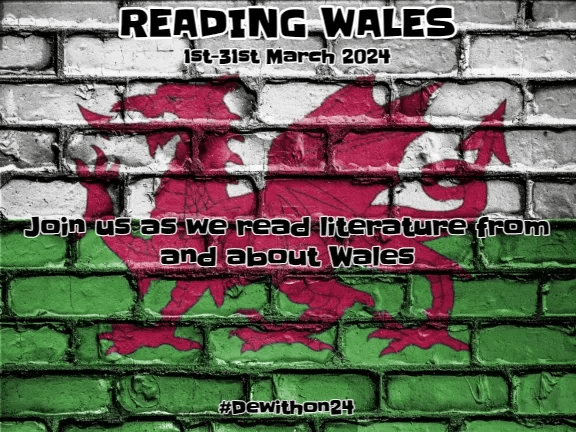
Paula at The Book Jotter is hosting the sixth Reading Wales celebration (aka Dewithon 24), a month-long event beginning on Saint David’s Day, during which book lovers from all parts of the world are encouraged to read, discuss and review literature from and about Wales. I haven’t taken part before but this year I hope I can read at least one book.

Here are a few books I have on my bookshelves to choose from:

How Green was My Valley by Richard Llewellyn. A story of life in a mining community in rural South Wales as Huw Morgan is preparing to leave the valley where he had grown up. He tells of life before the First World War.

Richard Llewellyn Richard Dafydd Vivian Llewellyn Lloyd, known by his pen name Richard Llewellyn, was born in Hendon, London of Welsh parents. Only after his death was it discovered that Llewellyn’s claim that he was born in St Davids, West Wales, was false.

The Earth Hums in B Flat by Mari Strachan. Gwenni Morgan is not like any other girl in this small Welsh town. Inquisitive, bookish and full of spirit, she can fly in her sleep and loves playing detective. So when a neighbour mysteriously vanishes, and no one seems to be asking the right questions, Gwenni decides to conduct her own investigation.

Mari Strachan was born into a Welsh family in Harlech, on the north-west coast of Wales, and was brought up there with Welsh as her first language.

Completely Unexpected Tales by Roald Dahl. Described on the back cover as a collection of macabre tales of vengeance, surprise and dark delights. I used to enjoy these tales in the TV series, Tales of the Unexpected, years ago. 

Roald Dahl was born n Llandaff, Glamorgan. His parents were Norwegian. I bought this at The Roald Dahl Museum and Story Centre in the village of Great Missenden, Buckinghamshire where Dahl lived until his death in 1990.

The Welsh Girl by Peter Ho Davies. In 1944, a German Jewish refugee is sent to Wales to interview Rudolf Hess; in Snowdonia, a seventeen-year-old girl, the daughter of a fiercely nationalistic shepherd, dreams of the bright lights of an English city; and in a nearby POW camp, a German soldier struggles to reconcile his surrender with his sense of honour. As their lives intersect, all three will come to question where they belong and where their loyalties lie.

Peter Ho Davies was born and raised in Coventry to Welsh and Chinese parents, he now makes his home in the US. 

The Fledgeling by Frances Faviell

Dean Street Press| 2016| 211 pages| My own copy| 4*

Karen @ Kaggsy’s Bookish Ramblings and Lizzy @ Lizzy’s Literary Life are hosting #ReadIndies for the fourth time. This is my first time taking part. And as I have several books published by the Dean Street Press I decided to read one of their books – The Fledgeling by Frances Faviell.

I enjoyed Frances Faviell’s memoir, The Dancing Bear, which is set in Berlin just after the end of the Second World War, so I was looking forward to reading another one of her books. The Fledgeling (first published in 1958) is her third novel. It appealed to me because it’s also a book about the post war period, but set a few years later in Britain in the late 1950s. National Service was then in force meaning that all men aged 17 to 21 had to serve in one of the armed forces for an 18-month period. It was discontinued in 1960, with the last servicemen discharged in 1963.

It tells the story of 19-year old Neil Collins , who deserted from his National Service for the third time taking place over the twenty four hour period following Neil’s desertion. When the book begins and sets out to go to his grandmother’s small basement flat in London. Mrs Collins is bedridden and dying. She has strong ideas about duty and thinks Neil should go back and finish his National Service. Nonie, his twin sister, supports him, despite the fact that Charlie, her husband, thinks he is a coward and should finish his National Service. But Nonie makes plans to get him to Ireland where their Great Aunt Liz lived. The flat is small and Neil has to stay hidden whilst several people visit during the day – Miss Rhodes the social worker, some of the neighbours, and Linda, a little girl who regularly climbs in through the basement window to see ‘Gran Collins’.

Neil is in a ‘sickening state of collapse’, is desperate to get away, and he lives in fear of the military finding him and taking him back. And adding to his terror is his fear that Mike, a bullying fellow soldier who has made Neil’s life a nightmare, will catch up with him, to escape with him to Ireland. It all seems hopeless to Neil.

In an Afterword by John Parker, Faviell’s son, he writes that each of her books were inspired by episodes in her own life. And The Fledgeling, about a National Service deserter was based on an actual incident. I enjoyed this book. As I read it I could imagine the reality of the fear and desperation that the family were experiencing. It gives an excellent insight into what life was like in Britain in the 1950s, and in particular into the impact National Service had at that time.