Book Beginnings: The Potter's Hand by A N Wilson

Whilst I’ve been reading from my own book shelves this year so far, I’ve accumulated a pile of library books that are tempting me away from them. One of these books is The Potter’s Hand by A N Wilson.
It begins:

The unoiled hinge joined its melancholy whine to the opium-dosed whimper of the patient who st gagged in his chair, and to the swift rasping of the saw. The door creaked ajar in the very moment that the doctor sawed off the leg of Sukey’s pa.

Such a dramatic opening that immediately grabbed my attention, conjuring up such a vivid picture complete with sound effects! The year is 1768. Sukey (Susannah), who later became the mother of Charles Darwin, was the daughter of Josiah Wedgwood,  an English potter and founder of the Wedgwood company.

The Potter’s Hand is a novel about Josiah Wedgwood and his family. Wilson explains in an Afterword that the broad outlines of the story and most of the details are true, but he has altered dates and rearranged historical events and nearly all the letters are invented. It is ‘meant to be read as fiction, even thought it is intended in part, as an act of homage to one of the great men of our history.’

I’ve read the first two chapters and think I’ll have to read on soon, after I’ve finished Death Under Sail by C P Snow, a crime fiction novel, if not sooner.

Every Friday Gilion at Rose City Reader hosts Book Beginnings on Friday, where you can share the first sentence (or so) of the book you are reading, along with your initial thoughts about the sentence, impressions of the book, or anything else the opener inspires.
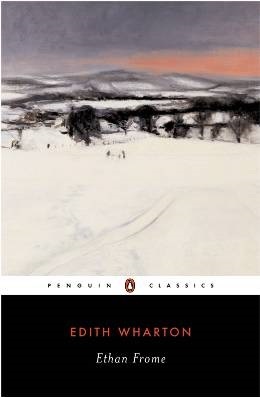
Ethan Frome by Edith Wharton

Ethan FromeWhat a fantastic book. Ethan Frome is a beautifully told tale – a tragedy, signalled right from the beginning of the book, when the unnamed narrator first saw Ethan Frome and was told he had been disfigured and crippled in a ‘smash up’, twenty four years earlier. Life had not been good to him:

Sickness and trouble: that’s what Ethan’s had his plate full up with ever since the very first helping.

I was a bit wary as I began reading Ethan Frome because I’d not long finished reading Doris Lessing’s The Grass is Singing and didn’t want to sink into another bleak and dismal book. I needn’t have worried, even though Ethan Frome is a tragedy there is light to contrast the darkness, and there is love and hope set against repression and misery. It’s another book (like The Grass is Singing) where I hoped the ending would be a happy one, although I knew it couldn’t be. 

It’s a short book (just over 120 pages) and deceptively simple to read, but there is so much packed into it. I enjoyed it very much.  As well as striking and memorable characters the setting is  beautifully described – a ‘mute and melancholy landscape, an incarceration of frozen woe‘, in the isolated village of Starkfield (a fictional New England village). Trapped in an unhappy marriage, Ethan’s life had changed when his father died and he had had to give up his studies to work on the farm. His wife Zeena had always been ill and needing help in the house, which was why her cousin Mattie came to live with them. At first it worked out quite well, but Ethan can’t shrug off a sense of dread, even though he could

… imagine that peace reigned in his house.

There was really even now, no tangible evidence to the contrary; but since the previous night a vague dread had hung on the sky-line. It was formed of Zeena’s obstinate silence, of Mattie’s sudden look of warning, of the memory of just such fleeting imperceptible signs as those which told him, on certain stainless mornings, that before night there would be rain.

His dread was so strong that, man-like, he sought to postpone certainty.

Edith Wharton (1862 – 1937) was an American author. Ethan Frome was first published in 1911 and is in contrast to some of her other books about the New York society of the 1870s to 1920s. It’s a rural tragedy of inevitable suffering and sadness that reminded me of Thomas Hardy’s books.

This book was the Classics Club Spin book for February/March and qualifies in the What’s in a Name 2014 in the Forename/Name category. It’s also a book I’ve owned before 1 January 2014 so is another book for the Mount TBR challenge.

What's in a Name 2014 – an Update

Whats in a name 7Charlie who hosts the What’s In A Name challenge on her blog The Worm Hole has added a a 6th category to the challenge. I was hoping she would as there has always been a 6th category for this challenge. Here it is in Charlie’s own words:

A book with a school subject in the title. And yes, that does mean you can get creative and use a magical academic subject if you wish €“ Hogwarts is a school, after all.

Examples of books you can choose: The History Boys by Alan Bennett, Angelology by Danielle Trussoni, Mastering The Art Of Soviet Cooking by Anya Von Bremzen

This sixth category will be considered a bonus. You can read for it or not €“ if you only want to read for the original five categories your last book of the five will still mean you have completed this year’s challenge.

I’ve had a quick look at my unread books (as I like to use challenges to read from my own books, rather than having to buy/borrow them) and have these to choose from:

History

The Brief  History of the Dead by Kevin Brockmeier
A Small Part of History by Peggy Elliott
The History of Love by Nicole Krauss

Languages

A Dead Language by Peter Rushforth
Italian Neighbours: An Englishman in Verona by Tim Parks

Music

An Equal Music by Vikram Seth

Art

The Lost Art of Keeping Secrets by Eva Rice

Shakespeare

1599: A Year in the Life of William Shakespeare by James Shapiro

Dancing

A Time To Dance, No Time To Weep by Rumer Godden

February's Books

This has been a fantastic February for reading. I finished eleven books, all of them from my to-be-read books (TBRs). The links are to my posts on the books:

  1. The Crow Trap by Ann Cleeves
  2. Playing With Fire by Peter Robinson
  3. Five Little Pigs by Agatha Christie
  4. The Grass is Singing by Doris Lessing
  5. Dying in the Wool by Frances Brody
  6. Crucible by S G MacLean
  7. The Steel Bonnets: the story of the Anglo-Scottish Border Reivers by George MacDonald Fraser  (Non fiction)
  8. The Thirty-Nine Steps by John Buchan
  9. Ethan Frome by Edith Wharton
  10. The Breaker by Minette Walters
  11. Purple Hibiscus by Chimamanda Ngozi Adichie

I enjoyed every one of them, but there are a couple of outstanding books, one of which is Crucible by S G MacLean and that is my Crime Fiction Pick of the Month. I was transported back to 17th century Scotland where Alexander Seaton investigates the murder of his friend, Robert Sim, the College librarian at the Marischal College in Aberdeen.

It’s absolutely compelling reading, including a quest for €˜a secret, unifying knowledge, known to the ancients‘ since lost to us. There are many twists and turns and another man is killed before he finally arrives at the truth.

For more Crime Fiction Picks of the Month see Kerrie’s blog, Mysteries in Paradise.

The other outstanding book is Purple Hibiscus by Chimamanda Ngozi Adichie, which I have yet to write about. I found this book quite hard to read when it was about the abuse happening to some of characters. In some ways it is a dark book and yet in other ways it is uplifting. Another book that I didn’t want to end and at the same time I wanted to rush through it to see how it would end.

I’ve had this book for nearly six years and am so glad I eventually got round to reading it.

Also worth a mention are The Thirty-Nine Steps by John Buchan and Ethan Frome by Edith Wharton (no review post as yet). I read both on my Kindle, both are short books, but beautifully composed, taut and precise. Of the two I think Ethan Frome has the edge, mainly because of Wharton’s descriptive writing evoking such an intense atmosphere.

I’m doing well at the moment sticking to reading my TBRs (books I’ve had since before 1 January 2014)  – I’ve plenty to choose from – although I am wavering and have started to read a library book. I keep finding books I haven’t included in my LibraryThing and Goodreads catalogues, so although the numbers of unread books on the shelves are going down, the numbers on LT and GR aren’t. And I have bought a few books this year to add to the unread totals!

Book Beginnings – The Flower Book

Yesterday I finished reading Purple Hibiscus by Chimamanda Ngozi Adichie, which I thought was an amazing book that kept me captivated even though it’s a challenging book to read because of its subject matter. I’ll write more about that in a later post.

It has left me with the usual problem of deciding what to read next and I’ve picked up and started so many books, none of which seem good enough after Purple Hibiscus. I’ve been reading from my own bookshelves this year, but I’m thinking of having a little break from that and reading a library book. It’s one I picked off the mobile library van, not knowing anything about it or about the author, Catherine Law – The Flower Book. It’s set in 1914 and also in 1936.

It begins in Cornwall in March 1914:

On certain nights if the wind was right, you could hear the sea from Old Trellick. So the legend has it, although Violet had never heard the waves and her parents would not try, due to the fact, she decided, that they had no imagination.

As a child she’d stand at the French windows and implore them to be quiet, to stop what they were doing and to concentrate with her, to catch this magical and elusive sound.

Every Friday Gilion at Rose City Reader hosts Book Beginnings on Friday, where you can share the first sentence (or so) of the book you are reading, along with your initial thoughts about the sentence, impressions of the book, or anything else the opener inspires.

I like the images the beginning of this book conjures and also the sounds. I always like the sight and sound of the waves breaking on the shore; to me too that has a certain magic. So this appealed to me straight away. Couple that with a story set against the backdrop of World War I as Aster Fairling searches for the truth behind her parents’ tragic love through the pages of her mother journal and I want to know more.

The Flower Book is Catherine Law’s third book.

The Thirty-Nine Steps by John Buchan

Way back in 2008 I watched The 39 Steps on TV with Rupert Penry-Jones as Richard Hannay, so inevitably as I read The Thirty-Nine Steps I could see Penry-Jones as Hannay. The dramatisation, however, although there are similarities, is different from John Buchan’s book. There are a number of historical inaccuracies and some artistic licence was used – none of which I was aware of as I watched the film and I thoroughly enjoyed it. It made me want to read the book and it’s taken me until now to get round to it – I’d forgotten most of the details of the film, except for visions of Penry-Jones running away from his pursuers in the Scottish moors, scrambling through the heather.

John Buchan 1936

John Buchan began writing The Thirty-Nine Steps in 1914; it was first published in 1916. He was born in Perth in 1875 and after leaving Oxford University he had a varied career, as well as writing books and articles he was a barrister, a member of Parliament, a soldier and a publisher. He was created Baron Tweedsmuir of Elsefield in 1935 and became the 15th Governor-General of Canada, a position he held until his death in 1940.

Once I began reading The Thirty-Nine Steps I didn’t want to put it down. It’s a fast moving action-story, beginning with an international conspiracy, involving anarchists, financiers and German spies. Richard Hannay, having found Scudder, murdered in his London flat, fears for his life and goes on the run, chased by villains in a series of exciting episodes, culminating in the discovery of the location of the ‘thirty-nine steps’. Hannay is a remarkable character, resourceful, and a master of disguise. As well as fleeing for his life he is searching for Scudder’s notebook, which contains clues to the international conspiracy – Scudder was a spy.

The master villain is also a master of disguise, having the ability to ‘hood his eyes like a hawk‘ :

There was something weird and devilish in those eyes, cold, malignant, unearthly, and most hellishly clever. They fascinated me like the bright eyes of a snake. (page 119)

He can impersonate the British First Sea Lord at a top secret meeting with people who knew the real First Sea Lord very well and is also convincing as the very British gentleman, the plump, bridge-player Percival Appleton.

The Thirty-Nine Steps is to my mind a gem. There are other Hannay books – the Complete series is available on Kindle, The Thirty-Nine Steps, Greenmantle, Mr. Standfast, The Three Hostages, and The Island of Sheep.

And so one book leads on to yet more books!