What’s in a Name 2016 – Completed

I have now completed the What’s In A Name 2016 challenge, hosted by Charlie at The Worm Hole. The challenge was to read books with titles from six categories. At the beginning of this challenge I listed the books I had initially chosen to read –  but I didn’t read any of them. Instead I realised, usually as I finished reading the books, that they just slotted into the categories.

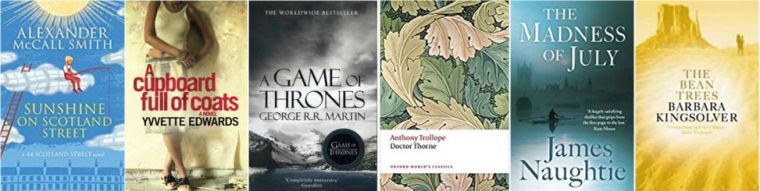
These are the books I read, with links to my reviews:

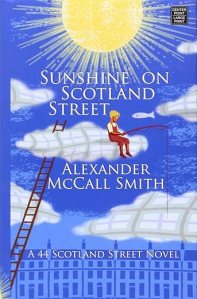
  • A countrySunshine on Scotland Street by Alexander McCall Smith – this is an easy read, meandering from one character to the next. It has a light, humorous tone that I enjoyed, along with thoughts about friendship, religion, spirituality and happiness.
  • An item of clothing – A Cupboard Full of Coats by Yvvette Edwards – a beautiful and intense book, dramatic and full of emotion and passion, about relationships and what happens when jealousy and betrayal tear people apart.
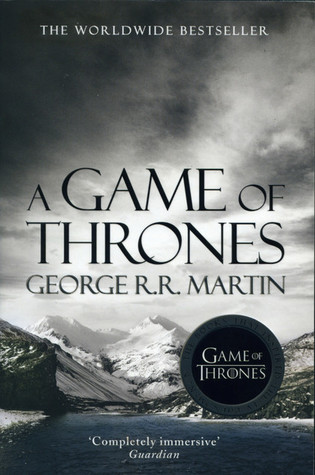
  • An item of furnitureA Game of Thrones by George R R Martin – I was completely immersed in the world of the Seven Kingdoms, inhabited by numerous characters, all portrayed in meticulous detail and expertly constructed so that all the fantastic creations are credible, and complete with back stories.
  • A profession – Doctor Thorne by Anthony Trollope –  about mid 19th century prosperous country life and the importance of birth, of wealth and above all about money, class and power. Trollope uses gentle satire, emphasising the absurdities of the class divisions in society and poking fun at the professions.
  • A month of the year – The Madness of July by James Naughtie -a political thriller set in London in the mid 1970s, a book that makes you think, that keeps you on your toes as you read, that both puzzles and entertains you.
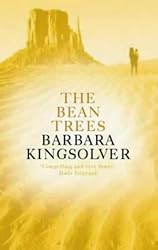
  • A title with the word ‘tree’ in itThe Bean Trees by Barbara Kingsolver – I loved this book. There are several themes including family relationships, particularly mother/child, sexual and physical abuse of small children, the integration of cultures, and the issue of refugees and illegal immigrants. I thought it was thought-provoking, as well as being fascinating reading.

I began the challenge in March when I read Doctor Thorne and finished it just a couple of days ago, reading A Cupboard Full of Coats. I enjoyed them all, each one different in style and genre, ranging from a 19th century classic to 21st century fantasy fiction.

A Cupboard Full of Coats by Yvvette Edwards

A Cupboard Full of Coats

A Cupboard Full of Coats is a beautiful and intense book, full of emotion and passion. It begins when Jinx opens the door to Lemon, who she hadn’t seen for fourteen years – fourteen years since the night her mother had been murdered. Over the next three days they talk about what had happened, bringing to the surface secrets, desires and jealousies that had led to the tragedy.

The narrative switches between the past and the present. Jinx’s relationship with her mother, had changed when she was sixteen and Berris, Lemon’s best friend, had moved in to live with them. It’s not clear at first just how or why her mother died although in the second paragraph Jinx reveals to the reader that she had killed her. But it is clear that both Jinx and Lemon (his full name is Philemon) have secrets that have been haunting them ever since. Lemon wants to talk about it and at first Jinx cannot open up to reveal anything, or indeed even to think about it let alone talk about it.

But I was no closer to telling him anything. He had told me heaps. More than I asked for. Much more. Yet, so far, I had shared nothing. He was right, you couldn’t just pick up a piece out of a story and present it on its own. Alone it was worthless. But I had not spoken to anyone ever about that night, had never trusted anyone enough to tell them the truth about what happened with my mother. I hadn’t wanted to. And now that I did want to, it seemed an impossible task. (pages 95 – 96)

But his talk and the delicious Caribbean food he cooks bring back her memories almost like flashbacks and her defences crumble. The cupboard full of coats helps her too – the expensive, beautiful coats, each one protected by transparent dustcovers, especially one coat, ‘made from nubuck suede, a long, ankle-length close-fitting garment, grey-blue like cloudy sky, with diagonal slit pockets lined in cobalt-coloured silk.’

It is a really dramatic story, layered and full of depth, as Jinx and Lemon relive that time of love, hatred, and violence. Beautifully written, it skillfully conveys the difficulties of relationships, communication and what happens when jealousy and betrayal tear people apart.

  • Paperback: 268 pages
  • Publisher: Oneworld Publications (21 Sept. 2011)
  • Language: English
  • ISBN-10: 1851688382
  • ISBN-13: 978-1851688388
  • Source: a library book

I borrowed this book from the library because the title, opening paragraphs and blurb interested me (see this post for the blurb etc) and I was pleased when I realised it was perfect for the final category I had to fill for the What’s in a Name challenge – the category of a book with an item of clothing in the title.

What’s in a Name 2017

whats-in-a-name17

Next year Charlie at The Worm Hole is hosting the tenth ‘“ yes, tenth! ‘“ annual What’s In A Name challenge, originally started by Annie, then handed to Beth Fish Reads and now continued by Charlie. For full details go to the sign-up post. I’ve been doing this challenge since Annie started it in 2007, just missing the one in 2009! So, even though I’m cutting back on challenges for 2017, I really want to take part in this one.

The basics

The challenge runs from January to December. During this time you choose a book to read from each of the following categories. (Charlie’s examples of books you could choose are in brackets ‘“ translations and other languages most definitely count!):

  • A number in numbers (84, Charing Cross Road; 12 Years A Slave; 31 Dream Street)
  • A building (The Old Curiosity Shop; I Capture The Castle; House Of Shadows; The Invisible Library; Jamaica Inn)
  • A title which has an ‘˜X’ somewhere in it (The Girl Next Door; The Running Vixen)
  • A compass direction (North and South; Guardians Of The West; The Shadow In The North; NW)
  • An item/items of cutlery (The Subtle Knife; Our Spoons Came From Woolworths)
  • A title in which at least two words share the same first letter ‘“ alliteration! (The Great Gatsby; The Luminous Life Of Lilly Aphrodite; Gone Girl; The Cuckoo’s Calling)

Charlie is asking for one review per category. Where possible I like to read from my TBRs for my challenges and I’ve found the following books on my shelves (some are e-books) for each category and will choose one from each for this challenge.

A number in numbers

  • 1066: What Fates Impose by G K Holloway
  • 1599: a Year in the life of William Shakespeare by James Shapiro
  • 1946: The Making of the Modern World by Victor Sebestyen
  • 3500: An Autistic Boy’s Ten-Year Romance with Snow White by Ron Miles

A building – lots to choose from

  • Citadel by Kate Mosse
  • The Chapel in the Woods by Susan Louineau
  • Corduroy Mansions by Alexander McCall Smith
  • Framley Parsonage by Anthony Trollope
  • Heather Farm by Dorte Hummelshoj Jakobsen
  • The House by the Churchyard by Joseph Sheridan Le Fanu
  • The House in the Attic by Helen Cardwell
  • House of the Seven Gables by Nathaniel Hawthorne
  • The House of the Spirits by Isabel Allende
  • The House on Fever Street by Celina Grace
  • Last Man in Tower by Aravind Adiga
  • The Murder at Sissingham Hall by Clara Benson
  • The Power House by John Buchan

A title which has an ‘˜X’ somewhere in it

  • Exhume by Danielle Girard
  • The Girl Next Door by Ruth Rendell
  • The Mitfords: Letters Between Six Sisters edited by Charlotte Mosley
  • Notes from an Exhibition by Patrick Gale
  • A Place of Execution by Val McDermid
  • The Sex Life of My Aunt by Mavis Cheek
  • The Taxidermist’s Daughter by Kate Mosse

A compass direction

  • The King in the North by Max Adams
  • North and South – Elizabeth Gaskell
  • South Riding by Winifred Holtby

An item/items of cutlery – I thought I must have some crime fiction in my TBRs with ‘knife/knives’ in the title – but I haven’t! I read Charlie’s suggestion of The Subtle Knife several years ago. The only book I have to read in this category is:

  • The Tiny Fork Diet by Alan Sugar

A title in which at least two words share the same first letter ‘“ alliteration!

  • Break No Bones by Kathy Reichs
  • The Child’s Child by Barbara Vine
  • A Death in the Dales by Frances Brody
  • Deja Dead by Kathy Reichs
  • Dialogues of the Dead by Reginald Hill
  • Gone Girl by Gillian Flynn
  • Hangman’s Holiday by Dorothy Sayers
  • The Pickwick Papers by Charles Dickens
  • The Repentant Rake by Edward Marston
  • The Sacred Stone: The Medieval Murderers
  • Tinker Tailor Soldier Spy by John Le Carre
  • Whitethorn Woods by Maeve Binchy

Sunshine on Scotland Street by Alexander McCall Smith

I’ve read a few of Alexander McCall Smith’s Isabel Dalhousie books, which I enjoyed – but not any of his 44 Scotland Street novels. So when I saw Sunshine on Scotland Street in the library, going off the blurb on the back cover, I thought it would be a change from the crime fiction and historical novels I’ve been reading recently.

From the back cover:

Scotland Street witnesses the wedding of the century of Angus Lordie to Domenica Macdonald, but as the newlyweds depart on honeymoon Edinburgh is in disarray. Recovering from the trauma of being best man, Matthew is taken up by a Dane called Bo, while Cyril eludes his dog-sitter and embarks on an odyssey involving fox-holes and the official residence of a cardinal. Narcissist Bruce meets his match in the form of a sinister doppelganger; Bertie, set up by his mother for fresh embarrassment at school, yearns for freedom; and Big Lou goes viral. But the residents of Scotland Street rally, and order – and Cyril – is restored by the combined effects of understanding, kindness, and, most of all, friendship.

My thoughts:

Even though I haven’t read the seven books before this one I had no difficulty in following the storylines, although it is obvious that the characters all have backstories and previous relationships that are hinted at in this book. In a way it’s very like the Isabel Dalhousie books as the action is interspersed with McCall Smith’s philosophical and ethical musings, his thoughts about human nature and relationships, which in general I liked more than the story.

It begins with an amusing account of the preparations for Angus and Domenica’s wedding, which Angus seems to think will just happen without much preparation by him – a hole in his kilt, his lack of a ring, and he has given no thought at all about where to go for thier honeymoon. But his bestman, Matthew helps him sort out the kilt and ring problem and Domenica has arranged both the reception and the honeymoon.

After that Angus and Domenica disappear from the book until the last chapter, leaving Cyril, Angus’s dog in the care of the Pollock family, the insufferable Irene, her long-suffering husband, Stuart, 6 year-old son Bertie and baby Ulysses. Cyril and Bertie are my favourite characters in the book and their ‘adventures’ caused me much concern, as Irene does not like Cyril and stifles both Bertie and Stuart. In fact I wasn’t too bothered about any of the other characters, apart from Bertie’s spindly-legged friend from cub scouts, Ranald Braveheart Macpherson and his mother who has no difficulty in putting Irene firmly in her place.

This is an easy read, meandering from one character to the next. It has a light, humorous tone that I enjoyed, along with thoughts about friendship, religion, spirituality and happiness. At the end as Angus looks round the group of people gathered for their homecoming party it strikes him that they are an ‘infinitely precious band of souls’:

And this realisation that he had was not specifically religious – although it could easily and appropriately be that. It was, rather, a spiritual notion – the idea that each of us, even the least of us, has a rich hinterland of value behind us: the lives we have led, the thoughts we have had, the love we have given and received – the little things of our lives that may not mean much to others unless and until they are granted the insight that brings love into the heart, sudden, exalting love. To see another as a soul was to acknowledge the magnifcent, epic course that life is for each of us, and to experience sympathy for the other in his or her negotiation of that course. It was quite different from seeing others simply as people. (pages 294 – 295)

Reading challenges: Read Scotland and What’s In a Name, in the category of a book with a country in the title.

  • Paperback: 304 pages
  • Publisher: Abacus (18 July 2013)
  • Language: English
  • ISBN-10: 0349139164
  • ISBN-13: 978-0349139166
  • Source: Library book

A Game of Thrones by George R R Martin

‘When you play the game of thrones, you win or you die. There is no middle ground.’
22740513

When we began watching the HBO TV series, A Game of Thrones, I was hooked and once we finished watching I immediately wanted to read the series, A Song of Fire and Ice. I’d just read The Sunne in Splendour by Sharon Penman, about the Wars of the Roses and had noticed the similarities between that and A Game of Thrones, the battles between the Houses of York and Lancaster paralleled by those between the Houses of Stark and Lancaster for example.

I don’t often read a book after seeing an adaptation, but in this case it proved ideal – the actors and scenery were perfect for my reading of the book, although there are some differences (the ages of the Stark children for example). I loved both the book and the TV series.

Blurb:

Summers span decades. Winter can last a lifetime. And the struggle for the Iron Throne has begun.

As Warden of the north, Lord Eddard Stark counts it a curse when King Robert bestows on him the office of the Hand. His honour weighs him down at court where a true man does what he will, not what he must ‘¦ and a dead enemy is a thing of beauty.

The old gods have no power in the south, Stark’s family is split and there is treachery at court. Worse, the vengeance-mad heir of the deposed Dragon King has grown to maturity in exile in the Free Cities. He claims the Iron Throne.

I was completely immersed in this world inhabited by numerous characters and set in different locations (Seven Kingdoms), all portrayed in meticulous detail and expertly constructed so that all the fantastic creations are credible, and complete with back stories and histories. Beginning with a Prologue the book is then narrated through different characters’ points of view – each chapter is headed by that character’s name making the plotlines easy to follow:

  • Lord Eddard “Ned” Stark, Warden of the North and Lord of Winterfell, Hand of the King.
  • Lady Catelyn Stark, of House Tully, wife of Eddard Stark.
  • Sansa Stark, elder daughter of Eddard and Catelyn Stark.
  • Arya Stark, younger daughter of Eddard and Catelyn Stark.
  • Bran Stark, second-youngest son of Eddard and Catelyn Stark.
  • Jon Snow, illegitimate son of Eddard Stark, mother unknown.
  • Tyrion Lannister, son of Lord Tywin Lannister, called the Imp, a dwarf, brother of the twins, the beautiful and ruthless Queen Cersei and Ser Jaime, called the Kingslayer,
  • Daenerys Targaryen, Stormborn, the Princess of Dragonstone, sister of Prince Viserys, the last of the Targaryens.

Other characters include:

  • King Robert of the House Baratheon, Lord of the Seven Kingdoms, Eddard Stark’s oldest friend, married to Queen Cersei, his son Joffrey, spoiled and wilful with an unchecked temper, heir to the Iron Throne.
  • Robb Stark, oldest true born son of Eddard Stark. He remained at Winterfell when Eddard became the Hand of the King.
  • Tywin Lannister, Lord of Casterly Rock, Warden of the West, Shield of Lannisport.
  • Khal Drogo – a powerful warlord of the Dothraki people on the continent of Essos, a very tall man with hair black as midnight braided and hung with bells.

Locations:

GOT Map1

  • Winterfell: the ancestral castle of House Stark.
  • The Wall: built of stone, ice and magic, on the northern border of the Seven Kingdoms, guarded by the Night’s Watch to protect the Kingdoms from the dangers behind the huge wall from ‘the Others’ and the Wildings.
  • Beyond the Wall: the first book begins Beyond the Wall with members of the Night’s Watch on the track of a band of Wildling raiders.
  • King’s Landing: a walled city, the capital of the continent of Westeros and of the Seven Kingdoms.
  • Essos: across the Narrow Sea from Westeros, includes the grassland known as the Dothraki Sea.

This article in The Telegraph lists the locations used in the TV series.

This is no fairy tale – it’s set in a grim and violent world full of tragedy, betrayals and battles; a tale of good versus evil in which family, duty, and honour are in conflict, the multiple viewpoints giving a rounded view of the conflicts the characters face. It’s a love story too. There are knights, soldiers and sorcerers, priests, direwolves, giants, assassins and bastards.  It’s complex and multifaceted, and it’s full of stories and legends – here for example Maester Luwin tells young Bran Stark about the children of the forest:

“They were people of the Dawn Age, the very first before kings and kingdoms,” he said. “In those days there were no castles or holdfasts, no cities, not so much as a market town to be found between here and the sea of Dorne. There were no men at all. Only the children of the forest dwelt in the lands we now call the Seven Kingdoms.

‘They were a people dark and beautiful, small of stature, no taller than children even when grown to manhood. They lived in the depths of the wood, in caves and crannogs and secret tree towns. Slight as they were, the children were quick and graceful. Male and female hunted together, with weirwood bows and flying snares. Their gods were the gods of the forest, stream and stone, the old gods whose names are secret. Their wisemen were called greenseers and carved strange faces in the weirwoods to keep watch on the woods. (page 713)

I shall be reading the next book in the series soon, A Clash of Kings. The other books are A Storm of SwordsA Feast for Crows, and A Dance with Dragons.

I read the Kindle Edition:

  • File Size: 8515 KB
  • Print Length: 819 pages
  • Page Numbers Source ISBN: 0007448031
  • Publisher: Harper Voyager (23 Dec. 2010)

Reading Challenges: Mount TBR Reading Challenge  – a book I’ve had since October 2015, and the What’s In a Name Challenge – in the category of a book with a piece of furniture in the title.
The Bean Trees by Barbara Kingsolver

If I don’t write about a book as soon as I’ve finished it the details begin to fade. I finished reading  Barbara Kingsolver’s first novel, The Bean Trees a few weeks ago. So this is a short post on the book, which doesn’t really do justice to it!

My thoughts:

I loved this book. Barbara Kingsolver writes in such a way that I can easily visualise the scenes, beginning with the opening paragraph in which she describes a tractor tire blowing up, flinging a man up in the air and throwing him over the top of a Standard Oil sign. Taylor (originally called Marietta/Missy) grew up in rural Kentucky. She left home when she had saved enough to buy a car, an old VW. She changed her name to Taylor after the first place where she ran out of petrol, which just happened to be Taylorville. She drove on until the car broke down in the middle of nowhere, on land owned by the Cherokee tribe. And it was there at a garage that an Indian woman abandoned a baby girl in Taylor’s car – she called the baby, Turtle.

They travel on to Tucson, where she settled for a while, living with Lou Ann, a mother whose husband, Angel Ruiz left before their son was born, and working for Mattie at ‘Jesus Is Lord Used Tires’. Mattie, however, is also involved in an underground railway moving illegal Guatemalan and Salvadoran immigrants to safe houses. She talks of the obligation under the United Nations ‘something or other’ ‘to take in people whose lives are in danger’. And Taylor becomes involved in helping her.

There are several themes running throughout this short, but well written book – both political and social including family relationships, particularly mother/child, sexual and physical abuse of small children, the integration of cultures, as well as the always current issue of refugees and illegal immigrants. I thought it was all thought-provoking as well as fascinating reading.

I have read some of Barbara Kingsolver’s later books, including The Poisonwood Bible, a longer and much more complex book, which I’ve read twice and loved. There is a sequel to The Bean Trees that I really want to read now – Pigs In Heaven.

Reading Challenges: What’s In a Name? in the category of a book with the word ‘tree’ in the title.