Book Beginnings

Book Beginnings ButtonGilion at Rose City Reader hosts Book Beginnings on Friday in which you share the first sentence (or so) of the book you are reading, along with your initial thoughts about the sentence, impressions of the book, or anything else the opener inspires.

I was looking at some of my books that I’ve had for a long time and wondering which one to read next and I came across Cloud Atlas by David Mitchell. This was immensely popular when it first came out in 2004 and so I bought a copy and began to read it. Although the opening pages intrigued me after a few more pages I put it down; I just couldn’t get into it. After a while I tried it again, and again and still found it not very interesting and when I looked forward in the book I found it looked very disjointed and I gave up. There were plenty of books to read without struggling to read one that wasn’t interesting me.

Then they made a film and people started enthusing about it again. So, how many times do I try to read this book? It begins:

Thursday, 7th November –

Beyond the Indian hamlet, on a forlorn strand, I happened upon on trail of recent footprints. Through rotting kelp, sea cocoanuts & bamboo, the tracks led me to their maker, a white man, his trowsers & Pea-jacket rolled up, sporting a kempt board & an outsized Beaver, shovelling & sifting the cindery sand with a tea-spoon so intently that he noticed me only after I hailed him from ten yards away. Thus it was, I made the acquaintance of Dr Henry Goose, surgeon to the London nobility. His nationality was no surprise. If there be any eyrie so desolate, or isle so remote that one may resort unchallenged by an Englishman, ’tis not down on any map I ever saw.

From the back cover:

Six interlocking lives – one amazing adventure. In a narrative that circles the globe and reaches from the 19th century to a post-apocalyptic future, David Mitchell erases the boundaries of time, genre and language to offer an enthralling vision of humanity’s will to power, and where it will lead us.

It knits together science fiction, political thriller and historical pastiche with musical virtuosity and linguistic exuberance …

It sounds amazing and extraordinary, but I’m still not sure because when I actually start reading it, the first chapter ends in the middle of a sentence. Is that really meant to make me want to read on when the next chapter seems totally unconnected? It reminds me of Italo Calvino’s If on a Winter’s Night a Traveller, a book I didn’t finish reading, although I loved the beginning of that book.

Is Cloud Atlas really so good! If you have read it, what do you think? Please let me know.

Saturday Snapshot – Flodden

It’s the 500th anniversary of the Battle of Flodden this year – it was on 9th September 1513 that the armies of England and Scotland met at Flodden Field, near Branxton in Northumberland. There have been events this year to commemorate the battle and the men from both nations who died in this last medieval battle between England and Scotland.

Living not far from the site of the battle this week we went to see what had changed as a result of the anniversary. There’s now a surfaced path leading up to the Monument.

(Click on the photos to see them enlarged)

500th anniversary P1010826

There are some more information boards and signs to guide you round the Battlefield Trail:

Battlefield trail signpost P1010837The monument isn’t actually on the site of the battle but stands on Piper’s Hill.

Flodden MonumentFrom the monument you can look towards the north down on the village of Branxton:

Branxton P1010831The two armies lined up south of the monument with a marshy dip between them. The Scots advanced first, unaware of the of the ground conditions below them. Now it’s a ditch but in 1513 there was a brook surrounded by a reeded quagmire downhill – where the Scots were bogged down, the rear ranks pushing forward into the front ranks, crushing the fallen bodies and causing chaos. They were then easy prey for the deadly English billhooks.

It looks like this now – the ditch between the hedge and fence is now nearly dry, after weeks of rain in 1513 it was a quagmire:

Boggy Ground P1010835

 and the two armies came face to face:

Tthe Killing Fields P1010858

Flodden 1513: Scotland’s Greatest Defeat by John Sadler is an excellent account of the strategies and tactics of both armies, with maps and plans showing how the battle began and a time timeline of the various conflicts giving a detailed account of events.

Having read this book and the information boards around the trail I was able to visualise the battle, even on a peaceful weekday afternoon 500 years later. The Scottish troops had moved from their original position on Flodden Edge as the English approached the battlefield, putting them at a disadvantage. The outcome could have been different if they had seen the dip below them as they charged down the hill – or even if the English had attacked first.

But then, the battle needn’t have taken place at all if James IV of Scotland had not invaded England in an attempt to divert English troops from their fight against the French. Indeed he had entered into a Treaty of Perpetual Peace with England in 1502. But in 1512 he had also renewed the Auld Alliance with the French, putting him in the position of either declaring for France against Henry VIII (James’s brother-in-law) or remaining neutral, which would make him vulnerable to any further English expansion, as Henry had revived his claim to the Scottish throne.

Despite pressure from senior members of his council to avoid an outright breach with England, when Henry arrived in Calais preparing to wage war against the French, James decided to go to war against the English. Prior to the battle at Flodden he had crossed the River Tweed into England where he then attacked and captured Norham Castle, and then destroyed both Etal and Ford Castles whilst the English were still mustering their troops. But the outcome was a disaster for Scotland and James was killed on Flodden Field:

The king’s was but one of many hundreds of bodies, sprawled and piled on the bloodied turf. The whole hillside from the brook northwards was a killing ground, the dead, maimed and horribly injured competing for space, severed limbs and streaming entrails spilling fresh gore. The din would have been terrific, with hoarse shouts and the screams of the dying men, the crash of spears, a crescendo rising and spilling like breakers against the shore. (page 82, Flodden 1513 by John Sadler)

Each time I go to Branxton, or see the monument as we drive south along the A697, I think about the battle and all those who died there in 1513.

For more Saturday Snapshots see Melinda’s blog West Metro Mommy Reads.

Saturday Snapshots

It’s been a busy time here recently, as these photos of some of the places we’ve visited show:

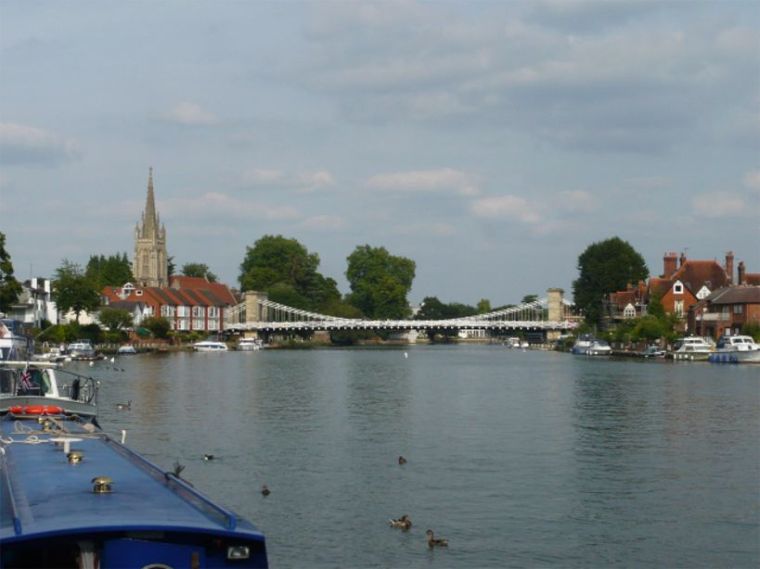
We’ve been away visiting family. We stayed at Marlow in Buckinghamshire. The photo below shows the Marlow Bridge – a road and footbridge across the River Thames. The original crossing probably dates back to 1309. The current suspension bridge was built 1829 and 1832 and was restored in 1956-7.

Marlow Bridge P1090134

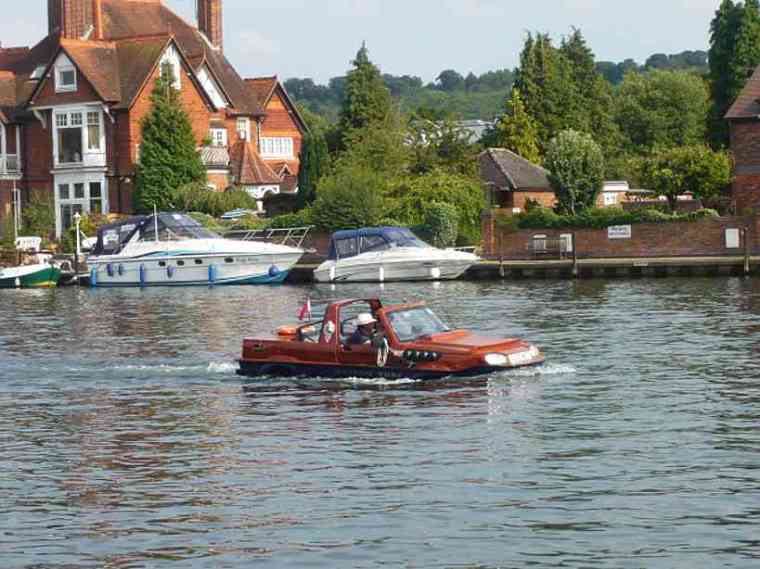
There were the usual boats, ducks and swans but we were surprised to see this driving up the Thames:

Amphibious car Marlow P1090141We had a flying visit to Eton and Windsor, not far from Marlow. We had lunch at the 300 year old George Inn at Eton on one side of the Thames:
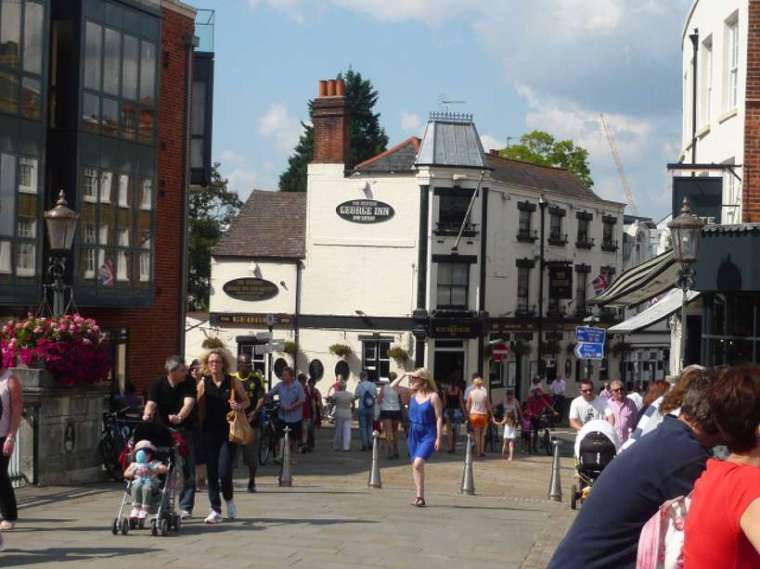
George Inn Eton P1090082and then we crossed the bridge into Windsor for a quick look at Windsor Castle:
Windsor Castle P1090097

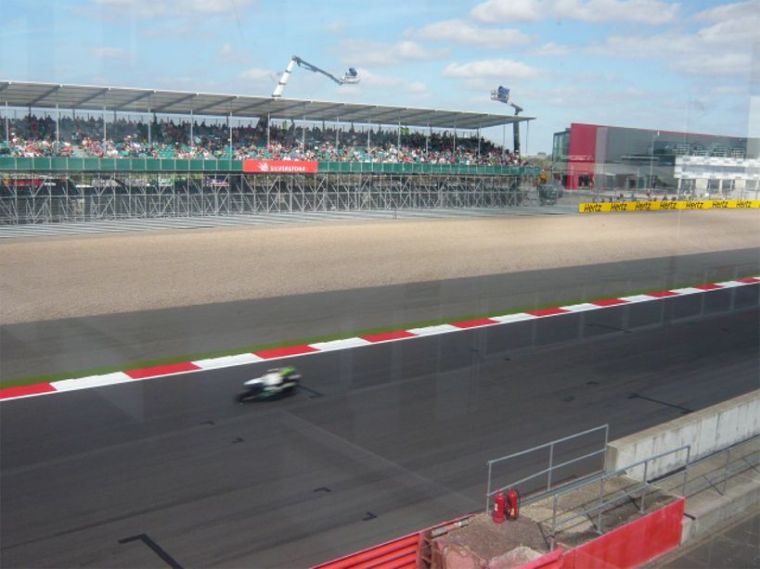
 Other trips out were to Silverstone in Northamptonshire where our nephew has a hospitality suite and we watched the practice for the British MotoGP. His suite, located right over the pit lane, has fantastic views over the start/finish straight.

Silverstone P1090230And then we were off to Coventry to see our other nephew’s show The Prodigals (he’s the musical supervisor/director). Before  the show we managed to go to Coventry Cathedral, but only to see the outside as it was near to closing time for the Cathedral and opening time for the show. The photo below shows the entrance to the Cathedral through the huge Screen of Saints and Angels, with a reflection of the ruins of the old Cathedral:
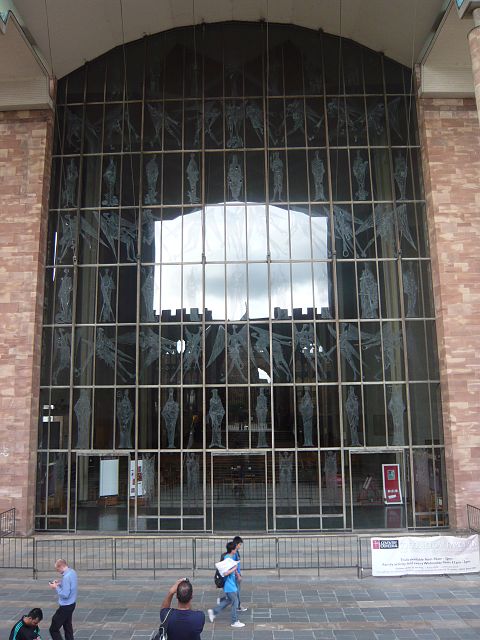
Coventry Cathedral P1090236and finally the next photo shows the enormous bronze statues, designed by Sir Jacob Epstein, of St Michael defeating the Devil:
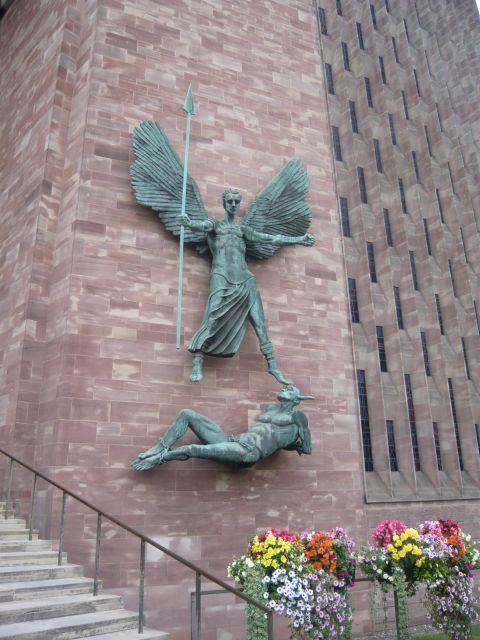
Coventry Cathedral P1090238

I’ve got more photos – plenty for several Saturday Snapshot posts!

For more Saturday Snapshots see Melinda’s blog West Metro Mommy Reads.

Saturday Snapshots: Pisa

I’ve been looking through some old holiday photos – these are from 2000 when we visited Pisa whilst staying near Florence.

This is our first view of the Leaning Tower, which doesn’t actually look as though it’s leaning much at this angle:

View Leaning Tower Pisa DCP_0104But when we got nearer you can see just how far it leans:

Leaning tower Pisa DCP_0105That’s me in the sun hat.

And here’s another view of the Tower taken from the roof of the Cathedral:

View Leaning tower Pisa DCP_0133We didn’t have long to spend in Pisa itself after we had looked round the Cathedral, but I was interested in this little church we passed on the way to the Cathedral Square. It’s Santa Maria della Spina, tucked away next to the river Arno:

Santa Maria della Spina, Pisa DCP_0101A lovely Gothic church, in sparkling white marble and very eye-catching as we walked by. I wished we’d had time to see more but we had to catch the train.

(Click on photos to enlarge)

For more Saturday Snapshots see Melinda’s blog West Metro Mommy Reads.

First Chapter First Paragraph Tuesday Intros

Every Tuesday Diane at Bibliophile By the Sea hosts First Chapter First Paragraph First chapterTuesday Intros, to share the first paragraph or (a few) of a book you are reading or thinking about reading soon.

The Cabinet Room, 10 Downing Street, London, 4.30pm, 9 May 1940

Churchill was last to arrive. He knocked once, sharply, and entered. Through the tall windows the warm spring day was fading, shadows lengthening on Horse Guards Parade. Margesson, the Conservative Chief Whip, sat with Prime Minister Chamberlain and Foreign Secretary Lord Halifax at the far end of the long, coffin-shaped table which dominated the Cabinet Room. As Churchill approached them Margesson, formally dressed as ever in immaculate black morning coat stood up.

‘Winston.’

Churchill nodded at the Chief Whip, looking him sternly in the eye. Margesson, who was Chamberlain’s creature, had made life difficult for him when he had stood out against party policy over India and Germany in the years before the war.He turned to Chamberlain and Halifax, the Prime Minister’s right-hand man in the government’s appeasement of Germany. ‘Neville. Edward.’ Both men looked back; no sign today of Chamberlain’s habitual half-sneer, nor of the snappy arrogance which had alienated the House of Commons during yesterday’s debate over the military defeat of Norway. Ninety Conservatives had voted with the Opposition or abstained; Chamberlain had left the chamber followed by shouts of ‘Go!’ The Prime Minister’s eyes were red from lack of sleep or perhaps even tears – though it was hard to image Neville Chamberlain weeping. Last night the word around a feverish House of Commons was that his leadership would not survive.

This is the opening of Dominion by C J Sansom, a novel about what might have happened, an alternative history, if Germany had been triumphant in the Second World War. All events that take place in this book after 5 p.m. on 9 May 1940 are imaginary.

I’ve read and enjoyed Sansom’s earlier books, the five Matthew Shardlake historical mysteries and Winter in Madrid, historical fiction set in Spain in 1940, but I wasn’t sure I wanted to read Dominion, his latest book, described on the book jacket as ‘a vivid, haunting re-imagining of 1950s Britain’ and ‘a gripping, humane spy thriller and a poignant love story.’

I like the opening paragraphs I’m still not sure because ‘re-imaginings’ don’t exactly appeal to me. I prefer historical fiction to be historical and fiction to be fiction, not  an alternative version of history. But when I saw a copy on the library shelves I was tempted to at least look at it and brought it home to see if it’s any good. After all it’s written by C J Sansom, so it can’t be bad, can it?

Saturday Snapshots: Wallington

Griffins' heads, Wallington

Wallington is now owned by the National Trust but was for generations the home of the Blackett and Trevelyan families. It’s in the village of Cambo, Northumberland, to the west of Morpeth, approached down a series of country lanes. We visited it just over a week ago, never having heard of it or of Cambo until I looked in the NT handbook. There’s a lot to see, including these strange objects on the front lawn – they’re griffin heads that were originally on Bishopsgate in London (according to wikipedia this was the gate where the heads of criminals were displayed on spikes).

I took lots of photos, mainly inside the house, which was built in the late 17th century. We didn’t have time to see everything and spent most of the time looking round the house. I’ve just posted a few of my photos today (click on them to enlarge):

First the entrance to the property is under a Clock Tower topped by a cupola on nine Doric columns:

Clock Tower, Wallington

This opens into a grassed courtyard where people were sitting having picnics and children were playing ball games. Crossing the grass takes you to the entrance to the house:

Wallington entranceI think the Central Hall is impressive, but one of the house stewards told me not all visitors like it. I suppose not everybody thinks an Italianate Renaissance palazzo type courtyard is right for the house, or perhaps it’s the wall paintings they don’t like.

Central Hall, Wallington P1080991The wall paintings illustrate the history of Northumberland. They are the work of William Bell Scott, a friend of Dante Gabriel Rossetti. The photo below shows three of the paintings, featuring Egfrid, King of Northumberland with St Cuthbert, Danish Vikings landing at Tynemouth and the death of the Venerable Bede.

Wall paintings, Wallington P1080993Just a few more photos – below a photo of one of the cabinets containing a collection of model soldiers, 3,800 in total. These belonged to the three sons of Sir George Otto Trevelyan. They set them out following the plans of the battles of Marlborough and Napoleonic wars to re-enact the battles. Now they are laid out in regiments:

Model soldiers, Wallington P1090002There are the usual rooms – Kitchen (my photos of this are a bit dark), Parlour, Study, Drawing Room, Dining Room, Library, Nusery, Bedrooms and Galleries, all with many paintings, sculptures, beautiful furniture and collections of ceramics and textiles.

I was intrigued by this large boot in one of the bedrooms:

Boot Bath, Wallington P1090021It’s a Boot Bath – used by Sir William Blackett in the 18th century. It’s made of metal sheets soldered together. I don’t think I’d have liked using it, but it was designed for modesty – just your head and shoulders could be seen when you’re sitting in it – and for warmth! It was originally used in a bedroom downstairs and placed near a fire. I don’t think I’d like to have been one of the servants either, whose job it was to fill it up or empty it.

One final photo. After going round the house and part of the garden we needed some refreshment: a cup of Earl Grey tea with coffee and walnut cake for me and and mug of coffee with chocolate fudge cake for David (you can see my reflection in the teapot):

Teatime, Wallington P1090036

That’s enough for now – more photos another day, maybe of the Cabinet of Curiosities on the top floor of the house.

For more Saturday Snapshots see Melinda’s blog West Metro Mommy Reads.