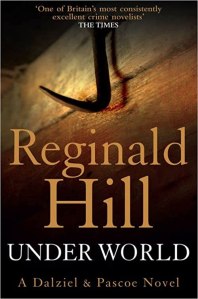
Underworld by Reginald Hill

Rating: 5 out of 5.

Deadheads is the 10th Dalziel and Pascoe novel first published in 1988, set in the small mining town of Burrthorpe (a fictional town) in Yorkshire. The setting is excellent and Hill paints a compelling account of the mining community and gives a convincing insight into the period a few years after the Miners’ Strike of 1984. The majority of the book is about the miners, their families, their hatred of the bosses, and their distrust and dislike of the police.

There are two mysteries facing Dalziel and Pascoe. One is current and the other is a case that had appeared to have been resolved several years earlier, when Tracy Pedley, a young girl disappeared. Her body was never discovered and some of the residents believed that Billy Farr, who was the last person to see her alive, was responsible for her death. But then Donald Pickford committed suicide leaving a letter confessing to killing several young girls in the area and although he hadn’t mentioned Tracy by name, she was counted as a probable victim. Even so, some people still thought Billy was guilty and their suspicions were confirmed when later on it appeared that he committed suicide when he fell to his death in an abandoned mineshaft.

Matters are brought to boiling point when the local newspaper serialises the memoirs of ex-Deputy Chief Constable Neville Whatmough, who had been in charge of the Pickford case. This incenses Colin Farr, Billy’s son. And then another man is found dead in the mine …

Dalziel has just a minor role as Pascoe leads the investigation. Ellie, Pascoe’s wife, also plays a major role. Her involvement comes about when she tutors some of the miners as part of the union-sponsored day release courses and meets Colin Farr, Billy’s son. He is an angry young man and Ellie is attracted both to his intelligence and his physical masculinity, despite the strength of her feminist views. She really is an irritating character, an angry young woman and for most of the book it looked as though the Pascoes’ marriage was about to come to an end. It’s left to Dalziel to bring a touch of humour to the book and his down to earth approach to the miners gets more results than Pascoe’s middle class attempts to understand them.

I thoroughly enjoyed Underworld.

Note:

The title appears as ‘Under World‘ in some editions and as ‘Underworld‘ on others. On the front cover of the paperback I read it is ‘Under World‘ but on the title page it is one word -‘Underworld‘. The Underworld or Hades in ancient Greek and Roman Mythology was where the souls of the dead resided. Hill divides Underworld into three parts and begins each part with verses from Dante’s The Divine Comedy, thus equating the mine with hell.

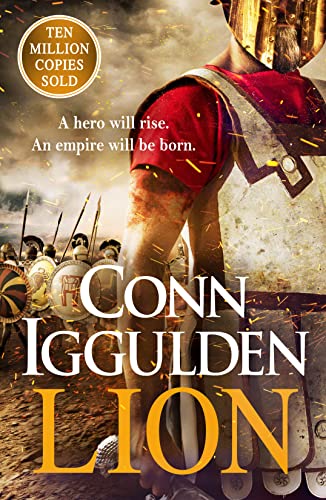
Lion by Conn Iggulden – the First in The Golden Age series

Penguin| 26 May 2022| 416 pages| Review Copy| 4*

Ancient Greece, 5th century BC

The age of myths and legends has given way to the world of men. In the front rank stands Pericles, Lion of Athens.
Behind Pericles lies the greatest city of the ancient world. Before him, on land and at sea, stands the merciless Persian army. Both sides are spoiling for war.

Though still a young man, Pericles knows one thing: to fight a war you must first win the peace

It’s time for a hero to rise.

For his enemies to tremble.

And for Athens, a city of wisdom and warriors, to shine with glory . . .

I was so pleased when I started reading Lion as I realised straight away I was going to enjoy it. It’s been a long time since I read anything set in Ancient Greece, so a lot was new to me, including the characters as well as the historical setting. This is the first book in Conn Iggulden’s Golden Age series set in the 5th century BCE. I thoroughly enjoyed it which surprised me as generally speaking I’m not keen on reading battle scenes and the book starts and ends with battles. But I had no problem with following the action of the battles between the Greeks and the Persians, and was able to visualise what was going on without any difficulty. The characters’ names took me a little while to get clear in my mind but I soon got used to them.

The two main characters are both young men, Cimon the older of the two has more authority than Pericles, the younger man. Lion is the story of their early careers. Iggulden covers the capture of Eion under Cimon’s leadership of the Delian League, an alliance of Greek states, and of Scyros where Cimon found the bones of Theseus and returned them to Athens. He then captured Cyprus and destroyed a Persian fleet on the Eurymedon River. Below the age of thirty little is known of Pericles’ life, but the likelihood is that he was with Cimon for these events.

The middle section of Lion forms an interlude between the battles and is about Pericles’ marriage to Thetis, and his involvement in the theatre in Athens and the Festival of Dionysus. Pericles was the ‘choregos’ (producer) of Aeschylus’ plays made up of three tragedies and a ‘satyr’ play. I found this part of the book just as fascinating as the battle scenes.

Iggulden adds a useful historical note and recommends reading Pericles: a Biography in Context by Thomas R Martin for more information.

The next book in the Golden Age series is Empire, which will be released on May 25, 2023.

My thanks to the publishers for a review copy via NetGalley.

The Lord of the Rings by J R R Tolkien

Last year I began re-reading The Fellowship of the Ring by J R R Tolkien and when I finished it I had to carry on with the other two books of the The Lord of the Rings trilogy. They were first published between 1954 and 1955. I first came across it at the library when I was a teenager. I loved it so much that I decided I needed to buy my own copy for myself and have since read the trilogy several times. The three books are The Fellowship of the Ring, The Two Towers and The Return of the King. Imagine my delight when I went to college and found that so many of the students on my course also loved the trilogy and I read it all again and could talk about it with the others.

What follows is not a review. It is some of my thoughts on reading this epic fantasy story about the quest undertaken by Frodo and the Fellowship of the Ring to destroy the One Ring of Power in the Mountain of Fire, Mount Doom in Mordor and thus prevent the Dark Lord, Sauron from conquering Middle-earth.

Re-reading The Lord of the Rings, I was delighted to find that it had lost none of the magic I found the first time. It is one of my all time favourite books and this time round I was struck by Tolkien’s world building and his powers of description of the characters and the locations, but most of all by Tolkien’s storytelling – superb. I read it slowly, taking my time over it, just a small section each day – letting the story soak into my mind.

The members of the Fellowship are Gandalf the Grey, a wizard; the hobbits Frodo, Merry, Pippin, and Sam; Gimli the Dwarf; Legolas the Elf; Boromir of Gondor; and a tall, mysterious stranger called Strider (later revealed as Aragorn, the heir of Isildur, an ancient King of Arnor and Gondor). And there’s a whole host of other characters.

Alongside my reading I also watched Peter Jackson’s three films, adaptations of the trilogy. When I watched these when they first came out I wasn’t surprised that they didn’t live up to my visualisation of the characters, except that Ian McKellen was just perfect as Gandalf, or of the locations, beautiful as the locations in the films are, Lothlorien is nowhere nearly as magical as I had imagined from reading the book. But the main difference I noticed this time is that the book is very descriptive, going into great detail about the routes of the journeys, of the places and of the characters, it is very long – The Fellowship of the Ring alone took me a month to read. Whereas the films are very much action movies with long and violent battle scenes, against the backdrop of the locations and the running time of each one is approximately three hours – with the extended versions being even longer.

So, inevitably there are changes from the books rearranging the sequence of events in places and cutting scenes – most notably for me the hobbits’ meeting with Tom Bombadil, one of my favourite episodes. Tom is a nature spirit and like the wizards he appears like a man. I loved that episode – when Tom rescued Merry and Pippin from Old Man Willow, the malevolent tree in the Old Forest that had grabbed them and enclosed them within the folds of his trunk. He lives in the Old Forest, near the Barrow-downs, with his wife Goldberry, ‘Daughter of the River’. Goldberry says he ‘He is the master of wood, water, and hill.‘ He has lived in Middle Earth from its earliest days and when Frodo asks him who he is he says

Eldest, that’s what I am. … Tom was here before the river and the trees; Tom remembers the first raindrop and the first acorn. He made paths before the Big People, and saw the little People arriving. He was here before the Kings and the graves and the Barrow-wights. When the Elves passed westward, Tom was here already, before the seas were bent. He knew the dark under the stars when it was fearless – before the Dark Lord came from Outside. (page 171)

Other characters and episodes that stand out for me are:

Frodo and Sam, two hobbits. I prefer to think of them both as they are in the books, rather than in the films, because the actors are totally different from how I first visualised the characters. Frodo was adopted by Bilbo Baggins, a distant relative and lived with him at Bag End as his heir and so he inherited Bag End and the One Ring. He and Bilbo shared the same birthday and the same party to celebrate Bilbo’s 111th birthday and Frodo’s coming of age birthday at the age of 33. On his 50th birthday Frodo left Bag End with Sam, his gardener, beginning his quest to destroy the One Ring. So, the depiction of the hobbits by the actors wasn’t right at all, they are far too young, and I had to remember that the films and the books are two separate creations (but it still rankles).

My favourite characters, in no particular order, are Gandalf the Grey, later known as Gandalf the White, especially his battle with the Balrog at the Bridge of Khazad-dûm, Strider/Aragorn, Gollum, all the Elves and the Ents.

This post is left over from last year when I stopped writing it just before I went into hospital and I have now finished it. I had intended it to be more detailed but it was not to be …

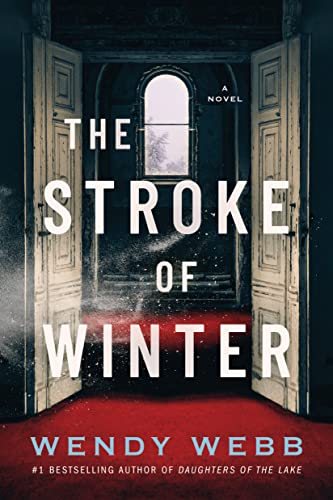
The Stroke of Winter by Wendy Webb

Lake Union| 1 November 2022 | 300 pages| e-book edition| My own copy| 2.5*

She’s restoring the old family home on the hill. And unearthing something evil.

In the tourist town of Wharton, on the coast of Lake Superior, Tess Bell is renovating her old family home into a bed-and-breakfast during the icy dead of winter…

As the house’s restoration commences, a shuttered art studio is revealed. Inside are paintings Tess’s late grandfather, beloved and celebrated artist Sebastian Bell, hid away for generations. But these appear to be the works of a twisted mind, almost unrecognizable as paintings she and others familiar with his art would expect. The sinister canvases raise disturbing questions for Tess, sparking nightmares and igniting in her an obsession to unearth the truth around their origins.

What evil has been locked away for so many years? The ominous brushstrokes, scratching at the door, and moving shadows begin to pull Tess further and further into the darkness in this blood-chilling novel of suspense by the #1 Amazon Charts bestselling author of The Keepers of Metsan Valo.

I haven’t read any of Wendy Webb’s books, but I liked the blurb so I got an ebook through Amazon First Reads. I didn’t know what to expect but I was rather disappointed. It is easy to read, almost too easy in a simplistic style in which actions such as getting items out of the fridge are described in detail. In fact it is so detailed that all the rooms in the house are described, along with all the furniture and furnishings. It is a mix of genres – a cozy mystery, a haunted house/ghost story with some creepy scenes, a horror story, a romance and a recipe book. There is lots of unnecessary repetition as various events are described over and over again and the ending is rushed.

Its good parts are that I liked the setting in the fictional town of Wharton on the shores of Lake Superior and despite my disappointment in the writing style I liked the plotline centered on Amethyst (known as Tess) Bell’s family and their family home. So I wanted to read on to find out what was going on, just what was making the scratching noises Tess hears in the middle of the night and what is the secret of the large room that had been closed off, the door permanently bolted and the windows shuttered in black? It had been like that as long as Tess could remember.

The Girl Who Died by Ragnar Jonasson, translated from the Icelandic by Victoria Cribb

Penguin| 3 June 2021| 328 pages| Review Copy| 3*

‘TEACHER WANTED AT THE EDGE OF THE WORLD . . .’

After the loss of her father, Una sees a chance to escape Reykjavík to tutor two girls in the tiny village of Skálar – population just ten – on Iceland’s storm-battered north coast.

But city life hasn’t prepared her for the unforgiving weather nor inhospitable village life. Worse, the creaky old house where she lives is playing on her already fragile mind when she’s convinced she hears the ghostly sound of singing.

Then, at midwinter, a young girl is found dead.

And one of the villagers must have blood on their hands . . .

The Girl Who Died is Icelandic noir, a mix of horror and psychological thriller, with a strong sense of place. Skálar is a close-knit community that doesn’t welcome newcomers, keeping its secrets well hidden. The only person who welcomes Una, to the village is Salka, the mother of Edda, one of the two girls Una is to teach. But even her welcome is short lived.

When Una arrived she had the feeling that it was like being a folk tale, an ominous supernatural tale set in a vague shifting world where nothing was solid or real, almost like a ghost town. The feeling grows stronger when she sees a little girl with long, pale hair in the window of Salka’s house – but Salka tells her that Edda was in bed. Later she discovers that the ghost of a young girl who had died fifty years earlier was said to haunt the house.

The supernatural elements of the story and the dark brooding atmosphere add to the mystery, but it is not quite as creepy or chilling as I’d thought it would be, mainly because of the slow plodding pace. Also I’m in two minds about Una as I really didn’t find her a very interesting character. And I began to care less and less about what was happening to her. Overall I found it a bit disappointing, and I found the ending puzzling.

However, the Author’s Note is interesting. Jonasson explains that Skálar is a real place. But it was abandoned in the mid 1950s, so the setting is real, but the buildings and the characters are fictitious. However, he has tried to give an accurate representation of the history of Skálar that describes in the book. He has also used the folk tales in Sigfús Sigfússon’s collections of Icelandic tales and legends.

My thanks to the publishers for a review copy via NetGalley.

Ghost Walk by Alanna Knight

The 4th book in Alanna Knight’s Rose McQuinn historical crime fiction series, Ghost Walk is set in 1897 mainly in Eildon, a village in the Scottish Borders.

Three years have passed since Rose McQuinn’s husband, Danny, disappeared in Arizona, whilst working for Pinkerton’s Detective Agency. During that time she has become a Lady Investigator and is about to marry her lover, Detective Inspector Jack Macmerry of the Edinburgh Police. But when a nun from the local convent claims to have received a letter from Danny she is anxious to find out if he is still alive. Rose hopes Danny’s older relative, Father McQuinn, a priest living in the village of Eildon in the Scottish Borders will be able to tell her more.

Rose lives in Solomon’s Tower, a (fictional) tower at the foot of Arthur’s Seat, an old volcano in Edinburgh. A mysterious deerhound, Thane lives somewhere on Arthur’s Seat and often accompanies her. There is a deep bond between the two of them and he often seems to read her mind and understand when she is in danger. As the novel begins Rose and Thane go to Eildon, to meet her future in-laws, just before the wedding, which will also give her an opportunity to talk to Father McQuinn. However, before she can ask him about Danny, he dies under mysterious circumstances and Rose becomes convinced that both his death and that of his housekeeper are in fact murders.

But the main focus of this book is not the murder mystery, nor the suspicions about a Fenian plot to assassinate Queen Victoria during the Jubilee celebrations, but the relationships between Rose and Jack, who has to stay in Edinburgh to testify at a trial, and also between Rose and Jack’s parents, particularly his mother who refuses to acknowledge that Rose is a widow. It also highlights the position of women in a country village during that period. I wanted to know more about Thane, particularly his role at the end of the book – how did he escape with his life?

I liked Rose for her determination to discover the truth and her persistence in being a Lady Detective, despite much opposition. There are nine books in the Rose McQuinn series. I’ve read the first one as well as Ghost Walk and hope to read the others to find out more about her.

  • Publisher ‏ : ‎ Allison & Busby (6 Sept. 2012)
  • File size ‏ : ‎ 537 KB
  • Print length ‏ : ‎ 288 pages
  • My own copy
  • Rating: 3*