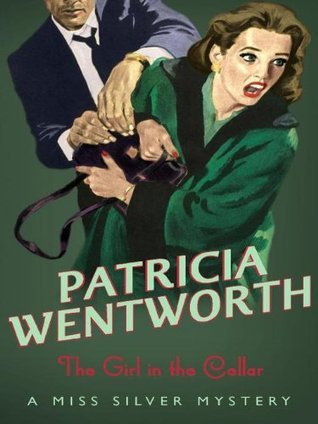
The Girl in the Cellar by Patricia Wentworth

I’m falling behind with reading for my 20 Books of Summer Challenge as I didn’t read any of them in July. I decided to read one of the shorter books to get back into the swing of the challenge and chose The Girl in the Cellar, a Miss Silver Mystery first published in 1961, by Patricia Wentworth (1878 – 1961). I wrote about the opening paragraph in this First Chapter, First Paragraph post.

It begins well as the main character finds herself in the dark in a cellar, not knowing who she is or how she got there. She is standing on the cellar steps and there is a dead girl lying at the bottom of the steps. She doesn’t recognise the dead girl either. She finds a bag beside her on the steps, which she doesn’t think is hers, but takes it with her as she escapes from the house and finds herself standing at the end of a road. She gets on a bus where she meets Miss Silver, who seeing how confused and frightened she is, takes her for a cup of tea and offers to help her. A letter in the handbag is addressed to Mrs James Fancourt and it seems that her name is Anne and she is to stay with her husband’s two aunts.

I think the opening of the book is the best part, setting up a scene of suspense and mystery. For most of the book Anne is suffering from amnesia but there is so much repetition of what little facts Anne knows that it became tedious reading, because it’s not just Anne who goes over and over what has happened but other characters too. I think the repetition lessened the sense of suspense, and overall, I thought the book was odd and not very convincing. There are too many coincidences, improbabilities, and loose ends.

This is the last of the Miss Silver Mysteries, published in the year Patricia Wentworth died. The first in the series was published in 1928. Miss Maud Silver is a retired governess who became a private investigator. She likes to help young lovers in distress – in The Girl on the Cellar, a ‘damsel in distress’ and she loves to knit and is a very sympathetic listener. I’ve only previously read one of the Miss Silver books, The Brading Collection, which is a much more convincing book.

As well as the 20 Books of Summer Challenge, this book qualifies for  Bev’s Vintage Mystery Cover Scavenger Hunt in the category, ‘Damsel in Distress’.

First Chapter, First Paragraph: The Girl in the Cellar

First chapterEvery Tuesday Diane at Bibliophile by the Sea hosts First Chapter First Paragraph Tuesday Intros to share the first paragraph sometimes two, of a book that she’s reading or planning to read soon.

I didn’t read any of my books for the 20 Books of Summer Challenge in July, so I’ve got some catching up to do. One of the shorter books on my list is The Girl in the Cellar by Patricia Wentworth, in which Miss Silver helps Anne, who has lost her memory, but who thinks she has witnessed a murder.

It begins:

She looked into the dead unbroken dark and had neither memory nor thought. She was not conscious of where she was, or of how she had come there. She was not conscious of anything except the darkness. She did not know if time had passed. There seemed to be no sense that it went by, but it must have done, because the moment when she knew nothing but darkness had changed into a moment in which she knew that her feet were on stone, and that she must not move from where she stood.

Blurb:

A young woman regains consciousness and finds herself on some cellar steps. At the bottom of the steps there is the corpse of a dead girl. She cannot remember who she is, what has happened or why she is there. Terrified and confused she manages to find a way out and as she flees she runs into Miss Silver, who offers to help her.

A letter in her bag is the only clue to her identity. But by investigating what has happened to her will she find herself in danger? Can she trust the letter writer? And who is the girl in the cellar?

This is a Miss Silver Mystery (there are 32 in the series), first published in 1961, the year that Patricia Wentworth died. She was born in India in 1878 and wrote dozens of best-selling mysteries being recognised as one of the ‘mistresses of classic crime.’She died in 1961 and was as popular in the 1940s as Agatha Christie and Dorothy L Sayers. Miss Silver, a contemporary of Miss Marple ‘was her finest creation‘.

What do you think? Would you keep reading? I think this opening paragraph sets the scene well, with the sense of danger and mystery to make me want to know more.

The Spy Who Came in from the Cold by John le Carré

I’ve recently read John le Carré’s biography by Adam Sisman and inevitably it made me want to read le Carré’s books. I decided to start with his third novel, The Spy Who Came in from the Cold, first published in 1963.

Blurb:

a gripping story of love and betrayal at the height of the Cold War. This Penguin Modern Classics edition includes an afterword by the author and an introduction by William Boyd, author of Any Human Heart.

Alex Leamas is tired. It’s the 1960s, he’s been out in the cold for years, spying in the shadow of the Berlin Wall for his British masters. He has seen too many good agents murdered for their troubles. Now Control wants to bring him in at last – but only after one final assignment. He must travel deep into the heart of Communist Germany and betray his country, a job that he will do with his usual cynical professionalism. But when George Smiley tries to help a young woman Leamas has befriended, Leamas’s mission may prove to be the worst thing he could ever have done. In le Carré’s breakthrough work of 1963, the spy story is reborn as a gritty and terrible tale of men who are caught up in politics beyond their imagining.

My view:

This is a dark, tense book and quite short, just 252 pages. It’s complicated and although the language le Carré uses is clear and straight forward at times I wasn’t sure just what was going on, what lay behind the scenes – just what was Leamas up to, amidst the various deceptions and subterfuges? George Smiley does appear briefly in the book, but is there throughout in that he is masterminding Leamas’ mission.

Back from Berlin where he had seen his last agent killed whilst trying to cross the Berlin Wall, Leamas is apparently no longer useful. He goes to seed whilst working out his contact in the Banking Section, transforming into a drunken wreck no longer of use to the Secret Services, left without any money or a job until he finds work as a helper in a library for Psychical Research. Here he meets Liz Gold, who then unwittingly gets drawn into Smiley’s plan.

The atmosphere throughout is of secrecy, manipulation, of human frailty and its duplicitous nature. As the German, Fiedler says for a secret agent:

… deception is first a matter of self-defence. He must protect himself not only from without, but also from within, and against the most natural of impulses; though he earns a fortune, his role may forbid him the use of a razor, though he  be erudite, it can befall him to mumble nothing but banalities; though he be an affectionate husband and father, he must under all circumstances withhold himself from those in whom he should naturally confide. (page 143)

By the end of the book Leamas is in despair as his mission seems to have failed. Liz can’t work out which side he is on and he says:

What do you think spies are: priests, saints, martyrs? They’re a squalid procession of vain fools, traitors too, yes; pansies, sadists and drunkards, people who play cowboys and Indians to brighten their rotten lives. (page 243)

I hate it; I hate it all; I’m tired. But it’s the world, it’s mankind that’s gone mad. We’re a tiny price to pay … but everywhere’s the same, people cheated and misled, whole lives thrown away, people shot and in prison, whole groups and classes of men, written off for nothing. (pages 244-5)

But then again did his mission fail? This is one of those books that I find so hard to write about without giving away too much of the plot – the introduction by William Boyd begins with this statement, ‘New readers are advised that this Introduction makes details of the plot explicit.‘ And indeed it does. I was glad I read it after reading the book, though, as it also gives an interpretation that I found helpful – in particular just what Boyd thought was meant by ‘coming in from the cold‘.

This fulfils the “Broken Object” category on the Silver Vintage Scavenger Hunt card.

Wycliffe and the Quiet Virgin by W J Burley

It’s that time of year again when I have less time for blogging – summer when the grass and the weeds grow in abundance. So what with that and a host of other things this post is shorter than I would like it to be.

I like W J Burley’s Wycliffe books. I’ve read several of them up to now and enjoyed each one. Set in Cornwall, they have a strong sense of place, and Wycliffe is a quiet, thoughtful detective.

In Wycliffe and the Quiet Virgin Chief Superintendent Wycliffe is staying with a Penzance lawyer, Ernest Bishop and his family for a few days over Christmas at the Bishops’ hill-top house. With his wife away in Kenya, Wycliffe is not looking forward to Christmas, and the welcome from the family is polite rather than welcoming. The situation only gets worse when a young girl goes missing after playing the part of the Virgin Mary in the local nativity play, and then her father also goes missing and her mother is found dead in their cottage. Wycliffe moves out of the Bishops’ house as it appears they may be suspects.

What follows is Wycliffe’s investigation which goes back to a crime committed five years earlier, involving many twists and turns. It was a quick and entertaining read with a lot of characters, but all are clearly distinguishable. The plot is complex and it was only as I was getting near the end that I began to have an inkling about the identity of the murderer.

W J Burley (1914 – 2002) lived near Newquay in Cornwall and was a teacher until he retired to concentrate on his writing. He wrote 22 Wycliffe novels. Wycliffe and the Quiet Virgin was the 13th, first published in 1986 and as such fits into Bev’s Vintage Mystery Cover Scavenger Hunt in the Silver Age (Vintage Mysteries first published any time from 1960 to 1989) in the category of ‘Spooky/House’ on its cover. It is also one of my 20 Books of Summer 2016.

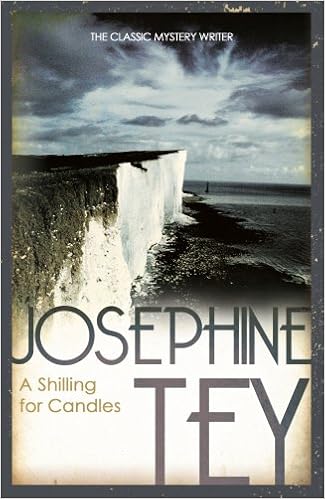
A Shilling for Candles by Josephine Tey

A Shilling for Candles, is the fourth book by Josephine Tey that I’ve read. It was first published in 1936 and is the second book in her Inspector Grant series. I enjoyed it but I have to admit that I don’t think it’s as good as the other books by her that I’ve read, namely:

  • The Daughter of Time, first published in 1951, a fascinating novel in which Inspector Alan Grant is in hospital and to keep his mind occupied he decides to discover whether Richard III really did murder his nephews – the Princes in the Tower;
  • Miss Pym Disposes, first published in 1946, a psychological study of characters and motives, in which Miss Pym investigates the death of a student at a physical training college; and
  • The Franchise Affair, first published in 1948, set in a post Second World War England reflecting the social attitudes of its time and based on a real case from the 18th century of a girl who went missing and later claimed she had been kidnapped.

Inspector Alan Grant investigates the apparent suicide of a young and beautiful film star, Christine Clay, who was found dead beneath the cliffs of the south coast. But he soon discovers that was in fact murder as a coat button was found twisted in her hair and he suspects a young man, Robin Tisdall who had been staying with Christine in a remote cottage near the beach, especially when it is revealed that she has named him as a beneficiary in her will. Tisdall has lost his coat and so the search is on to find it to prove either his innocence or guilt.
But it is not so straight forward and Grant has other suspects – Christine’s aristocratic and wealthy husband, an American songwriter, and her estranged brother to whom she had left the gift of ‘ a shilling for candles’. Then there are her friends, including the actress Marta Hart, a leading lady, Judy Sellers, who played dumb blondes and Lydia Keats, an astrologer who casts horoscopes for the movie stars.

Other characters include my favourite in the book, Erica Burgoyne, the Chief Constable’s 17 year old daughter, a quirky character who proves to be most resourceful.

I enjoyed it but thought that overall it was a bit messy, a bit all over the place, as Grant dashed about the south coast and London. It’s definitely a book of its time with several casual anti-Semitic references and Tey has used a lot of slang and idioms that aren’t so recognisable today. There are red herrings and plenty of twists and turns, all of which meant that although at first I identified the culprit, by the end I had no idea who it was. What I thought was more interesting is the way she wrote about the destructive nature of celebrity and the lengths to which the stars went to keep some privacy in their lives – not so different from today.

This book fits into several of the challenges I’m doing this year – the 20 Books of Summer, Mount TBR Reading Challenge, the Vintage Mystery Scavenger Hunt (in the category of a cover showing a body of water) and the Read Scotland Challenge, because Josephine Tey, whose real name was Elizabeth Mackintosh (1896 – 1952). She was a Scottish author who wrote mainly mystery novels.

Josephine Tey’s books:

Alan Grant
The Man in the Queue (1929) aka Killer in the Crowd
A Shilling for Candles (1936) (the basis of Hitchcock’s 1937 movie Young and Innocent)
The Franchise Affair (1948) 
To Love and Be Wise (1950)
The Daughter of Time (1951)
The Singing Sands (1952)

Novels
Kif: an Unvarnished History (1929) (writing as Gordon Daviot)
The Expensive Halo (1931)
Miss Pym Disposes (1946)
Brat Farrar (1949) aka Come and Kill Me
The Privateer (1952)
Non-Fiction

Claverhouse (1937) (writing as Gordon Daviot) A biography of John Graham of Claverhouse, 1st Viscount Dundee (1648 ‘“ 1689), known as ‘Bonnie Dundee’after leading the Jacobites to victory at the Battle of Killiecrankie in 1689, in which he lost his life.

  • Paperback: 256 pages
  • Publisher: Arrow; First Thus edition (3 Feb. 2011)
  • Language: English
  • ISBN-10: 0099556685
  • ISBN-13: 978-0099556688
  • Source: I bought my copy

Before the Fact by Francis Iles

On the face of it Before the Fact is a straight forward story. It tells the tale of wealthy, intelligent but plain Lina McLaidlaw whose family are against her marriage to the handsome, charming and fascinating Johnnie Aysgarth; Lina’s father tells her Johnnie is a ‘rotter’. But right from the opening paragraph it’s obvious that Lina’s father is right. In fact Johnnie is much worse than her father realised:

Some women give birth to murderers, some go to bed with them, and some marry them. Lina Aysgarth had lived with her husband for nearly eight years before she realized that she was married to a murderer.

First published in 1932 by Francis Iles (* see below*), Before the Fact is a Golden Age crime fiction novel that is a psychological character study of its two main characters, Lina and Johnnie. It’s cleverly written. Lina slowly realises Johnnie’s true nature – that of a compulsive liar and gambler, a manipulative scoundrel who thinks nothing of being unfaithful, even of arranging a murder, or two.  But still she stays with him, trying to control and change him, believing his lies until she has to accept him for what he is, with disastrous consequences.

As Lina’s eyes are slowly opened I became exasperated at her naiveté, her acceptance of what she she has discovered about Johnnie. She comes across as a fool besotted by him and desperate for his love and attention, and even though her suspicions are aroused she still deliberately ignored all the warning signs, descending from panic, terror, horror and despair into passivity. She is maddening, a born victim and I began to wonder how it could possibly end. It was even more chilling than I had imagined.

*About the Author (copied from the publishers):

Frances Iles was a pseudonym of Anthony Berkeley Cox, who was born in 1893 in Watford. After serving in the army during the First World War, Berkeley worked as a journalist for many years before his first foray into the crime genre with The Layton Court Mystery (1925).

His two primary non-de-plumes were Francis Iles and Anthony Berkeley. As the former, he was a master of the psychological suspense genre, always with a wry humorous tenor to his writing; as the latter he acted as a trailblazer in the classic ‘Golden Age’ of crime and detective novels.

An intensely private man who always shunned publicity, Berkeley died in 1971.

As I read I marked a few passages that although not directly connected with the story I found interesting:

About artistic criticism – in particular female criticism:

If one did not happen to like a certain book, picture, or piece of music, one took it for granted that the book, picture, or piece of music was just bad; and the people who thought it was good, were, quite simply and plainly, mistaken. It never occurred to any female critic that a book might possibly be above her own level of intelligence (the men of course read only detective stories). (page 42)

on artists:

‘Aren’t artists intelligent?’ Lina asked innocently.

‘Of course they’re not. Most of them haven’t got the brains of a mouse. They just have this odd knack of being able to put things on canvas, and that’s all. They are the dullest of all the creators. Musicians are the nicest: you never hear a musician talk about himself at all. Then the really good authors. They don’t thrust their work down one’s throat; they’ve no need to. Then the second-rate authors, who do, and have. And then the painters, a long way bottom.’ (page 125)

I wonder who he was referring to?

And on murder:

When you incite a person to do something which both of you know will probably kill him – is that legally murder or not? (page 177)

Lina discusses this point with Isobel Sedbusk (based on Dorothy L Sayers), a writer of detective stories, thinking that it wasn’t ‘real murder, like giving the man poison, or shooting him, or anything like that.’ Isobel replies:

‘No, I’m inclined to doubt whether it would be murder, from the legal point of view. The legal definition of murder is ‘to kill with malice aforethought’. Still, you’ve got the malice aforethought all right. And if he knowingly incited the man to commit an act which would result in his death …’

Malice Aforethought – another novel by Francis Iles (published in 1931) begins with revealing the identity of the murderer. I shall have to read that one soon.

Reading Challenges: