which for me is Moll Flanders by Daniel Defoe. The rules of the Spin are that this is the book for me to read by 29th January 2023.
Synopsis
I grew as impudent a Thief, and as dexterous as ever Moll Cut-Purse was’
Born and abandoned in Newgate Prison, Moll Flanders is forced to make her own way in life. She duly embarks on a career that includes husband-hunting, incest, bigamy, prostitution and pick-pocketing, until her crimes eventually catch up with her. One of the earliest and most vivid female narrators in the history of the English novel, Moll recounts her adventures with irresistible wit and candour—and enough guile that the reader is left uncertain whether she is ultimately a redeemed sinner or a successful opportunist.
I hesitated before adding this book to my Classics Club list and now I’m not sure that I do want to read it. I’m hoping that at least I’ll like it. If you have read it I’d love to know what you thought of it.
Did you take part in the Classics Spin? What will you be reading?
Before next Sunday, 18 September, create a post that lists twenty books of your choice that remain “to be read” on your Classics Club list. On that day the Classics Club will post a number from 1 through 20. The challenge is to read whatever book falls under that number on your Spin List by 30 October, 2022.
Here’s my list:
Sense and Sensibility by Jane Austen
Another Part of the Wood by Beryl Bainbridge
In Cold Blood by Truman Capote
The Case of the Gilded Fly by Edmund Crispin
The Stars Look Down by A J Cronin
Moll Flanders by Daniel Defoe
Nicholas Nickleby by Charles Dickens
The Lost World by Arthur Conan Doyle
The Black Tulip by Alexandre Dumas
The Birds and other short stories by Daphne du Maurier
Strangers on a Train by Patricia Highsmith
Brave New World by Aldous Huxley
Daisy Miller by Henry James
Go Set a Watchman by Harper Lee
How Green Was My Valley by Richard Llewellyn
Fire from Heaven by Mary Renault
On the Beach by Nevil Shute
Tortilla Flat by John Steinbeck
The Invisible Man by H G Wells
Between the Acts by Virginia Woolf
I don’t mind which one is picked as I’m aiming to read all of them in due course! But which one/s would you recommend?
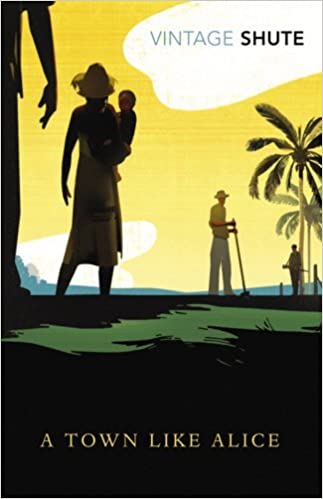
First published in 1950 A Town Like Alice by Nevil Shute is one of those books I’ve been meaning to read for years and now I have at last read it. It was not quite what I had imagined it to be, about Alice Springs in Australia. It is actually set in three parts, with just the third part set in Australia, not in Alice Springs but in Willstown, a fictional town in the outback.
Narrated by Noel Strachan, a solicitor, this is the story of Jean Paget. It begins a few years after the Second World War, when he tells her she has inherited a considerable sum of money from her uncle. But it is held in trust until she reaches the age of thirty five. Until then she will receive about £900 a year to spend. She wonders what to do with the money and eventually decides she wants to go back to Malaya, where she had been a prisoner of war, to dig a well. She tells Noel about what had happened to her in Malaya.
The second part is about that time in Malaya during the War at the time when the Japanese invaded the island. Jean and a group of European women and children were forced by the Japanese to walk for hundreds of miles from place to place before finally managing to stay in one village. Able to speak Malay and being courageous and resourceful, she takes on the role of the leader of their group. She met an Australian soldier, Sergeant Joe Harman, also a prisoner, who was driving a lorry for the Japanese and they became friends with disastrous consequences. This section is the best in the book to my mind.
On her return after the War she writes to Noel telling him how she set about organising the villagers to dig the well so that the women would have fresh water close to their houses and also build a washing-house. And it is here that she learns more about what had happened to Joe and decides to carry on travelling to Australia to find him and thank him for the help he had given her and the other women.
The third part is set in Australia. Jean is an organiser and on her arrival in Willstown she discovers that this is a place where the young women leave as soon as they are old enough. There are no jobs or entertainment to keep them there. So Jean decides she wants to make the town into a town just like Alice Springs. And she does this with remarkable success building a workshop for the girls to make shoes and handbags, providing an ice cream parlour and a public swimming pool and shops. At the same time her search for Joe is eventually successful. She continues writing to Noel about her life in the Australian outback, letters full of detail about her enterprises and the difficulties of cattle ranching in such isolated places – a bit too much detail for me really. But the episode where Jean helped in rescuing an injured stockman is full of drama.
This is really just the bare bones of the story – there is so much more to it than that. Others have commented on the casual racism in the book. It tells it as it was, how people lived at the time, and reflects the attitudes that people had. Jean is of course the main character, a woman somewhat ahead of her time with great strength of character, determination and entrepreneurial skills. The resourcefulness she showed in Malaya is developed in Australia.
In his Author’s Note Shute explains that the forced march during WW2 took place in Sumatra and not in Malaya and the women in the group were Dutch and not British. As in his novel, the local Japanese commander was reluctant to assume responsibility for these women and, to solve his problem, marched them out of his area and took them on a trek all around Sumatra that lasted for two and a half years.
Jean Paget was based on Mrs Geysel, whom Shute had met when he visited Sumatra in 1949. She had been one of the Dutch party, then aged 21, recently married and with a young baby she had carried for over twelve hundred miles around Sumatra. A remarkable story that I really enjoyed.
which for me is The Mousetrap and Other Plays by Agatha Christie and I am delighted as this is a book I’ve wanted to read for years!. The rules of the Spin are that this is the book for me to read by 7th August, 2022.
Synopsis from the book:
These four gripping plays by the undisputed Queen of Crime, here published for the first time in book form, provide yet more evidence of her mastery of the domestic thriller. Agatha Christie’s talents as a playwright are equal to her skills as a novelist and reading her plays, with their ingenious plots and colourful cast of characters, is every bit as pleasurable.
The Mousetrap has made history by becoming the longest running play ever. And Then There Were None was another huge theatrical success and was made into a superb film by Rene Clair. The two remaining plays were both adapted by Agatha Christie from her earlier novels: The Hollow, set in the English countryside and Appointment with Death, set among the exotic ruins of Petra in the suffocating heat of the Jordan desert.
Agatha Christie dramatised many of her own stories and frequently devised new twists of plot and character to surprise and enthrall her audience.
The Mousetrap opened in London’s West End in 1952 and ran continuously until 16 March 2020, when the stage performances had to be temporarily discontinued during the COVID-19 pandemic. It then re-opened on 17 May 2021. It’s set in a guest house, Monkswell Manor, wintertime “in the present day”, that is the early 1950s. The play has a twist ending, which the audience are traditionally asked not to reveal after leaving the theatre, so I’ll be limited in what I can write about it.
Did you take part in the Classics Spin? What will you be reading?
Before next Sunday, 12 June, create a post that lists twenty books of your choice that remain “to be read” on your Classics Club list. On that day the Classics Club will post a number from 1 through 20. The challenge is to read whatever book falls under that number on your Spin List by 7 August, 2022.
Here’s my list:
Sense and Sensibility by Jane Austen
Another Part of the Wood by Beryl Bainbridge
In Cold Blood by Truman Capote
The Awakening by Kate Chopin
The Mousetrap and Selected Plays by Agatha Christie
The Case of the Gilded Fly by Edmund Crispin
The Stars Look Down by A J Cronin
Moll Flanders by Daniel Defoe
Nicholas Nickleby by Charles Dickens
The Black Tulip by Alexandre Dumas
The Birds and other short stories by Daphne du Maurier
Strangers on a Train by Patricia Highsmith
Brave New World by Aldous Huxley
Go Set a Watchman by Harper Lee
How Green was My Valley by Richard Llewellyn
A Town Like Alice by Neville Shute
On the Beach by Nevil Shute
Tortilla Flat by John Steinbeck
The Invisible Man by H G Wells
Between the Acts by Virginia Woolf
I don’t mind which one is picked as I’m aiming to read all of them in due course! But which one/s would you recommend?
Edited on June 9, because I’ve just realised I’ve included A Room with a View which I’ve read – it was my Classics Club Spin book from the last Spin! I just copied the previous list (with a few alterations) and didn’t realise it was still on the list. I’ve now removed it and added The Awakening by Kate Chopin instead.
The Life and Adventures of Martin Chuzzlewit is my last book to review on my first Classics Club list. I read this in December 2017 and didn’t write a post, mainly because it was during the Christmas/New Year period, a busy time. All I recorded was this: ‘It is long, starts very slowly and then gets more interesting, with great characters and some comic and satirical episodes. It’s a study of selfishness and hypocrisy.’
From the back cover of my paperback copy:
Moving from the sunniest farcicality to the grimmest reaches of criminal psychology, Martin Chuzzlewit is a brilliant study in selfishness and hypocrisy.
The story of an inheritance, it relates the contrasting destinies of the two descendants of the brothers Chuzzlewit, both born and bred to the same heritage of selfishness, showing how one, Martin, by good fortune escapes and how the other, Jonas, does not – only to reap a fatal harvest. Peopled with Dickens immortals as Mrs Gamp, Poll Sweedlepipe, Montague Tiggs, Chevy Slime, it is one of Dickens’ great comic masterpieces.
It was Dickens’ sixth novel, serially published in 1843-44, and was something of a flop, with a dramatic decline in sales, compared to his early books. I can understand that because it’s not one of my favourites of his books. It is too long – over 900 pages in my Penguin Classics edition. I stuck with it as I had previously enjoyed watching the 1994 TV Mini Series with an excellent cast including Paul Schofield, Keith Allen, Julia Sawalha, Ben Walden, and Lynda Bellingham amongst others.
In this case I think the TV adaptation scores over the novel, which dragged in parts for me. It is a satire, a black comedy, a romance of the sickly sentimentality sort, a story of blackmail and murder, that involves hypocrisy, greed and selfishness.
I thought the section set in America where young Martin went to seek his fortune was overdone and it became tedious. It seems that Dickens had not enjoyed his own visit to America in 1842 as in this section he mocks what he disliked about America – the corrupt newspapers, slavery, the violence, obsession with business and money and so on and so forth. I was glad when young Martin returned to England.
But I enjoyed the comic characters – the drunken nurse of sorts, Mrs Gamp and her invisible friend, Mrs Harris, and Sam Pecksmith, the scheming architect. The Pecksmith family’s visit to London is hilarious. These characters saved the book for me. Mrs Gamp is one of the most bizarre characters with her mispronunciations and monologues recounting her conversations with her imaginary friend Mrs Harris. Her speciality lies in the polar extremities of life, birth and death:the lying in and the laying out.