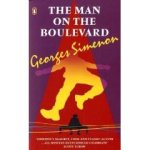
I borrowed The Man on the Boulevard by Georges Simenon, translated by EileenEllenbogen, from my local library. It is the third Maigret book I’ve read in the past few months and all the way through I was thinking this was the best of the three, until the end that is. It has a puzzling murder to solve – Louis Thouret is found stabbed in a little alleyway. Seemingly a perfectly ordinary man of regular habits who leaves his home in the suburbs to go to his job as a storekeeper in Paris for the past twenty five years. His wife is surprised to find he was wearing light brown shoes because he always wore black, a flamboyant tie unlike the one he normally wore and that there were two cinema tickets in his pocket as well as more money in his wallet than he normally carried with him.
So it turns out that Louis has a double life that his wife knows nothing about. It appears he has been having an affair and for the past three years he has not had a job, so how has he managed to bring home his monthly salary? Where does he change his shoes every day and why? It’s the shoes that set Maigret on the right track to solving the mystery. The book was originally called Maigret et l’homme du banc or Maigret and the man on the bench – it just so happened that Louis spent part of the day sitting on a bench talking to an unknown man, ‘the sort of person who sits on benches’ and that forms another important clue.
There were lots of things I liked in this book – the attention to detail, the descriptions of the weather (cold and wet), and the characters themselves. It’s set in Paris and without knowing the location of the various boulevards I could still get a good impression of the city and its suburbs. I liked the theme of a man following a double life and the way Louis resolves his problem of keeping up appearances with his wife and family although I thought his method of maintaining his income was rather implausible.
Maigret and his colleagues gradually discover Louis’s secrets and I was beginning to wonder just where this was taking me as I couldn’t work out who had killed him. I really had no idea who it could be. And then the book was spoiled for me by the abrupt and unsatisfactory ending. The culprit was someone who hadn’t been mentioned at all. It was such an anti-climax as though Simenon just ran out of inspiration.


 BooksPlease