Saturday Snapshot

This is the Bell Tower at the northern side of Berwick-upon-Tweed, the most northerly town in England. It was built about 1577, replacing a 14th century tower on the medieval walls of the town. There used to be a warning bell in the tower that sentries would sound at the sight of danger to the townspeople. At one time there used to be a beacon on top, which could be lit if the country was invaded.

These days it’s an odd sight on a grassy mound at the end of a residential road.

But in earlier days it was in a prime position overlooking the sea, the fields and the town. Nearby is Lord’s Mount, a fort built in  around 1540 during Henry VIII’s reign. It was orginally on two floors but all that remains are parts of the ground floor and you can see fireplaces, a flagged kitchen floor, a well and a privy.

There used to be guns mounted on the parapet and I climbed what was left of the steps to see the view. I didn’t venture on to the top; it was very windy and I don’t have a head for heights!

Photos taken September 2011.

For more Saturday Snapshots see Alyce’s blog At Home With Books.
I Never Knew That About England by Christopher Winn

I came across I Never Knew That About England by Christopher Winn, soon after I decided to read my way around Britain in my Britain in Books project. This book is a collection of stories ‘that have England as their backdrop’.

It’s arranged alphabetically by the 39 traditional counties of England, so it fits in very well with my project. Winn writes in his preface that he has made every effort to get the facts right, but notes that many of the stories

are not eternal truths but have been handed down through time, sometimes by word of mouth only. Details can vary according to different sources, but the essential substance and essence remains. (page 7)

The book is a miscellany of stories, anecdotes and a ‘smattering of fascinating facts and figures.’  I’m going to dip into it every now and then and post little snippets as they appeal to me, starting with my home county of Cheshire.

Cheshire - click on image to enlarge

Cheshire is in the north-west of England, bordering Wales. Readers of Mrs Gaskell know that Cranford is based on the town of Knutsford, but what I never knew is that the village of Mobberley, near Knutsford, where one of my aunties lived, is the birthplace of George Mallory (1886 – 1924), the mountaineer who died attempting to climb Mount Everest. His father was the Rev. Herbert Leigh Mallory, the rector of Mobberley and it is said that he practised climbing up the church tower. I found this article in the Knutsford Guardian about the family home, Hobcroft House.

When asked why he wanted to climb Everest, Mallory replied: ‘Because it’s there’. It’s never been discovered whether Mallory did reach the summit. The camera Mallory and his companion Sandy Irvine took with them as they set out to make it to the top has never been found. Irvine’s body too has never been discovered, but in 1999 Mallory’s body was found on the North Face, 1,000 feet below the summit. There is a memorial window in the St Wilfrid’s Church dedicated to Mallory, inscribed:

lost to human sight between earth and heaven

Saturday Snapshot

I’ve been reading Joan Leegant’s novel Wherever You Go, which is set in Israel and America. I’ll be writing about this book, which I really liked in a future post. It reminded me of our visit to Israel in 1993, so I got out the photo albums and here are just a few:

First a sight of camels on the skyline – photo taken from the coach on the way to Jerusalem.

Then a view of Jerusalem showing the Dome of the Rock, but not the usual view of the golden dome because this was in 1993 when the covering was being refurbished. It was covered with scaffolding all around it!

The Chagall Windows get a brief mention in Wherever You Go, when one of the characters talks of them disparagingly – Mariah the self-appointed arbiter of taste saying to Yona, one of the main characters:

I suppose you’ll go see the Chagall windows in the famous hospital in Jerusalem, Mariah had sniffed, the legendary artist deemed by the gallery crowd to be the painterly equivalentof Fiddler on the Roofall mush and sloppy sentimentality, colorful art, like colorful clothes, against the law. (page 122)

The beautiful Chagall Windows in the Synagogue of the Hadassah Medical Centre were on our tour and I loved them. You couldn’t take photos inside but here is one of the outside:

I bought a tapestry canvas of one of the windows, Zebulon, whilst I was there. I still haven’t bought the wool to actually stitch the tapestry! I’d love it to look something like this when I’ve stitched it:

The whole visit was very memorable, and we have loads of photos, but one in particular was very special – the Yad Vashem Memorial. The photo shows the statue at the entrance to the Children’s Memorial in an underground cavern. You go down into a dark chamber where candles are reflected so it seems as though you are lost in space surrounded by stars:

Maybe sometime I’ll post more photos of our visit.

Saturday Snapshot is hosted by Alyce on her blog At Home With Books.

Saturday Snapshot

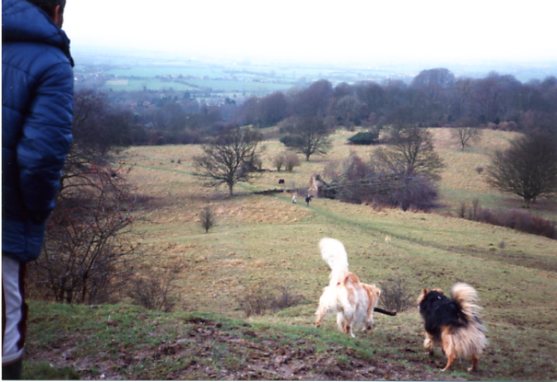
I’m stepping back in time again this week for my Saturday Snapshot, but not quite as far back as last week. This is a photo of the two dogs we used to have, enjoying running for a stick in the Chiltern Hills, near our home at that time, in Great Kimble in Buckinghamshire. We were on the footpath below Pulpit Wood looking down on the old rifle range.

Zoe is the golden retriever, who always had to get the stick first with Ben, the border collie cross following on behind.

Saturday Snapshot is hosted by Alyce of At Home With Books.

Favourite Places – Bath

For today’s Favourite Places post I’m featuring Bath. For more Favourite Places see Margot’s blog Joyfully Retired.

The last time we have Bath was just over three years ago, when we had a weekend there. There is a lot to see in Bath and we only managed to go to a few places – the main one being the Roman Baths.

We stayed here:

and walked into the centre of Bath, down Great Pulteney Street, passing this Victorian pillar box:

We walked over Pulteny Bridge and looked down on the River Avon and the weir:

Here is Bath Abbey, where Edgar was crowned King of the English in 973:

*

*Added after first posting:

There have been three churches on the site of Bath Abbey – the first was an Anglo-Saxon church dating from 757, destroyed by the Normans after 1066. The present Abbey church was founded in 1499 and completed in 1611.*

Visting the Roman Baths was the highlight of our weekend. We could have stayed in there all day, with so much to look at. 


Here is the underfloor heating.

Although we were footsore after walking round the Baths we managed to go to the Fashion Museum, which is housed in the Assembly Rooms

and after looking at the displays of fashion dating back to the eighteenth century

we wandered round the Ball Room, imagining what it was like on ball nights during Jane Austen’s time and then had a cup of coffee in the Assembly Rooms cafe.