It’s Tuesday – Where Are You?/Teaser Tuesday

tuesdaywhereareyou

Today I’m in Paris in the 1860s with the Impressionists. Paris is overrun with art students  wanting to exhibit their paintings in the annual exhibition in the Salon des Beaux Arts. Today it’s 17 May 1863 and everyone is crowded into the exhibition of rejected works called the Salon des Refuses, where people are shocked by the paintings, jeering and hooting with laughter. But the painting that has completely stolen the show is Edouart Manet’s Le Dejeuner sur l’herbe.

It’s Tuesday – where are you? is hosted by raidergirl3.

Now the teaser (tteaser-tuesdayo see more teasers click on the button). The ‘official rules’ are to select a page at random in the book you’re currently reading and pick two sentences between lines 7 and 12. My teaser is a bit longer than two sentences, not random and not from lines 7 – 12. It’s from page 28 of Sue Roe’s The Private Lives of the Impressionists. 

Edouard Manet, who had exhibited at the Salon before, was this year exhibiting a monstrosity. Everyone stared in horror at Le Dejeuner sur l’herbe, an outrageous depiction of a naked woman, brazen and unashamed, staring straight out at the viewer and seated on a riverbank between two clothed men. Behind her, a second, lightly draped woman, up to her ankles in water, stoops in the distance. This bold display was shocking enough in itself, but what really astounded the public was the modernity of the scene. The men were grouped casually, in modern dress: the painting seemed to be about the present day.

It wasn’t the nudity that was shocking, but the casual style and the fact that the painting looks so real. It was seen as “an obscene, provacative taunt, doubly shocking by virtue of its ordinariness.” The critics complained that Manet appeared to have no sense of harmony, light or shade and thought that the colours were brash and harsh – garish and jarring!

I don’t think so – what do you think?

le-dejeuner-sur-lherbe-manet

The Pre-Raphaelites

The Pre-Raphaelite Brotherhood was first formed in the summer of 1848. From the start their work had no common denominator – the painters called “Pre-Raphaelites” were all individual and their paintings show great contrasts. Pre-Raphaelitism cannot be defined; there are as many differences between the paintings as there are similarities. The original members of the Brotherhood were James Collinson, William Holman Hunt, John Everett Millais, Dante Gabriel Rossetti, William Michael Rossetti, Frederick Stephens and Thomas Woolner. Other artists became more or less loosely associated with the movement.

This isn’t a post about art history or about individual artists. I just wanted to record some of my favourite paintings that can be defined, somewhat loosely in some cases, as Pre-Raphaelite.  I love looking at these, mainly for the colour and style of the paintings. In no particular order of preference they are as follows.

Millais Ophelia blog

Ophelia by John Everett Millais 1851 – 1852, showing the drowned Ophelia from Hamlet. This reproduction doesn’t do justice to the original, which is held by the Tate Britain, currently part of the Millais Exhibition on display in Japan -in the Kitakyushu Municipal Museum of Art from 7 June to 17 August 2008, and The Bunkamura Museum of Art, 30 August to 26 October 2008. For more infomation click here. I particularly like the detail in Ophelia’s dress and flowers which are all symbolic.

William Dyce blog
Pegwell Bay, Kent, a Recollection of October 5th, 1858 by William Dyce 1859 – 1860, (Tate Britain). The figures in the foreground are members of Dyce’s family, dwarfed by the chalk cliffs behind. Again it’s the detail and colour that I love in this painting. It doesn’t show in the reproduction below but in the sky is the trail of Donati’s comet.
Rossetti_beata beatrix

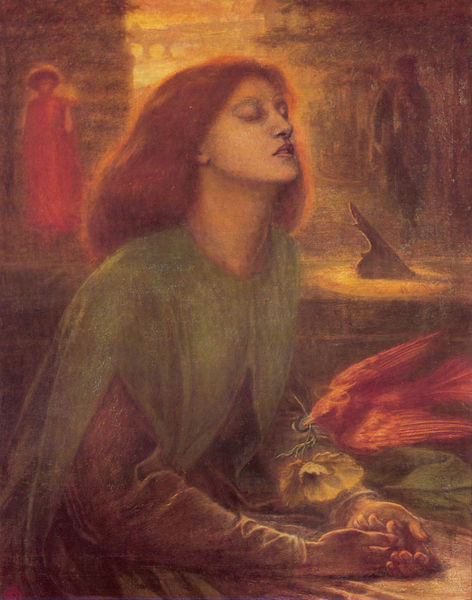
Then an absolute favourite  – Beata Beatrix by Dante Gabriel Rossetti c. 1863, (Tate Britain). This was inspired by Dante’s poem La Vita Nuova about his love for Beatrice. This is Rossetti’s portrait mourning the death of Lizzie Siddell in a trance-like state. The white poppy because she was thought to have been poisoned with opium and the sundial pointing to 9 relating to the meeting of Dante and Beatrice when he was 9 years old. I think this is such a beautiful, powerful painting – Rossetti described it saying Lizzy was ‘rapt from earth to heaven’.

Ford_Madox_Brown_-_Work

Work by Ford Madox Brown, 1852 – 1865 (Birmingham Museum and Art Gallery). It’s the movement and gestures of the figures that I like in this painting and the contrasts in the characters. There are the workmen digging and drinking as they work, a beggar, the figures of Carlyle and F D Maurice (the ‘brain workers’), the rich, dogs and children. There is so much to see in this painting.

Little is known about Henry Wallis, who painted Chatterton, 1856 (Tate Britain). I like the pathos in this painting and the contrast between the illuminated figure of Chatterton as the dawn light strikes the dark background of the attic room where he had killed himself. Peter Ackoyd’s novel Chatterton tells the story of the artist’s suicide.

The paintings are copied from Wikipedia where there is a list of paintings by Pre-Raphaelite artists and artists associated with the Pre-Raphaelite style. The Pre-Raphaelites by Timothy Hilton is a very good source of information, with many reproductions of the paintings mainly in black and white, but with a few in colour. I haven’t included all my favourites – more to come in another post, maybe.

Keeping the World Away by Margaret Forster

Keeping the World Away

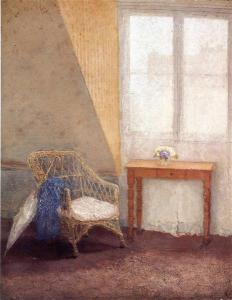
I expect a book by Margaret Forster to be good and this one is no exception. It is essentially the story of a painting, a variant of Gwen John’s The Corner of the Artist’s Room in Paris, as over the years it passes from one woman to another.

a-corner-of-the-artist-s-room-paris.jpg!Large

I knew very little about Gwen John before I read Keeping the World Away and now I want to know more. (Fortunately there is a list of books about her in the back of the book.)

The title of the book comes from a quotation from Gwen John’s Papers in the National Library of Wales:

“Rules to Keep the World away: Do not listen to people (more than is necessary); Do not look at people (ditto); Have as little intercourse with people as possible; When you come into contact with people, talk as little as possible … ” 3 March 1912

It seems from this novel that Gwen John was completely infatuated and in thrall to the artist Rodin. She became his lover and tried to please him by being tranquil and calm and striving for harmony in her life. Inwardly, however she “felt volcanic, as though burning lava filled her and would explode with the force of what was beneath it, her overwhelming passion for him.”

Her room was the image of how Rodin wished her to be and she painted a sunlit corner of it where it was “all peace and calm and serenity” in contrast to Gwen herself who “radiated energy”. She rearranged the room and painted several versions; with the window open, with an open book on the table, with flowers on the table, with and without the parasol.

I wished that the whole book had been about Gwen John. However, it’s about the painting and how its successive owners acquire it and what it means to each of them. It gets lost, is stolen, turns up on a market stall, is bought, given away and fought over. As each new owner is introduced there are links between them, but each time the painting passed to a new person I wanted to know more about each of them.

The painting is seen as expressing a yearning for something unobtainable, having an air of mystery, conveying a sense of waiting, of longing, of anticipation of someone’s arrival, painful, soothing or uplifting, empty, and symbolic of an independent, simple life free of entanglements. It becomes part of the lives of its owners. The novel starts with Gillian, the school girl reflecting that art speaks for itself, regardless of the artist’s intention. “She was convinced  that art should be looked at in a pure way, uninfluenced by any knowledge of the artist or the circumstances in which it had been painted.” It ends with Gillian, the aspiring artist, reflecting on the nature of art and the purpose of this painting – “Had that not been its purpose? To keep the world away, for a few precious moments, at least every time it was looked at?”

I can’t quite agree with Gillian. I can see that seeing a painting in isolation from the artist can be a pure experience, but I’m always filled with curiosity both about artists and authors – who they were, when they lived, what was going on in the world they lived in and how it affected their work. However, I also think that a painting is like a book in that they can both be interpreted in many ways regardless of the artist’s or author’s intentions.

This is a remarkable book, which I’m sure I shall read again and again.

(This book meets the criteria for the Celebrate the Author Challenge – Margaret Forster’s birthday is in May.)

Dante’s The Divine Comedy

Dante finished writing The Divine Comedy in 1321 shortly before his death. The subject of the final talk in my course on Dante’s Florence was The Divine Comedy, its sources, structure, an introduction to some of its characters, concluding with Dante’s legacy in art.

I don’t think that I’ve ever had such a long introduction to a literary work and I’m eager now to actually read The Divine Comedy. My copy is the Oxford World’s Classics publication. It is 741 pages long, including several introductory essays with plans and maps, and copious notes. I also have the much shorter The Descent Into Hell translated by Dorothy L Sayers. This is only 130 pages and contains extracts from the Inferno (the first part of The Divine Comedy).

Dante’s first title for this was The Vision. He wrote it in Italian, not Latin, so that it was accessible for everyone. It was recited and is basically a sermon, a sacred poem. He changed the title to comedy, which in the ancient tradition was a story, beginning as tragedy and moving to a happy ending. Boccaccio added Divine to the title in the 14th century. It’s an epic, allegorical poem and also an historical chronicle of Dante’s time packed with information on topics such as politics, theology, geography, the arts, and love.

It depicts three regions of the dead – Inferno, Purgatory and Paradise – a journey through the spiritual realms. There are 100 cantos, written in third rhyme – terza rima, invented by Dante, ie the first and third lines rhyme, with the second line indicating the next rhyme. This is an aid to memory and also helps to move the narrative forward. It’s packed with imagery, with multiple meanings and although it includes contemporary characters it’s amazingly modern. Florence is depicted as hell, with the Pope, Boniface VIII and clerics condemned because of the corrupt state of the church, although Dante describes meeting Christian theological thinkers in Paradise.

Dante used many sources, including the Bible, Greek mythology, Roman history, Ovid’s Metamorphosis, Livy, legends, miracle and medieval morality plays and his own stories. The poem begins with an exciting episode at the gates to the underworld in a dark, confusing wood, symbolising doubt, sin and the sterility of the soul. Dante, the narrator, has lost the path and is guided by Virgil through Hell and Purgatory to Paradise, where he meets his beloved Beatrice, who guides him through Heaven. Paradiso is the place of perfect harmony ordained by God. Dante followed the Ptolemaic system of the Cosmos in which Earth is the centre of the universe. He placed Hell at the centre of the Earth, underneath Jerusalem, reached through nine different circles, containing sinners suffering terrible punishments and torture. Purgatory was somewhere in the southern hemisphere, ascending up to Paradise located in Heaven above the Earth.

There are about 600 characters in the whole poem, 250 from the classical era, 80 from the Bible and 250 from Dante’s own time. Dante admired Virgil, his guide through Hell and Purgatory. He describes him as that fount of splendour, symbolising human reason and wisdom. Amongst the many characters are Brunetto Latini, Dante’s mentor who took an active role in politics and the art of oratory, found in Hell because of the sin of sodomy, which was considered as violence against nature; and Farinata degli Uberti, the leader of the Ghybelline party, also found in Hell as punishment for heresy because he was an Epicurean believing that the soul died with the body. He rises from the burning tomb of heretics to speak to Dante. The first mention of Florence is from Ciacco, guilty of the sin of gluttony, when he refers the bloodshed between the citizens of ‘the divided city‘.

Other people mentioned are members of the ancient Donati family (Dante’s wife was Gemma Donati) – Dante’s friend Foresi Donati, Corso Donati, a thief being changed into a serpent and Piccarda Donati his sister,  ‘pearl on a white forehead’, who had belonged to the Order of Poor Clares and was forced to marry to forge a political alliance; the violent tempered Agenti who opposed Dante’s recall from exile; Gianni Schicchi (the source of Puccini’s opera – including the beautiful aria O mio babbino caro); and Count Ugolino, the tyrant who had switched allegiance and was left to starve in Pisa’s Tower of Famine – he was said to have eaten his sons and grandsons and for punishment in Hell was forced to chew on the head of Archbishop Ruggieri.

The Divine Comedy has been read and copied ever since with commentaries coming very quickly after Dante’s death. The first biography of Dante was written in about 1351 by Giovanni Boccaccio, based on oral history from Dante’s contemporaries. The poem was seen as a difficult, obscure work, gothic and heavy going in 14th century England, but Chaucer mentioned it in the Monk’s Tale in his Canterbury Tales. English translations were made from 1802 onwards by Henry Boyd and Henry Cary (promoted by Coleridge). It influenced amongst others John Milton, Shelley and Byron, Wordsworth and Elizabeth Barrett Browning.

There are many examples of Dante’s legacy in art – here are just a few:

Giotto’s Last Judgment, in the Arena Chapel in Padua.
Frescos in the Basilica of Santa Maria Novella showing the tiered compartments of Hell and Cerberus the monster with three throats, wings and the body of a beast guarding Hell and the Elect – Saints and Cardinals rising up from their tombs.
The Last Judgment of Fra Angelico.


The painting of the Madonna in Majesty by the Siennese painter Martini.
Botticelli’s scenes of Inferno commissioned to illustrate The Divine Comedy by the Medicis – 92 survive and are in the Vatican Library.

Drawn in pen and ink he intended to colour them all. The one shown below is of the City of Dis, the lower part of Hell, with winged monsters, and the Circle of Deceivers. Dante is shown in red and Virgil in blue.


Frescoes of the Last Judgment in Orvietto Cathedral in 1500 reflecting the doom and gloom of the times fearing the end of the world with images of the damned, a mass of contorted bodies, by Signorelli, a master of human anatomy – the Resurrection of the flesh showing skeletons and bodies emerging from their tombs.
Michelangelo’s Last Judgment in the Sistine Chapel.
Gustave Dore’s illustrations of The Divine Comedy.


William Blake’s watercolour paintings of Inferno


Dante Gabriel Rossetti’s translation of La Vita Nuova in 1848.
Christina Rossetti’s studies of Dante – she saw him as a figure of romance.
Rossetti’s Beata Beatrix 1863 – his portrait of Lizzie Siddell in a trance-like state. The white poppy because she was thought to have been poisoned with opium and the sundial pointing to 9 relating to the meeting of Dante and Beatrice when he was 9 years old. This is one of my favourite paintings.


Rodin’s Gates of Hell and The Thinker, also The Kiss, depicting Francesca de Rimini whom Dante meets in Canto 5 of the Inferno. Francesca had fallen in love with Paulo, her husband’s younger brother. The legend goes that they were killed by Giovanni, her husband.

There are many, many more – see this Wikipedia link.