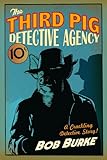
The Third Pig Detective Agency by Bob Burke

Reading The Third Pig Detective Agency by Bob Burke was a complete change of genre for me. It’s funny, a bit silly, a pastiche of American gumshoe crime fiction, and a fantasy  – indeed it’s a fairytale detective story. I did enjoy recognising all the fairy tale characters Bob Burke throws into the mix.

The Third Pig is Harry Pigg, who in his own words:

was the pig that built the house out of bricks while my idiot brothers took the easy route and went for cowboy builders and cheap materials.

Following his success at defeating the Big Bad Wolf, Harry became a detective, finding the two missing kids Hansel and Gretel and then identifying them as the murderers of the little old lady who lived in the gingerbread house.

But work for Harry had almost dried up, so when ‘an oriental gentleman the size and shape of a zeppelin‘, or in other words, Aladdin, the richest man in Grimmtown, accompanied by a sturdy white goat, none other than the eldest of the Gruff Brothers, demands his services, Harry can’t turn him down. Aladdin’s lamp had been stolen, an old battered lamp that he had kept under close guard, protected by hi-tech security and surveillance systems and Harry has to get it back for him. And so Harry sets out in pursuit of the lamp, aided or hindered by numerous characters, finding himself in all sorts of tricky and dangerous situations.

It’s a case of spot the characters from fairy tales and nursery rhymes and it’s most entertaining. Boy Blue, that lazy former shepherd tells Harry the lamp is rumoured to be a magic lamp, but Harry hates magic:

As a working detective it’s bad enough running the risk of being beaten up or thrown into a river with concrete boots on, without having to live with the possibility of being changed into a dung beetle or having a plague of boils inflicted on you. If you think humans were disgusting covered in boils, imagine how I might look.

And Harry just couldn’t have survived without the help of his Apprentice Gumshoe, Jack Horner, who rescues him several times.

There is no doubt that I’ll be reading more of Bob Burke’s books. the next one is The Ho Ho Ho Mystery which starts where The Third Pig Detective Agency ended when a very large lady dressed in black boots, bright red trousers and a hooded jacket came to see Harry and announced:

I need you to find my husband. He’s been kidnapped and it’s only two days to 25th December. If he’s not found soon we may have to cancel Christmas.

Carl’s Once Upon a Time VII challenge is coming to an end soon (21 June) and this is the fourth book I’ve finished. I may make five (my target for the challenge).

The Lollipop Shoes by Joanne Harris

ChocolatI read Chocolat by Joanne Harris in 2008 and loved it. Here’s an extract from my post at that time.

It’s the story about Vianne Rocher who arrives in Lansquenet-sous-Tannes, a place that is’ no more than a blip on the fast road between Toulouse and Bordeaux’ on Shrove Tuesday. She takes over the old bakery and transforms it into La Celeste Praline Chocolaterie Artisanale €“ in other words the most enticing, the most delicious and sensuous Chocolaterie, selling not only all sorts and types of chocolate treats but delicious chocolate drinks. Together with Anouk her daughter and Anouk’s imaginary friend Pantoufle the rabbit, she also transforms everyone’s life along the way.

It’s not just a story about a chocolaterie – it’s about fear of the outsider, prejudice against ‘these people’ €“ immigrants, vagrants, and gypsies; bigotry; fear of death, old age and illness; and fear that the Church will lose its purity and that the community will be corrupted by liberal and heretic beliefs. It’s also about how so many lives intersect and interact and above all about the importance of love and understanding in everyone’s life.

So, I had high expectations about the next two books about Vianne Rocher – The Lollipop Shoes (in the US this is published as The Girl With No Shadow) and Peaches for Monsieur Le Curé (in the US – Peaches for Father Francis). Maybe my expectations were too high because I was disappointed – neither book is as good, or as enchanting as Chocolat.

The Lollipop Shoes continues Vianne’s story four years later in Paris with Anouk and a second daughter Rosette. Blown there by the wind, Vianne now goes by the name of Yanne Charbonneau and Anouk, now eleven years old, is known as Annie. Rosette who is nearly four years old has an imaginary friend, a monkey called Bam. Yanne is now trying to live a ‘normal’ life, without using magic, trying to fit in with the people around them. However, her efforts are disrupted by the arrival of Zozie de l’Alba, the young lady with the shiny red shoes – the ‘lollipop’ shoes, Annie calls them. Zozie has no scruples and doesn’t hesitate to practise her own kind of magic, bewitching Annie with her spells and the power of her mind. Zozie’s magic though, is dark magic, evil and dangerous. She’s a stealer of lives and plans to take Vianne’s identity and make Annie her own.

As in Lansquenet-sous-Tannes, Yanne is living above a chocolaterie. This one in Montmarre is owned by Thierry le Tresset, ‘fifty-one; divorced, one son, a churchgoer, a man of rock’. He wants to marry Yanne, but she isn’t sure. Annie is having problems at school, fitting in with the other children and Rosette is a child living very much in her own world, she hardly speaks and communicates by signs. Is Bam just an imaginary friend or is there more to him?

This is really a story about good versus evil and where Chocolat was about the power of love, The Lollipop Shoes is about the strength and destructive power of evil. But there is something missing, there is no sparkle; it’s flat. The story is narrated by Annie, Zozie and Yanne and sometimes I found it difficult to decide which character was the narrator, and had to check the little symbol at the beginning of each chapter. Maybe it’s just me, because other people have really enjoyed this book – there are lots of 4 and 5 stars on both Goodreads and Amazon.

This book qualifies for two challenges – Mount To-Be-Read 2013 and Once Upon a Time VII (Fantasy).

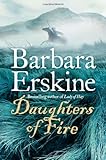
Daughters of Fire by Barbara Erskine

Daughters of Fire is historical time-slip fiction switching between the present day and the first century CE Britannia, a mix of historical fiction, fantasy and romance.  It was with relief that I finished reading it – relief, because although the story of Cartimandua, Queen of the Brigantes tribe is fascinating and that of historian Viv Lloyd Rees is initially interesting, the book is too long, and too wordy.

Daughters of Fire intermingles two stories, that of  Viv and Cartimandua. Viv has published a book on Cartimandua, a book using alternative as well as traditional historical sources – ie using legends, her dreams and visions as well as the writings of Roman historians. She has ‘borrowed’ an ancient cursed brooch from her boss, Professor Hugh Graham, who has criticised her book as fantasy. The rest of her story is their obsession with and struggle to gain control of the brooch.

Cartimandua, back in the first century is beset by enemies on all sides, Romans and  the leaders of the other tribes. It all goes from bad to worse when she betrays Caradoc (Caractacus), the leader of the Catuvellauni tribe, who led the tribes in resisting the Roman invaders and hands him over in chains to the Romans.

For me the essential story was good, but lost impact as it dragged on, drowned in words and by the repetition of the struggles between the characters. Because of this the ending was drained of any impact and suspense for me. I like time-slip stories, the supernatural and the paranormal, so that wasn’t a problem. And I liked the sections explaining Celtic beliefs – their belief in the immortality of the soul, in reincarnations and transmigration of the soul. As one of the characters said:

Remember the world he lived in was an animistic, rainbow world of links and connections which included vast echelons of spirits and gods and ancestors, people dead and people yet to be born, all of whom could be summoned to his aid. (page 258)

In the Author’s Note, Barbara Erskine emphasises that this is above all fiction:

In the absence of written information one has to make do with imagination, dreams and deductive techniques of a dubious nature! … (page 562)

and regarding Cartimandua:

We don’t know her tribe, or if she had children, and although far more is known about her life than that of he much more famous contemporary, Boudicca, she is still an enigma.

So, for all that is historically known about Cartimandua I refer the reader to the Roman historians.

For the truth of her life we must consult archaeology and the oracles.

The rest is silence. (page 562)

A couple of years ago I read Barbara Erskine’s book, The Warrior Princess, another time-slip book, which I also thought was too drawn out and would have been better if the plotting had been tighter. I own one more of her books, which I’ve yet to read – Sands of Time, a collection of short stories, described on the back cover as ‘spine-tingling‘ tales all with ‘a touch of the unexpected … suspense, romance, passion, unexpected echoes of the past.’ I hope, because these are short stories, they will be more succinct than the two books I have read.

This book qualifies for several challenges – Mount To-Be-Read 2013 (it’s been on my shelves for about 4 years), The Historical Fiction Reading ChallengeWhat’s in a Name 6 (in the Fire category) and Once Upon a Time VII (Fantasy).

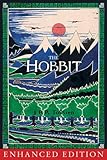
The Hobbit by J R R Tolkien

Many years ago I read Tolkien’s The Lord of the Rings and loved the story, so much so that over the years I’ve re-read the books several times. Somehow I’ve ignored The Hobbit, or There and Back Again, maybe thinking that because it’s a children’s book it was too late for me to appreciate it. So even though I’ve had a copy for years it’s only now that I’ve got round to reading it, spurred on by seeing the film this year. (I read the enhanced version on Kindle.) How wrong I was not to have read it before – The Hobbit is a book that all ages can enjoy.

It’s an adventure story of a quest set in a fantasy world, so beautifully written that it seems completely believable. Bilbo Baggins, a hobbit, is recruited through Gandalf, the wizard, to accompany a party of thirteen dwarves, led by Thorin, on their quest to recover the dwarves’ treasure stolen by Smaug the dragon and regain possession of the Lonely Mountain. Along the way Bilbo grows in confidence and becomes a hero, meeting elves, outwitting trolls, fighting goblins, and above all gaining possession of the ring from Gollum.

The enhanced version has a foreword by Christopher Tolkien, complete with illustrations including manuscript pages and unused drawings, in which he describes how and why his father came to write The Hobbit: he would stand in front of the fire in his study and tell stories to Christopher (then aged between four and five years old) and his brothers. One story, this story, he said, was a long story about a small being with furry feet, which he thought he would call a “Hobbit”. This was in about 1929. The book was eventually published in 1937, written whilst Tolkien was engrossed in writing the myths and legends told in The Silmarillion. He hadn’t intended The Hobbit to be connected to the mythology, but his tale gradually became larger and more heroic as he wrote it.

The Hobbit sold very quickly and people asked for a sequel. At first Tolkien thought that writing more details about Gandalf and the Necromancer (Sauron) would be too dark and that many parents “may be afraid that certain parts of it would be terrifying for bedtime reading.” He also wrote:

Mr Baggins began as a comic tale among conventional and inconsistent Grimm’s fairy-tale dwarves, and got drawn into the edge of it – so that even Sauron the terrible peeped over the edge. And what more can hobbits do? They can be comic, but their comedy is suburban unless it is set against things more elemental. (location 339)

Three days after writing those words he wrote:

I have written the first chapter of a new story about Hobbits – “A long expected party.”

That was the first chapter of The Lord of the Rings. (location 339)

It also includes recently discovered audio recordings of J.R.R. Tolkien reading excerpts from The Hobbit, including the dwarves’ party song, the account of their capture by the three trolls, and Bilbo Baggins’s creepy encounter with Gollum.

The Hobbit is an excellent first book for Carl’s Once Upon a Time VII.

Once upon a Time …

“Once upon a time” – words that conjure up a world of magic and enchantment. Words that promise to bewitch and beguile and whisk you away to a fairytale world. But fairy tales don’t always end “… and they all lived happily ever after.” I remember very well being frightened by the stories in a big illustrated book of fairy tales when I was a child – maybe it was the pictures, or the words, or the combination of the two. Whatever it was, fairy tales are not always nice and comfortable, of the “are you sitting comfortably? then I’ll begin” variety. They can be scary …

It’s time once again for Carl’s Once Upon a Time Challenge VII, which began on Thursday, March 21st and continues until Friday, June 21st.

Carl writes that It’s not really a challenge, more of a reading and viewing event that encompasses four broad categories: Fairy Tale, Folklore, Fantasy and Mythology, including the seemingly countless sub-genres and blending of genres that fall within this spectrum. The entire goal is to read good books, watch good television shows and movies, and most importantly, visit old friends and make new ones.

There are several ways to participate, and I’m choosing Quest the First:Read at least 5 books that fit somewhere within the Once Upon a Time categories. They might all be fantasy, or folklore, or fairy tales, or mythology€¦or your five books might be a combination from the four genres.

Quest 1

These are the books I’m choosing from, some of which I’ve had for ages and have never got round to reading and some of which are new ones which I’ve added during the last couple of years:

  • The Death of King Arthur – this is a translation of the 13th century French version of the Camelot legend.
  • The Ingoldsby Legends by Richard Harris Barham – a collection of myths, legends, ghost stories and poetry.
  • The Brief History of the Dead by Kevin Brockmeier – about a place between heaven and earth where everyone ends up after they die.
  • The Book of Lost Things by John Connolly – Twelve-year old David takes refuge in myths and fairytales.
  • Daughters of Fire by Barbara Erskine – a time slip novel focussed on the legends surrounding Cartimandua, a Celtic queen.
  • Helen of Troy by Margaret George – the myth narrated from Helen’s point of view.
  • Shadowland by C M Gray –  historical fantasy set in Dark Ages Britain.
  • The Owl Killers by Karen Maitland – a tale of witchcraft and pagan superstition.
  • Dreamwalker (The Ballad of Sir Benfro) by James Oswald – fantasy fiction – Welsh mythology and folklore.
  • The first four Merrily Watkins books by Phil Rickman –  The Wine of Angels, Midwinter of the Spirit, A Crown of Lights, and The Cure of Souls –  paranormal crime thrillers with supernatural and spiritual causes.
  • The Last Enchantment by Mary Stewart – a tale of Merlin and King Arthur and the third book in the Merlin trilogy. I read The Crystal Cave and The Hollow Hills years ago and don’t think I’ve ever read this one.
  • The Children of Hurin by J R R Tolkien – Tales of Middle-earth from times before The Lord of the Rings, set in the country that lay beyond the Grey Havens in the West.
  • The Hobbit by J R R  Tolkien – even though I’ve read The Lord of the Rings trilogy several times I’ve not read this!
  • A Connecticut Yankee in King Arthur’s Court by Mark Twain – fantasy fiction in which a Yankee engineer is accidentally transported back in time to the court of King Arthur.

I know I’ve got more but this is more than enough to start with.  It’s a mixed bunch and as I like making lists and don’t like making reading plans, I haven’t decided which ones to read over the next three months. Right now, I want to start them all!

The Little Stranger by Sarah Waters: Book Review

The Little Stranger is the only book I’ve read by Sarah Waters. I saw the TV version of Tipping the Velvet and wasn’t impressed. It didn’t make me want to read any of her books. But, so many other bloggers have praised them that I was interested enough to borrow The Little Stranger when I saw it in the library. That’s the influence book bloggers have.

It begins very well – an old dilapidated house, Hundreds Hall, just after the end of the Second World War, a family struggling to come to terms with post-war life and lack of money, and the hint of something supernatural lurking in the background. The Hall has a major part in this book. This is how it is seen through the eyes of the narrator Dr Faraday, who had known it thirty years earlier when his mother had been a nursery maid there.

I remembered a long approach to the house through neat rhododendron and laurel, but the park was now so overgrown and untended, my small car had to fight its way down the drive. When I broke free of the bushes at last and found myself on a sweep of lumpy gravel with the Hall directly ahead of me, I put on the brake, and gasped in dismay. The house was smaller than in memory, of course – not quite the mansion I’d been recalling – but I’d been expecting that. What horrified me were the signs of decay. Sections of the lovely weathered edgings seemed to have fallen completely away, so that the house’s uncertain Georgian outline was even more tentative than before. Ivy had spread, then patchily died, and hung like rat’s-tail hair. The steps leading up to the broad front door were cracked, with weeds growing lushly up through the seams. (page 5)

Reminiscent of Rebecca, I thought. It’s not just the house that is decaying, the family too is cracking up. Dr Faraday remembered it in it’s prime – now there are just Mrs Ayres, Caroline her daughter and Roderick, her son left, living on their own in the house with help from one servant, a maid – Betty, a fourteen year old girl. Roderick was injured in the war, and Caroline is a plain young woman over-tall for a woman with thickish ankles and legs, but a ‘clever’ girl. Their mother still has a good figure, with a heart-shaped face and handsome dark eyes. As the book progresses she declines rapidly, overcome by events and it is soon revealed that she has never got over the death of her first child, Susan who was ‘her one true love’.

It begins with Dr Faraday called out to see Betty who tells him there is something bad in the house that makes wicked things happen. What follows is a sequence of terrible events. Dr Faraday is a very tedious character, dismissing all thoughts that things that are moved from one place to another and much worse events are in any way supernatural, believing there is either a rational or pscyhological explanation for it all.  He is reinforced in his beliefs when he talks to another doctor, Dr Seeley who says:

The subliminal mind has many dark corners, after all. Imagine something loosening itself from one of those corners. Let’s call it a – a germ. And let’s say conditions prove right for that germ to devlop – to grow like a child in the womb. What would this little stranger grow into? A sort of shadow-self, perhaps: a Caliban, a Mr Hyde. A creature motivated by all the nasty impulses and hungers the conscious mind had hoped to keep hidden away: things like envy, malice, and frustration … (page 380)

I got very tired of Dr Faraday and his persistence. It is all very drawn-out, no doubt to increase suspense but I felt that all the tension and spookiness that had initially been built up just drained away in the middle of the book. It did pick up towards the end with several dramatic scenes, but I think it would have been better if the book had been shorter. However, I did enjoy it – the descriptions of the house and park are vivid and I liked the social commentary. The post-war period is well defined, indicating the attitude of the upper classes towards the working classes, the coming introduction of the National Health Service and the breaking up of landed estates to build Council estates – new houses for the workers .

So, just what is the ‘ravenous frustrated energy’ at the heart of the matter? All the characters are built up as suspects and it was only towards the end that I realised what (or who) was responsible.

The Little Stranger has been shortlisted for the Orange Prize for Fiction. Will it win? Maybe not, there are some other very good books on the list, which I suspect may over shadow this one.