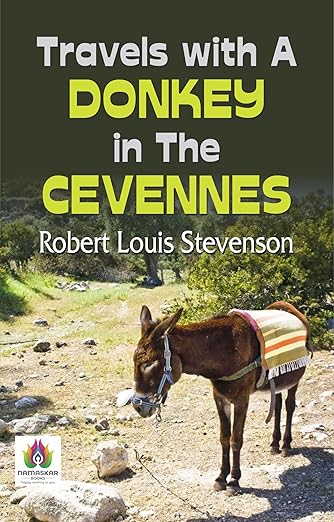
Travels with a Donkey in the Cévennes by Robert Louis Stevenson – Short Nonfiction

Travels with a Donkey in the Cévennes: A Journey of Solitude and Reflection  by Robert Louis Stevenson, first published 1879

Namaskar Books| 2022| 124 pages| e-book| my own copy| 4*

The wild Cévennes region of France forms the backdrop for the pioneering travelogue Travels with a Donkey, written by a young Robert Louis Stevenson. Ever hopeful of encountering the adventure he yearned for and raising much needed finance at the start of his writing career, Stevenson embarked on the 120-mile, 12-day trek and recorded his experiences in this journal. His only companion for the trip was a predictably stubborn donkey called Modestine. Travels with a Donkey gives the reader a rare glimpse of the character of the author, and the journalistic and often comical style of writing is in refreshing contrast to Stevenson’s more famous works. (Goodreads)

This is a short nonfiction book, just right for both Nonfiction November and Novellas in November. It’s a book I’ve had since 2011 and I’m glad to say that it was well worth the wait. I enjoyed it on several levels, as travel writing, history of the Cévennes region, descriptive writing of the French countryside in 1878, observations of the local people and Stevenson’s thoughts on religion.

He began his journey through the Cévennes, a range of mountains in south-central France, at Le Monastier, a highland valley fifteen miles from Le Puy, where he spent a month preparing for his excursion southward to Alais (modern name, Alès) a distance of 120 miles.

I was struck by what he took with him – a sleeping sack, because he didn’t intend to rely on the hospitality of a village inn, and a tent was troublesome to pitch and then strike. Whereas, a sleeping sack was always ready to get into. His was extraordinary, made of green waterproof cart-cloth lined with blue ‘sheep’s fur’, nearly six feet square plus two triangular flaps to make a pillow at night and the top and bottom of the sack by day. It was a huge sort of long roll or sausage, large enough for two at a pinch. And that was why he bought a donkey from an old man. He called her Modestine because she was

a diminutive she-ass, not much bigger than a dog, the colour of a mouse, with a kindly eye and a determined under-jaw. There was something neat and high-bred, a quakerish elegance, about the rogue that hit my fancy on the spot.

But he soon discovered that unless he beat Modestine with a staff, which he didn’t want to do; it sickened him – and me too. He had to let her go at her own pace and patiently follow her and there were times when she just stopped and wouldn’t go any further. This was extremely slow and in the end he resorted to a goad, which was a plain wand with an eighth of an inch of pin which worked wonders on poor Modestine, who carried most of his equipment.

As well as his clothing, he also took his travelling wear of country velveteen, pilot coat and knitted spencer (a short waist-length, double-breasted, man’s jacket, originally named after George Spencer, 2nd Earl Spencer), some books, a railway rug, food, and a variety of other things including a revolver, a spirit lamp, lantern, candles, a jack-knife and large leather flask, a bottle of Beaujolais, a leg of cold mutton and a considerable quantity of black bread and white for himself and the donkey and of all things an eggbeater, which he later abandoned. He wasn’t travelling light!

The book is full of Stevenson’s descriptions of the countryside, such as this one of the landscape as he approached the Trappist Monastery of Our Lady of Sorrows:

The sun had come out as I left the shelter of a pine-wood, and I beheld suddenly a fine wild landscape to the south. High rocky hills, as blue as sapphires, closed the view, and between these lay ridge upon ridge, heathery, craggy, the sun glittering on veins of rock, the underwood clambering in the hollows, as rude as God made them at first.

Modestine had to stop at St Jean du Gard, as she just couldn’t travel any further and needed to rest. He sold her and continued on to Alais by diligence (a public stagecoach). He missed her after she was gone.

For twelve days we were fast companions; we had travelled upwards of a hundred and twelve miles, crossed several respectable ridges, and jogged along with our six legs by many a rocky and many a boggy road. After the first day, although sometimes I was hurt and distant in manner, I still kept my patience; and as for her, poor soul! she had come to regard me as a god. She loved to eat out of my hand. She was patient, elegant in form, the colour of an ideal mouse, and inimitably small.

And he wept!

I was rather surprised by how much I enjoyed this book, mainly because I didn’t know anything about it other than its title and thought it was perhaps fiction. Of course it isn’t and it’s full of detail of his hike that I haven’t mentioned in this review. I shouldn’t have been surprised as I’ve enjoyed other books by Stevenson – Treasure Island, Kidnapped and Catriona.

I read in Wikipedia that Stevenson’s purpose in making his journey ‘was designed to provide material for publication while allowing him to distance himself from a love affair with an American woman of which his friends and family did not approve and who had returned to her husband in California’, but without giving a source for this information. In his book Stevenson does say when talking to a monk he met at the Trappist Monastery that he was not a pedlar (as the monk thought), but a ‘literary man, who drew landscapes and was going to write a book’.
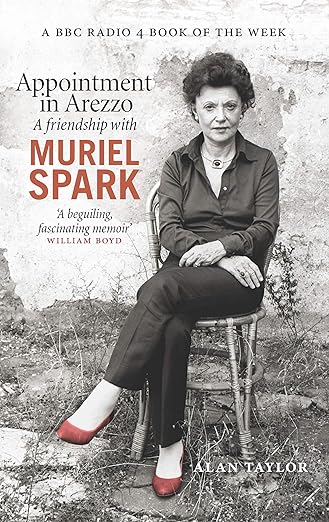
Appointment in Arezzo by Alan Taylor – Short Nonfiction

Appointment in Arezzo: A friendship with Muriel Spark by Alan Taylor

Polygon| 2017| 169| e-book| My own copy| 5*

Description:

This book is an intimate, fond and funny memoir of one of the greatest novelists of the last century. This colourful, personal, anecdotal, indiscreet and admiring memoir charts the course of Muriel Spark’s life revealing her as she really was. Once, she commented sitting over a glass of chianti at the kitchen table, that she was upset that the academic whom she had appointed her official biographer did not appear to think that she had ever cracked a joke in her life.

Alan Taylor here sets the record straight about this and many other things. With sources ranging from notebooks kept from his very first encounter with Muriel and the hundreds of letters they exchanged over the years, this is an invaluable portrait of one of Edinburgh’s premiere novelists. The book was published to celebrate the 100th anniversary of Muriel’s birth in 2018.

My thoughts:

This is a short nonfiction book of 169 pages on Kindle, so it’s just right for both Nonfiction November and Novellas in November. It’s a book I’ve had for a few years after a friend recommended it to me. I didn’t read it straight away because at the time the only book by Muriel Sparks I’d read was The Prime of Miss Jean Brodie, which I loved. Since then I’ve read Loitering with Intent, (review to follow in due course), so I thought it was time I read Appointment in Arezzo.

Muriel Spark was born on 1 February 1918, in Edinburgh, the daughter of Bertie Camberg, a Jew who was born in Scotland and her mother, Sarah who was English and an Anglican. Alan Taylor touches on her early life and teenage years in Edinburgh in a middle -class enclave , where she attended James Gillespie’s High School for Girls – immortalised as Marcia Blaine School in The Prime of Miss Jean Brodie.

In July 1990 Alan Taylor first met Muriel Spark and her friend Penelope – Penny – Jardine in a hotel in Arezzo for dinner. The two women had shared a rambling house deep in the Val di Chiana 15 kilometres from Arezzo in Tuscany for twenty years. Penny is a sculptor who has exhibited at the Royal Academy in London; she supplied the domestic and business circumstances which allowed Muriel to flourish. Alan Taylor, a former deputy editor of The Scotsman and the founder-editor of the Scottish Review of Books, was there to interview her on the publication of her novel Symposium (1990). Their meeting led to a friendship and since then they met frequently during the last fifteen years of her life. She died at her home in Tuscany in April 2006 and is buried in the cemetery of Sant’Andrea Apostolo in Oliveto.

Following that first meeting, over the next fifteen years they met many times, when Taylor visited her in Tuscany, New York, London, Prague and finally in 2004 in Scotland and Edinburgh as well as exchanging many letters and telephone conversations. Taylor outlined details of her brief marriage in 1937 to Sidney Oswald Spark, which only lasted until 1940 when they separated, and about her son, Robin and their disagreement over her Jewishness. Robin believed that one must be either a Jew or a Gentile, whereas Muriel believed:

It was impossible ‘to separate’ the Jewess within her from the Gentile. In her mind, the two coexisted in harmony’ ‘uncomplainingly amongst one’s own bones’. Was she a Gentile? Or a Jewess? ‘Both and neither. What am I? I am what I am.

But Robin couldn’t cope with such ambiguity; he wanted certainty – in his mind one must be either Jew or Gentile. Their beliefs were irreconcilable. The full details are in Chapter 6, A Question of Jewishness.

Amongst many other topics they talked about her writing:

Fleur in Loitering with Intent spoke for her when she said: ‘I’ve come to learn for myself how little one needs, in the art of writing, to convey the lot, and how a lot of words, on the other hand, can convey so little. (page 17)

She had no idea when writing a book how it might turn out. Its theme built of itself and if it did not develop, it ramified. I wanted to know what she saw as her achievement, her legacy. ‘I have realised myself, ‘ she replied. ‘I have expressed something I brought into the world with me. I have liberated the novel in many ways, shown how anything whatever can be narrated, any experience set down, including sheer damn cheek. I think I have opened doors and windows in mind, and challenged fears – especially the most inhibiting fears about what a novel should be. (pages 98-99)

In a very real sense Muriel’s life is to be found in her work. She always said that if anyone wanted to know about the person behind the prose and poems they had only to read them closely and imaginatively. She is there, in the times and places and characters, in the choice of words and the construction of sentences, in the tone of voice, above all in the philosophy of existence. (pages 141-142)

There is so much more in this book. It is a fascinating insight into her life, and what she thought about writing, as well as reflecting on her books, as well as much more. I’ve really only touched the surface of this very readable book and I finished it knowing a lot more about Muriel Spark and her books – and keen to read more of them. And it’s illustrated with many photographs making it a warm, personal and affectionate account.

Nonfiction November 2025: Week 5 – New to My TBR

Week 5 of Nonfiction November is hosted by Deb Nance at Readerbuzz and we’re looking back at the previous weeks. And in particularly at which ones have made it onto our TBR?

I’ve thoroughly enjoyed taking part in Nonfiction November and there are so many fascinating books I could easily add to my TBR list. But I know my limitations, so these are my choices:

From Liz – Adventures in Reading, Running and Working from Home

From Frances – Volatile Rune

From What? Me Read?Life Among the Qallunaat by Mini Aodla Freeman

From She Reads Novels –  Britain’s Greatest Private Detective by Nell Darby

From What Cathy Read NextTake Courage: Anne Brontë and the Art of Life by Samantha Ellis

Nonfiction November 2025: Week 4 Diverse Perspectives

This week’s topic is hosted by Rebekah @ She Seeks Nonfiction.

One of the greatest things about reading nonfiction is the way it can open your eyes to the world around you–no plane ticket required. What nonfiction book or books have impacted the way you see the world in a powerful way? Is there one book that made you rethink everything? Is there a book that, if everyone read it, you think the world would be a better place?

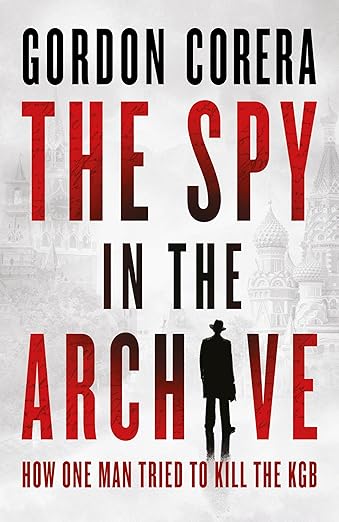
I think that The Spy in the Archive: How One Man Tried to Kill the KGB (my review) by Gordon Corera certainly opened my eyes and enlightened me about the extent of corruption, torture and terror within Russia, and the infiltration of Western countries.

It’s about Vasili Mitrokhin, a KGB archivist who defected to Britain in 1992. Mitrokhin, a quiet, introverted and determined man, was a reluctant defector, because whilst he loved Russia he came to hate the KGB and the Soviet system. It is a remarkable book about a remarkable man, an in-depth account, that is both fascinating and informative.

As the in-house archivist for the KGB, the secrets he was exposed to inside its walls turned him first into a dissident and then a spy, a traitor to his country but a man determined to expose the truth about the dark forces that had subverted Russia, forces still at work in the country today. It is the story of what it was like to live in the Soviet Union, to raise a family and then of one man’s journey from the heart of the Soviet state to disillusion, betrayal and defection. At its heart is Mitrokhin’s determination to take on the most powerful institution in the world by revealing its darkest secrets.

Mitrokhin wanted the documents he had copied to be made public, not just to the world but to open the Russians’ eyes to the corruption, torture and terror that was prevalent. Sadly, despite his determination that his work would reach the Russian people, that has not proved possible

Gordon Corera is the BBC’s security correspondent. He covers terrorism, cyber-security, spying and other related issues in the UK and around the world. Before taking on the role in 2004 he worked for the Today programme on Radio 4 as a foreign reporter. Gordon joined the BBC in 1997. He has presented documentaries and written a number of books relating to espionage and security.

Nonfiction November 2025: Week 3: Book Pairings

Week 3 (11/10-11/16) is hosted by Liz, an ex-librarian, a freelance editor and transcriber, a runner and a volunteer. She blogs about everything from social justice and geology nonfiction to YA romance and literary fiction at Adventures in reading, Running and Working from Home

This week, pair up a nonfiction book with a fiction title. Maybe it’s a historical novel and the real history in a nonfiction version, or a memoir and a novel, or a fiction book you’ve read and you would like recommendations for background reading. Or maybe it’s just two books you feel have a link, whatever they might be. You can be as creative as you like!

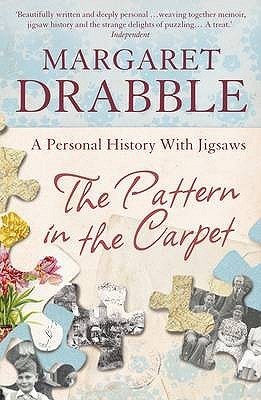
My nonfiction book is The Pattern in the Carpet by Margaret Drabble. I’ve always enjoyed doing jigsaws. So when I saw this book about jigsaw puzzles, their history and their place in her life I wanted to read it. They were a big part in my childhood and I still enjoy doing them.

Margaret Drabble describes her book thus:

This book is not a memoir, although parts of it may look like a memoir. Nor is it a history of the jigsaw puzzle, although that it was what it was once meant to be. It is a hybrid. … This book started off as small history of the jigsaw, but it has spiralled off in other directions and now I am not sure what it is.

I think is a memoir because what she does in this book is to weave her own story into a history of games, in particular jigsaws, which have offered her and many others relief from melancholy and depression. She writes about the importance of play and notes the way that doing a jigsaw is like creating order out of chaos, and because they have no verbal content they exercise a different part of the brain, bringing different neurons and dendrites into play. 

I enjoyed parts of immensely – those parts about her childhood, and life at Bryn, her grandparents’ house in Long Bennington and about her beloved Aunt Phyl (Phyllis Boor) and of course those parts about jigsaws, both personal and historical, about mosaics (looking at them as a form of jigsaw), the history of children’s games and puzzles and amusements. She does ‘spiral off in other directions’ which meant in parts it lacks a clear structure in a sort of ‘stream of consciousness’ style, particularly in her reminiscences and nostalgia about life (reproduced in some jigsaws) in a rural community that no longer exists.

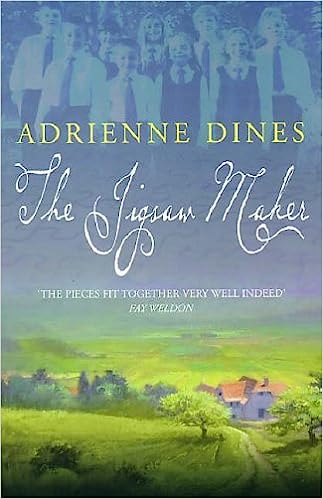
I’m pairing it with The Jigsaw Maker by Adrienne Dines, another book that appealed to me because it’s about jigsaws.

The Jigsaw Maker is a beautifully written novel, one with pace and tension in just the right places. Lizzie Flynn has a shop in a village near Kilkenny, a sort of knick-knack shop selling a variety of goods, cards, flower arrangements, and home-made sweets. The ‘Jigsaw Maker’ is Jim Nealon, a stranger who walks into her shop one morning and asks her to sell his beautiful jigsaws.

But these are no ordinary jigsaws. Jim makes wooden jigsaws, tiny intricately shaped pieces ‘finely cut so that they were more like buttons than jigsaw pieces’  And each one is individual showing a photograph of a real place accompanied by a personalised history of the scene.

He proposes to take photos of places, not the tourist attractions, but the places their ancestors might have lived and worked. He asks Lizzie to help him by writing about the scenes. To begin with he shows her a photo of the local school and asks her to picture herself back there in 1969 and write what she remembers – what it was like to be a pupil there.

It just so happens that 1969 had been quite an eventful year. This opens up the floodgates of memory for Lizzie as painful and puzzling events from that year almost over power her. Looking back at the child she was she realises that not everything was as it had appeared to her then.

It is just like a jigsaw – all the pieces are there and both the reader and Lizzie have to put them together correctly to get the correct picture. I could visualise the scenes and the characters and I became anxious for Lizzie as she realised the truth not only about the events she had seen, but also about her place in those events. There are plenty of repressed secrets that come to the surface and an added mystery too – who is Jim? Why has he come to the village and why did he ask Lizzie in particular to help him?

Nonfiction November 2025 Week 2

The second week of Nonfiction November is being hosted by Frances at Volatile Rune. The title of this week’s challenge is: Choosing Nonfiction

She wrote: There are many topics to choose from when looking for a nonfiction book.  For example:  Biography, Autobiography, Memoir, Travel, Health, Politics, History, Art, Medicine, Gardening, Food, Business, Education, Music to name but a few.  Maybe use this week to  challenge yourself to pick a genre you wouldn’t normally read?   Or stick to what you usually like is also fine.  If you are a nonfiction genre newbie, did your choice encourage you to read more?

There are many topics I’d like to know more about – Anatomy and Physiology to name but one. Religion is another topic. Over the years I have read many books on Theology, Christianity, the Bible, books about the history of Israel and the creation of the state of Israel, a few books about Buddhism, but next to nothing about Islam or any other religion. Like many other people I’m horrified by what is going on in Israel and Gaza and last year I attempted to find out more. I read a few books – Enemies and Neighbours: Arabs And Jews In Palestine And Israel, 1917-2017 by Ian Black, The Israeli-Palestinian Conflict: What Everyone Needs to Know by Dov Waxman, both of which gave me much to think about.

Now I would like to know more about Islam and I have two books that I’m hoping will enlighten me at least a little. They are Islam: A Very Short Introduction by Malise Ruthven and The Hundred Years’ War on Palestine by Rashid Khalidi. I’ll begin with the first book and hope it will help me understand the basics and that the second will fill in the huge gaps in my knowledge of the history of Palestine.

Are there books you could recommend I read too?