Slow Down – You Read Too Fast

I read too quickly and it stems from the time when I learnt to speed read, scanning the page, picking out the key words, not reading all the letters in each word and so on. This has its drawbacks – I don’t actually read headlines in newspapers properly, nor chapter headings. I’ve realised though that I am never going to be able to read all the books I’d like to no matter how quickly I read.

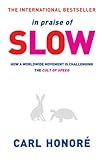
A few years ago I came across this book – In Praise of Slow by Carl Honore and as I was thinking about slowing down my reading speed I dug it out again. This is not just about reading slowly as it covers many aspects of life and it’s really about living better by striking a balance between fast and slow. I’ve come across this quote in other places:

“There is more to life than increasing its speed.” (Gandhi)

There are some things that just cannot be hurried – they just take time. Hand knitting is an example, although some people can knit at great speed, and because the rhythmic, repetitive movement of the needles is so therapuetic knitting can actually lower the heart rate and blood pressure. I find doing a jigsaw puzzle can have the same effect, provided it is not too difficult. It’s an absorbing pastime that requires concentration and has a calming effect.

Reading slowly is not an easy thing for me to do, especially when I’m engrossed in the story and am impatient to find out what happens next, but sometimes this means that I miss a lot of the details and cannot remember much of the book when I’ve finished it. This is why I like to re-read a book that I’ve enjoyed and often find so much more in it than on the first reading.

I’ve also found that writing about the books means that I’ve slowed down. I never used to take notes when reading, unless I’d been studying for an exam, so this was a new thing for me when I started to write my blog. And going over it again in my mind thinking about its themes also helps. But this book suggests that reading is more of a pleasure if you take your time and read in small sips – much in the same way that Dicken’s novels were first published in monthly installments spread out over a year. So maybe my pitifully slow progress in reading Les Miserables is the best way to read it, or maybe not as I keep stopping and reading other books in between.

There is so much more in In Praise of Slow than slowing down reading and as the pace of life seems to ever increasing it pays I think to stop living my life by the clock and trying to fit in as many things as possible. I shall start with reading slowly.

Sunday Salon – Our Longest Days

This week I’ve concentrated on reading Our Longest Days: A People’s History of the Second World War by the writers of Mass Observation, edited by Sandra Koa Wing. I’ve been completely immersed in the war years through this fascinating and personal book.

Mass Observation is a social research organisation, founded in 1937, with the aim of creating an “anthropology of ourselves” – a study of the everyday lives of ordinary people in Britain. The information was gathered in various ways, including a team of paid observers and a national volunteer panel of writers. People were interviewed on a number of topics and filled in monthly ‘directives’ on themes such as jokes, eating habits, money and marriage. In August 1939, with war approaching, the organisation asked its panel to keep diaries to record their daily lives and selections from fifteen of these diaries are included in Our Longest Days. They make fascinating reading.

From Sandra Koa Wing’s introduction:

It is worth noting, however, that the diarists did not represent a true cross-section of British society during the war. Although they came from a variety of backgrounds, and from different regions, most of them were middle-class, well-read and articulate. They tended to be people with a natural capacity for observing – and for recording what they observed. Moreover, on the whole their political leanings tended towards left of centre; several were pacifists or conscientious objectors.

Because they are personal accounts there is that sense of being actually there during the air raids, hearing Churchill’s speeches, reading the newspaper reports, experiencing the grief at the number of casualties and deaths and the terrible devastation of the war, the food and clothes rationing and the excitement of D-Day. There is also the hopelessness of the defeats during the first years of the war, the weariness as it went on and on, the yearning for peace and then the excitement, the anticipation and the anti-climax of VE Day and VJ Day.

The main events of each year are summarised before the diary entries for that year, which I found very useful as a quick guide to set the diaries in the context of world events. I began to feel as though I knew the people who wrote the diaries, so the brief biographies are the end were also interesting as there were brief details about what happened to them after the war. There are also a number of photographs, an excellent index and a selection of further reading of Mass Observation publications and other histories of Britain in the Second World War together with a list of related websites.

I think one of my favourites is Muriel Green, who was 19 when the war began. She became a land girl and moved around the country. On her 21st birthday she was working as an under-gardener at Huntley Manor in Gloucester. She wrote:

I shan’t forget my 21st birthday. Apart from getting two greetings telegrams and achieving the first bath for nearly a month it has been the last word in flat. Totally depressing in fact. Life wasn’t all depressing for Muriel and she is one person who kept mainly optimistic and in October 1944 she reflected: It seemed strange to think that the war had been on over five years and how little different it was for us in spite of the ravages of war and what some had gone through. Of course it will never be the same again, but there are many families with far greater losses than our petty grumbles.

Muriel’s family was among the lucky ones. Not so Kenneth Redmond, whose brother Tom was killed in action. His entry on 11 November 1944 reads:

This day only means Remembrance of Tom – War and its horrors, Peace and the best of life that it can bring – all these things will mean to me Tom. I get very morbid when I think of it.

Herbert Brush was 70 in 1939. He was living in south London, a keen gardener, art lover, reader and writer of verse. He wrote diary entries from September 1940 to March 1951 and I particularly liked the personal details he included. He couldn’t buy any razor blades in June 1942 and at the same time he was wondering how accurate the reports of the numbers of casualties reported by the Germans and Russians were, thinking of how pleasant it was ‘to read about so many Nazis being slaughtered and noting the number of different pronunciations of ‘Nazi’.

Churchill says ‘Nazzi’, others say ‘Nartzi’, or’Nertzi’ or ‘Nassie’. I like Churchill’s best as he puts a snarl into the word.

My dad must have liked Churchill’s best too as that is how he said it.

Margaret Forster is quoted on the front cover: ‘I relished all these diaries’. Me too. An excellent book.

Exploring Britain – In Books. A Thursday Thirteen

For a while now I’ve been reading Thursday Thirteen posts on a number of blogs and wondering about writing one myself. Until last week there was no theme to Thursday Thirteen, it could be whatever you wanted it to be. They have now introduced a theme, but I’ve been writing this list on books on Britain, so I’m not following the theme and here is my first Thursday Thirteen.


These are books that explore different aspects of Britain – things that interest me, landscape, places, history, architecture, writers, cookery, walking and so on. They’re books I own and enjoy looking at; some I’ve read and others I’ve only dipped into. They have all provided me with hours of delight. There are a number of books reflecting my fascination with history in its physical form – standing stones, castle, churches, stately homes – others my interest in Britain’s geography and topography. The book that triggered this list is A Reader’s Guide to Writers Britain by Sally Varlow, which I bought this week in the library book sale.

From bottom to top they are:

1. English Landscapes photography by Rob Talbot, text by Robin Whiteman (1995). The English countryside in full colour, explored region by region from Penzance to Penrith, landmarks, local architecture, social and historical surveys, literary and artistic connections, geography and local customs. An amazing collection exploring the byways of England. A book to sit and pore over planning where to go.

2. Yesterday’s Britain published by the Readers’ Digest. Full of photographs this book covers the period 1900 -1979 and is ‘the story of how we lived, worked an played’ throughout the 20th century. It contains personal anecdotes, eyewitness accounts and intimate stories: a ‘family scrapbook of the nation’.

3. British Isles: a Natural History by Alan Titchmarsh, accompanying the BBC1 series. Beginning in the mists of time, 3 billion years ago this book traces the evolution of Britain exploring everything from geology and geography to flora and fauna. It includes a section on Places to Visit, from Stone Age villages at Skara Brae, Orkney to the Centre for Alternative Technology, Powys, Wales. A beautifully illustrated and informative book.

4. Land of the Poets: Lake District, Photographs by David Lyons (1996). The English Lake District, that much visited area of Britain, is one of my favourite places. I’d love to live there, even though it rains and is often full of tourists. This book illustrates the drama and beauty of the countryside, the grandeur of the crags and hills, complimented with poetry inspired by the mountain streams and lakes. The anthology is mainly drawn from William Wordsworth and his near contemporaries, with photographs relating directly to the poems – The Langdale Pikes, Home at Grasmere, (Wordsworth), Helvellyn (Walter Scott) to name but a few.

5. Mountain: exploring Britain’s High Places by Griff Rhys Jones to accompany the BBC series. I was so impressed with Griff’s fitness as well as his great sense of humour as he climbed Snowdon and the other High Peaks in England, Scotland and Wales. These are such spectacular places, also rough and arduous climbs. Amazingly he had never done any climbing before! One third of Britain is covered in mountains – I didn’t know that before. There’s a bit of history in this book too.

6. Great British Menu, the book that accompanied the first series on BBC2, when 14 chefs competed to decide who should cook for the Queen at the celebration lunch marking Her Majesty’s 80th birthday. It contains recipes from the chefs representing the South East, the North, Wales, the South West, Northern Ireland, the Midlands and East Anglia, and Scotland – including Lancashire Hot Pot made with wild boar, Finnebroague Venison with Colcannon Pie and Wild Mushrooms (Northern Ireland) and Pan-Fried Cornish Lobster (South West). Delicious, mouth-watering recipes.

7. How We Built Britain by David Dimbleby, describing a journey through Britain and a thousand years of history seen through Britain’s buildings and the people who built them. This is more than the book of the TV series, immensely detailed, reflecting Dimbleby’s enthusiasm and delight in a huge span of British history from 1066 to the modern day.

8. Sacred Britain: a guide to the sacred sites and pilgrim routes of England, Scotland and Wales by Martin Palmer and Nigel Palmer. This gives information about ancient stone circles and tombs, Christian and pre-Christian shrines, medieval synagogues, churches, cathedrals, holy wells and rivers, ancient yew trees and symbolic plants. It also describes 13 traditional pilgrimage routes eg the Canterbury Pilgrimage from Winchester to Canterbury (129 miles). Illustrated with colour photographs and coloured sketch plans of the routes.

9. A Reader’s Guide to Writers’ Britain by Sally Varlow (2000). This is a beautiful book containing maps and photographs, and giving a guide to places to visit linked with writers and books, from all parts of the British Isles. There’s an index of authors and places with anecdotes and fascinating facts. Hours of endless pleasure reading about where to visit.

10. In Search of Stones:a pilgrimage of faith, reason and discovery by M Scott Peck. Scott Peck’s account of the trip he and his wife took through the countryside of Wales, England and Scotland looking for ancient megalithic stones. It covers travel, history, archaeology, as well as Scott Peck’s meditations on spirituality and mysticism. Illustrated with drawings by Christopher Peck. I’ve read this book twice so far and have visited some of the sites he describes.

11. Mysterious Wales by Chris Barber looks at beautiful and magical places in Wales. It’s a guide to prehistoric megaliths, holy wells, magic trees, secret caves, lonely lakes, bottomless pools and sites associated with legends concerning King Arthur, Merlin and the Devil. Illustrated with photographs and drawings. Absolutely fascinating.

12. The Hidden Places of England edited by Joanna Billing is a travel guide to some of the less well known places of interest to visit (together with other less ‘hidden’ places eg Stratford-upon-Avon, Bath and Oxford), with short descriptions accompanied by line drawings and coloured maps. It also has information about places to stay and eat, many in out-of-the way places. My edition was published in 1997 but it is still a useful book to find out about the history of villages and towns, churches, pubs, restaurants, cafes, tearooms, and numerous other attractions.

13. A Pictorial Guide to the Lakeland Fells: The Central Fells by A Wainwright. This is one in a series of the Wainwright walking guides to the Lakeland Fells, reproduced from the original handwritten pages and intricate pen and ink sketches of the routes and the landscape. Alfred Wainwright was born in 1907, fell in love with the Lake District and moved to Kendal in 1941. The guides describe the fell walks as they were in the 1950s and 1960s; the footpaths, cairns and other waymarks may not all be the same now and you do need to take an up-to-date map with you but, as the BBC series ‘Wainwright Walks’ have shown, the routes are very much as Wainwright knew them.
Giving Up the Ghost by Hilary Mantel

In the first chapter of Hilary Mantel’s memoir she writes, ”I hardly know how to write about myself. Any style you pick seems to unpick itself before a paragraph is done.”  She then advises herself to trust the reader, to stop spoon-feeding and patronising and write in ‘the most direct and vigorous way that you can.’ She worries that her writing isn’t clear, or that it is ‘deceptively clear’. It comes across to me as being clear, honest and very moving. She’s not looking for sympathy but has written this memoir to take charge of her memories, her childhood and childlessness, feeling that it is necessary to write herself into being.

When I read Beyond Black a couple of years ago I was struck by the biographical information at the end of the book – that as a child she believed their house was haunted and that she was often very frightened. She expands on this in her memoir. From the age of 4 she believed that she had done something wrong and she was ‘beyond remedy and beyond redemption’. She thought it was because of her that her parents were not happy and that without her they would have had a chance in life. It didn’t get any better as her father left home and she was left to live with two younger brothers and their mother and her mother’s lover. Home was a place where secrets were kept and opinions were not voiced. Her experience of ghosts at the age of 7 was horrifying she felt as though something came inside her, ‘some formless, borderless evil’.

She wasn’t happy at school; and by the age of twelve she no longer believed in God and as she was at a convent this must have been difficult. She went to university to study law, and was married at 20, struggling to combat the prejudice against women prevailing in the early 1970s:

‘It was assumed that marriage was the beginning of a woman’s affective life, and the end of the mental one. It was assumed that she neither could nor would exercise choice over whether to breed; poor silly creature, no sooner would her degree certificate be in her hand before she’d cast all that book-learning to the winds, and start swelling and simpering and knitting bootees. When you went for an interview, you would be asked, if you were not wearing a wedding ring, whether you were engaged; if you were engaged or married, you would be asked when you intended to’start your family’.

Oh yes, I remember that too!

Life got worse for Hilary as her health deteriorated and the doctors thinking depression was the cause prescribed anti-depressants, which in turn damaged her further. From being underweight she went from a size 10 up to size 20 and developed akathisia as a side effect of the drugs she was given. This condition looks and feels like madness and was the worst thing she had ever experienced, apart that is from the horror she had felt as a child of 7. As a result of the misdiagnosis of her condition (eventually it was diagnosed as endometriosis) she was unable to have children. She sees the children she never had as ghosts within her life; ghost children who never age, who never leave home. Ghosts in her definition are also

the tags and rags of everyday life, information you acquire that you don’t know what to do with, knowledge that you can’t process; they’re cards thrown out of your card index, blots on the page.  It’s just the little dead, I say to myself, kicking up a fuss, demanding attention by the infantile methods that are the only ones available to them.

I found it a remarkable memoir.

Glimpses of Edward Gibbon at Sheffield Place (Sheffield Park Garden, East Sussex)

Each day during this last week I’™ve been reading one of Virginia Woolf’™s essays from the collection in The Death of the Moth and Other Essays. Each one has provided some fascinating glimpses into the lives of a number of writers including Edward Gibbon (1737 – 1794), about whom I know very little. In fact before I read her two essays “The Historian and ‘˜The Gibbon’™” and “Reflections at Sheffield Place” all I knew was that Gibbon had written The History of the Decline and Fall of the Roman Empire.

I didn’™t know about his connection to Sheffield Place and was interested when I realised that this is now Sheffield Park in Sussex. Although the house is privately owned, the National Trust owns Sheffield Park Garden. I visited it several years ago when I had no inkling that Gibbon had also visited it some 300 years earlier. The garden was originally designed by ‘Capability’ Brown for John Holroyd (who later became Lord Sheffield) in about 1775. So, Gibbon who was a great friend of Lord Sheffield would have seen the garden when he stayed with Lord Sheffield, but I doubt that he would have walked round very much of it as, according Maria, Sheffield’™s daughter, Gibbon was “a mortal enemy to any person taking a walk.” To her he was a figure of fun “waddling across the room”, but she admitted that he was ‘œthe most delightful of talkers’ and she was genuinely fond of him.

Woolf in her essay Reflections at Sheffield Park ponders whether Gibbon had paused in front of the ‘œgreat ponds ‘¦ bordered with red, white and purple reflections, for rhododendrons are massed upon the banks and when the wind passes over the real flowers the water flowers shake and break into each other.’ I wish I had known that when I visited. I remember how beautiful Sheffield Park Garden was with its colourful displays of flowers and trees surrounding the lakes; I could have stood there imagining that maybe Gibbon had stood on the same spot and seen a similar display! The lakes, cascades and waterfalls make this one of the most picturesque gardens I’ve visited. I can’t find the photos we took when we were there, so this photo is from Wikipedia, showing one of the lakes. The National Trust website has a few photos showing the Garden at different times of the year.

Woolf’™s description of Gibbon’™s appearance as well as his character caught my imagination and brought him to life. He was fat and ugly, talked incessantly, was sickly and had none of the advantages of birth. She describes his appearance as ‘œridiculous ‘“ prodigiously fat, enormously top-heavy, precariously balanced upon little feet upon which he spun round with astonishing alacrity.’

Gibbon apparently abandoned his purple language and wrote racy colloquial prose to Sheffield and was the only person who could restrain Sheffield’™s extravagance. The contrasting characters of his eccentric Aunt Hester and his Aunt Kitty who brought him up after his mother died show the complexity of his nature. Woolf wrote that Aunt Hester’™s view was that he was ‘œa worldling, wallowing in the vanities of the flesh, scoffing at the holiness of faith.’ Aunty Kitty on the other hand, thought he was a prodigy and was intensely proud of him.

Virginia Woolf’™s essays are brief but give enough facts and a general impression of how Gibbon grew up and became a historian to make me keen to find out more. Gibbon did of course write in a very ornate, ironic and elaborate style, but Woolf considers reading it is like being ‘œmounted on a celestial rocking-horse’, which then becomes a ‘œwinged steed; we are sweeping in wide circles through the air and below us Europe unfolds; the ages pass; a miracle has taken place.’

I still have essays on Coleridge, Shelley, Henry James, George Moore and E M Forster to read in this little book ‘“ such a wide sweep of literature yet to explore.

Eating, Sleeping and Living with Books

Books, Baguettes and Bedbugs: the Left Bank World of Shakespeare & Co. by Jeremy Mercer (Phoenix 2006 paperback 260 pages).

I read about this book on another blog and was intrigued enough to read it for myself. It’s a remarkable memoir of the author’s refuge at the Paris bookshop, Shakespeare & Co. on the banks of the River Seine opposite Notre Dame. Jeremy Mercer, a Canadian crime reporter, packed his bags and headed for Paris after receiving a death threat. He arrived during the last days of 1999 and shortly afterwards found his way to Shakespeare & Co, where he was amazed to find not only is it a bookshop but also a place providing beds for a number of writers. The owner George Whitman, then 86 years old, had been inviting writers to stay in the shop since he opened it in 1951, provided they helped in the shop and read a book a day, hardly an onerous task.

Jeremy recounts how George made him welcome, how he found ways to exist on very little money, with meals from George, Sunday morning pancake breakfasts, morning ablutions at the Cafe Panis and baguettes (‘with the occasional speck of blue-green mold on the bread’) from the Sandwich Queen. Jeremy finds friends amongst the other residents and tells of their story-telling sessions on the banks of the Seine, and other escapades, including a trip to Ireland with Simon, an English poet and long time resident at Shakespeare & Co. As the future of the shop was called into question Jeremy helps George produce a booklet on the history of Shakespeare & Co and succeeds in tracking down George’s daughter Sylvia, whom he hoped would carry on the shop in the future.

It’s full of fascinating characters – the many writers who have been connected with it including Henry Miller, Anais Nin, Lawrence Durrell and Alan Ginsberg; the individuals living in the shop; and not forgetting perhaps the most remarkable character of all, George himself. George’s generosity is in line with the original occupants of the building, built on the foundations of a 16th century monastery. He ‘compares himself to the monks who used to live on the same spot, a frere lampier who keeps a light on to welcome strangers and cares for old books and lost folk with semisacred devotion.’ However, as the residents of the shop change Jeremy eventually finds that it felt ‘strange and dislocating’ when he saw new people ‘amok among the books’ and he decided that it was time to move on.