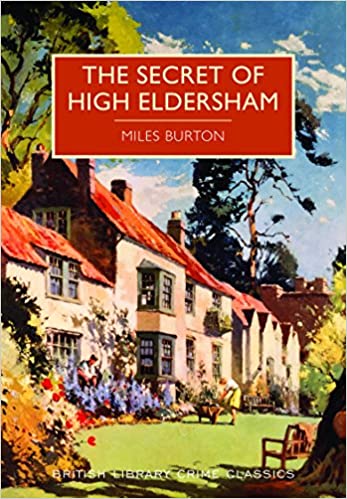
The Secret of High Eldersham by Miles Burton

Rating: 4 out of 5.

The Secret of High Eldersham by Miles Burton was first published in 1930. Miles Burton is a pseudonym. His real name was Cecil John Charles Street (1884 – 1964) and he also wrote under the names of John Rhode and Cecil Way. I like these names – variations on the word ‘street’. This edition was published by the British Library in 2016 and is one of my TBRs.

It’s not an easy book to write about. There is a murder – that of the landlord of the Rose and Crown Inn in the village of High Eldersham. He was found dead slumped in a chair, having been stabbed in the neck. The local police don’t feel able to deal with the murder so call in help from Scotland Yard.

But when Detective Inspector Young arrives he discovers that there is something very strange about the village and its inhabitants. Like a lot of small and remote villages the local people keep themselves to themselves and are very wary of strangers – they’re not made welcome and they don’t stay very long. But it’s more than that. Strange things are happening, and Young’s theory to account for the queerness of the place seemed to him (and to me) ‘so impossible, so utterly fanciful, that to entertain it was to doubt his own sanity.’ It concerns ancient legends and customs with a supernatural element. And this is what makes it difficult to write about because to say anything more about this ‘queerness‘ would be to give away a major part of the plot.

Young decides he can’t deal with this on his own and he contacts his friend, Desmond Merrion, a brilliant individual from the intelligence branch of the Admiralty, he had met during the war. He writes to Merrion inviting him to the inquest into the Inn’s landlord death, where he meets a war-time acquaintance, Laurence Hollesley.

From that point on the novel branches into two stories – the murder mystery and a thriller full of danger, drama and pace, plus a damsel in distress and spot of smuggling thrown into the mix. I enjoyed it. It’s easy to read, even if I find it difficult to write about, with clearly identifiable characters and a good sense of location. There’s suspense and the tension rises as the mystery reaches its climax.

Merrion also appears in the one other book I have by Miles Burton – Death in the Tunnel, which I hope to read soon.

The Luminaries by Eleanor Catton

Sometimes I read books and have no desire to write about them, not because I didn’t enjoy them but because I just want to get on and read the next book. And this summer has been one of those times, so that now I’m finding difficult to remember all the details of the books I’ve read because I didn’t write about them soon after I finished reading. It’s been a strange time during this pandemic and it’s not been easy to concentrate. But I do want to keep a record of my reading and the only way now to catch up is to write some brief notes about each book, beginning with The Luminaries by Eleanor Catton, the winner of the 2013 Booker Prize,

Rating: 4 out of 5.

I downloaded The Luminaries by Eleanor Catton 3 years ago. I read it in July. It is a long and detailed book, written with such intricate plotting and numerous characters that it bewildered me at times. It’s historical fiction set in New Zealand in the 1860s, during its gold rush and it has everything – gold fever, murder, mystery and a ghost story too.

Blurb from Goodreads:

It is 1866, and young Walter Moody has come to make his fortune upon the New Zealand goldfields. On the stormy night of his arrival, he stumbles across a tense gathering of twelve local men who have met in secret to discuss a series of unexplained events: A wealthy man has vanished, a prostitute has tried to end her life, and an enormous fortune has been discovered in the home of a luckless drunk. Moody is soon drawn into the mystery: a network of fates and fortunes that is as complex and exquisitely ornate as the night sky. Richly evoking a mid-nineteenth-century world of shipping, banking, and gold rush boom and bust, The Luminaries is a brilliantly constructed, fiendishly clever ghost story and a gripping page-turner. 

I found the structure a bit of a stumbling block at first as the chapters halve in length from the very long opening chapter to the very short final chapter – so that from feeling overwhelmed by the length and detail of the opening chapters, by the time that I neared the ending I felt distinctly dissatisfied with the brevity of the concluding chapters – the early chapters are too long and the final ones are too short. And the significance of the astronomical headings completely bypassed me.

But if this sounds as though I didn’t enjoy this novel, that is wrong, because I did for the major part of the book. I loved the pictures it builds up of the setting in New Zealand, the frontier town and its residents from the prospectors to the prostitutes, and the obsessive nature of gold mining. And I did become fully absorbed in the story during the week it took me to read. it

These are the other books I read in July and August and have not yet reviewed:

  • Thin Air by Michelle Paver
  • The Birdwatcher by William Shaw
  • Still Life by Val McDermid
  • Dead Man’s Footsteps by Peter James

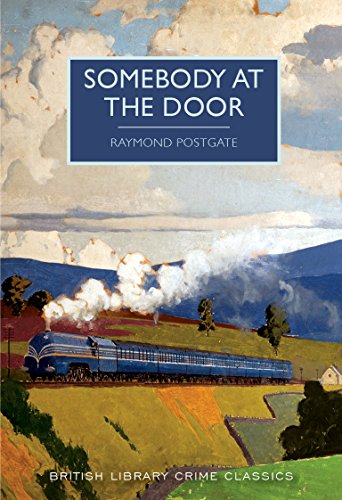
Somebody at the Door by Raymond Postgate

Rating: 4 out of 5.

Somebody at the Door is one of the British Library Crime Classics, originally published in 1943. It’s set in 1942 and it gives a vivid picture of what life was like in wartime England. There is an interesting introduction by Martin Edwards.

In January 1942, Henry Grayling is on the 6.12 train from Euston, travelling home to Croxburn from work in London. There’s a fuel shortage so there are less trains than usual and the carriages are crowded – Grayling views all his fellow passengers with dislike and suspicion as he clutches his attache case, containing £120 pounds close to his chest.

He sits next to a young man, Evetts, who works for the same company and is smoking a foul smelling pipe, and on his other side is the Vicar of Croxburn, both of whom he knows. He also recognises Ransom, a corporal in the Home Guard platoon in which he, Grayling is a second lieutenant. The other occupants of the carriage are a fair young man with a club foot, a refugee doctor, a fat middle aged woman and her teenage daughter, and two young working men in overalls. Most of the passengers are suffering from colds, coughing and sneezing and Grayling has to hold his handkerchief in front of his nose. He is relieved to leave the train when it eventually pulls into the station at Croxburn. However, when Grayling arrived home he is seriously ill and dies later that evening.

An autopsy reveals that he had died of mustard gas poisoning and Inspector Holly finds that there are too many suspects; Grayling was an extremely unlikable person. The rest of the book reads like a collection of short stories as Holly investigates Grayling’s fellow passengers. Their stories are detailed and at times I felt they were too long and slowed the book down too much, but they are interesting in themselves. I particularly like the German refugee’s story, casting light on what life was like in Germany just before and at the onset of the war.

I did enjoy the book, the characters stand out as real people and also reflect Postgate’s own likes and dislikes. Martin Edwards’ introduction gives the background to Postgate’s writing – he was an atheist and a one-time Communist. His stories reveal the corruption in local government at that period, and the attitudes of the British government in the lead up to the war. The murder mystery is really secondary to the suspects’ stories, which makes the book more a reflection of the period, which Postgate does really well, than crime fiction. However, the murder mystery is well plotted, giving me plenty to unravel and it was only in the final section that I guessed who had killed Grayling.

  • Kindle Edition
  • File Size : 3089 KB
  • Print Length : 239 pages
  • Publisher : British Library Publishing (10 Oct. 2017)
  • Source: Prime Reading Library

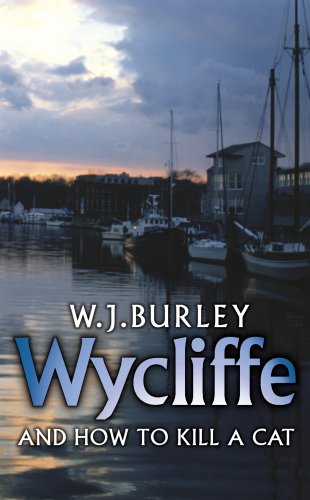
Wycliffe and How To Kill a Cat by W J Burley

W.J. Burley (1914 – 2002) was first an engineer, and later went to Balliol to read zoology as a mature student. On leaving Oxford he went into teaching and, until his retirement, was senior biology master in a large mixed grammar school in Newquay. He created Wycliffe in 1966 and the series was televised in the 1990s with Jack Shepherd starring in the title role. But I’ve never watched any of them. Set in Cornwall, they have a strong sense of place, and Wycliffe is a quiet, thoughtful detective.

Wycliffe and How to Kill a Cat is the second book in the series and is the 7th one I’ve read. It was first published in 1970 as To Kill a Cat. It’s well written, with descriptions of the coast of Cornwall, firmly set in the late 1960s, specifically at the time of the astronauts first moon landing in July 1969. At one point Wycliffe reflects on the fact that a quarter of a million miles away men were walking on the moon.

Superintendent Wycliffe, despite being on holiday can’t help getting involved when a young woman is found murdered in her seedy hotel bedroom. She’d been strangled and her face had been savagely smashed in. A thousand pounds was still in a drawer, hidden beneath her clothes, so the motive wasn’t theft.

It’s a complex story that kept me guessing to the end. Once Wycliffe had established the young woman’s identity, there were several suspects he investigated, including her husband, a meek man whose mother dominated him and his aunt who doted on him, or maybe it was the owner of the nightclub, the Voodoo where she’d worked, or one of its patrons. I kept thinking it was this person and then that person …

I like Wycliffe, a quiet man who works on instinct, but I did feel sorry for his wife, left very much on her own as he occupied himself on investigating the murder – after all they were supposed to be on holiday. She doesn’t complain. Instead she made friends with some local people and went out with them in their motor launch to explore a bit of Du Maurier country.

Wycliffe is a comparative newcomer to the area and the divisional inspector, Inspector Fehling’s first impression of him was not favourable. He thought that Wycliffe did not look like a policeman. He didn’t look ‘tall enough and he seemed almost frail. A teacher, some kind of academic, perhaps a parson, but never a policeman.’ This reminded me that there used to be a minimum height requirement for policemen of 5ft 8in tall.

These two extracts describe how Wycliffe worked:

“Wycliffe stood for a while, apparently lost in thought. Actually, though ideas chased each other through his mind they could hardly be said to have any pattern of rational consecutive thought.”

“It was when he made an effort to think in a disciplined way about anything that he was most conscious of his shortcomings. And this reflection brought him back to the case. Not only did he find sus­tained logical thought difficult but he was always short of written data. He had the official reports but these were so full as to be almost useless. Any other detective would have a sheaf of private notes, but he rarely wrote anything down and if he did he either lost it or threw it away. Notes were repugnant to him. Even now he ought to be sitting at a desk with a notepad in front of him, jotting down his ideas, transposing and relating facts like a jig-saw.”

This is police procedural, reflecting the social values and attitudes of the 1960s. It’s an early book in the series, but I think it clearly shows Wycliffe’s character and the way he worked. I’ve read the books in the series totally out of order, so it was good to read the second one. I’m still wondering about the title as there are no details in it about how to kill a cat! I’m hoping to read the first one – Wycliffe and the Three Toed Pussy, which despite its title is not about an actual cat either, but about a young woman with a deformed foot.

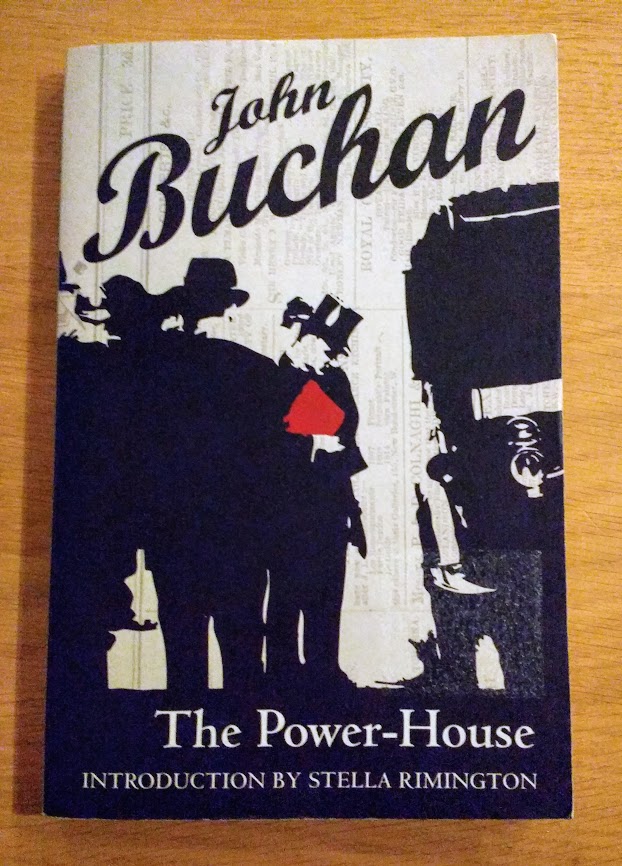
The Power-House by John Buchan

As usual I am behind with writing book reviews, but whilst it is still relatively fresh in my mind I’m going to begin catching up with the latest book I read. It’s only short – 108 pages – and I enjoyed it far more than I thought I would.

Rating: 5 out of 5.

John Buchan’s The Power-House, was written in 1913 when it was serialised in Blackwood’s Magazine and then published in book form in 1916. In her Introduction to the Polygon Books edition Stella Rimington described it as:

Pure essence of Buchan – a demonstration of his magical power to weave a tale out of no materials but the threads and colours of his imagination. It does, however, possess a theme – John Bunyan’s idea, in Pilgrim’s Progress, of men of goodwill and courage struggling with an intelligent, evil power at the root of all the world’s troubles and confessions. (page vii)

The narrator is Edward Leithen, a barrister and MP. His friend and fellow MP Tommy Deloraine tells him is off to Moscow to track down one of their Oxford contemporaries, Charles Pitt-Heron, who had disappeared without letting his wife where he was going. He told her he’d be home for luncheon, but never came back. Whilst Tommy goes off in pursuit of Pitt-Heron, Leithen stays in London, but soon his curiosity draws him into the mystery, because, as he tells himself, ‘every man at the bottom of his heart believes that he is a born detective.’ And so, having collected a few items of information merely by accident and coincidence, he finds the connecting link between them in the person of Andrew Lumley, a wealthy Englishman. Lumley, an elderly man, with menacing, pale eyes, hidden behind his tinted glasses is the key to the whole mystery.

Just as Hannay in Buchan’s later novel, The Thirty-nine Steps, meets the villain Von Schwabing in the library of his country house, so Leithen meets Lumley in his gentleman’s country house, High Ashes, in his library. The two men dine together and then settle themselves in armchairs to smoke cigars and proceed to talk about many things. Leithen is perplexed by him and his speculations on the nature of civilisation, and of power.

I was struck by these thoughts: Lumley states that civilisation is a conspiracy to which Leithen responds that it is in the interests ‘of all the best brains in the world to keep up the conspiracy.‘ To which Lumley replies:

Do we really get the all the best brains working on the side of the compact? Take the business of Government. When all is said, we are ruled by amateurs and the second-rate. The methods of our departments would bring any private firm to bankruptcy. The methods of Parliament – pardon me – would disgrace any board of directors. Our rulers pretend to buy expert knowledge, but they never pay the price of it that a business man would pay, and if they get it they have not the courage to use it. (pages 33 -34)

Lumley continues in this vein and concludes that what is needed is some sort of Power-House to start the ‘age of miracles‘. Leithen is unsettled, to say the least, by his talk and his ‘eerie persuasiveness’.

From an somewhat slow start and a middle consisting mainly of conversation, the novel then picks up pace dramatically. Just as in The Thirty-nine Steps when Hannay goes on the run, fearing for his life, over the moors, so Leithen, in danger of his life, flees his pursuers through the streets of London, as he is lured in deserted buildings, taxis and a decidedly dodgy restaurant. He realises how thin the protection of civilisation is and how there were dozens of ways of spiriting him out of ‘this gay, bustling world‘, alone in a crowd with no one to help him, only his own wits.

Buchan tells a good story, even if I had little idea what the Power-House really was. It’s an international anarchist network, but who they were, what they were actually after, or how they hoped to achieve their ends was never clear to me. But I really enjoyed this book. As Stella Rimington says it has an ‘intoxicating blend of madness with scents of home and countryside.’ And

… the thinness of the crust of civilisation, whatever that may be these days, is as relevant in our time as it was when Buchan was writing in the early war-torn years of the twentieth century. (page xi)

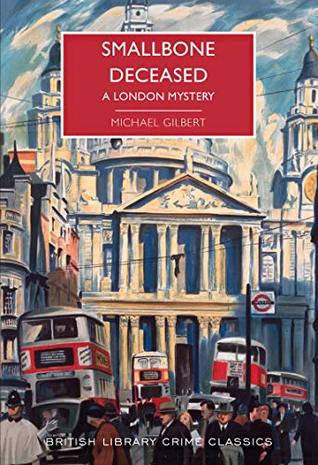
Smallbone Deceased by Michael Gilbert

Rating: 4 out of 4.

Smallbone Deceased by Michael Gilbert, first published in 1950, was his fourth Inspector Hazelrigg novel. It’s the first one I’ve read, although I have read two of his other books. There is an excellent introduction by Martin Edwards, which gives details of Gilbert’s career as a a solicitor and as a mystery writer. He wrote 30 novels and 185 short stories, as well as work for radio, television and stage.

As the title tells you Smallbone is dead. He was one of the trustees of the Ichabod Stokes Trust together with Abel Horniman, the senior partner of a London law firm, Horniman, Birley and Craine. After the recent death of Abel, whilst looking for the deeds relating to the Trust, Marcus Smallbone’s body was discovered in the Trust’s deed box, a large, hermetically sealed box.

Inspector Hazelrigg runs the police investigation. It’s obviously an inside job and with the help of Henry Bohun, a newcomer to the firm, the police investigate each of the suspects until by process of elimination the culprit is identified. Of course it’s not that straight forward, as each person’s motive, opportunity and alibi is considered and there are a number of red herrings that did baffle me a little. There is rather too much detail about the finances of the firm for my liking, but apart from that the book moves along swiftly.

The setting in the solicitors’ office after the end of the Second World War is well done and reflects the differences between the male professionals and the female admin staff with their intrigues, rivalries and flirtations. I think Bohun is the most interesting character, although they are all individually distinguishable. Bohun is not just new to the firm, but also a newly qualified solicitor. He has para-insomnia and never gets a full night’s sleep, averaging about ninety minutes a night. It doesn’t make him feel tired, but means he has lots of time to help Inspector Hazelrigg and still carry out his job, as well as doing a good deal of reading, walking the streets and even working as a night watchman. It’s written with a light touch and a sense of humour and I enjoyed it very much.

Now, I’d like to read more of Gilbert’s work, maybe starting with some of his short stories as Bohun appeared in nine short stories and also in a six-part radio thriller and Hazelrigg featured in nineteen short stories as well as in six novels.

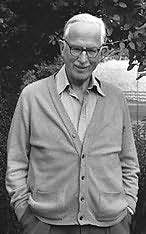
Michael Gilbert

Michael Gilbert (1912-2006) wrote thrillers, police procedurals and espionage novels that rank among the highest and most varied achievements of British crime writing in the second half of the twentieth century. A founding member of the Crime Writers’ Association, Gilbert was for many years partner in a London law firm and drew on his knowledge of the law in writing his most acclaimed novel. For more information about Michael Gilbert see this article by Martin Edwards.

Format: Kindle Edition
File Size: 5145 KB
Print Length: 236 pages
Page Numbers Source ISBN: 0755119193
Publisher: British Library Publishing (22 Jan. 2019)
Source: I bought it