A Murder is Announced by Agatha Christie

A Murder is Announced was first published in 1950. My copy is in a collection of four Miss Marple stories – A Miss Marple Quartet. I particularly like this cover, showing Joan Hickson as Miss Marple.

Synopsis from Amazon:

The villagers of Chipping Cleghorn, including Jane Marple, are agog with curiosity over an advertisement in the local gazette which reads: ‘A murder is announced and will take place on Friday October 29th, at Little Paddocks at 6.30 p.m.’ A childish practical joke? Or a hoax intended to scare poor Letitia Blacklock? Unable to resist the mysterious invitation, a crowd begins to gather at Little Paddocks at the appointed time when, without warning, the lights go out.

Of course it isn’t a practical joke and someone is murdered. But the mystery is to identify the victim – it’s not as straight forward as it first appears and there are plenty of red herrings. I vaguely remembered seeing the TV version (with Joan Hickson, perfect as Miss Marple) years ago and although I couldn’t remember who did it knew that I had to pay close attention to the detail of where people were sitting or standing in the room at the Little Paddocks when the lights went out. But even though I read it very carefully I was still baffled. It all hinges on family relationships and details of the characters’ identities which are so skilfully hidden that I was kept guessing until very near the end.

It’s not without flaws, some of the characters are a bit sketchy, and some of the novel borders on farce, with Miss Marple imitating a dead person’s voice whilst hiding in a broom cupboard and Mitzi, the highly strung and paranoid cook, a refugee from Germany, screaming like a siren and insisting that the police will take her away and torture her. Still, I wish her recipe for the chocolate cake ‘Delicious Death’ had been revealed.

What I really like about A Murder is Announced is the picture it paints of life in post-war Britain, showing how society was in the process of change. Miss Marple is her usual brilliant self, now seeming very old with ‘snow white hair and a pink crinkled face and very soft innocent blue eyes’, chattering and fluttering, but still as sharp and observant as ever. As she explains the world has changed since the war when everyone knew who everybody was. But now people come and settle in a village and all you know of them is what they say of themselves – you don’t know who they really are! And so, she compares them to the people she does know, people in her village of St Mary Mead, which helps to throw light on the mystery. It’s a layered mystery involving past illness, identities, and questions of inheritance.

Mount TBR Challenge: September Checkpoint

Mount TBRIt’s time to check in for Bev’s Mount TBR Reading Challenge 2013.

This is a very simple challenge – to read books from your own shelves.  All the books I own are ones I want to read so why is it so difficult to reduce my TBR mountain of books?I think it’s because of the temptation to read newly acquired books, those recently published and also older books that I come across either on the internet, or in the library or bookshops.

I suppose the only way not to keep adding to the TBR mountain is to stop going to the library, bookshops or read the internet – and I really don’t want to do that and I could miss out on some good books. So, the TBR piles never get smaller, even though I’ve been reading quite a lot this year – 26 so far, which is one more than I read in the whole of last year.

This quarter I’ve read 13 of my TBR books (linked to my posts on the books):

  1. Falling Angels by Tracy Chevalier
  2. Tamburlaine Must Die by Louise Welsh
  3. The Sense of an Ending by Julian Barnes
  4. The Case of the Howling Dog by Erle Stanley Gardner
  5. The Red Coffin by Sam Eastland
  6. To Kill a Mockingbird by Harper Lee
  7. Third Girl (Poirot) by Agatha Christie
  8. Agatha Christie at Home by Hilary Macaskill
  9. The Birthday Boys by Beryl Bainbridge
  10. The Pillars of the Earth by Ken Follett
  11. The Death Maze by Ariana Franklin
  12. Relics of the Dead by Ariana Franklin
  13. Not the End of the World by Christopher Brookmyre

There are a couple of outstanding books in the ones I’ve read this quarter – To Kill a Mockingbird, and The Birthday Boys. 

Here are my answers to some of Bev’s questions:

1. Tell us how many miles you’ve made it up your mountain (# of books read).  If you’re really ambitious, you can do some intricate math and figure out how the number of books you’ve read correlates to actual miles up Pike’s Peak, Mt. Ararat, etc. 

This means in terms of mountains climbed (according to the Challenge criteria) that I’ve scaled Mont Blanc (24 books) and am now in the foothills of Mt Vancouver (36 books) – quite a way to go until my target of Mt Ararat (48 books).

2. Which book (read so far) has been on your TBR mountain the longest? Was it worth the wait? Or is it possible you should have tackled it back when you first put it on the pile? Or tossed it off the edge without reading it all?

Of the books read this quarter I think Falling Angels has been on the list the longest and it was well worth the wait. I always wonder why I haven’t read such a book earlier when I’ve enjoyed reading it so much, but really it doesn’t matter when I read it, so long as I do sometime!

Not the End of the World by Christopher Brookmyre

Not the End of the World

Not the End of the World by Christopher Brookmyre is a crime thriller set in Los Angeles at the end of the last century when people were in the grip of ‘1999 Syndrome’:

1999 Syndrome took plain old Things Are Getting Worse and changed it into Things Are Getting Worse Because The End Is Nigh. Crime used to be seen as instances of anti-social behaviour, sins against society. But now there was this resigned attitude at large that it was indicative of a greater, inexorable process of decay. Each crime now had to Mean Something, each new atrocity held up as the next marker on our descent into uncharted depths of stygia. (page 37)

Synopsis (from Christopher Brookmyre’s website):

The crew of an oceanic research vessel goes missing in the Pacific along with their mini-submarine.

An evangelical media star holds a rally next door to a convention in LA devoted to ‘nubile’ cinematic entertainment.

The cops know there’s going to be trouble and they are not disappointed. What they didn’t foresee was the presence in their state of a Glaswegian photographer with an indecipherable accent and a strong dislike of hypocrisy or of a terrorist who seems to have access to plutonium as well as Semtex.

My View

I became absorbed in this book as I read it. The plot is tightly constructed but the novel is interspersed with details of the main characters’ backgrounds and how they came to have their beliefs and personality traits, which slows down the action somewhat. However, this does flesh out the characters – the tension and drama slowly comes up to boiling point.

Larry Freeman of the LAPD is overseeing security at the Pacific Vista Hotel where the American Feature Film Market is being held. Just over the road the Evangelical Festival of Light is being held, including the Mission of Purity and the American Legion of Decency, led by the TV evangelist and ex-Presidential candidate Luther St John. St John has predicted that time is running out, the countdown has begun and a tidal wave is going to hit LA as God’s punishment for all the evil man has committed. St John’s wrath is also aimed at the ‘Whore of Babylon’, the porn actress Madeleine Witherson, whose father is a Republican Senator. Steff Kennedy is a Scottish photographer who falls in love with Maddy and gets mixed up in the whole scene and the result is chaos. Add into this mix diatribes against fundamental religion and this is the book in a nutshell.

I enjoyed it, but could have done with less detail about the characters’ backgrounds. Brookmyre’s style is snappy, cynical and wise-cracking, although in places I thought it was too wordy. I really liked the ancient history references to the Minoan eruption of Thera (Santorini), one of the largest volcanic eruptions of all time, a ‘devastating caldera eruption’, resulting in one of the largest seismic waves in history. I’d like to find out more about that!

Not the End of the World is Christopher Brookmyre’s third book. He is a Scottish novelist whose novels mix politics, social comment and action with a strong narrative. He has been referred to as a Tartan Noir author.

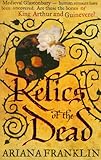
Relics of the Dead by Ariana Franklin

As soon as I’d finished reading The Death Maze I began Ariana Franklin’s third book in her Mistress of the Art of Death series, Relics of the Dead. Now this one was more to my liking and I enjoyed it very much.

The date is 1176, the setting is Glastonbury where the monks, after a fire had destroyed their monastery, discovered two skeletons buried in their graveyard. The question is  – are these the remains of King Arthur and Queen Guinevere? The problem is that Henry II needs evidence that they are not – that the legendary Arthur is indeed dead and not the ‘Once and Future King’, sleeping but waiting for the right time to lead the belligerent Welsh against him. Henry’s solution is to send Adelia Aguilar, the anatomist, to examine the bones for evidence, preferably to establish that no one can say that the bones are not that of Arthur and his queen. Given that this is the 12th century and the technology wasn’t there to prove the age and identity of the bones, Adelia assisted by Mansur, does a pretty good job in her investigation, despite attempts on her life.

Where Relics of the Dead stands out is in the depiction of Glastonbury, a mysterious, spiritual place, ‘one of the world’s sacred centres, a place where the division between man and God was thinner than anywhere else‘, a place where ‘there was a special magnetism that pulled people to worship a presence her long before Christ had set foot on his native heath.’ But Adelia, that down-to-earth, practical woman couldn’t feel it – for her all mysteries had to have an explanation. And she was determined to find it.

I’ve always liked the stories about King Arthur and the beliefs about his life and death, about Excalibur (which does feature in this book), about Guinevere’s affair with Lancelot,  and the Holy Grail (which do not). As well as a strong sense of place and atmosphere the characters are well-drawn and believable, even if some aspects of the plot required quite a hefty suspension of disbelief (which I managed easily enough).

Similarly I wasn’t bothered by Franklin’s use of modern language – in her Author’s Note, she had noted that she was sometimes criticised for making her characters use modern language and explained that ‘in 12th century England the common people spoke a form of English even less comprehensible than Chaucer’s in the 14th, the nobility spoke Norman French and the clergy Latin. Since people then sounded contemporary to each other, and since I hate the use of what I call ‘Gadzooks’ in historical novels to denote a past age, I insist on making them sound contemporary to us.’ If she had used such ‘gadzooks’ language I don’t think I’d have got very far into the book. And, it didn’t occur to me that her dialogue was anachronistic.

Franklin also used a lot of terms common to the age, such as ‘Mort d’Ancestor’, which she did explain within the text, so that that too did not bother me. In fact I liked it, I think it added to the atmosphere and I did enjoy looking up such terms for more information in a book I used to use a lot when I worked in a local archive repository – The Local Historian’s Encyclopedia by John Richardson, a fascinating book.

Ariana Franklin was the pseudonym of Diana Norman. She died in 2011. The last book in the series is The Assassin’s Prayer (published as Murderous Procession in the US), continuing Adelia’s story.

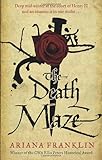
The Death Maze by Ariana Franklin

Normal service has been resumed – thankfully!! – I’m back to writing on this blog thanks to my son.

It seems quite a while since I finished reading Ariana Franklin’s The Death Maze (published as The Serpent’s Tale in the US), so these are just a few thoughts about the book.

Back in 2007 I’d really enjoyed her first book, Mistress of the Art of Death (which I wrote about here) and I was eager to read the next book about Adelia Aguilar, the 12th century anatomist employed by Henry II. But I was a bit put off by reports that The Death Maze was not as good, and other books grabbed my attention. Time passed, the third book came out – Relics of the Dead – and curiosity got the better of me so I bought both books, and eventually I got round to reading them – one after the other.

Yes, The Death Maze does not live up to the first book for me, but it’s still enjoyable. Rosamund Clifford, Henry II’s mistress has been poisoned, allegedly by Eleanor of Aquitane, Henry’s wife. Adelia is summoned to investigate her death. So, she sets off to Oxford, accompanied by her baby daughter, Allie, her servant Gyltha and the Saracen, Mansur, who has to pose as the doctor whilst Adelia pretends to be his assistant. Adelia was a graduate of the School of Medicine in Salerno, which, unlike England, allowed women to train as physicians; in England her forensic skills would have been considered witchcraft.
Rosamund had lived in a strange and sinister tower surrounded by a maze, constructed of walls of granite with blackthorn planted against them. So, the first problem Adelia had to solve was to find the way through the maze. She was then faced with the gruesome discovery of Rosamund’s dead body. The main thrust of the book centres on Eleanor’s moves to overthrow Henry II, and after Eleanor and her supporters capture Adelia, they take her to the nunnery at Godstow, where they wait snowbound for the right moment to launch their rebellion.

I think the book works well as historical fiction, even though as Ariana Franklin wrote in her Author’s Notes that there is only a brief reference to Rosamund Clifford in the historical records and so this is a fictional portrayal based on legend. And she inserted a fictional rebellion in England in a gap in the medieval records. It has whetted my appetite to know more about the period. But as crime fiction, I was rather disappointed because although I found the details of Rosamund’s death interesting, there was actually very little about Adelia’s investigation, very little for her to exercise her forsenic skills, which was one of the elements I’d enjoyed in Mistress of the Art of Death. 

This is my second book for Carl’s  R.I.P.VII challenge and it also slots into the Historical Fiction Challenge and the Mount TBR Challenge 2013.

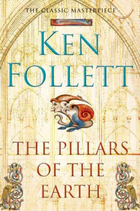
The Pillars of the Earth by Ken Follett

I’ve been working my way through some of the books I’ve owned for ages – books I really wanted to read when I bought them, but have since just sat on the bookshelves unread for a variety of reasons. I’ve had The Pillars of the Earth by Ken Follett for five years! The main reason I haven’t read it before now is its length – it has 1,076 pages!

I can’t remember now why I bought this book, possibly it was because I like historical novels and I like historic buildings and The Pillars of the Earth is set in 12th century England during the time of the civil war between Stephen and Matilda/Maud (she’s known by both names – in this book she’s called Maud, but at school we were taught her name was Matilda). It’s also the story of the building of a cathedral.

I was interested in the details of building a cathedral, the architecture and building techniques, but it is in essence a family saga. However it is so long-winded and repetitive that I began to think Follett must have written it as maybe three books and then joined them together without editing them, or maybe he was reminding himself of what he’d written earlier – it took him years to complete the book.

It’s a bit like a soap opera – terrible things happen, the characters overcome them and recover only to be knocked down again by more terrible events –  violence, power struggles and rape and pillage abound. It’s a bit simplistic with a really bad, evil character and a saintly one, a beautiful woman and a witch-type and so on. But it kept me entertained without having to think too hard and I even found myself thinking about it when I wasn’t reading, wondering what could possibly happen next. Parts of the novel came to life more than others – one being near the end of the book with the story of Thomas à Becket’s murder in Canterbury Cathedral.

There is a sequel, World Without End, set in the same place and featuring descendants of the original characters nearly 200 years after the events in The Pillars of the Earth. I’m not rushing to read it!

There was a TV version – I didn’t see it!