Six Degrees of Separation: from Three Women to …

I love doing Six Degrees of Separation, a monthly link-up hosted by Kate at Books Are My Favourite and Best. Each month a book is chosen as a starting point and linked to six other books to form a chain. A book doesn’t need to be connected to all the other books on the list, only to the one next to it in the chain.
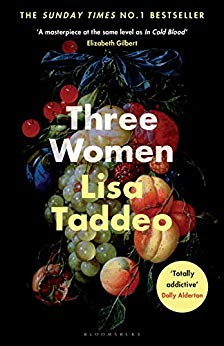
Three Women


This month the chain begins with Three Women by Lisa Taddeo – a book I haven’t read, or even heard of before. It’s described on Goodreads as Desire as we’ve never seen it before: a riveting true story about the sex lives of three real American women, based on nearly a decade of reporting. I have no desire to read it.

My first link is to one of the books I’m currently reading – a biography of D H Lawrence, a man who believed himself to be an outsider in angry revolt against his class, culture and country, and who was engaged in a furious commitment to his writing and a passionate struggle to live according to his beliefs. He also struggled all his life with his relationships with women, particularly about those with his mother and his wife, Frieda.

Leading on from Lawrence’s biography my second link is to his book, Women in Love,  a book I first read as a teenager. It’s about the relationships of two sisters, Ursula and Gudrun. Ursula falls in love with Birkin (a self portrait of Lawrence) and Gudrun has an affair with Gerald, the son of the local colliery owner. Later on I watched the film version with Glenda Jackson as Gudrun, Oliver Reed as Gerald, Alan Bates as Birkin and Jennie Linden as Ursula. Lawrence considered this book to be his best and the one that clearly showed his ideas of society at the time (1922).

Moving on from a book about sisters, my third link is to a book about brothers. It’s The Lost Man by Jane Harper, set in an isolated part of Australia hundreds of miles from anywhere and revolving around the death of Cameron Bright. There are three Bright brothers – Nathan the oldest, then Cameron and the youngest brother, Bub. They have a vast cattle ranch in the Queensland outback. The book begins with the discovery of Cameron’s body lying at the the base of the headstone of the stockman’s grave – a headstone standing alone, a metre high, facing west, towards the desert, in a land of mirages.

My fourth link is to another book set in Australia – Sarah Thornhill by Kate Grenville, a love story set in 19th century Australia, where the convicts, transported or ‘sent out‘ are  now called ‘old colonists‘. A story about prejudice – some people, those who had ‘come free‘,  thought being ‘sent out‘ meant you were tainted for all time, but for others having money and land overcame their distaste. And then there is the prejudice about the ‘blacks’. When Sarah, the daughter of William Thornhill, an ‘old colonist’ and now a landowner on the Hawkesbury River, falls in love with Jack Langland, whose mother was a native woman, racial prejudice and hatred rear their ugly heads.

Prejudice and racial tension is also uppermost in The Tea Planter’s Wife by Dinah Jefferies, set in Ceylon (now called Sri Lanka) in 1913. It was a time of unrest, with political and racial tension between the Sinhalese and Tamil workers and the British plantation owners. After a whirlwind romance, Gwendolyn Hooper marries a tea planter, Laurence, an older man, and a widower. But this is not the idyllic life she expected – there are secrets, locked doors and a caste system and culture that is alien to her. There is a mystery, too, surrounding the death of Caroline, Laurence’s first wife.

And so to the last link, which is to another book about the death of a wife. It’s The Evidence Against You by Gillian McAllister – Gabe English has been released from prison on parole, having served seventeen years for the murder of his wife, Alexandra. But nobody really knew exactly what had happened the night Alexandra was killed – she simply went missing and then her body was found – she’d been strangled. Gabe’s daughter Izzy thought that her father could never have harmed anybody, let alone her mother. Now, he swears that he is innocent and wants to tell his side of it. He asks her to consider the evidence for herself. But is he really guilty – can she trust her father?

My chain is link by books about women, sisters and brothers, prejudice and racial tension, books set in Australia and about the deaths of wives. It passes from America to Great Britain,  and Sri Lanka, via books of crime fiction, historical fiction and non-fiction.

Next month (November 2, 2019), we’ll begin with Alice’s Adventures in Wonderland – a book I have read and loved.
My Friday Post: Black Water Lilies by Michel Bussi

Book Beginnings Button

Every Friday Book Beginnings on Friday is hosted by Gillion at Rose City Reader where you can share the first sentence (or so) of the book you are reading, along with your initial thoughts about the sentence, impressions of the book, or anything else the opener inspires.

Last week I bought Black Water Lilies by Michel Bussi and I can’t resist starting it even though there are plenty of books in my TBR piles that I ‘should’ be reading. 
 
Black water lilies

Three women lived in a village.

The first was mean, the second a liar, and the third was an egoist.

Their village bore the pretty name of a garden, Giverny.

Also every Friday there is The Friday 56, hosted by Freda at Freda’s Voice.

30879-friday2b56These are the rules:

  1. Grab a book, any book.
  2. Turn to page 56, or 56% on your eReader. If you have to improvise, that is okay.
  3. Find any sentence (or a few, just don’t spoil it) that grabs you.
  4. Post it.
  5. Add the URL to your post in the link on Freda’s most recent Friday 56 post.

Pages 56 -7:

He used to be an art teacher in the United States, he tells her. He never stops saying that she talks all the time, and even though she’s very gifted, she needs to be able to concentrate more. Like Monet did.

I’ve read one other book by Michel Bussi, Time is a Killer, which I really enjoyed and so I thought I’d like this one. It’s the story of a mystery, of thirteen days that begin with one murder and end with another. Jérôme Morval, a man whose passion for art was matched only by his passion for women, has been found dead in the stream that runs through the gardens at Giverny, where Monet did his famous paintings.

Have read this book? What did you think about it? And if you haven’t, would you keep on reading?

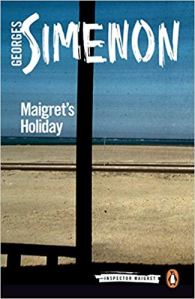
My Friday Post: Maigret’s Holiday by Georges Simenon

Book Beginnings Button

Every Friday Book Beginnings on Friday is hosted by Gillion at Rose City Reader where you can share the first sentence (or so) of the book you are reading, along with your initial thoughts about the sentence, impressions of the book, or anything else the opener inspires.

Maigret’s Holiday by Georges Simenon is one of my TBRs, the 28th Inspector Maigret novel in which Maigret’s wife falls ill whilst on their seaside holiday at Les Sables d’Olonne and  a visit to the hospital sends him on an unexpected quest to find justice for a young girl.

Maigret's Holiday


The street was narrow, like all the streets in the old quarter of Les Sables d’Olonne, with uneven cobblestones and pavements so narrow that you had to step off to let another person pass.

Also every Friday there is The Friday 56, hosted by Freda at Freda’s Voice.

30879-friday2b56These are the rules:

  1. Grab a book, any book.
  2. Turn to page 56, or 56% on your eReader. If you have to improvise, that is okay.
  3. Find any sentence (or a few, just don’t spoil it) that grabs you.
  4. Post it.
  5. Add the URL to your post in the link on Freda’s most recent Friday 56 post.

Page 56:

‘I was very fond of that girl, but I repeat that my feelings for her were purely fraternal. I am aware that things are often otherwise. A man can easily be in love with two sisters, especially if they are both living under his roof. That is not the case  and besides, Lili was not in love with me. I’ll go further. I was the exactly the opposite of what she loved. She found me cold and cynical. She often said I had no heart.’

I’ve been reading the Maigret books as I come across them – so, totally out of order of publication. It doesn’t seem to matter. Maigret’s Holiday was originally published in 1948

Have read this book? What did you think about it? And if you haven’t, would you keep on reading?

First Chapter First Paragraph: The Vanished Bride by Bella Ellis

Every Tuesday First Chapter, First Paragraph/Intros is hosted by Vicky of I’d Rather Be at the Beach sharing the first paragraph or two of a book she’s reading or plans to read soon.

This week I’m featuring The Vanished Bride by Bella Ellis, one of the books I’m currently reading.

Vanished Bride

Haworth Parsonage, December 1851

Drawing her shawl a little closer around her, Charlotte adjusted her writing slope once more and dipped the nib of her pen into the ink, her head bent low, nose just above the paper. Yet, just as so many times before, her hand hovered over the blank page, and it seemed impossible to put pen to paper in a house so empty of anything but the ghosts of those she loved.

Blurb 

A young woman has gone missing from her home, Chester Grange, leaving no trace, save a large pool of blood in her bedroom and a slew of dark rumours about her marriage. A few miles away across the moors, the daughters of a humble parson, Charlotte, Emily, and Anne Brontë are horrified, yet intrigued.

Desperate to find out more, the sisters visit Chester Grange, where they notice several unsettling details about the crime scene: not least the absence of an investigation. Together, the young women realise that their resourcefulness, energy and boundless imaginations could help solve the mystery – and that if they don’t attempt to find out what happened to Elizabeth Chester, no one else will.

The path to the truth is not an easy one, especially in a society which believes a woman’s place to be in the home, not wandering the countryside looking for clues. But nothing will stop the sisters from discovering what happened to the vanished bride, even as they find their own lives are in great peril…

~~~

I’ve read nearly half the book so far and I’m really enjoying it. And it is making keen to get back to reading Juliet Barker’s biography, The Brontës, which I began reading last year!

What do you think – does The Vanished Bride appeal to you too?

Six Degrees of Separation: from A Gentleman in Moscow to …

I love doing Six Degrees of Separation, a monthly link-up hosted by Kate at Books Are My Favourite and Best. Each month a book is chosen as a starting point and linked to six other books to form a chain. A book doesn’t need to be connected to all the other books on the list, only to the one next to it in the chain.

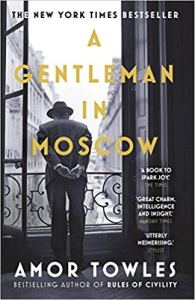
A Gentleman in Moscow

This month the chain begins with A Gentleman in Moscow by Amor Towles – a book I haven’t read, or even heard of before. It looks interesting from the description on Amazon:

On 21 June 1922, Count Alexander Rostov – recipient of the Order of Saint Andrew, member of the Jockey Club, Master of the Hunt – is escorted out of the Kremlin, across Red Square and through the elegant revolving doors of the Hotel Metropol.

Deemed an unrepentant aristocrat by a Bolshevik tribunal, the Count has been sentenced to house arrest indefinitely. But instead of his usual suite, he must now live in an attic room while Russia undergoes decades of tumultuous upheaval.

Can a life without luxury be the richest of all?

My first link is to another book set in Moscow – Mrs Harris goes to Moscow by Paul Gallico This is a lovely little book. Mrs Harris is a London char lady who wins a trip to Moscow, where she wants to find her employer’s long-lost love. Mayhem ensues when she is thought to be Lady Char (the Russians not understanding what a ‘char lady’ is had converted it to ‘Lady Char’) and also a spy.

My second link is to a book about another visitor to Moscow: Archangel by Robert Harris. Set in present day Russia, it tells the story of Fluke Kelso, a former Oxford historian who is in Moscow for a conference on the newly opened Soviet archives. He learns of the existence of a secret notebook belonging to Josef Stalin and his search takes him to the vast forests near the White Sea port of Archangel.

Moving away from Moscow, but still in Russia my third link is Midnight in St Petersburg by Vanora Bennett. It begins in 1911 in pre-revolutionary Russia with Inna Feldman travelling by train to St Petersburg to escape the pogroms in Kiev. I liked the way Inna’s personal story is intermingled with the historical characters of the time, including Father Grigory (Rasputin), Prince Youssoupoff and Lenin.

The next book that came into my mind is another book set in St Petersburg and featuring Rasputin – Sashenka by Simon Sebag Montefiore. It begins in 1916 in St Petersburg. Sashenka’s mother parties with Rasputin whilst Sashenka is involved with conspiracy. It then moves forward to 1939 in Moscow under Stalin and ends in the 1990s when a young historian researches her life and discovers her fate. I haven’t read this book yet, even though I’ve had it for a long time.

My fifth link is a book I did read a long time ago, also set in Russia during the Russian Revolution – Doctor Zhivago by Boris Pasternak. At this distance in time my memories of it are a bit vague, but I remember more about the film of the book starring Julie Christie and Omar Sharif amongst others. I’d love to read it again sometime …

And so to the last link. It really should be to another book set in Russia to complete the chain with just one common theme. I wondered about a few – Anna Karenina, The Brothers Karamazov, or War and Peace, but eventually settled on a non fiction book, A People’s Tragedy: the Russian Revolution by Orlando Figes,  Unlike the other books in my chain I haven’t read this book, and it is not one of my TBRs – but it is now. It’s been described as the most vivid, moving and comprehensive history of the Russian Revolution available today. It’s long – 960 pages – and has won several awards.


My chain has one link throughout – Russia – passing from Moscow to St Petersburg and covering the modern day and the Russian Revolutionary period. Apart from the last book they are all fiction, beginning with the rather twee novel about Mrs Harris in Moscow. And for once I haven’t included any crime fiction!

Next month (October 5, 2019), we’ll begin with Three Women by Lisa Taddeo.

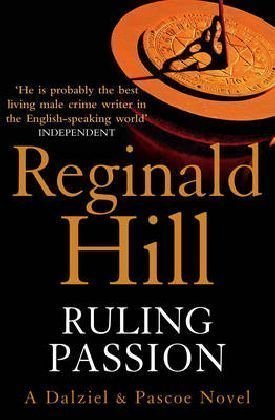
My Friday Post: Ruling Passion by Reginald Hill

Book Beginnings Button

Every Friday Book Beginnings on Friday is hosted by Gillion at Rose City Reader where you can share the first sentence (or so) of the book you are reading, along with your initial thoughts about the sentence, impressions of the book, or anything else the opener inspires.

Ruling Passion by Reginald Hill is one of the books I’m reading at the moment.  It’s one of my TBRs, the third Dalziel and Pascoe book in which Pascoe finds his social life and work uncomfortably brought together by a terrible triple murder. Meanwhile, Dalziel is pressuring him about a string of unsolved burglaries, and as events unfold the two cases keep getting jumbled in his mind.

Ruling passion

Brookside Cottage,Thornton Lacey. September 4th.

Well hello, Peter Pascoe!

A voice from the grave! Or should I say the underworld? Out of which Ellie (who gave me the glad news of your existence when we met in town last month) hopes to lead you, for a while at least, back into the land of the living.

As soon as I finished reading the 2nd book in the series, An Advancement of Learning, I just had to start the third. I’ve read some of the later books but not the early ones, so I’m keen to know more about Dalziel and Pascoe. In An Advancement of Learning Pascoe and Ellie (his wife in the later books) had just renewed the relationship they’d had at university and so I’m pleased to see in the opening chapters of this book that they are together. In this first chapter a friend from their university days has invited them to stay for a weekend in the country.

Also every Friday there is The Friday 56, hosted by Freda at Freda’s Voice.

30879-friday2b56These are the rules:

  1. Grab a book, any book.
  2. Turn to page 56, or 56% on your eReader. If you have to improvise, that is okay.
  3. Find any sentence (or a few, just don’t spoil it) that grabs you.
  4. Post it.
  5. Add the URL to your post in the link on Freda’s most recent Friday 56 post.

Page 56:

‘We got on very well from the start. I’d only known her and Colin a couple of months, but we soon got on friendly terms. That’s why it came as such a shock … I still can’t believe it.’

The weekend in the country has turned into a nightmare!

Have read this book? What did you think about it? And if you haven’t, would you keep on reading?