Library Books: April 2021

Our libraries are now open – for limited browsing and the ‘Select and Collect’ service they’ve been running whilst the libraries have been closed. The mobile library is also back and on Tuesday the van came almost to our door, backing down our access drive! We still couldn’t go in the van, but could ask for books. There were no books by the authors I wanted, but there was plenty of crime fiction to choose from – I realise now how limited my crime fiction reading has been as these are all by authors I hadn’t heard of before.

As they are all new-to-me authors I’ve included some details about them – two are American , two are British and three of them are also screenwriters.

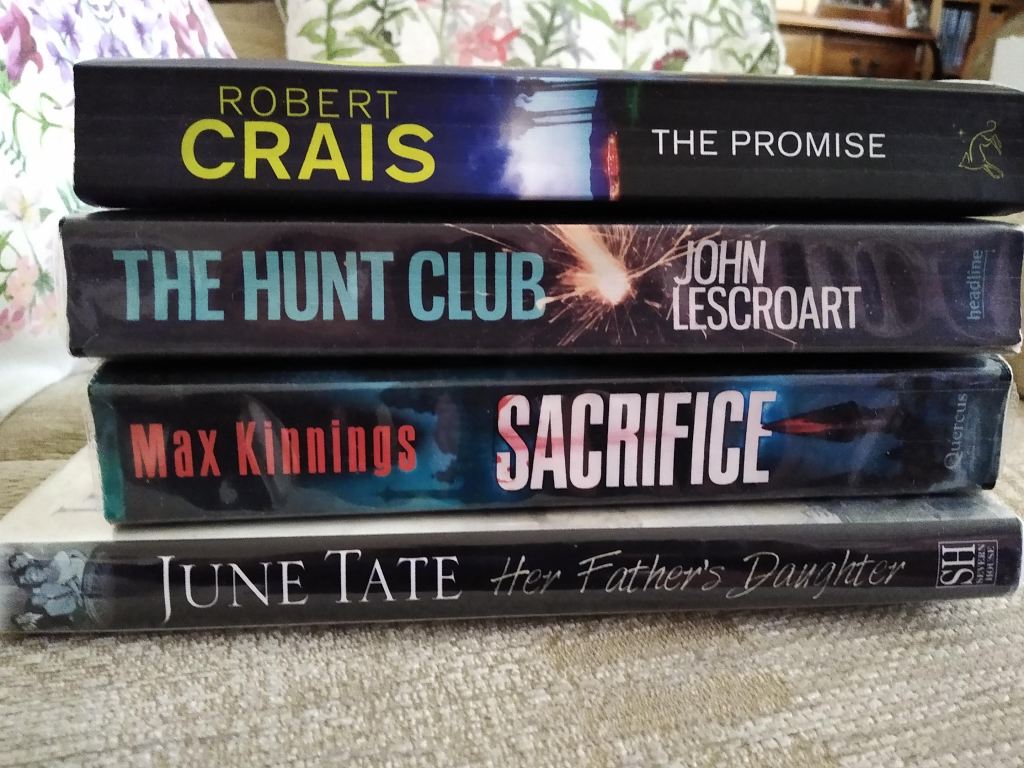
From top to bottom they are:

The Promise by Robert Crais, an Elvis Cole and Joe Pike novel.

Robert Crais is a New York Times bestselling author of twenty novels, sixteen of them featuring private investigator Elvis Cole and his laconic ex-cop partner, Joe Pike. Before writing his first novel, Crais spent several years writing scripts for such major television series as Hill Street BluesCagney & LaceyMiami ViceQuincyBaretta, and L.A. Law. He received an Emmy nomination for his work on Hill Street Blues, and one of his standalone novels, Hostage, was made into a movie starring Bruce Willis. His novels have been translated into forty-two languages and are bestsellers around the world. A native of Louisiana, he lives in Los Angeles.

Book description: Loyalty, commitment, the fight against injustice – these are the things that have always driven Elvis Cole and Joe Pike. If they make a promise, they keep it – even if it could get them killed. When Elvis Cole is hired to locate a woman who may have disappeared with a stranger she met online, it seems like an ordinary case – until Elvis learns the missing woman worked for a defence contractor and was being blackmailed to supply explosives components for a person or persons unknown.

The Hunt Club by John Lescroart, the first Wyatt Hunt murder mystery.

John Lescroart is an American author best known for two series of legal and crime thriller novels featuring the characters Dismas Hardy and Abe Glitsky. In addition to his novels, Lescroart has written several screenplays. He is the author of twenty-nine novels.

Book description: Wyatt Hunt is a self-employed P.I., working low-profile surveillance and insurance fraud cases. Following the death of his fiancée and a twelve-year stint with San Francisco’s Child Protective Services, he isn’t looking for any trouble. So when a federal judge is found murdered in his Pacific Heights home with his mistress, Wyatt figures it’s someone else’s case – until his friend and business associate, attorney Andrea Parisi, becomes the lead suspect in the murder. The case takes a wild turn after Andrea mysteriously disappears, and with the help of his confederation of friends, stringers, and associates – known as the Hunt Club – Wyatt does whatever he must to find Andrea and bring a murderer to justice.

Sacrifice by Max Kinnings, an Ed Mallory thriller.

Max Kinnings is a screenwriter and novelist based in Oxford, England. Max has written feature films, Act of Grace (2012), Alleycats (2016) and The Pagan King (2018) as well as various projects in development including an adaptation of his novel, Baptism. He is the author of four novels, Hitman (2000), The Fixer (2002), Baptism (2012) and Sacrifice (2013). He was the ghost writer of actor/comedian Rik Mayall’s bestselling spoof autobiography, Bigger Than Hitler Better Than Christ (2005) and part of the writing team for the award winning Sony PlayStation game, Little Big Planet 3 (2014). Prior to writing full-time, Max spent twelve years devising advertising and marketing campaigns for music festivals, tours, comedy shows and West End theatre productions. He lectures in Creative Writing at Brunel University London where he was recently awarded a PhD.

Book description:

London, Christmas Morning.

09:13am. Disgraced hedge fund manager Graham Poynter hides shamefully in his Belgravia mansion.

10:16am. A masked intruder stands over Poynter and his terrified family, while the last remaining security guard hangs impaled on a railing spike outside the house.

10:38am. Surrounding the scene are police helicopters, special forces teams, and Ed Mallory – blind hostage negotiator – who must stop this twisted retribution.

Her Father’s Daughter by June Tate – other people who borrowed this book said they didn’t know what to make of it – it’s funny book, not funny ha ha but funny peculiar, so I thought I’d see what I think.

June Tate was born in Southampton and spent the early years of her childhood in the Cotswolds. After leaving school she became a hairdresser on cruise ships the Queen Mary and the Mauritania, meeting many Hollywood film stars and VIPs on her travels. She has written 22 books. I found this post on Allison and Busby’s blog about how she constructs an authentic sense of period in her novels.

Book description: On the night before the grand reopening of Club Valletta, former Wren Victoria Teglia can’t help but wonder what her late father would think. She can still clearly remember the day her mother told her that, rather than simply being a courageous hero, her father was also a criminal, and his club was a hotbed of prostitution and illegal gambling.

I’m not sure about any of them – so, I’d love to know what you think – have you read any of these books, if so did you enjoy them? If not, do they tempt you?

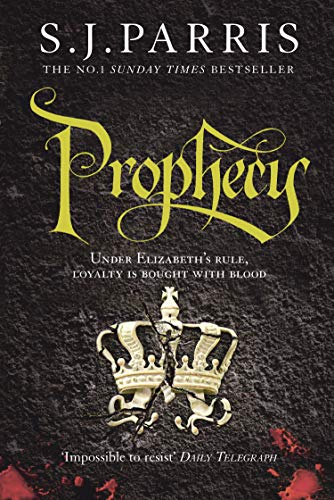
My Friday Post: Prophecy by S J Parris

Every Friday Book Beginnings on Friday is hosted by Gillion at Rose City Reader where you can share the first sentence (or so) of the book you are reading. You can also share from a book you want to highlight just because it caught your fancy.

This week I’m featuring one of my library books, Prophecy, It’s the second in S J Parris’ Giordano Bruno series set in the reign of Elizabeth I. Bruno was a monk, poet, scientist, and magician on the run from the Roman Inquisition on charges of heresy for his belief that the Earth orbits the sun and that the universe is infinite. In this book set in 1583, Elizabeth’s throne is in peril, threatened by Mary Stuart’s supporters scheme to usurp the rightful monarch.

It begins with a Prologue:

Mortlake, House of John Dee
3rd September, Year of Our Lord 1583

Without warning, all the candles in the room’s corners flicker and feint, as if a sudden gust has entered, but the air remains still. At the same moment, the hairs on my arms prickle and stand erect and I shudder; a cold breath descends on us, though outside the day is close.

Also every Friday there is The Friday 56, hosted by Freda at Freda’s Voice. *Grab a book, any book. *Turn to Page 56 or 56% on your  ereader . If you have to improvise, that is okay. *Find a snippet, short and sweet, but no spoilers!

Page 56:

‘Treaties be damned!’

Henry Howard throws back his chair and pounds a fist on the table, so suddenly that again we all jolt in our seats. The candles have burnt down so far that his shadow leaps and quivers up the panels behind him and creeps over the ceiling, looming like an ogre in a children’s tale.

Lord Henry Howard, was a devout Catholic and a dangerous man, the head of the most powerful Catholic family in England. He took part in the 1583 Throckmorton Plot, one of a series of attempts by English Roman Catholics to depose Elizabeth I of England and replace her with Mary, Queen of Scots, then held under house arrest in England.

Candles flickering, shadows cast and a feeling of dread and suspense in both these extracts set the scene for a thrilling story!

Library Books – December 2020

I last wrote about the books I’ve borrowed from the library in February – just before the lockdown in March. Although the libraries opened up a while ago with a Select and Collect service I haven’t used it and now there is time-limited browsing at some branches, and the mobile library is also operating. On Tuesday it came here and I ventured up the road to the library van.

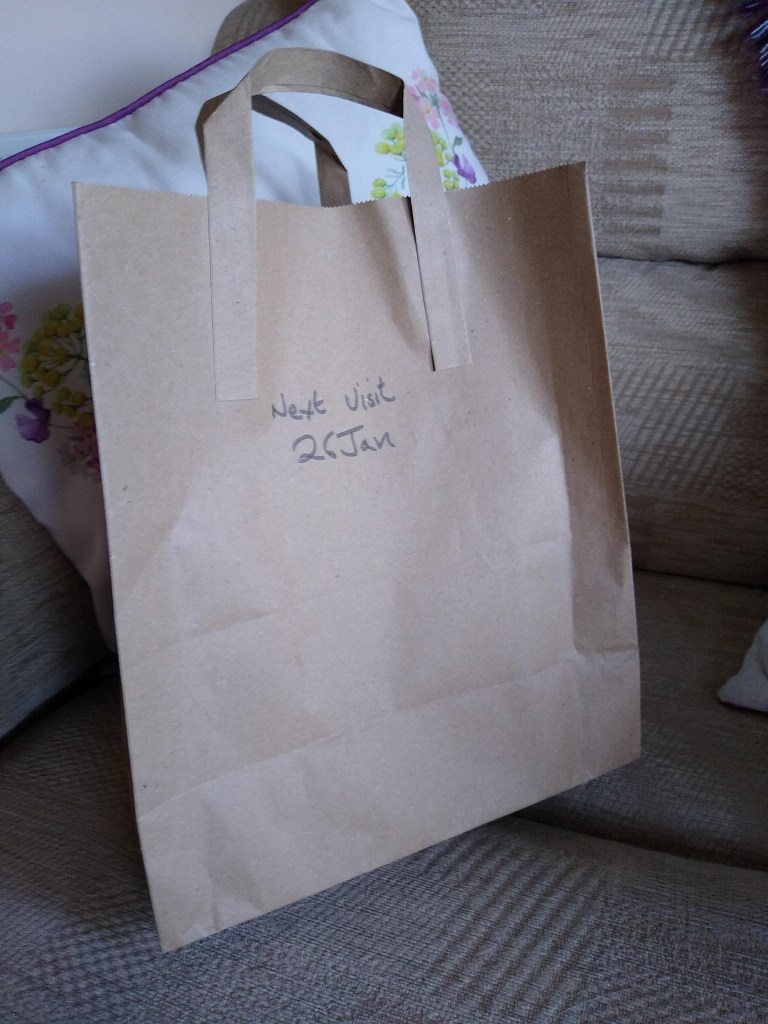
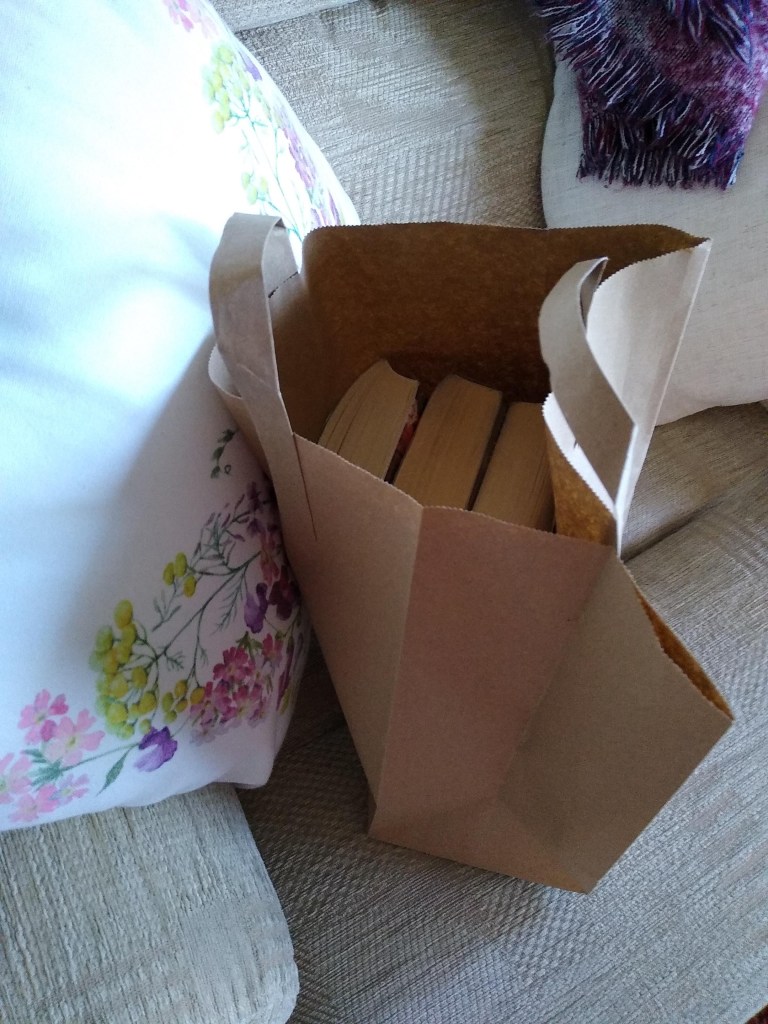
We can’t actually go into it but I could ask for books – I came home with just three. I had to wait for a couple of days before I could actually touch them. Here they are in a library bag showing the date of the next mobile visit.

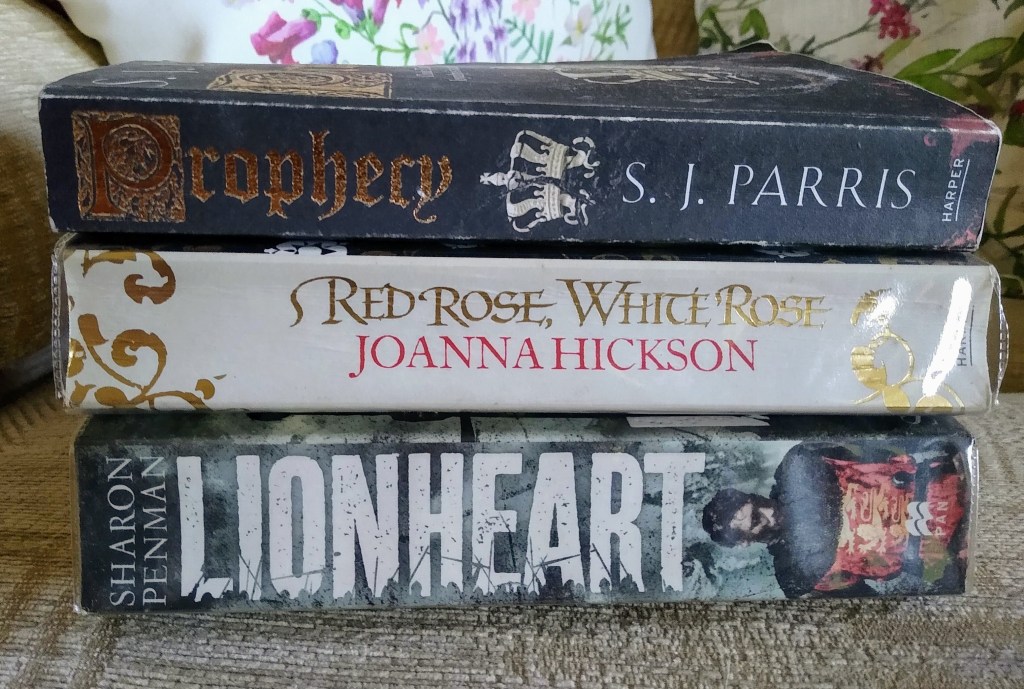
Today I took them out of the bag – all historical fiction:

I haven’t read any of S J Parris’ books before but Prophecy looks very interesting. It’s the second in her Giordano Bruno series set in the reign of Elizabeth I. Bruno was a monk, poet, scientist, and magician on the run from the Roman Inquisition on charges of heresy for his belief that the Earth orbits the sun and that the universe is infinite. In this book set in 1583, Elizabeth’s throne is in peril, threatened by Mary Stuart’s supporters scheme to usurp the rightful monarch.

Next Red Rose, White Rose by Joanna Hickson, set in 15th century England during the Wars of the Roses when Cecily Neville was torn between both sides. Her father was Richard Neville, the Duke of Westmorland and a staunch Lancastrian and she married Richard Plantagenet of York and became the mother of Edward IV and Richard III. I’ve read and enjoyed two of her books, The Tudor Crown and The Lady of the Ravens, so I’m expecting to like this book too.

I’ve always been fascinated by stories of Richard the Lionheart, so Lionheart by Sharon Penman about Richard I appeals to me. Richard was crowned King in 1189 and set off almost immediately on the Third Crusade to regain the Holy Land. Sharon Penman’s The Sunne in Splendour is one of my all time favourite books, and I have four more by her in my Kindle waiting to be read – Here Be Dragons, The Queen’s Man, Prince of Darkness and When Christ and His Saints Slept. So I can see that next year will be a Penman reading feast – and I may have to buy an e-book copy of Lionheart as the font is minute in the printed book!

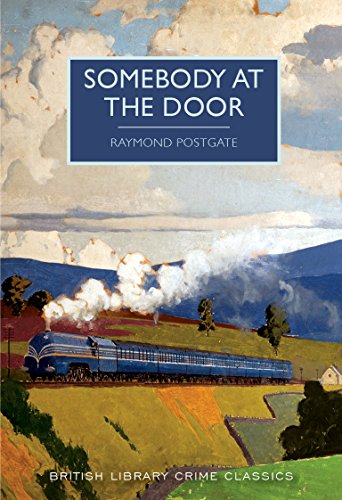
Somebody at the Door by Raymond Postgate

Rating: 4 out of 5.

Somebody at the Door is one of the British Library Crime Classics, originally published in 1943. It’s set in 1942 and it gives a vivid picture of what life was like in wartime England. There is an interesting introduction by Martin Edwards.

In January 1942, Henry Grayling is on the 6.12 train from Euston, travelling home to Croxburn from work in London. There’s a fuel shortage so there are less trains than usual and the carriages are crowded – Grayling views all his fellow passengers with dislike and suspicion as he clutches his attache case, containing £120 pounds close to his chest.

He sits next to a young man, Evetts, who works for the same company and is smoking a foul smelling pipe, and on his other side is the Vicar of Croxburn, both of whom he knows. He also recognises Ransom, a corporal in the Home Guard platoon in which he, Grayling is a second lieutenant. The other occupants of the carriage are a fair young man with a club foot, a refugee doctor, a fat middle aged woman and her teenage daughter, and two young working men in overalls. Most of the passengers are suffering from colds, coughing and sneezing and Grayling has to hold his handkerchief in front of his nose. He is relieved to leave the train when it eventually pulls into the station at Croxburn. However, when Grayling arrived home he is seriously ill and dies later that evening.

An autopsy reveals that he had died of mustard gas poisoning and Inspector Holly finds that there are too many suspects; Grayling was an extremely unlikable person. The rest of the book reads like a collection of short stories as Holly investigates Grayling’s fellow passengers. Their stories are detailed and at times I felt they were too long and slowed the book down too much, but they are interesting in themselves. I particularly like the German refugee’s story, casting light on what life was like in Germany just before and at the onset of the war.

I did enjoy the book, the characters stand out as real people and also reflect Postgate’s own likes and dislikes. Martin Edwards’ introduction gives the background to Postgate’s writing – he was an atheist and a one-time Communist. His stories reveal the corruption in local government at that period, and the attitudes of the British government in the lead up to the war. The murder mystery is really secondary to the suspects’ stories, which makes the book more a reflection of the period, which Postgate does really well, than crime fiction. However, the murder mystery is well plotted, giving me plenty to unravel and it was only in the final section that I guessed who had killed Grayling.

  • Kindle Edition
  • File Size : 3089 KB
  • Print Length : 239 pages
  • Publisher : British Library Publishing (10 Oct. 2017)
  • Source: Prime Reading Library

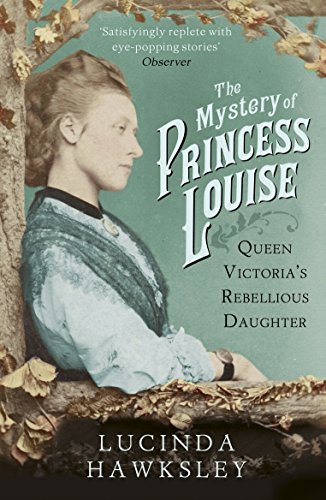
The Mystery of Princess Louise by Lucinda Hawksley

Mystery of Princess Louise

Vintage Books | 2014 | 416 pages | Paperback | library book | 4.5*

This is another catching up post. I finished reading The Mystery of Princess Louise: Queen Victoria’s Rebellious Daughter by Lucinda Hawksley during lockdown on 21 April, but didn’t feel like reviewing it that time. It’s a library book and as the library is still closed it has been renewed automatically for me.

Princess Louise was Victoria’s sixth child – her fourth daughter, born on 18th March 1848. It was an agonising and terrifying birth in a year of revolution and rebellion, a time when royal families throughout Europe were being deposed and in Britain the working classes were agitating for higher pay, better working conditions and more legal rights.

There is so much detail about her life in this book, packed with intrigues, scandals and secrets.

Blurb:

What was so dangerous about Queen Victoria’s artistic tempestuous sixth child, Princess Louise?

When Lucinda Hawksley started to investigate, often thwarted by inexplicable secrecy, she discovered a fascinating woman, modern before her time, whose story has been shielded from public view for years.

Louise was a sculptor and painter, friend to the Pre-Raphaelites and a keen member of the Aesthetic movement. The most feisty of the Victorian princesses, she kicked against her mother’s controlling nature and remained fiercely loyal to her brothers – especially the sickly Leopold and the much-maligned Bertie. She sought out other unconventional women, including Josephine Butler and George Eliot, and campaigned for education and health reform and for the rights of women. She battled with her indomitable mother for permission to practice the ‘masculine’ art of sculpture and go to art college – and in doing so became the first British princess to attend a public school.

The rumours of Louise’s colourful love life persist even today, with hints of love affairs dating as far back as her teenage years, and notable scandals included entanglements with her sculpting tutor Joseph Edgar Boehm and possibly even her sister Princess Beatrice’s handsome husband, Liko. True to rebellious form, she refused all royal suitors and became the first member of the royal family to marry a commoner since the sixteenth century.

My thoughts:

I knew nothing about Princess Louise. She had a difficult childhood, disliked and bullied by her mother and she often rebelled against the restrictions of life as a princess. She had an unhappy marriage to John Campbell, the Marquess of Lorne, later the 9th Duke of Argyll, a homosexual, and went with him to Canada in 1882 when he was appointed as Governor-General. Her relationship with Canada became a love-hate one, but began and ended with Canadian adoration.

The scandals arose about whether she had had an illegitimate child and her long term love affair with the sculptor Joseph Boehm. The mystery is still unresolved as Louise’s files in the Royal Archives are closed and her husband’s family archives are inaccessible.

Lucinda Hawksley writes:

I discovered that it was not only information about Princess Louise that had been hidden away, but information about a vast number of people who had played a role in her life, including royal servants and her art tutors. A great many items about these people that one would expect to be in other collections have been absorbed into the Royal Collection. … Over the decades, there has been some very careful sanitising of Princess Louise’s reputation and a whitewashing of her life, her achievements and her personality. (page 3)

I was amazed at her achievements, not only her artistic ability in both painting and sculpture, but also her charitable activities, raising money for hospitals, schools and other causes, such as the Gentlewomen’s Employment Association. She supported general suffrage and equal rights for both genders. She was fascinated by the social reformer Josephine Butler, who campaigned for the abolition of slavery, fed the homeless and worked with prostitutes and single mothers. Louise wanted to help Josephine in her campaign to reform the Contagious Diseases Act but Victoria and most of the rest of her family were outraged and she was forced not to take part. Louise was unconventional, generous and charming to people she liked.

It’s not a book to read quickly, as despite the lack of records, it is very detailed. There is an index and a bibliography, as well as several photographs. In this post I have simply skimmed the surface of all the stories about her, many of them simply amazing. I came away with the impression that she was ahead of her times. She was a forceful personality:

She was renowned by the public for her good looks, her unusual artistic dress sense and her sense of humour. Most importantly, Louise was also known for her compassion and her many ‘good works’. … She was regularly described as ‘captivating’, ‘charming’ and ‘clever’. people felt able to approach her, members of the public wrote letters to her, or begged for her help with charitable of political causes. … she spoke openly and controversially about subjects that other people shrank from and she was not above criticising the monarch. (page 11)

Louise died in 1939 at her home in Kensington Palace. Her last rebellious action was to leave instructions for her cremation – it was a very divisive issue, many were firmly against the idea. Her wishes were respected and a private cremation was carried out and the urn containing her ashes was transported to the Albert Memorial Chapel in Windsor, where her funeral was held. The next day they were interred in the Royal Burial Ground behind the family mausoleum at Frogmore in the Windsor Home Park. She had no legitimate children and the boy that it was claimed she had given up for adoption died in 1907. So it seems unlikely that the truth will ever be known unless the records are released.

My Friday Post: A Body in the Bath House by Lindsey Davis

Book Beginnings Button

Every Friday Book Beginnings on Friday is hosted by Gillion at Rose City Reader where you can share the first sentence (or so) of the book you are reading, along with your initial thoughts about the sentence, impressions of the book, or anything else the opener inspires.

A body in the bath house

A Body in the Bath House by Lindsey Davis is one of my current library loans. It’s historical crime fiction, a Marcus Didius Falco novel, an ‘informer with a nose for trouble’.


But for Rhea Favonia, we might have lived there.

‘There’s a smell! There’s a horrible smell. I’m not going in there!’

I didn’t need to be an informer to know we were stuck. When a four-year-old girl reckons she has detected something nasty, you just give in and look for it.

Also every Friday there is The Friday 56, hosted by Freda at Freda’s Voice.

30879-friday2b56These are the rules:

  1. Grab a book, any book.
  2. Turn to page 56, or 56% on your eReader. If you have to improvise, that is okay.
  3. Find any sentence (or a few, just don’t spoil it) that grabs you.
  4. Post it.
  5. Add the URL to your post in the link on Freda’s most recent Friday 56 post.

Page 56:

‘Imagine Britain as a rough triangle.’ Helena had a letter in her hand, so well studied she hardly referred to it. ‘We are going to the middle of the long south coast. Elsewhere there are high chalk cliffs, but this area has a gentle coastline with safe anchorages in inlets. There are some streams and marshland but also wooded places for hunting and enough good farming land to attract settlers. The tribes have come down from their hillforts peacefully here. Noviomagus Regnensis – the New Market of the Kingdom Tribes – is a small town on the modern model.’

Noviomagus Regnensis was the Roman town which is today called Chichester, in the modern English county of West Sussex.

Blurb

AD 75. As a passion for home improvement sweeps through the Roman Empire, Falco struggles to deal with a pair of terrible bath-house contractors who have been causing him misery for months. Far away in Britain, King Togidubnus of the Atrebates tribe is planning his own makeover. His huge new residence (known to us as Fishbourne Palace) will be spectacular – but the sensational refurbishment is beset by ‘accidents’. The frugal Emperor Vespasian is paying for all this; he wants someone to investigate.

Falco has a new baby, a new house, and he hates Britain. But his feud with Anacrites the Chief Spy has now reached a dangerous level, so with his own pressing reasons to leave Rome in a hurry, he accepts the task. A thousand miles from home, he starts restoring order to the chaotic building site and realises that someone with murderous intentions is now after him…

~~~

Fishbourne Roman Palace is in the village of Fishbourne, Chichester in West Sussex. The palace is the largest residential Roman building discovered in Britain, dated 75 AD, around thirty years after the Roman conquest of Britain.

Have you read this book? What did you think?