Miss Austen & Godmersham Park by Gill Hornby

In January I read Miss Austen by Gill Hornby, but despite enjoying it I didn’t write about it then. And in September I read Godmersham Park. Both are based on Jane Austen and her relationships with family and friends.

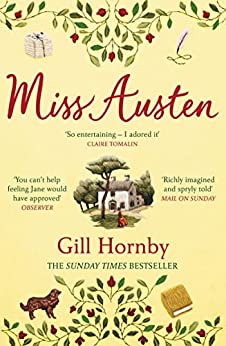
Miss Austen is the untold story of the most important person in Jane’s life – her sister Cassandra. After Jane’s death, Cassandra lived alone and unwed, spending her days visiting friends and relations and quietly, purposefully working to preserve her sister’s reputation. Set in 1840, Cassandra in her ’60s, visits Isabella Fowle following the death of her father, the Reverend Fowle when Isabella is packing up her parents’ belongings so that a new reverend can move in. Cassandra is convinced that her own and Jane’s letters to Eliza Fowle, the mother of Cassandra’s long-dead fiancé, are still somewhere in the vicarage. Eventually she finds the letters and confronts the secrets they hold, secrets not only about Jane but about Cassandra herself. Will Cassandra reveal the most private details of Jane’s life to the world, or commit her sister’s legacy to the flames?

I was surprised by how much i enjoyed this book as I don’t usually like spin-offs, sequels or prequels of my favourite books, but I really enjoyed this book as Cassandra relives her life with Jane, revealing what life was like for spinsters living in the early 1800s. It is different from Jane Austen’s own novels but still manages to recreate that flavour of her novels that I have loved ever since I first read Pride and Prejudice. It’s very well researched, a novel that held my attention from the beginning right to the end. A definite 4.5 star book.

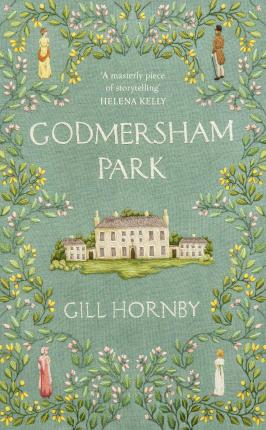
I didn’t enjoy Godmersham Park quite as much as Miss Austen. It is the fictionalised life of Anne Sharp, employed as the governess to Fanny, Jane Austen’s niece. Fanny’s father was Edward Austen, who was adopted by the wealthy Knight family (Thomas Knight was a cousin), taking their name in 1812. Anne became one of Jane’s closest friends.

Little is actually known about Anne as Gill Hornby acknowledges in her Author’s Note. So the story of her early life before her arrival in 1804 at Godmersham Park is a ‘fiction, fashioned out of the biographies of other, contemporary genteel ladies who found themselves working as governesses.’ But the two years she spent working for the Austen family were recorded by Fanny in her diaries and so Gill Hornby has closely followed her account. Henry Austen, Jane’s favourite brother was a regular visitor at Godmersham and Jane, Cassandra and their mother visited too during those two years.

Anne had no experience of teaching, but was left with no alternative as her mother had died and she had to find employment. She found it difficult – treated neither as a servant nor as one of the family, she risked dismissal if she overstepped the mark. Similarly she found that Henry Austen’s attention put her in the most awkward situations. But when Jane visited she was able to relax in her company and the two struck up a friendship.

I can’t quite put my finger on why I find this novel not as good as Miss Austen. But it moves at a slower pace and apart from the mystery that surrounds Anne’s father, I didn’t find it as absorbing – there’s that anticipation in Miss Austen of will Cassandra find the letters and what will they reveal. In parts Godmersham Park came over to me as just a tiny bit flat and I never grew as fond of Anne as I did of Cassandra. Having said that, I did enjoy this book enough to give it 3.5 stars.

Library Books 18 June 2022

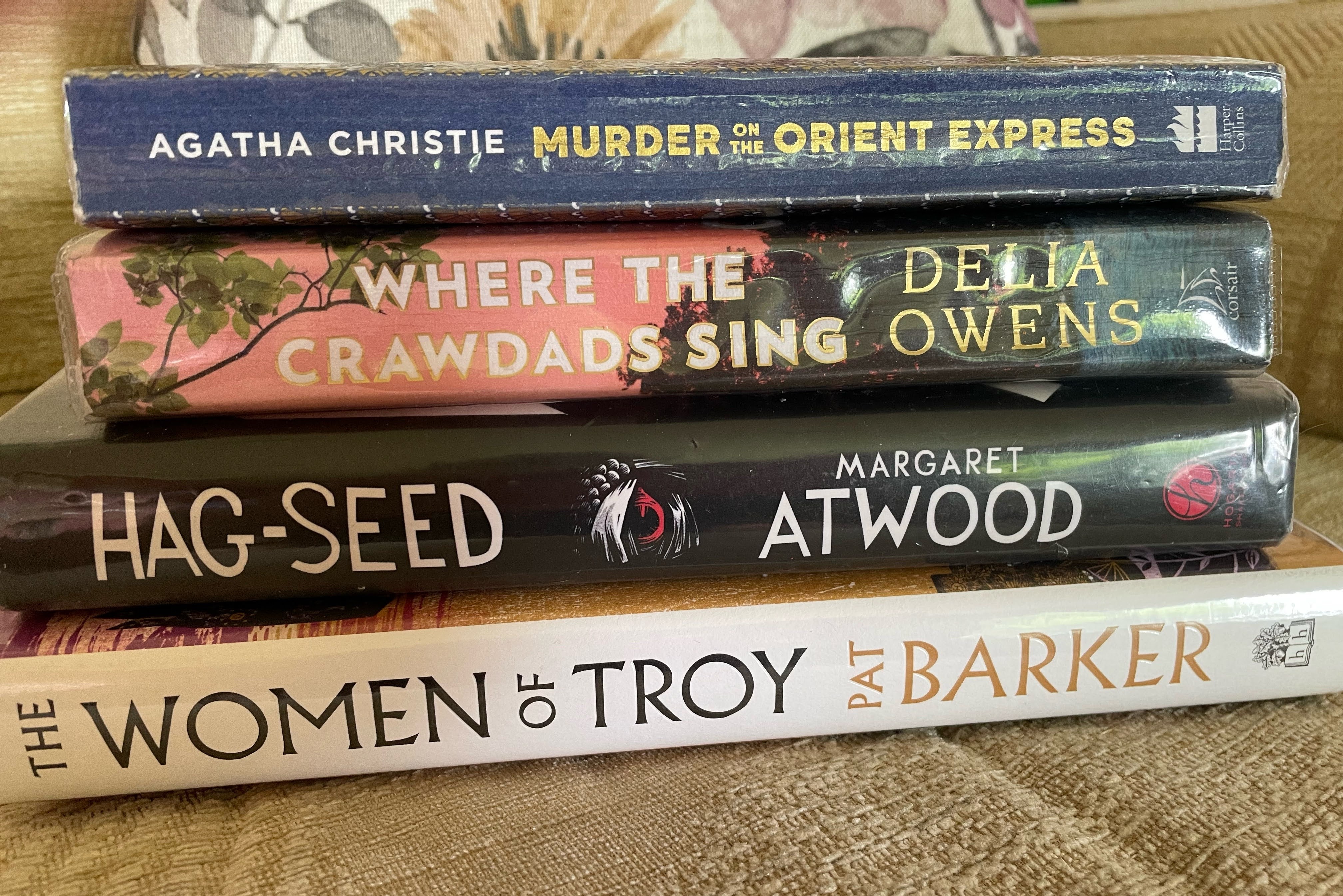
It’s time for another Library Books post – here are my current library loans. From the bottom up they are:

The Women of Troy by Pat Barker – the continuation of the story of Troy following on from The Silence of the Girls (which I have, but have not read yet). It is a retelling of The Iliad from the perspective of the women of Troy who endured it. I hope I’ll be able to read both before I have to return it.

Hag-Seed by Margaret Atwood, a retelling of Shakespeare’s The Tempest, one of my favourites of his plays. I’ve seen it performed on stage twice, once at the Barbican in London and then at the Royal Shakespeare Company Theatre in Stratford-upon-Avon. Margaret Atwood is one of my favourite authors, so I’m expecting this will be good.

Where the Crawdads Sing by Delia Owens. Now, this is a book I’ve wondered about reading ever since I saw other book bloggers’ reviews. It seems to be a book that some people love and others don’t, varying from five to one star ratings. I started to listen to the audiobook, but had to return it unfinished. It’s described as ‘part murder-mystery, part coming-of-age novel’ set in the North Carolina marshlands.

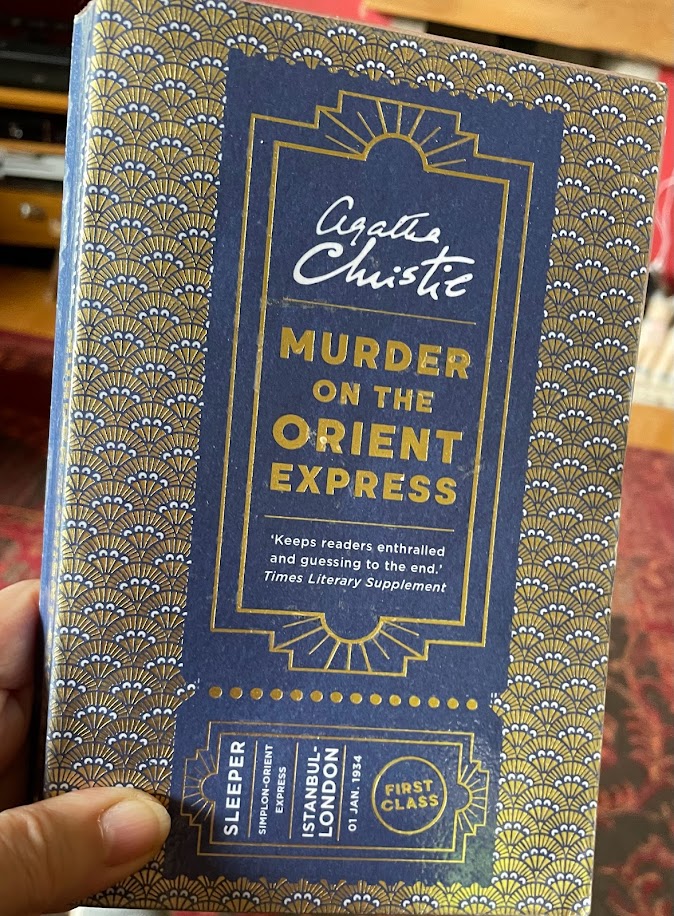
Murder on the Orient Express by Agatha Christie, a Poirot murder mystery. I have read this book, but I fancied reading it again, even though I do know who murdered Mr Ratchett, an American tycoon who was murdered in his compartment, stabbed a dozen times, his door locked from the inside. I really like the cover of this book!

What have you been reading from the library recently?

Library Books 24 February 2022

I love libraries – here are some of the books I have on loan at the moment. I had made a few attempts to take a photo of these books and wasn’t happy with any of them. I’d left the books in a pile on the floor and was delighted to see this photo that my husband had taken – much better than any of my attempts.

Trigger Mortis by Anthony Horowitz – because I enjoy his books, but I’m not sure I’ll like this one as much as his crime fiction books. It’s a James Bond thriller set in 1957 re-inventing the golden age of Bond, incorporating previously unseen Ian Fleming material.

An Event in Autumn by Henning Mankell, a Wallender thriller, again because I’ve enjoyed other books by him. This is a novella in which Wallender makes an offer on a house, and then discovers the skeleton of a middle-aged woman in the garden. What a nightmare!

Prague Nights by Benjamin Black. Black is the pen name of John Banville, another author whose books I like. This is historical crime fiction set in Prague in 1599, when the mistress of Rudolf II, the Holy Roman Emperor, is killed and her body found thrown upon the snow in Golden Lane.

Presumed Innocent by Scott Turow, the first book in his Kindle County series, because I enjoyed the last book in the series, The Last Trial so much. This is a courtroom drama in which prosecutor Rusty Sabich stands accused of killing Carolyn with whom he had been having an affair.

Ordinary Heroes by Scott Turow, historical fiction set in World War Two, described on the front cover as ‘part mystery, part thriller, this is a quietly powerful piece of fiction.’ A courtroom journalist researches the experiences of his grandfather during the War.

Library Books: February 2022

The mobile library service is back to normal now and I borrowed these books this week:

From top to bottom they are:

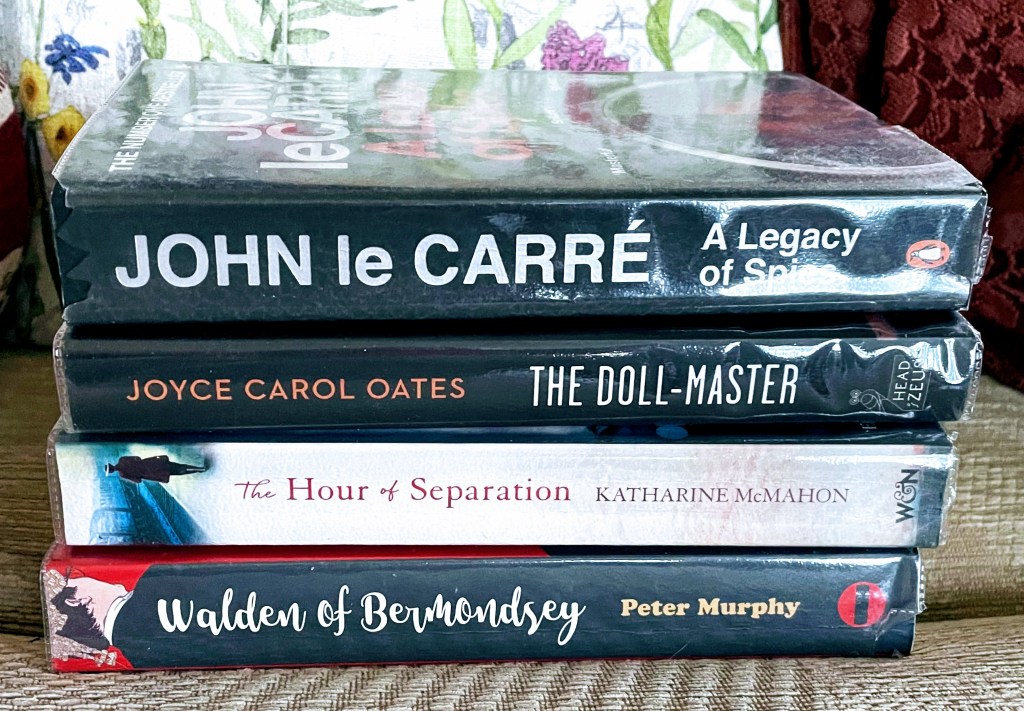
A Legacy of Spies by John Le Carré. It’s the 9th book in his George Smiley series. I’m not sure about reading this one yet as I’ve only read 2 of the series, The Spy Who Came in from the Cold and Tinker, Tailor, Soldier, Spy. But whilst it was there on the shelves I decided to borrow it and at least start it to see if it reads like a standalone. And according to this article on the Penguin website all five of novels in the Smiley series are easily read as standalones. You do not need to read them in order but they do suggest a reading order.

Book description: Peter Guillam, former disciple of George Smiley in the British Secret Service, has long retired to Brittany when a letter arrives, summoning him to London. The reason? Cold War ghosts have come back to haunt him. Intelligence operations that were once the toast of the Service are to be dissected by a generation with no memory of the Berlin Wall. Somebody must pay for innocent blood spilt in the name of the greater good . . .

The Doll-Master and Other Tales of Terror by Joyce Carol Oates. I’m not sure I want to read this book – it’s described on the back cover as ‘Six terrifying tales to chill the blood’.They may be too terrifying! But I have enjoyed her books before, so maybe this one will be OK.

Book description: .

In the title story, a young boy becomes obsessed with his cousin’s doll after she tragically passes away from leukemia. As he grows older, he begins to collect “found dolls” from the surrounding neighborhoods and stores his treasures in the abandoned carriage house on his family’s estate. But just what kind of dolls are they?

In “Gun Accident”, a teenage girl is thrilled when her favorite teacher asks her to house-sit, even on short notice. But when an intruder forces his way into the house while the girl is there, the fate of more than one life is changed forever.

In “Equatorial”, set in the exotic Galapagos, an affluent American wife experiences disorienting assaults on her sense of who her charismatic husband really is, and what his plans may be for her.

The Hour of Imagination by Katharine McMahon. I borrowed this because I’ve read two of her books and enjoyed them.

Book description: Estelle never really knew her mother, Fleur, but is haunted by her legacy. A legendary resistance heroine in the Great War, she had helped Allied soldiers escape from Belgium – and was not alone in paying a terrible price.

Christa’s father was one of those Fleur saved – but he returned home a ruined man. So, when Estelle arrives on Christa’s doorstep hungry for information about her mother, an intense and complex friendship is ignited.

In 1939, as conflict grips Europe once more, Estelle follows her mother’s destiny. Then Christa discovers that Fleur was betrayed by someone close to her and the truth may destroy them all…

Walden of Bermondsey by Peter Murphy. I’ve not read any of his books, so this is unknown territory for me. Peter Murphy spent a career in the law, as an advocate, teacher, and judge. He has worked both in England and the U.S., and served for several years as counsel at the Yugoslavian War Crimes Tribunal in The Hague. This book is the first in his Judge Walden series.

Book description: When Charlie Walden takes on the job of Resident Judge of the Bermondsey Crown Court, he is hoping for a quieter life. But he soon finds himself struggling to keep the peace between three feisty fellow judges who have very different views about how to do their jobs, and about how Charlie should do his. And as if that’s not enough, there’s the endless battle against the “Grey Smoothies”: the humorless grey-suited civil servants who seem determined to drown Charlie in paperwork and strip the court of its last vestiges of civilization. No hope of an easy life for Charlie then, and there are times when his real job – trying the challenging criminal cases that come before him – actually seems like light relief.

I’d love to know what you think – have you read any of these books, if so did you enjoy them? If not, do they tempt you?

Book Beginnings & The Friday 56: Servant of Death by Sarah Hawkswood

Every Friday Book Beginnings on Friday is hosted by Gillion at Rose City Reader where you can share the first sentence (or so) of the book you are reading. You can also share from a book you want to highlight just because it caught your fancy.

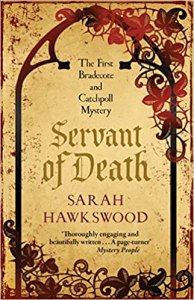
Servant of Death is one of the books I’ve recently borrowed from the library. It’s historical crime fiction set in 1143 in Pershore Abbey, the first in the series of Bradecote and Catchpoll Mysteries set in the twelfth century, in Worcestershire.  

The Book Begins:

Elias of St Edmondsbury, master mason, stood with the heat of the midsummer sun on broad back and thinning pate, rivulets of sweat trickling down between his shoulder blades. The wooden scaffolding clasped the north transept of the abbey church, close as ivy.

Also every Friday there is The Friday 56, hosted by Freda at Freda’s Voice. *Grab a book, any book. *Turn to Page 56 or 56% on your  ereader . If you have to improvise, that is okay. *Find a snippet, short and sweet, but no spoilers!

These are the rules:

  1. Grab a book, any book.
  2. Turn to page 56, or 56% on your eReader. If you have to improvise, that is okay.
  3. Find any sentence (or a few, just don’t spoil it) that grabs you.
  4. Post it.
  5. Add the URL to your post in the link on Freda’s most recent Friday 56 post.

Page 56:

‘He dropped to his knees, careful to avoid the dark, sticky stain, and slid his hand beneath the corpse. Feeling around tentatively, he was relieved to find the cords of the monk’s scrip, and followed them to the leather bag, which was still full. Whoever had killed him had not had time or inclination to investigate it.

Summary:

The much-feared and hated Eudo – the Lord Bishop of Winchester’s clerk – is bludgeoned to death in Pershore Abbey and laid before the altar in the attitude of a penitent. Everyone who had contact with him had reason to dislike him, but who had reason to kill him? The Sheriff of Worcestershire’s thief taker, wily Serjeant Catchpoll, and his new and unwanted superior, Undersheriff Hugh Bradecote, have to find the answer. And as the claustrophobic walls of the Abbey close in on the suspects, the killer strikes again.

This is the first book by Sarah Hawkswood that I’ve come across.

About Sarah Hawkswood, a pen name.

Sarah Hawkswood read Modern History at Oxford University and specialised in Military History and Theory of War. She turned from writing military history to mediaeval murder mysteries set in the turmoil of The Anarchy in the mid 12thC, all located in Worcestershire, where she now lives. The Bradecote & Catchpoll series began with Servant of Death (previously published as The Lord Bishop’s Clerk) and the ninth, Wolf at the Door, was published in August 2021 with the tenth, A Taste for Killing, due out in 2022.

~~~

What have you been reading lately?

Recent Loans from the Library

Guilty Creatures: A Menagerie of Mysteries edited and introduce by Martin Edwards. I like these anthologies as much, if not more, for Martin Edwards’ introductions than for the actual stories. I often find that they’re too short for my liking, but I’m hoping there will be some that will prove me wrong. This collection includes stories by Arthur Conan Doyle, G K Chesterton, Edgar Wallace, Josephine Bell and Christianna Brand, among others.

The Descent of Man by Grayson Perry. During the fist lockdown I loved watching Grayson’s Art Club, Channel 4’s documentary series hosted by him and his wife, psychotherapist Philippa Perry. In this book he is looking at masculinity, particularly examining how men dominate much of our world, how men dress and act, how men resort to crime and violence, and how men feel.

Black Sheep by Susan Hill, a novella about a brother an sister who grew up in a coal mining village and yearn to escape. Neither can break free and their decisions result in brutal consequences. It sounds a bit grim!

Rescue by Anita Shreve. The last few books by Anita Shreve I’ve read haven’t been as good as her earlier ones, so I’m hoping this one won’t be disappointing. It’s about a paramedic who rescues a troubled young woman from a car crash. They start a love affair and have a daughter. Eighteen years later he is raising the girl on his own,

Servant of Death by Sarah Hawkswood, historical murder mystery set in the 12th century, the first in the Bradcote and Catchpole mystery series. The Lord Bishop of Winchester’s clerk – is bludgeoned to death in Pershore Abbey and laid before the altar in the attitude of a penitent. Who hated him enough to murder him?

The Long Way Home by Louise Perry. I thought it looked familiar and when I got home and checked my blog I realised I’d borrowed this book before – in 2018! But I took it back unread, thinking I’d try to get the first one. It’s the 10th Chief Inspector Gamache novel – and I still haven’t read any of the previous books, so maybe I’ll read this one this time.