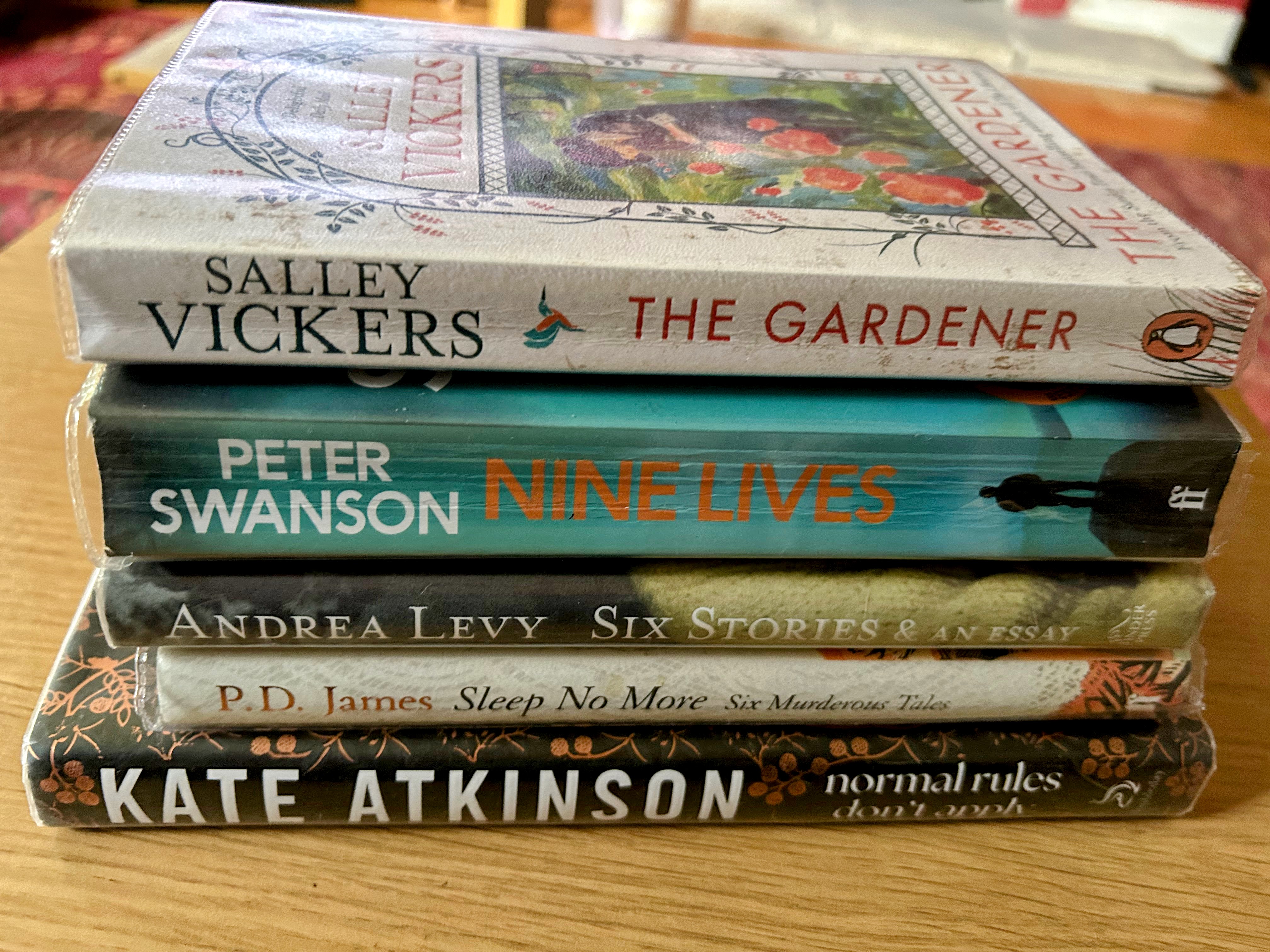
Normal Rules Don’t Apply by Kate Atkinson – Eleven interconnected stories, where everything is changing, where nothing is quite as it seems.
Six Stories and an Essay by Andrea Levy – This collection opens with an essay about how writing has helped Andrea Levy to explore and understand her heritage. She explains the context of each piece within the chronology of her career and finishes with a new story, written to mark the centenary of the outbreak of the Great War in 1914.
I also borrowed two other books:
The Gardener by Salley Vickers – Previously I’ve read five books by Vickers, and enjoyed them, especially Miss Garnet’s Angel and Mr Golightly’s Holiday. The last one I read was The Librarian, which I thought was rather underwhelming. I hope this one is better.
Nine Lives by Peter Swanson – I haven’t read any of Swanson’s books, but keep seeing them on book blogs and thought I’d see if I like this one.
It’s been a while since I posted about the books I’ve borrowed from the mobile library van. It’s one of three mobiles in the County Library service that comes round once a month, visiting villages and remote rural areas. It parks near our house. This week I borrowed three books.
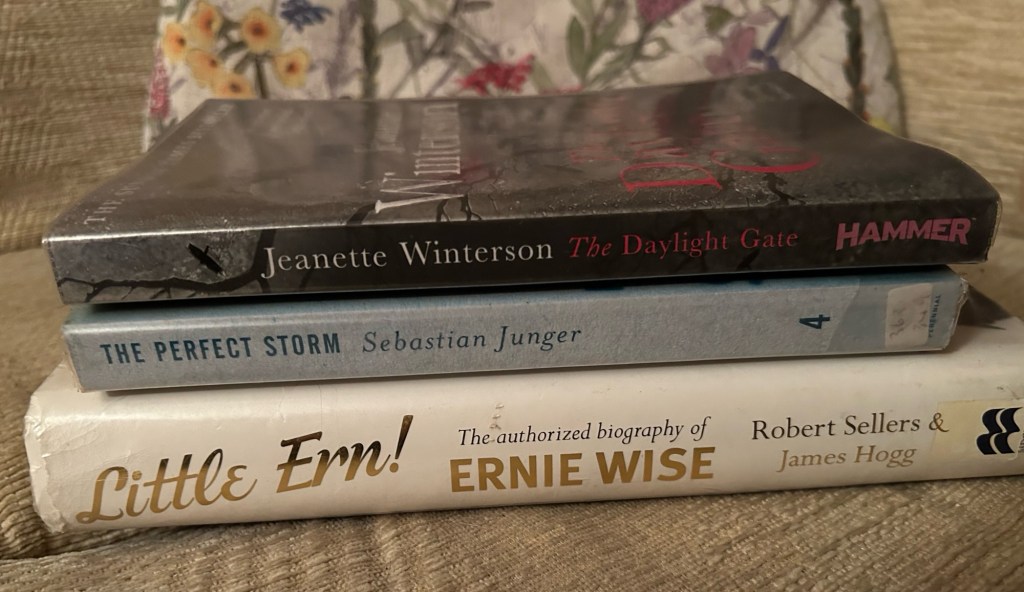
The Daylight Gate by Jeanette Winterson. I thought this looks promising. The Trial of the Lancashire Witches in 1612 was the first witch trial to be documented. Thomas Potts, a lawyer, wrote his account: The Wonderfull Discoverie of Witches in the County of Lancashire. It’s supposedly an eyewitness verbatim account and Winterson follows the historical account and the religious background in telling her story. The places are real places and the characters were real people, although she has taken liberties with their motives and means. She states that the story of Alice Nutter (not the Alice Nutter of history) and Elizabeth Southern is her own creation and has no basis in fact. And she was pleased that there might have been a connection with Dr John Dee, and with Manchester, London as well as with Shakespeare himself. And she says: ‘Pendle Hill is still the enigma it ever was though the Malkin Tower is long gone.’
The Forest of Pendle used to be a hunting ground, but some say that the hill is the hunter – alive in its black-and-green coat cropped like an animal pelt.
Good Friday, 1612. Two notorious witches await trial and certain death in Lancaster Castle, whilst a small group gathers in secret protest. Into this group the self-made Alice Nutter stakes her claim and swears to fight against the rule of fear. But what is Alice’s connection to these witches? What is magic if not power, and what will happen to the women who possess it? (Amazon UK)
The Perfect Storm: A True Story of Men Against the Sea by Sebastian Junger I took this off the shelf and flicked through the pages, wondering what to expect from this book, described as creative nonfiction. It recounts a storm in October 1991 that resulted in the fishing boat AndreaGail going down off the coast of Nova Scotia with the loss of all six crew members.
In 2000, the book was adapted by Warner Brothers as a film of the same name, starring George Clooney and Mark Wahlberg.
It was the storm of the century, boasting waves over one hundred feet high—a tempest created by so rare a combination of factors that meteorologists deemed it “the perfect storm.” In a book that has become a classic, Sebastian Junger explores the history of the fishing industry, the science of storms, and the candid accounts of the people whose lives the storm touched. The Perfect Storm is a real-life thriller that makes us feel like we’ve been caught, helpless, in the grip of a force of nature beyond our understanding or control. (Amazon UK)
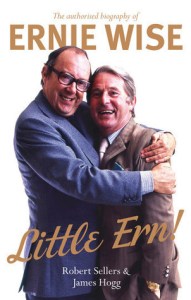
Little Ern! the Authorized Biography of Ernie Wise by Robert Sellers and James Hogg. For years I loved watching comedians Morecambe and Wise, also known as Eric and Ernie, on TV. Their partnership lasted from 1941 until Morecambe’s sudden death in 1984. And watching their shows years later they still make me laugh.
Even though they are the most famous comedy double act Britain has ever seen, until now there has never been a biography of Ernie Wise. Seen by some as just the straight man in the partnership, in fact ‘Little Ern’ was regarded by his peers as a great comedian in his own right. It took no ordinary talent to be the perfect foil for the genius of Eric Morecambe, and to be his friend, business partner and co-performer for nearly forty years. Morecambe’s personality flared with ego and insecurity, and theirs was a personal relationship that had to be nurtured as carefully as were their on-screen personas.
Nearly thirty years after their last appearances, the pair still dominate the landscape of British comedy, and are loved and revered as ever. With the cooperation of Ernie’s widow Doreen, and drawing on unpublished material from the family archive as well as interviews with friends, Robert Sellers and James Hogg have shifted the spotlight sideways to examine for the first time the true and patient genius of one of the greatest entertainers of his generation. (Goodreads)
Every Friday Book Beginnings on Friday is hosted by Gillion at Rose City Readerwhere you can share the first sentence (or so) of the book you are reading. You can also share from a book you want to highlight just because it caught your fancy.
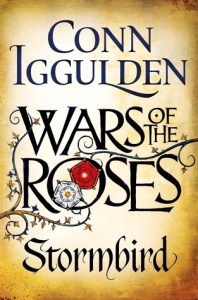
Wars of the Roses: Stormbird by Conn Iggulden is the first episode of The Wars of the Roses series and is one of the books I was given at Christmas.
The book begins with a Prologue set in 1337 as Edward III lay dying.
Prologue:
Anno Domini 1377
Bowls of dark royal blood lay beneath the bed, forgotten by the physician. Alice Perrers rested on a chair, panting from the effort of wrestling the king of England into his armour. The air in the room was sour with sweat and death and Edward lay like his own effigy, pale and white-bearded.
Part One – ChapterOne:
Anno Domini 1443
Sixty six years after the death of Edward III
England was cold that month.
Also every Friday there is The Friday 56, hosted by Freda at Freda’s Voice, but she is taking a break and Anne at My Head is Full of Books has taken on hosting duties in her absence. You grab a book and turn to page 56 (or 56% of an eBook), find one or more interesting sentences (no spoilers), and post them.
Page 56
‘They’ve asked for the marriage to take place in the cathedral at Tours, that’s what. Land that will have the French army camped outside, ready to take possession of the price of the truce,that’s what! I’m not letting Henry walk in there, William, not while there’s life in me.’
Description from Goodreads:
King Henry V – the great Lion of England – is long dead.
In 1437, after years of regency, the pious and gentle Henry VI, the Lamb, comes of age and accedes to the English throne. His poor health and frailty of mind render him a weakling king -Henry depends on his closest men, Spymaster Derry Brewer and William de la Pole, Duke of Suffolk, to run his kingdom
Yet there are those, such as the Plantagenet Richard, Duke of York, who believe England must be led by a strong king if she is to survive. With England’s territories in France under threat, and rumours of revolt at home, fears grow that Henry and his advisers will see the country slide into ruin. With a secret deal struck for Henry to marry a young French noblewoman, Margaret of Anjou, those fears become all too real.
As storm clouds gather over England, King Henry and his supporters find themselves besieged abroad and at home. Who, or what can save the kingdom before it is too late?
I’ve read some of Iggulden’s historical fiction novels and loved them, so I’m looking forward to reading this in the new year.
Other books in the Wars of the Roses series are:
Stormbird (2013)
Trinity (2014) (titled Margaret of Anjou in North America)
Bloodline (2015)
Ravenspur (2016)
What do you think, does this book appeal to you? What are you currently reading?
Every Friday Book Beginnings on Friday is hosted by Gillion at Rose City Readerwhere you can share the first sentence (or so) of the book you are reading. You can also share from a book you want to highlight just because it caught your fancy.
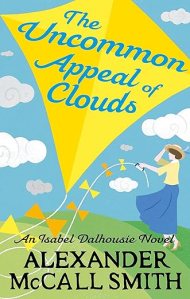
I’m featuring The Uncommon Appeal of Clouds by Alexander McCall Smith, an Isabel Dalhousie book, that I’ve borrowed from my local lbrary.
ChapterOne:
‘Mozart’ said, Isabel Dalhousie. And then she added, Stinivasa Ramamjan .
Also every Friday there is The Friday 56, hosted by Freda at Freda’s Voice, but she is taking a break and Anne at My Head is Full of Books has taken on hosting duties in her absence. You grab a book and turn to page 56 (or 56% of an eBook), find one or more interesting sentences (no spoilers), and post them.
But then, we can misjudge each other so easily, she thought; so easily.
Description from Amazon:
As a mother, wife, employer and editor of the Review of Applied Ethics, Isabel Dalhousie is aware that to be human is to be responsible. So when a neighbour brings her a new and potentially dangerous puzzle to solve, once again Isabel feels she has no option but to shoulder the burden.
A masterpiece painting has been stolen from Duncan Munrowe, old-fashioned philanthropist, father to two discontented children, and a very wealthy man. As Isabel enters into negotiations with the shadowy figures who are in search of a ransom, a case where heroes and villains should be clearly defined turns murky: the list of those who desire the painting – or the money – lengthens, and hasty judgement must be avoided at all cost. Morals, it turns out, are like Scottish clouds: complex, changeable and tricky to get a firm grip on; they require a sharp observational eye, a philosophical mindset, and the habit of kindness. Fortunately for those around her, Isabel Dalhousie is in possession of all three.
I’ve read some of his other Isabel Dalhousie books and enjoyed them. So I’m hoping to enjoy this one too. I really like the gentle pace of these books and what I find so fascinating is that whilst not a lot actually happens, a lot goes on in Isabel’s head.
What do you think, does this book appeal to you? What are you currently reading?
Two Roads| 2021| 354 pages| paperback| Library book|5*
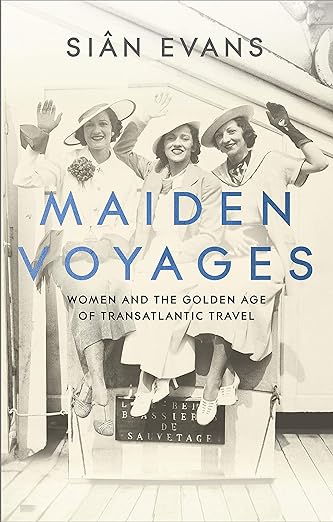
I first read about Maiden Voyages: Women and the Golden Age of Transatlantic Travel by Siân Evans on Cath’s blog Read-Warbler. I thought it sounded excellent, so I reserved a copy from the library. It covers a wide range of topics that fascinate me – not just travel, but also social history, both World Wars, the sinking of the Titanic, emigration, the impact that the ocean liners had on the economy. and on women’s working lives and independence, adventure and so much more besides.
It is a ‘collection of selected biographical tales, both cautionary and life-affirming, about dynamic women on the move, set primarily between the two World Wars, during the golden age of transatlantic travel.‘ (page 25)
It is well written, and thoroughly researched. Like all good non-fiction it has a bibliography and an index. For more detail about the contents of this book I think this description on Amazon UK summarises it very well and I need say no more:
Summary:
Migrants and millionairesses, refugees and aristocrats all looking for a way to improve their lives.After WW1 a world of opportunity was opening up for women … Before convenient air travel, transatlantic travel was the province of the great ocean liners and never more so than in the glory days of the interwar years. It was an extraordinary undertaking made by many women. Some traveled for leisure, some for work; others to find a new life, marriage, to reinvent themselves or find new opportunities. Their stories have remained largely untold – until now.
Maiden Voyages is a fascinating portrait of these women, and their lives on board magnificent ocean liners as they sailed between the old and the new worlds. The ocean liner was a microcosm of contemporary society, divided by class: from the luxury of the upper deck, playground for the rich and famous, to the cramped conditions of steerage or third class travel. These iconic liners were filled with women of all ages, classes and backgrounds: celebrities and refugees, migrants and millionairesses, aristocrats and crew members.
Full of incredible gossip, stories and intrigue, Maiden Voyages has a diverse cast of inspiring women – from A-listers like Josephine Baker, a dancer from St Louis who found fame in Paris, Marlene Dietrich and Wallis Simpson, Violet ‘the unsinkable’ Jessop, a crew member who survived the sinking of the Titanic, and entrepreneur Sibyl Colefax, a pioneering interior designer.
Whichever direction they were travelling, whatever hopes they entertained, they were all under the spell of life at sea, a spell which would only break when they went ashore. Maiden Voyages is a compelling and highly entertaining account of life on board: part dream factory, part place of work, independence and escape – always moving.
Siân Evans is a Welsh author, journalist, commentator, speaker, publicist and film consultant specialising in social history. She is the author of a plethora of popular social histories, including Mrs Ronnie: the Society Hostess Who Collected Kings; The Manor Reborn (tied in to a major four-part BBC1 TV series); Life Below Stairs in the Victorian and Edwardian Country House; Ghosts: Mysterious Tales from the National Trust; seven National Trust Guidebooks between 2008 and 2014 and Queen Bees, a book examining the role of six influential interwar society hostesses.
These are the books I have on loan from my local library:
Daphne Du Maurier and her sisters : the hidden lives of Piffy, Bird and Bing by Jane Dunn.The Du Mauriers – three beautiful, successful and rebellious sisters, whose lives were bound in a family drama that inspired Angela and Daphne’s best novels. Much has been written about Daphne but here the hidden lives of the sisters are revealed in a riveting group biography. The sisters are considered side by side, as they were in life, three sisters who grew up during the 20th century in the glamorous hothouse of a theatrical family dominated by a charismatic and powerful father. This family dynamic reveals the hidden lives of Piffy, Bird & Bing, full of social non-conformity, love, rivalry and compulsive make-believe, their lives as psychologically complex as a Daphne du Maurier novel.
Politics on the edge : a memoir from within by Rory Stewart. Over the course of a decade from 2010, Rory Stewart went from being a political outsider to standing for prime minister – before being sacked from a Conservative Party that he had come to barely recognise. Tackling ministerial briefs on flood response and prison violence, engaging with conflict and poverty abroad as a foreign minister, and Brexit as a Cabinet minister, Stewart learned first-hand how profoundly hollow and inadequate our democracy and government had become. Cronyism, ignorance and sheer incompetence ran rampant. Around him, individual politicians laid the foundations for the political and economic chaos of today. Stewart emerged battered but with a profound affection for his constituency of Penrith and the Border, and a deep direct insight into the era of populism and global conflict. This book invites us into the mind of one of the most interesting actors on the British political stage.
In the Springtime of the Year by Susan Hill. After just a year of close, loving marriage, Ruth has been widowed. Her beloved husband, Ben, has been killed in a tragic accident and Ruth is left suddenly and totally bereft. Unable to share her sorrow and grief with Ben’s family, who are dealing with their pain in their own way, Ruth becomes increasingly isolated, hiding herself in her cottage in the countryside as the seasons change around her. Only Ben’s young brother is able to reach out beyond his own grief to offer Ruth the compassion which might reclaim her from her own devastating unhappiness.
I’d love to know if you’ve read any of these books and if so what did you think? If you haven’t, do any of them tempt you?