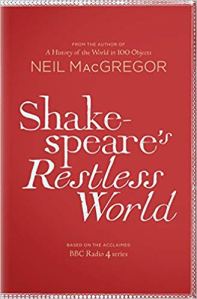
Shakespeare's Restless World by Neil MacGregor

Shakespeare’s Restless World was an impulse buy last year. I saw it on display at Main Street Trading bookshop, took it down off the shelf to look at it whilst having lunch there and then couldn’t resist buying it. It’s such a beautiful book recreating Shakespeare’s world through examining twenty objects. It reveals so much about the people who lived then, who went to see Shakespeare’s plays in the 1590s and 1600s, and about their ideas and living conditions.

The objects include an iron fork  found, when the Rose Theatre on the south bank of the river Thames was excavated, in the remains of the theatre’s inner gallery walls, relics, medals, gold objects, a rapier and a dagger and strange objects such as an eye relic mounted in silver, complete with photos and illustrations. Through looking at each object MacGregor explores a number of themes, not just the theatre, but including what people ate whilst watching plays, religion, medicine, the plague, magic, city life, treason, and the measuring of time amongst other topics. It’s all fascinating and informative, and easy to read. There are plenty of quotations from Shakespeare’s plays and puts both him and his work into context. For me, it was a new way of seeing into the past, which I missed when the series was broadcast on BBC Radio4.

It may seem strange to include this book in the Read Scotland 2014 challenge, but Neil MacGregor, the Director of the British Museum, was born in Glasgow and the challenge is to “read and review Scottish books -any genre, any form- written by a Scottish author (by birth or immigration) or about or set in Scotland.”

I would have read this book in any case, but I was pleased to find that there are sections in it that fit very well into the challenge, including a chapter on Shakespeare’s ‘Scottish Play’ ie Macbeth. Shakespeare lived through a period of great change for Britain, not only the changes to be expected through the passage of time, but also changes nationally and politically with the death of Elizabeth I. The big question of the day in the 1590s was the constitutional question of who would succeed her, but in England the Treasons Act of 1571 forbade any discussion of the succession.  But dramatists addressed this through their plays – such as Shakespeare’s dramatization of the Wars of the Roses.

MacGregor covers James VI of Scotland’s succession to the English crown in 1603, bringing the whole island of Britain under one rule for the first time.  It was not clear then how things would change:

Everybody knew that with James as King of England and King of Scotland a new political world had been born. But it was not at all clear how things were going to change. …

But making a new nation turned out to be very difficult. For much of the previous 300 years England and Scotland had been at war; they had very different political and legal systems, a different established church, different currencies, separate parliaments and a long history of intense dislike and deep suspicion. James’s central ambition was to make two very foreign countries into one new state, with a new name – Great Britain.

The succession of James VI of Scotland to the English throne in 1603 created a dynastic union, and a personal union of political authority, but it did not create a union of the crowns in constitutional, legal, ecclesiastical or economic terms. Forging such a union was James’s paramount aim. (pages 204 – 205)

It was another hundred years before the formal Act of Union united England and Scotland into one state of Great Britain. These days Scotland is currently debating whether to break the union and once again things are very unclear – how will things change if Scotland becomes an independent state?

This post is also my contribution to The Classics Club’s event Shakespeare in January, as well as qualifying for the Mount TBR Challenge 2014.nIt’s also the first non-fiction book I’ve read this year.

The Steel Bonnets: the opening chapter

A friend has just lent me The Steel Bonnets : the Story of the Anglo-Scottish Border Reivers by George MacDonald Fraser and having looked at the opening chapter I know I just have to read on, rather than waiting for January when Peggy Ann’s Read Scotland 2014 Challenge starts. It’s a long, detailed book so I shall probably still be reading it in January anyway.

The Steel Bonnets 001I live on the English side of the Border with Scotland and the history of the area just fascinates me. The Steel Bonnets covers the period from the building of Hadrian’s Wall to 1603, when James VI of Scotland became James I of England. Four hundred or so years ago it was all very different around here and as the history of the Border Reivers is very complicated I’m hoping this book will guide me through it.

The opening paragraph took me by surprise:

At one moment when President Richard Nixon was taking part in his inauguration ceremony, he appeared flanked by Lyndon Johnson and Billy Graham. To anyone familiar with Border history it was one of those historical coincidences which send a little shudder through the mind: in that moment, thousands of miles and centuries away in time away from the Debateable Land, the threads came together again; the descendants of three notable Anglo-Scottish Border tribes – families who lived and fought within a few miles of each other on the West Marches in Queen Elizabeth’s time – were standing side by side, and it took very little effort of the imagination to replace the custom-made suits with leather jacks or backs-and-breasts. Only a political commentator would be tactless enough to pursue the resemblance to Border reivers beyond the physical, but there the similarity is strong.

In the following paragraphs he goes on to describe their physical features, particularly those of Nixon and Johnson, as ‘excellent specimens of two distinct but common Border types.’ I hadn’t expected this at all.

For more Book Beginnings see Gilion’s blog Rose City Reader.

Gone With the Wind: Historical Fiction

Gone With the Wind

In a previous post on Gone With the Wind I wrote that I had learned a lot about the American Civil War and Reconstruction, about slavery (very different from Uncle Tom’s Cabin) and a lot about Georgia and Atlanta. In the comments Jane pointed out, quite correctly, that the book ‘shouldn’t be taken as history, but as reflective of a very strong point-of-view of American history, circa 1930.’

I hadn’t meant that I was taking GWTW as historical fact, but that it had led me to wanting to know more about the period and in that respect it had opened up new areas for me. For example, I’d never heard of ‘Reconstruction’ before in the sense of what happened to the southern states following the Civil War and I knew next to nothing about the causes of the war, other than the fact that the southern states wanted to leave the Union, that they wanted to be an independent nation. I was in no doubt, however, that the book is a novel – historical fiction, not historical fact.

All written history is a selection of facts and involves to a greater or lesser extent an interpretation of those facts. Its accuracy depends on the sources used, and in turn those sources inevitably are subject to perspective and bias. Similarly, historical fiction can throw light on the past; it can flesh out the facts, bringing the past to life – and it can be subject to the bias and opinions of the author.

I was fascinated to read that Margaret Mitchell, who was born in Atlanta in 1900 grew up listening to the war stories of Confederate veterans and yet she didn’t know until she was ten years old that the South had lost the war!

Margaret Mitchell was writing from a Southerner’s perspective, but that does not mean that her book is any the less invalid. She presents the Civil War period and its aftermath as seen through southern eyes and basically it is the story as seen through the women’s eyes. There is little about the actual battles, but this is still a war novel, even though it’s set mostly in the homes of the characters – in Tara, and in Atlanta. It depicts the hardships and suffering of the civilian population as well as the wounded soldiers, their grief and desolation and the devastating effect on the land and townships. You can see Atlanta going up in flames, the devastation of the countryside as the railroads and plantations were destroyed, and feel the hunger as the people starved.

Then there is the question of slavery and the Ku Klux Klan, both essential elements in the novel. The depiction of slaves divides them into two categories – house slaves and field hands, raising racial issues and the different attitudes between the North and the South towards the slaves. The plantation owners are portrayed as viewing their slaves, in particular the house slaves, as part of their family, protecting them and caring for them, treating them as children and of lower intelligence, and the slaves responded with loyalty to their owners. Again this is one perspective on the past, one that is at variance that of the northern states – clearly indicated in the novel. There are several references in Gone With the Wind to Uncle Tom’s Cabin in which Margaret Mitchell contradicts Harriet Beecher Stowe’s scene of bloodhounds chasing runaway slaves. Similarly the view she gives of the Ku Klux Clan is not what I expected. This led me to want to know more about the history of slavery in America and I turned to the one book I own, specifically on American history – Out of Our Past: The Forces that Shaped Modern America by Carl N Degler to find out more.

This is one of the things  I like about reading historical fiction – as well as giving me a glimpse into the past, showing me areas of history I know little or nothing about, bearing in mind that there is always more than one side to a story. And I really need to do more research into these matters.

Saturday Snapshot – Flodden

It’s the 500th anniversary of the Battle of Flodden this year – it was on 9th September 1513 that the armies of England and Scotland met at Flodden Field, near Branxton in Northumberland. There have been events this year to commemorate the battle and the men from both nations who died in this last medieval battle between England and Scotland.

Living not far from the site of the battle this week we went to see what had changed as a result of the anniversary. There’s now a surfaced path leading up to the Monument.

(Click on the photos to see them enlarged)

500th anniversary P1010826

There are some more information boards and signs to guide you round the Battlefield Trail:

Battlefield trail signpost P1010837The monument isn’t actually on the site of the battle but stands on Piper’s Hill.

Flodden MonumentFrom the monument you can look towards the north down on the village of Branxton:

Branxton P1010831The two armies lined up south of the monument with a marshy dip between them. The Scots advanced first, unaware of the of the ground conditions below them. Now it’s a ditch but in 1513 there was a brook surrounded by a reeded quagmire downhill – where the Scots were bogged down, the rear ranks pushing forward into the front ranks, crushing the fallen bodies and causing chaos. They were then easy prey for the deadly English billhooks.

It looks like this now – the ditch between the hedge and fence is now nearly dry, after weeks of rain in 1513 it was a quagmire:

Boggy Ground P1010835

 and the two armies came face to face:

Tthe Killing Fields P1010858

Flodden 1513: Scotland’s Greatest Defeat by John Sadler is an excellent account of the strategies and tactics of both armies, with maps and plans showing how the battle began and a time timeline of the various conflicts giving a detailed account of events.

Having read this book and the information boards around the trail I was able to visualise the battle, even on a peaceful weekday afternoon 500 years later. The Scottish troops had moved from their original position on Flodden Edge as the English approached the battlefield, putting them at a disadvantage. The outcome could have been different if they had seen the dip below them as they charged down the hill – or even if the English had attacked first.

But then, the battle needn’t have taken place at all if James IV of Scotland had not invaded England in an attempt to divert English troops from their fight against the French. Indeed he had entered into a Treaty of Perpetual Peace with England in 1502. But in 1512 he had also renewed the Auld Alliance with the French, putting him in the position of either declaring for France against Henry VIII (James’s brother-in-law) or remaining neutral, which would make him vulnerable to any further English expansion, as Henry had revived his claim to the Scottish throne.

Despite pressure from senior members of his council to avoid an outright breach with England, when Henry arrived in Calais preparing to wage war against the French, James decided to go to war against the English. Prior to the battle at Flodden he had crossed the River Tweed into England where he then attacked and captured Norham Castle, and then destroyed both Etal and Ford Castles whilst the English were still mustering their troops. But the outcome was a disaster for Scotland and James was killed on Flodden Field:

The king’s was but one of many hundreds of bodies, sprawled and piled on the bloodied turf. The whole hillside from the brook northwards was a killing ground, the dead, maimed and horribly injured competing for space, severed limbs and streaming entrails spilling fresh gore. The din would have been terrific, with hoarse shouts and the screams of the dying men, the crash of spears, a crescendo rising and spilling like breakers against the shore. (page 82, Flodden 1513 by John Sadler)

Each time I go to Branxton, or see the monument as we drive south along the A697, I think about the battle and all those who died there in 1513.

For more Saturday Snapshots see Melinda’s blog West Metro Mommy Reads.

Books in Synch

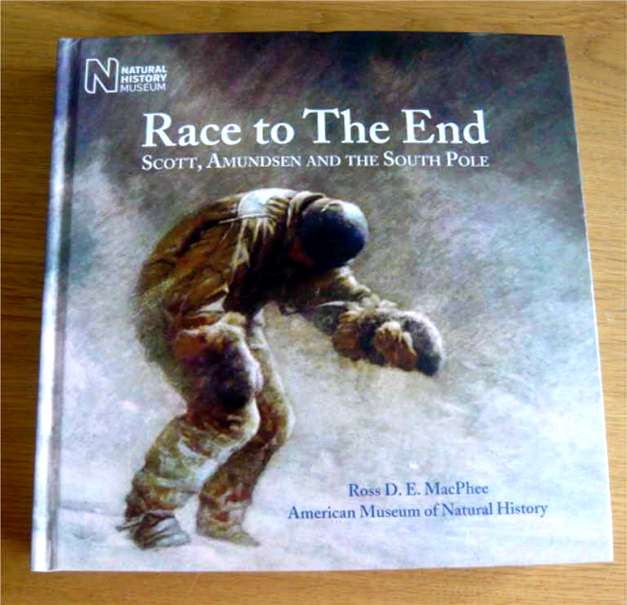
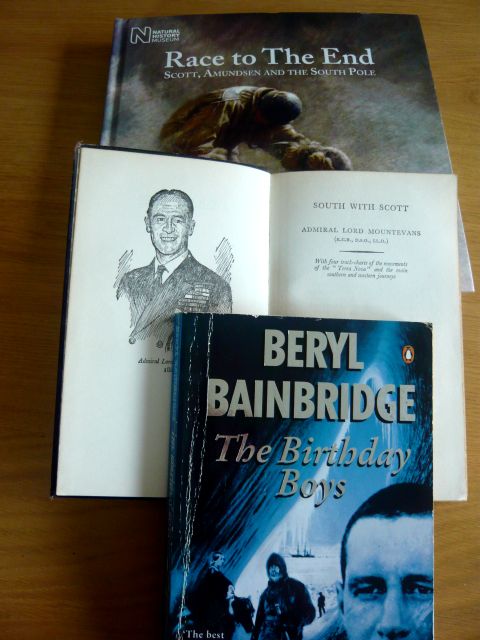
South with Scott, The Birthday Boys, Race to The End

Birthday Boys & SWS Race to the End 2


Beryl Bainbridge’s novel The Birthday Boys is a fictionalised version of Scott’s 1912 Antarctic expedition. Ever since I bought South with Scott by Lord Mountevans when I was at school I’ve been fascinated by race to reach the South Pole and reading The Birthday Boys made me take down South with Scott from my bookshelves to compare the two. But even so I was wanting to know more and so, when I went to the library yesterday morning I thought I’d see if there was anything else I could read about. AND THERE WAS!

Race to The End cover

As Alex said last week when I wrote about the coincidence of finding The English Spy in the library when I had reserved Road to Referendum it really does seem as if books do call out to each other, because sitting there on the library shelves just as though it was waiting for me was this beautifully illustrated book – Race to The End: Scott, Amundsen and the South Pole by Ross D E MacPhee.

As I read The Birthday Books I was wondering how true to the facts Bainbridge had been in her novel. I’ve had time just to compare one event that is common to all three books, when Dr Wilson (Uncle Bill), Lieutenant ‘Birdie’ Bowers and Apsley Cherry-Garrard set off to Cape Crozier to recover emperor penguin eggs in the middle of the Antarctic winter – and Bainbridge’s version seems remarkable accurate, bringing the terrible hardships vividly to life. I think she must have read South with Scott. I shall write more about these books.

Birthday Boys & SWS Race to the End 1

Sunday Selection: Sisters

One of my aims this year is to reduce my massive backlog of unread books, hence the reason for joining the Mount TBR Reading Challenge.  I’m not doing too badly as so far I’ve read 19, but it’s still only a drop in the ocean. In June I wrote about some of the books I’ve owned for more than a year and today I’m looking at some more the books on the list – in some cases I’ve had these books for several years! It’s about time I read at least one of these sometime soon. I don’t like to plan too far ahead what I’m going to read but I like to have some titles in mind.

When I looked through my books I realised that I was picking out books about SISTERS:

First up for consideration are two non fiction books (the blurbs are extracts from Amazon/Goodreads):

The Sisters Who Would Be Queen: The tragedy of Mary, Katherine and Lady Jane Grey by Leanda de Lisle – this is the story of the tumultuous lives of Lady Jane Grey, known as the ‘Nine-Day Queen’ and her sisters. I’ve had this book for 3 years. I was full of enthusiasm when I first bought it because I’d been reading novels about the Tudor period and thought I’d balance them with non fiction.

Lady Jane Grey is an iconic figure in English history. Misremembered as the ‘Nine Days Queen’, she has been mythologized as a child-woman destroyed on the altar of political expediency. Exploding the many myths of Lady Jane’s life and casting fresh light onto Elizabeth’s reign, acclaimed historian Leanda de Lisle brings the tumultuous world of the Grey sisters to life, at a time when a royal marriage could gain you a kingdom or cost you everything.

The Mitfords: Letters Between Six Sisters by Charlotte Mosley – a selection of unpublished letters between the Mitford sisters – Nancy, Pamela, Diana, Unity, Jessica and Deborah. I’ve had this book for 5 years! I think two of the reasons I’ve not read it before now is that it is so long – over 800 pages and it’s in a very small font.

Carefree, revelatory and intimate, this selection of unpublished letters between the six legendary Mitford sisters, compiled by Diana Mitford’s daughter-in-law, is alive with wit, passion and heartbreak. The letters chronicle the social quirks and political upheavals of the twentieth century but also chart the stormy, enduring relationships between the uniquely gifted ‘and collectively notorious Mitford sisters’. 

And then some novels featuring sisters:

Bunner Sisters by Edith Wharton. I’ve not had this one for that long – just since last November. I down loaded it on my Kindle because it’s a free book and I thought maybe I should try another book by Edith Wharton, having failed to finish The House of Mirth. At the time I was not in the mood for it.
In the days when New York’s traffic moved at the pace of the drooping horse-car, when society applauded Christine Nilsson at the Academy of Music and basked in the sunsets of the Hudson River School on the walls of the National Academy of Design, an inconspicuous shop with a single show-window was intimately and favourably known to the feminine population of the quarter bordering on Stuyvesant Square. It was a very small shop, in a shabby basement, in a side-street already doomed to decline; its fame was so purely local that the customers on whom its existence depended were almost congenitally aware of the exact range of “goods” to be found at Bunner Sisters’.

Her Fearful Symmetry by Audrey Niffeneger – I’m not sure how long I’ve had this book, but it’s about three years. I’m not sure I’ll like it as I wasn’t keen on The Time Traveler’s Wife, but it was the time travelling aspect that irritated me with that book – the constant switching backwards and forwards in time. This one looks a bit different.

Set in and around Highgate Cemetery in London. Julia and Valentina are semi-normal American teenagers with an abnormally intense attachment to one another. The girls move to their aunt’s flat, which borders Highgate Cemetery in London and as the girls become embroiled in the fraying lives of their aunt’s neighbors, they also discover that much is still alive in Highgate, including–perhaps–their aunt, who can’t seem to leave her old apartment and life behind.

Rise and Shine by Anna Quindlen, a book I’ve had for six years! I bought it because I’d enjoyed Blessings a satisfying but sad novel about an abandoned baby. 

A novel about two sisters, the true meaning of success, and the qualities in life that matter most. It’s an otherwise ordinary Monday when Meghan Fitzmaurice’s perfect life hits a wall. A household name as the host of Rise and Shine, the country’s highest-rated morning talk show, Meghan cuts to a commercial break but not before she mutters two forbidden words into her open mike. 

In an instant, it’s the end of an era, not only for Meghan, who is unaccustomed to dealing with adversity, but also for her younger sister, Bridget, a social worker in the Bronx who has always lived in Meghan’s long shadow.

I’ve nearly finished reading Third Girl by Agatha Christie, also one of my to-be-read books, so now all I have to do is decide which book to read next. At the moment I’m leaning towards Her Fearful Symmetry, despite my misgivings about The Time Traveler’s Wife.