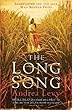
Weekend Cooking – from The Long Song

One of the books I’m currently reading is The Long Song, a novel about slavery set in 19th century Jamaica, by Andrea Levy. The narrator is July, now an old woman born as a slave, writing her memoirs.

This morning I read about the preparations for the Yuletide dinner of 1831. There were to be twelve people at the plantation owner’s table.  Caroline, the owner’s sister is giving Hannah, the cook, her orders for the food to be provided.

There was to be both turtle and vegetable soups, mutton, pigeon pies and guinea fowl, a boiled ham and a turkey or two, turtle served in the shell (but she would prefer beef), four stewed ducks, cheese, as many hogsheads as they could get and roasted pig.

There was also to be:

… malt liquor, wine, porter, cider, brandy and rum, watermelon, mango, pawpaw, naseberry, soursop, grandilla fruit. ‘And make sure the preserve has come from England. Strawberry or damson. Do not serve guava, ginger or that ghastly sorrel jelly. I’m so tired of Jamaican jams.’

Hannah had stopped listening, for the need to shout ‘And me to fix-up all this? You  a gut-fatty, cha!’ at her misssus was becoming overpowering in her. (pages 74 – 75)

And in case they were still hungry after this obscene amount of food, Hannah was told to make plum pudding. Hannah remembered how to make it –

A little fruit, a little molasses, some cornmeal, eggs, plenty rum. Mash it up a bit. Put this mess in that silly round mould the missus did give her the first Christmas she arrived, and boil it until the water does run dry. And when the thing is hard then it is done. (pages 75 – 76)

So far I think this book is beautifully written, vivid, lively and enthralling.

Weekend Cooking is hosted by Beth Fish Reads.

Sunday Salon – Historical Fiction

Historical fiction has long been a favourite genre and although these days I seem to be reading more crime fiction, it still has an irresistible draw for me. So, I was really pleased when my son gave me The Sunne in Splendour by Sharon Penman as a Mother’s Day present today. It’s about the life and times of Richard III. I find Richard a fascinating person, accused of killing his nephews and I’ve read about him from Shakespeare’s play, Richard III to Josephine Tey’s Daughter of Time and Alison Weir’s non-fictional The Princes in the Tower. Now I can become immersed in the period of the Wars of the Roses to Richard’s death at the Battle of Bosworth Field in 1485.

More historical fiction came to my attention this morning when I read that the Walter Scott Prize Shortlist has been announced. This is the 2nd Walter Scott Prize for Historical Fiction. Last year’s prize was won by Hilary Mantel for her novel, Wolf Hall. the winner will be announced on June 18th at the Borders Book Festival at Melrose.

The shortlist for the 2011 award is:

  • The Long Song by Andrea Levy
  • C by Tom McCarthy
  • The Thousand Autumns of Jacob de Zoet by David Mitchell
  • Ghost Light by Joseph O’Connor
  • Heartstone by C J Sansom
  • To Kill A Tsar by Andrew Williams

The only one of these I’ve read is – Heartstone by C J Sansom. This is Sansom’s fifth book in his 16th century England, Matthew Shardlake series. Heartstone is set in 1545 as England goes to war with France. I thought it was good but not as good as his earlier books, but it is very good on the details of life in Tudor times. Sansom’s research is excellent, his characters are well drawn and the atmosphere and sense of place are convincing.

Andrea Levy’s The Long Song is the next book for discussion at my Book Club at the end of this month, so I’ll be reading it soon. I haven’t read any of Andrea Levy’s four earlier books so I don’t know what to expect. It’s set in Jamaica as slavery came to an end. At the back of my copy there is Bonus Material – Andrea Levy writes about how she came to write The Long Song. I think I’ll start by reading that.

I know very little about the other books, but as I wasn’t too keen on Tom McCarthy’s Remainder and I gave up twice with David Mitchell’s Cloud Atlas, both of which I know other people rated highly, I may pass on those.  That leaves Joseph O’Connor’s Ghost Light which does sound appealing and I’ve downloaded a sample on Kindle to find out more. This article in The Scotsman has more details.

Crime Fiction Alphabet – K is for …

… Karen Maitland

Karen Maitland writes medieval mysteries. She has a doctorate in psycholinguistics and has done all kinds of jobs from cleaner to lecturer, egg packing to dance-drama, before she started writing for a living in 1996. She has travelled and worked in many parts of the world, from the Arctic Circle to Africa, and now lives in the medieval city of Lincoln in England. She is a member of the Crime Writers’ Association, the Historical Novel Society, the Society of Authors and of International Thriller Writers. And she is now one of the Medieval Murderers.

The first book of hers that I read is Company of Liars: a Novel of the Plague, set in the 14th century about a group of nine people travelling to escape from the plague and suspected of concealing the killer of a little girl. It’s a memorable book, with a colourful cast of characters. Although it is a long book (over 550 pages) and there are many other characters than the group of nine I had no difficulty keeping track of who was who. It’s full of suspense and drama and I loved it.

Her second medieval mystery is The Owl Killers: a Novel of the Dark Ages. Again this is set in 14th century England, this time in ‘an isolated village where pagan Owl Masters rule through fear superstition and murder’ (from the back cover). I haven’t finished reading this yet but it’s promising to be equally as good as Company of Liars. Karen Maitland is a wonderful storyteller and her descriptions of the place and period draw me in as though I was actually there.

Her latest book is The Gallows’ Curse, set in the reign of King John (1210). The ‘plot involves people-trafficking, murder and, oh yes… a very feisty dwarf and a eunuch with a hunger for revenge’.

For more crime fiction ‘K‘ entries see Kerrie’s Crime Fiction Alphabet.

True Grit by Charles Portis: Book Review

True Grit is a change of genre for me and I would not have chosen to read it myself – it’s my face-to-face book group book for this month. We met last night – the overall opinion was that it was OK, but rather disappointing, not living up to the quotes on the back of the book, or to the Introduction by Donna Tartt, who explained how much she and her family loved the book.

I used to like watching Westerns, but I don’t think I’ve read any since I was a child. My library had quite a lot of what I thought of as ‘cowboy’ books and after I’d read all the fairy tale books I moved on to those. I’ve watched the John Wayne film True Grit many years ago and remembered very little about it, other than an old and overweight Wayne wearing an eye patch helping a girl to trace her father’s murderer. And that is really the plot in a nutshell.

Mattie Ross, the girl in question, is a determined 14 year-old who in the 1870s leaves her mother and younger brother at home whilst she sets out after Tom Chaney, who had worked for her father and had killed him. Chaney had joined a band of outlaws – the Lucky Ned Pepper gang and gone into hiding in the Indian territory , which was under the jurisdiction of the US marshals. The sheriff tells her that one of the marshals, Rooster Cogburn is the ‘meanest’, a ‘pitiless man, double-tough, and fear don’t enter into his thinking. He loves to pull a cork.’ She hires him to get Tom Chaney.

In the book Cogburn is not quite like the John Wayne portrayal. He’s younger, in his late forties, but he is fat, one-eyed with walrus moustaches, unwashed and drunk most of the time. Most of our group had difficulty accepting that a 14 year old girl would behave as Mattie does or that Cogburn and LaBoeuf (a Texas Ranger who is also looking for Chaney) would take her along with them.

I liked the format of the story told from Mattie’s point of view as an adult remembering what had happened and the straight forward style. She is a very down-to-earth character who sees things as either right or wrong and backs up her opinions with Bible texts. The other characters are a bit like cardboard cutouts though and not too convincing. It’s a quick easy read but not one to stay in my mind for long – I finished it over a week ago and my memory of the detail is fading already. However, it has made me interested in watching John Wayne’s True Grit (it was on TV last week and we recorded it) and in seeing the new film, starring Jeff Bridges, Matt Damon,  Josh Brolin and Hailee Steinfield as Mattie.

Sunday Salon – Current Books

This week I’ve finished reading two crime fiction books:

and posts on these books will be on my blog this coming week.

I’m still reading Eden’s Outcast: the story of Louisa May Alcott and Her Father by John Matteson. So far I’ve been reading about Bronson Alcott and his unorthdox ideas about educating and bringing up children.  It was quite a coincidence I thought, when I was reading the Daily Express in the coffee shop recently and came across a review of Fruitlands: The Alcott Family and their Search for Utopia by Richard Francis. The reviewer describes this book as a

… richly textured history of the life and times of a back’‘to’‘nature community in 19th-century America. It was called Fruitlands, though Fruitcakes would have been more apt.
(Read more from this review.)

I haven’t got up to this venture so far in Eden’s Outcasts. There are many entries in the index under ‘Fruitlands’ so I expect to find out much more about it. His career as a teacher was not a success and it seems that his venture into communal farming wasn’t either.

I spent other reading time this week downloading more books onto my Kindle and have read the opening paragraphs of most of them. It really is so easy to get carried away and add more books to my to-be-read lists! But I only bought one book this week, so that’s not too bad.

It’s Reading Like a Writer by Francine Prose and it’s been on my wish list for a long time. I read fairly quickly and know that I often read too quickly to take in all the detail. Prose writes that reading quickly can be ‘a hindrance‘ and that it is ‘essential to slow down and read every word‘. She also contradicts the advice to novice writers ‘to show, not tell‘, when ‘the responsibility of showing should be assumed by the energetic and specific use of language‘. Using Alice Munro’s short story Dulse as an example, she says:

There are many occasions in literature in which telling is far more effective than showing. A lot of time would have been wasted had Alice Munro believed that she could not begin her story until she had shown us Lydia working as an editor, writing poetry, breaking up with her lover, dealing with her children, getting divorced, growing older, and taking all the steps that led up to the moment at which the story rightly begins.

Most interesting, I thought.

I still haven’t got used to Kindle’s use of locations as opposed to page numbers – the extract above is from Location 409 – 12. Nor have I mastered the technique of transferring my highlighted passages and notes from the Kindle to the computer!

I’m also reading The Matchmaker of Kenmare by Frank Delaney. This is an Advance Uncorrected Proof; the book is scheduled to be on sale on 8 February. It’s the first book I’ve read by Delaney, described by the publisher as a

… lush and surprising historical novel, rich as a myth, tense as a thriller …

From what I’ve read of it so far I’d go along with that description, except for the tenseness – but it’s early days yet. It’s set in 1943 in Ireland, a neutral country in the Second World War. It’s a long book and takes its time in setting the scene and introducing the characters. It promises well.

Booking Through Thursday – Foreign

Today’s Booking Through Thursday’s question is:

Name a book (or books) that you love from a country other than your own (in my case the UK).

Where to start? There are so many! My choices are books that came to mind today – another day I could choose many other books and other countries.

I think the first one is a book from Switzerland – one  from my childhood. It’s Heidi by Johanna Spyri. I loved this book and the sequels, Heidi Grows Up and Heidi’s Children both written by Charles Tritten. It was first published in 1880. Johanna Spyri was born and lived in Switzterland. In the story Heidi goes to live in the Swiss Alps with her grandfather who lives on his own isolated from the other villagers. At first he doesn’t want Heidi there at all but she gradually softens his heart. I haven’t read it for years and would probably find it terribly dated and sentimental, but it lives in my mind as a beautiful book.

Next, a book from the USA – Angle of Repose by Wallace Stegner. This book won the Pullitzer Prize for fiction in 1972. It is the story of Lyman Ward, a wheelchair bound retired historian who is writing his grandparents’ life history and also gradually reveals his own story. It’s the story set in the wilderness of the American West – of Oliver Ward’s struggles with various mining and engineering construction jobs, contrasted with Susan Ward’s efforts to support him against great difficulties. This is made more difficult when she compares her life with that of her New York society friend, Augusta.

One of the reasons I chose this book is my fascination with the Wild West.

Margaret Atwood is favourite author who is Canadian. Which book to chose? I’ve decided to highlight the first one that I read – The Blind Assassin.

I think it may have been one of the first books I read that contains a story within a story and it’s about writers and readers as well as about the lives of two sisters, one of whom apparently committed suicide.

Another favourite author is the Australian Colleen McCullough. I’ve loved her books – the Rome series – The First Man in Rome and so on. I first came across her books many years ago with the TV series of The Thorn Birds and then read the book, but my favourite has to be Morgan’s Run. This is an historical novel based on the history of Botany Bay centred on the life of Richard Morgan who was transported from Britain to New South Wales. Again it’s my fascination for history that made me enjoy this book so much.

Finally, a book from China. I read A Loyal Character Dancer by Qiu Xiaolong last year and it’s another favourite. Qiu Xiaolong was born in Shanghai and was a member of the Chinese Writers’ Association, publishing poetry, translations and criticism in China. Since 1989 he has lived in the United States, his work being published in many literary magazines and anthologies. His first crime novel, Death of Red Heroine, won the AnthonyAward for Best First Crime Novel. A Loyal Character Dancer is his second book featuring Chief Inspector Chen Cao, of the Shanghai Police Bureau. Apart from the story which is crime fiction there is a lot about China in it – life, the country and the impact of the Cultural Revolution.