Book Beginnings – The Flower Book

Yesterday I finished reading Purple Hibiscus by Chimamanda Ngozi Adichie, which I thought was an amazing book that kept me captivated even though it’s a challenging book to read because of its subject matter. I’ll write more about that in a later post.

It has left me with the usual problem of deciding what to read next and I’ve picked up and started so many books, none of which seem good enough after Purple Hibiscus. I’ve been reading from my own bookshelves this year, but I’m thinking of having a little break from that and reading a library book. It’s one I picked off the mobile library van, not knowing anything about it or about the author, Catherine Law – The Flower Book. It’s set in 1914 and also in 1936.
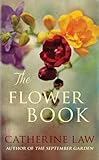
It begins in Cornwall in March 1914:

On certain nights if the wind was right, you could hear the sea from Old Trellick. So the legend has it, although Violet had never heard the waves and her parents would not try, due to the fact, she decided, that they had no imagination.

As a child she’d stand at the French windows and implore them to be quiet, to stop what they were doing and to concentrate with her, to catch this magical and elusive sound.

Every Friday Gilion at Rose City Reader hosts Book Beginnings on Friday, where you can share the first sentence (or so) of the book you are reading, along with your initial thoughts about the sentence, impressions of the book, or anything else the opener inspires.

I like the images the beginning of this book conjures and also the sounds. I always like the sight and sound of the waves breaking on the shore; to me too that has a certain magic. So this appealed to me straight away. Couple that with a story set against the backdrop of World War I as Aster Fairling searches for the truth behind her parents’ tragic love through the pages of her mother journal and I want to know more.

The Flower Book is Catherine Law’s third book.

Crucible by S G MacLean

Once again I was transported back to 17th century Scotland with Crucible by S G Maclean, the third of her Alexander Seaton books. I read the first, The Redemption of Alexander Seaton in February 2013 and now a year later I’ve been just as engrossed in Crucible. I think her style of writing suits me perfectly, the characters are just right, credible well-rounded people, the plot moves along swiftly with no unnecessary digressions and it’s just full of atmosphere. I loved it.

It’s set in 1631 in Aberdeen, where Alexander is now a Master at Marischal College. On Midsummer’s eve he stumbles across the body of his friend, Robert Sim, the college librarian, a few feet from the library steps, with his throat cut, blood congealing around the wound. Dr Dun, the college principal asks Alexander to investigate the matter, to look into Robert’s private life, hoping he’ll find nothing to reflect badly on the college.

I found it absolutely compelling reading. Robert had been cataloguing a new acquisition to the library before he was killed and Alexander is convinced that Robert was troubled by what he found there, amongst the books of history, alchemy  and hermetics – the quest for ‘a secret, unifying knowledge, known to the ancients’ since lost to us. There are many twists and turns and another man is killed before he finally arrives at the truth.

This is the third book in the series, but although I haven’t read the second book, I don’t think that matters as I think Crucible stands well on its own. The fourth book in the series is The Devil’s Recruit – the hardback and Kindle versions are available now, whilst the paperback will be available on 14 May. Now I’ve lifted my book buying ban I think I may just have to get the Kindle version soon.

Crucible qualifies for four of the challenges I’m doing this year – the Mount TBR challenge, the Historical Fiction Challenge, My Kind of Mystery Challenge and the Read Scotland Challenge.

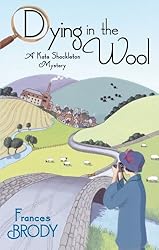
Dying in the Wool by Frances Brody

After I finished reading The Grass is Singing (see my previous post) I felt I needed to read something lighter and easier, so I turned to Dying in the Wool by Frances Brody and it turned out to be just the right book – not too taxing on either the brain or the emotions and a rather interesting mystery too.

It’s the first of Frances Brody’s Kate Shackleton Mysteries set in Yorkshire in 1922, with flashbacks to 1916. Bridgestead is a peaceful mill village, until the day in 1916 when mill owner Joshua Braithwaite went missing after apparently trying to commit suicide. Seven years later his daughter, Tabitha, who is getting married, still can’t believe her father is dead and she asks her friend Kate Shackleton to find out what really happened to him.

This is another post World War 1 crime novel, along the lines of Jacqueline Winspear’s Maisie Dobbs and Carola Dunn’s Daisy Dalrymple books, with an independent female amateur detective. Kate is a widow, her husband was missing in action during the war, presumed dead, her father is a police superintendent and she is a keen amateur photographer. On her father’s recommendation she hires Jim Sykes, an ex-policeman to help her. Once they start asking questions things start to happen with disastrous effects.

I liked the characters, Kate and Jim in particular, and the setting is lovely. The novel is well grounded historically in the aftermath of the First World War. I also liked the way the chapter headings were textile related with an explanation of the terms used and relevant to the events described in the chapters – very skilfully done, I thought. And just like woven cloth this mystery has many separate strands that Kate and Jim have to bring together to reveal what had happened in 1916.

This book fits well into several challenges – see the categories listed above.

Other books in the Kate Shackleton series are:

2. A Medal For Murder (2010)
3. Murder in the Afternoon (2011)
4. A Woman Unknown (2012)
5. Murder on a Summer’s Day (2013)
6. Death of an Avid Reader (2014)

First Chapter: The Observations

First chapterEvery Tuesday Diane at Bibliophile by the Sea hosts First Chapter First Paragraph Tuesday Intros, where you can share the first paragraph or (a few) of a book you are reading or thinking about reading soon.

My choice this week is a book I’ll be reading soon. It’s The Observations by Jane Harris and Chapter 1 ‘I Find a New Place‘ begins:
I had reason to leave Glasgow, this would have been about three or four years ago, and I had been on the Great Road about five hours when I seen a track to the left and a sign that said ‘Castle Haivers’. Now there’s a coincidence I thought to myself, because here I was on my way across Scratchland to have a look at Edinburgh castle and perhaps get a job there and who knows marry a young nobleman or prince. I was only 15 with a head full of sugar and I had a notion to work in a grand establishment.

Jane Harris was born in Belfast and grew up in Scotland before moving to England in her 20s.  The Observations, her first book is set in Scotland in 1863. It was shortlisted for the Orange Prize for Fiction in 2007 and the Prix du Premier Roman Etranger in 2009. Her second novel Gillespie and I, which I read just over two years ago, was shortlisted for the National Book Awards in 2011 and the Scottish Book Awards in 2012.

I enjoyed Gillespie and I, a book that lingered in my mind long after I’d finished reading it, so I’m hoping I’ll have a similar reaction to this book.

2014 Historical Fiction Reading Challenge

Historical Tapestry will be hosting the challenge again next year. The challenge runs from Historical Fiction 20141 January to 31 December 2014 and you can choose from the following levels:

20th century reader €“ 2 books
Victorian reader €“ 5 books
Renaissance Reader €“ 10 books
Medieval €“ 15 books
Ancient History €“ 25 books
Prehistoric €“ 50+ books

I’ve been thinking about the definition of ‘historical fiction’. It’s not as straight forward as it seems – a historical novel is obviously one set in the past. But have far back in the past? Does it have to have been written by someone who did not live through the events described?

I’ve been a bit unsure sometimes whether a book is actually historical fiction, for example yesterday, 5 years ago, 10, 20 years ago are all in the past, but are books set so recently ‘historical fiction’? I don’t think so. So to make it clear for myself I have decided that next year I will be using the Historical Novel Society’s definition:

To be deemed historical (in our sense), a novel must have been written at least fifty years after the events described, or have been written by someone who was not alive at the time of those events (who therefore approaches them only by research).

We also consider the following styles of novel to be historical fiction for our purposes: alternate histories (e.g. Robert Harris’ Fatherland), pseudo-histories (eg. Umberto Eco’sIsland of the Day Before), time-slip novels (e.g. Barbara Erskine’s Lady of Hay), historical fantasies (eg. Bernard Cornwell’s King Arthur trilogy) and multiple-time novels (e.g. Michael Cunningham’s The Hours).

I will be aiming for Ancient History (25 books) again but will see how close I can get to the Prehistoric level!

Gone With The Wind: Some Thoughts

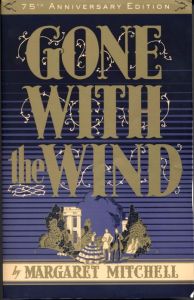
Gone with the wind 001

Yesterday I finished reading Margaret Mitchell’s masterpiece, Gone With The Wind. I loved it. When I started it I decided that I wouldn’t take any notes as I read and neither would I mark any passages. I just wanted the pure reading experience, reading to get immersed in the story and Margaret Mitchell was a superb storyteller. There are parts full of description that enabled me to see the scenes and parts where I couldn’t turn the pages fast enough to discover what happened next, or how the characters would behave. It was a grand experience, and not just a reading experience but a learning experience too.

I saw the 1939 film many, many years ago and my memories of it are vague, not much beyond its setting, Clark Gable as Rhett Butler and Vivien Leigh as Scarlett O’Hara, and a few quotes: ‘Tomorrow is another day’ and Frankly, my dear I don’t give a damn’ – this is actually a misquote from the book – Rhett says ‘lightly but softly: ‘My dear, I don’t give a damn.’

 My knowledge of American history is quite limited, so I learnt a lot about the American Civil War and Reconstruction, about slavery (very different from Uncle Tom’s Cabin) and a lot about Georgia and Atlanta – I couldn’t even have placed them on a map before!!!

I liked the structure of the novel – straightforward chronological sequence told in the third person.

The characters are well-defined and are developed as the book progresses. Even the minor characters are distinct and I had no trouble identifying them. But the main characters are magnificent: Scarlett O’Hara, wilful, spirited, supremely self-centred and single-minded, a cheat and liar, but also charming, brave and fearless, as her character develops from a frivolous flirt to a much darker personality. She is obsessed by her infatuation for Ashley Wilkes, by her need for money and her desperate desire never to be hungry ever again. I swung between not liking her, admiring her courage, then thoroughly disliking the person she became and willing her to change – she didn’t of course.

Rhett Butler, black-hearted, flashy, a speculator, blockade runner and scallawag, who scandalises Atlanta, is the anti-hero who is gradually revealed as a hero, a tender-hearted, over-indulgent father, who really does love Scarlett, even though he can’t tell her. He’s a much more complicated character than Scarlett who understands human nature much better than Scarlett, seeing both the goodness and strength in Melanie Hamilton (Scarlett’s sister-in-law and Ashley’s wife).

There is so much to write about this book, (and I’m thinking of writing at least one more post about it) but for now I’m ending with these words from Margaret Mitchell when she was asked what Gone With The Wind was about:

… if the novel has a theme it is that of survival. What makes some people come through catastrophes and others, apparently just as able, strong and brave go under? It happens in every upheaval. Some people survive; others don’t. What qualities are in those who fight their way through triumphantly that are lacking in those that go under? I only know that survivors  used to call that quality ‘gumption’. So I wrote about people who had gumption and those who didn’t. (1936) (About the Author)