Saturday Snapshot

My photos this week are a few of Cragside in Northumberland, now owned by the National Trust. It was built in 1863, with further extensions over the next 15 or so years, by William Armstrong, who later became Lord Armstrong. Armstrong was a remarkable man – a scientist, an innovator and a successful industrialist.

We visited it last year. Here is the view of the house approaching from the public car park:

and the view from the gardens:

It has to be one of my favourite National Trust properties and it’s a very popular house with everyone else too – the place was packed when we were there last April. There is so much to see inside the house, too much for one post. The house was very modern for its times, with all the latest and advanced technical devices of the day.

One of my favourite rooms is the Library, with its  stained glass windows, comfy chairs, leather sofas and the latest lighting available. This was the first room in the world to be lit by hydro-electricity.

The light suspended from the ceiling has four bulbs within the ornate and fringed light shade. I tried very hard to get a photo without any of the other visitors, but gave up when there was just one person looking out of the window – anyway he gives scale to the room.

There are four more bulbs around the room, place in globes, sitting on vases:

The books are in oak bookcases around the room:

Note the library steps at the left-hand side of the photo.

Click on the photos to enlarge them.

At a later date I might post more photos – of the kitchen with its dishwasher, the lovely dining room with its William Morris stained glass windows and of the amazing Gallery, with its collection of paintings and sculptures. As for the Drawing Room, this was not to my taste at all with its huge marble chimney piece.

See more Saturday Snapshots on Alyce’s blog At Home With Books.

Saturday Snapshot

This is the Bell Tower at the northern side of Berwick-upon-Tweed, the most northerly town in England. It was built about 1577, replacing a 14th century tower on the medieval walls of the town. There used to be a warning bell in the tower that sentries would sound at the sight of danger to the townspeople. At one time there used to be a beacon on top, which could be lit if the country was invaded.

These days it’s an odd sight on a grassy mound at the end of a residential road.

But in earlier days it was in a prime position overlooking the sea, the fields and the town. Nearby is Lord’s Mount, a fort built in  around 1540 during Henry VIII’s reign. It was orginally on two floors but all that remains are parts of the ground floor and you can see fireplaces, a flagged kitchen floor, a well and a privy.

There used to be guns mounted on the parapet and I climbed what was left of the steps to see the view. I didn’t venture on to the top; it was very windy and I don’t have a head for heights!

Photos taken September 2011.

For more Saturday Snapshots see Alyce’s blog At Home With Books.

Saturday Snapshot – Newcastle’s Castle

A few Saturdays ago I posted photos of Newcastle uponTyne’s bridges. Today here are some more photos I took on that grey, gloomy day. This time they are of Newcastle’s Castle Keep and Black Gate.

Our first sight of the castle was as it appeared behind the railway line:

The Castle was was built in stone during the reign of Henry II, between 1168 and 1178, at a cost of £1,144. There was an earlier castle on the site, a wooden motte and bailey castle built by William the Conqueror’s son, Robert Curthose. This was replaced by the stone castle – hence the name of Newcastle! It stands high above the River Tyne – Newcastle upon Tyne.

This is the Castle Keep, which is the only remaining part of the 12th century Castle:

It is a Scheduled Ancient Monument and is open to the public, but we didn’t have time that day to go inside. On our next visit to Newcastle, we will make time to have a proper look at the Castle Keep!

The Gatehouse to the Castle is still standing – the Black Gate. It was added to the Castle site in 1247 by Henry III.  The wooden footbridge was originally a drawbridge.

Saturday Snapshot is hosted by Alyce at At Home With Books.

Saturday Snapshot

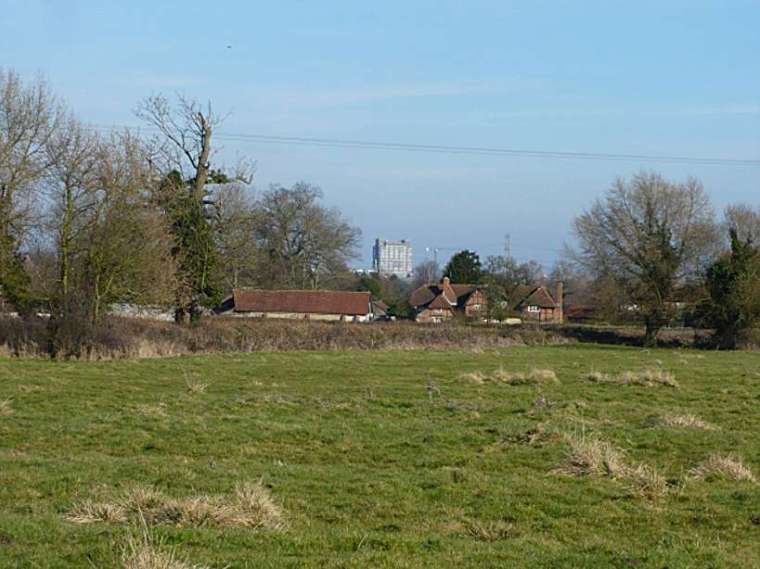
I have a scrolling photo viewer on the computer desktop and this photo greeted me this morning when I switched the computer on. It’s the view from the field near to my previous house looking towards the town of Aylesbury in Buckinghamshire. The grey tower block in the background is where I used to work at the County Council offices – I was on the 8th floor, just over halfway up the building.

I like this photo because it shows the contrast between the old and the new, although the County Hall tower block is not new, completed in 1966, it’s certainly centuries older than the timber-framed house in the foreground.

Believe it or not, the tower block, sometimes called Pooley’s Folly after the architect, is a Grade II Listed Building. It’s constructed out of concrete and glass and whilst I was working there it was discovered that the core of the building was crumbling and it had to be reinforced. We were surrounded by scaffolding for months. It’s also a most inconvenient building to work in, boiling hot in the summer, freezing in the winter, draughty windows and only two lifts serving 13 fours and no service lift. I spent hours in total over the years I worked there just waiting for the lift. Still, that meant I had more time to read whilst waiting.

Saturday Snapshot is hosted by Alyce of At Home with Books.

Saturday Snapshot

These are the ruins of Melrose Abbey in the Scottish Borders, founded by Cistercian monks in 1136, and now maintained by Historic Scotland.  Alexander II and other Scottish kings and nobles are buried at the abbey and the embalmed heart of Robert the Bruce is said to be buried here. We visited it on a sunny April day last year.

Below is a view from the roof:

and here is a close up of two of the gargoyles:

Posted for Saturday Snapshot, hosted by Alyce of At Home With Books.

Saturday Snapshot

I posted photos of a ruined castle last Wednesday. Today I’m featuring a much larger castle – Alnwick Castle, which is the second largest inhabited castle in England.  The Duke of Northumberland and his family live here; the family have lived at Alnwick for 700 years. The castle was used to film parts of some of the Harry Potter films – the castle was Hogwarts in the first two films and Harry’s broomstick flying lessons were filmed in the Outer Bailey. Other films made there include Elizabeth and Robin Hood Prince of Thieves.

We went there the week before last with our grandson, a lover of Harry Potter. He liked the historical setting, the battlements and the canons,  but most of all I think he liked the Knights’ Quest and the Harry Potter magic show, with Harry and Professor Dumbledore:

We’ll have to go back for another visit as there is so much to see and we only had time for a quick walk round the State Rooms, which are very grand, although I was amused to see a Table Football in the Library (I think that is where it was), definite proof that Alnwick Castle is also a family home.

See more Saturday Snapshots at Alyce’s blog At Home with Books.