My Friday Post: The Radium Girls by Kate Moore

On Fridays I often join in with two book memes:

Book Beginnings on Fridays hosted by Rose City Reader, where bloggers share the first sentence or more of a current read, as well as initial thoughts about the sentence(s), impressions of the book, or anything else that the opening inspires. 

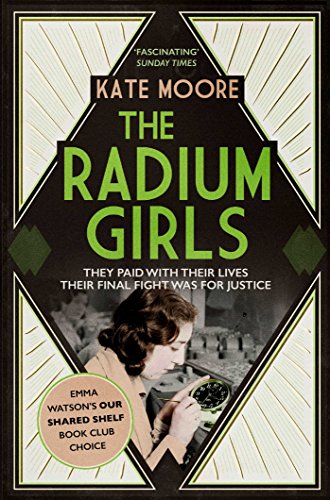
This week I’m featuring The Radium Girls: They paid with their lives. Their final fight was for justice by Kate Moore, one of my TBRs. It’s the true story about dial-painters, girls and women who painted the numbers on clocks, watches and other instruments using radium-infused luminous paint in the 1920s and 1930s. The girls shone brightly in the dark, covered head to toe in dust from the paint. 
The scientist had forgotten all about the radium. It was tucked discreetly within the folds of his waistcoat pocket, enclosed in a slim glass tube in such a small quantity that he could not feel its weight.
Also on a Friday The Friday 56 is hosted by Freda’s Voice, where you grab a book and turn to page 56 (or 56% of an eBook), find one or more interesting sentences (no spoilers), and post them.

56%:

‘Every week there seemed to be some emergency order that required an extra pair of hands. Then Catherine would slip her brush between her lips, dip it in the powder and paint; the girls all still did it that way at Radium Dial, for their instructions were never changed.
My Friday Post: The King’s Justice by E M Powell

On Fridays I often join in with two book memes:

Book Beginnings on Fridays hosted by Rose City Reader, where bloggers share the first sentence or more of a current read, as well as initial thoughts about the sentence(s), impressions of the book, or anything else that the opening inspires. 

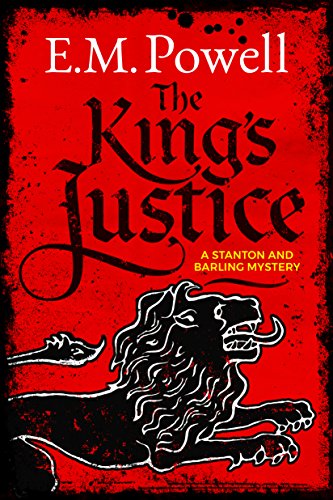
This week I’m featuring The King’s Justice by E M Powell one of my TBRs. It’s the first in her Stanton and Barling medieval murder mystery series, set during the reign of Henry II. Aelred Barling is a senior clerk to the justices of King Henry II, and Hugo Stanton, his assistant are sent to investigate a brutal murder in a village outside York.

The City of York, 12 June 1176

Pit or punishment: Hugo Stanton couldn’t tell which excited the folk of these hot, crammed streets more.

Three men accused of vicious murder but who would not confess. Innocent, they’d claimed to King Henry’s travelling justices, sitting in the court in the high keep of the city’s castle.

The men were to be judged by water: lowered into a pit of water if they sank they were innocent, if they floated they were guilty and strung up on the gallows to die.

Also on a Friday The Friday 56 is hosted by Freda’s Voice, where you grab a book and turn to page 56 (or 56% of an eBook), find one or more interesting sentences (no spoilers), and post them.

Page 56:

‘The glow of the setting sun fell on his face. A glorious evening, one for lying in the long grass with his lost, beautiful love. Not standing facing a circle of angry, shouting people, people who wanted to take a man’s life. And wanted to take it now.

My Friday Post: Th1rt3en by Steve Cavanagh

On Fridays I often join in with two book memes:

Book Beginnings on Fridays hosted by Rose City Reader, where bloggers share the first sentence or more of a current read, as well as initial thoughts about the sentence(s), impressions of the book, or anything else that the opening inspires. 

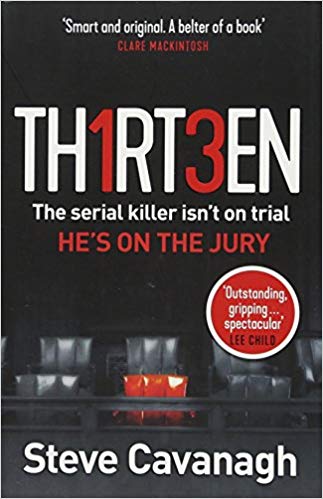
This week I’m featuring Th1rt3en by Steve Cavanagh, one of my TBRs. I remembered I’d got this book when I saw the author on Pointless last Saturday.

It begins with a Prologue:

At ten after five on a raw December afternoon, Joshua Kane lay on a cardboard bed outside the Criminal Courts Building in Manhattan and thought about killing a man.

Also on a Friday The Friday 56 is hosted by Freda’s Voice, where you grab a book and turn to page 56 (or 56% of an eBook), find one or more interesting sentences (no spoilers), and post them.

Page 56:

‘There’s no real security here, Mr Flynn. I’ll be outside for tonight. In the morning I’ll arrange for a safe to be delivered to your office. The laptop is to be kept in this safe when you’re not in. That okay with you?’ said Holten.

Blurb:

THE SERIAL KILLER ISN’T ON TRIAL. HE’S ON THE JURY…

To your knowledge, is there anything that would preclude you from serving on this jury?’

Murder wasn’t the hard part. It was just the start of the game.

Joshua Kane has been preparing for this moment his whole life. He’s done it before.

But this is the big one.

This is the murder trial of the century.

And Kane has killed to get the best seat in the house.

But there’s someone on his tail. Someone who suspects that the killer isn’t the man on trial.

Kane knows time is running out – he just needs to get to the conviction without being discovered.

~~~

This is the fourth Eddie Flynn novel and I haven’t read the first three, but apparently they are standalone books that can be read in any order, so that’s okay. The description reminds me a bit of John Grisham’s books. What do you think?

My Friday Post: Prophecy by S J Parris

Every Friday Book Beginnings on Friday is hosted by Gillion at Rose City Reader where you can share the first sentence (or so) of the book you are reading. You can also share from a book you want to highlight just because it caught your fancy.

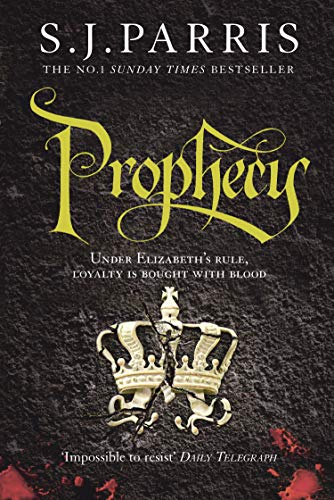
This week I’m featuring one of my library books, Prophecy, It’s the second in S J Parris’ Giordano Bruno series set in the reign of Elizabeth I. Bruno was a monk, poet, scientist, and magician on the run from the Roman Inquisition on charges of heresy for his belief that the Earth orbits the sun and that the universe is infinite. In this book set in 1583, Elizabeth’s throne is in peril, threatened by Mary Stuart’s supporters scheme to usurp the rightful monarch.

It begins with a Prologue:

Mortlake, House of John Dee
3rd September, Year of Our Lord 1583

Without warning, all the candles in the room’s corners flicker and feint, as if a sudden gust has entered, but the air remains still. At the same moment, the hairs on my arms prickle and stand erect and I shudder; a cold breath descends on us, though outside the day is close.

Also every Friday there is The Friday 56, hosted by Freda at Freda’s Voice. *Grab a book, any book. *Turn to Page 56 or 56% on your  ereader . If you have to improvise, that is okay. *Find a snippet, short and sweet, but no spoilers!

Page 56:

‘Treaties be damned!’

Henry Howard throws back his chair and pounds a fist on the table, so suddenly that again we all jolt in our seats. The candles have burnt down so far that his shadow leaps and quivers up the panels behind him and creeps over the ceiling, looming like an ogre in a children’s tale.

Lord Henry Howard, was a devout Catholic and a dangerous man, the head of the most powerful Catholic family in England. He took part in the 1583 Throckmorton Plot, one of a series of attempts by English Roman Catholics to depose Elizabeth I of England and replace her with Mary, Queen of Scots, then held under house arrest in England.

Candles flickering, shadows cast and a feeling of dread and suspense in both these extracts set the scene for a thrilling story!

My Friday Post: Weeds by Richard Mabey

On Fridays I join in with two book memes:

Book Beginnings on Fridays hosted by Rose City Reader, where bloggers share the first sentence or more of a current read, as well as initial thoughts about the sentence(s), impressions of the book, or anything else that the opening inspires. 

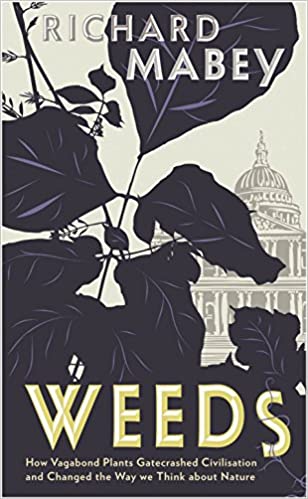
This week I’m featuring a non-fiction book, Weeds: How Vagabond Plants Gatecrashed Civilisation and Changed the Way We Think About Weeds by Richard Mabey. This is a book that I’ve dipped into, mostly at this time of year, when the weeds in our garden begin to grow again. It is full of fascinating facts – a cultural history of weeds. Richard Mabey argues that ‘we have caused plants to become weeds because of our reckless treatment of the earth. They are part of nature’s immune system, of its instinctive drive to green over the barrenness of broken soil and decaying cities.

Plants become weeds when they obstruct our plans, or tidy maps of the world. If you have no such plans or maps, they can appear as innocents, without stigma or blame. My own discovery of them was my first close encounter with plants, and they seemed to me like a kind of manna.

The Friday 56 hosted by Freda’s Voice, where you grab a book and turn to page 56 (or 56% of an eBook), find one or more interesting sentences (no spoilers), and post them.

To gaze at Albrecht Durer’s extraordinary painting Large Piece of Turf (Das Grosse Rasenstuck, (1503) is to glimpse an imagination pierced through the artistic conventions and cultural assumptions of its time and projecting itself forward three centuries. This is painting’s discovery of ecology. This is any corner of any waste patch of land in the early twenty-first century, or at any time. This is a clump of weeds looked at with such reverent attention that they might have been the flowers of Elysium.

Durer’s painting is not reproduced in the book, but this is it:

Large Piece of Turf Durer 1503

I’ve had this book for ten years – I think it’s time I read it through from start to finish.

My Friday Post: The Lieutenant by Kate Grenville

Every Friday Book Beginnings on Friday is hosted by Gillion at Rose City Reader where you can share the first sentence (or so) of the book you are reading. You can also share from a book you want to highlight just because it caught your fancy.

I’m currently reading A Room Made of Leaves by Elizabeth Grenville, her latest book, and have nearly finished it. I love her books and as I’ve nearly finished it I was wondering which book to read next and remembered I have one of her earlier books, The Lieutenant still waiting to be read. To my surprise when I opened it this morning I found that it is another book about one of the characters in A Room Made of Leaves. That character is William Dawes, a real person, a soldier in the first days of the Colony of New South Wales.

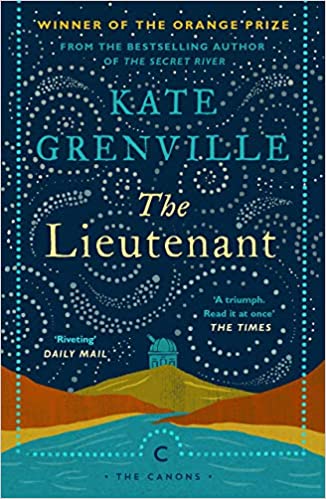
The Lieutenant  is about Daniel Rooke, based on real events in William Dawes’ life, using his notebooks in which he recorded his conversations with a young girl, Patyegarang, (also in A Room Made of Leaves), in his efforts to learn the language of the indigenous people of Sydney. It is a novel that stays close to the historical events. 

It begins:

Daniel Rooke was quiet, moody, a man of few words. He had no memories other than of being an outsider.

Also every Friday there is The Friday 56, hosted by Freda at Freda’s Voice. *Grab a book, any book. *Turn to Page 56 or 56% on your  ereader . If you have to improvise, that is okay. *Find a snippet, short and sweet, but no spoilers!

  1. Grab a book, any book.
  2. Turn to page 56, or 56% on your eReader. If you have to improvise, that is okay.
  3. Find any sentence (or a few, just don’t spoil it) that grabs you.
  4. Post it.
  5. Add the URL to your post in the link on Freda’s most recent Friday 56 post.

Page 56:

It seemed that the natives did not like the surgeon’s music any more than they had enjoyed his performance with the pistol. Their faces were stony. After a minute they took the two pieces of shield and disappeared into the woods.

Book description:

1788 Daniel Rooke sets out on a journey that will change the course of his life. As a lieutenant in the First Fleet, he lands on the wild and unknown shores of New South Wales. There he sets up an observatory to chart the stars. But this country will prove far more revelatory than the skies above.

Based on real events, The Lieutenant tells the unforgettable story of Rooke’s connection to an Aboriginal child – a remarkable friendship that resonates across the oceans and the centuries.