First Chapter, First Paragraph: Bilgewater

Every Tuesday Diane at Bibliophile by the Sea hosts First Chapter First Paragraph Tuesday Intros to share the first paragraph sometimes two, of a book that she’s reading or planning to read soon.

This week’s first paragraph is from Bilgewater by Jane Gardam, one of my TBR books that I’m planning to read soon.

BilgewaterChapter 1

My mother died when I was born which makes me sound princess-like and rather quaint. From the beginning people have said that I am old-fashioned. In Yorkshire to be old-fashioned means to be fashioned-old, not necessarily to be out of date, but I think that I am probably both. For it is rather out of date, even though I will be eighteen this February, to have had a mother who died when one was born and it is fashioned -old to have the misfortune to be and look like me.

Blurb:

Marigold Green calls herself ‘hideous, quaint and barmy’. Other people call her Bilgewater, a corruption of Bill’s daughter. Growing up in a boys’ school where her father is housemaster, she is convinced of her own plainness and peculiarity. Groomed by the wise and loving Paula, upstaged by bad, beautiful Grace and ripe for seduction by entirely the wrong sort of boy, she suffers extravagantly and comically in her pilgrimage through the turbulent, twilight world of alarming adolescence.

I’m looking forward to reading this as I’ve enjoyed other books by Jane Gardam, such as her Old Filth books.

Would you keep reading, or not?
First Chapter, First Paragraph: Burial Rites

Every Tuesday Diane at Bibliophile by the Sea hosts First Chapter First Paragraph Tuesday Intros to share the first paragraph sometimes two, of a book that she’s reading or planning to read soon.

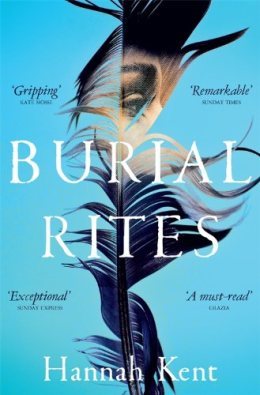
This week’s first paragraph is from Burial Rites by Hannah Kent.

Burial RitesIt begins with a Prologue:

They said I must die. They said that I stole the breath from men, and now they must steal mine. I imagine, then, that we are all candle flames, greasy-bright, fluttering in the darkness and the howl of the wind, and in the stillness of the room I hear footsteps, awful coming footsteps, coming to blow me out and send my life up away from me in a grey wreath of smoke. I will vanish into the air and the night. They will blow us all out, one by one, until it is only their own light by which they see themselves. Where will I be then?

Blurb:

Northern Iceland, 1829. A woman condemned to death for murdering her lover. A family forced to take her in. A priest tasked with absolving her.

But all is not as it seems, and time is running out: winter is coming, and with it the execution date. Only she can know the truth. This is Agnes’s story.

A while ago I noticed that people were reading this book when it was shortlisted for many awards, but although it’s historical fiction, one of my favourite genres, and based on a true story it didn’t really appeal to me at the time. Then I read Hannah Kent’s second novel, The Good People, which I thought was such a beautifully written and moving book, and I decided to try her debut novel.

What do you think? Would you keep reading?  And if you have read it what did you think about it?

First Chapter, First Paragraph: State of Wonder

First chapterEvery Tuesday Diane at Bibliophile by the Sea hosts First Chapter First Paragraph Tuesday Intros to share the first paragraph sometimes two, of a book that she’s reading or planning to read soon.

This week I’m looking at State of Wonder by Ann Patchett, one of my TBR books on my Kindle and thinking of reading it next.

State of Wonder

It begins:

The news of Anders Eckman’s death came by way of Aerogram, a piece of bright blue airmail paper that served both as the stationery and, when folded over and sealed along the edges, the envelope. Who even knew they still made such things? The single sheet had traveled from Brazil to Minnesota to mark the passing of a man, a breath of tissue so insubstantial that only the stamp seemed to anchor it to this world. Mr Fox had the letter in his hand when he came to the lab to tell Marina the news. When she saw him there at the door she smiled at him and in the light of that smile he faltered.

“What?” she said finally.

He opened his mouth and then closed it. When he tried again all he could say was, “It’s snowing.”

Blurb:

Among the tangled waterways and giant anacondas of the Brazilian Rio Negro, an enigmatic scientist is developing a drug that could alter the lives of women for ever. Dr Annick Swenson’s work is shrouded in mystery; she refuses to report on her progress, especially to her investors, whose patience is fast running out. Anders Eckman, a mild-mannered lab researcher, is sent to investigate.
A curt letter reporting his untimely death is all that returns.

Now Marina Singh, Anders’ colleague and once a student of the mighty Dr Swenson, is their last hope. Compelled by the pleas of Anders’s wife, who refuses to accept that her husband is not coming home, Marina leaves the snowy plains of Minnesota and retraces her friend’s steps into the heart of the South American darkness, determined to track down Dr. Swenson and uncover the secrets being jealously guarded among the remotest tribes of the rainforest.

What Marina does not yet know is that, in this ancient corner of the jungle, where the muddy waters and susurrating grasses hide countless unknown perils and temptations, she will face challenges beyond her wildest imagination.

Marina is no longer the student, but only time will tell if she has learnt enough.

I can see why I bought this book – but why haven’t I read it yet? It looks so good. What do you think – would you keep reading?

First Chapter, First Paragraph: The Snow Child

First chapterEvery Tuesday Diane at Bibliophile by the Sea hosts First Chapter First Paragraph Tuesday Intros to share the first paragraph sometimes two, of a book that she’s reading or planning to read soon.

This week my opening is from Eowyn Ivey’s first book, The Snow Child.

The Snow Child

It begins:

Wolverine River, Alaska, 1920

Mabel had known there would be silence. That was the point after all. No infants cooing or wailing. No neighbor children playfully hollering down the lane. No pad of small feet on wooden stairs worn smooth by generations, or clackety-clack of toys along the kitchen floor. All those sounds of her failure and regret would be left behind, and in their place would be silence.

I’ll be reading this book soon because I’ve read and loved her second book, To the Bright Edge of the World and I’ve heard that The Snow Child is also a wonderful book. These opening sentences are full of pathos and denial of Mabel’s desires and draw me in.

Blurb:

A bewitching tale of heartbreak and hope set in 1920s Alaska, Eowyn Ivey’s THE SNOW CHILD was a top ten bestseller in hardback and paperback, and went on to be a Finalist for the Pulitzer Prize.

Alaska, the 1920s. Jack and Mabel have staked everything on a fresh start in a remote homestead, but the wilderness is a stark place, and Mabel is haunted by the baby she lost many years before. When a little girl appears mysteriously on their land, each is filled with wonder, but also foreboding: is she what she seems, and can they find room in their hearts for her?

Written with the clarity and vividness of the Russian fairy tale from which it takes its inspiration, The Snow Child is an instant classic.

Would you read on? If you have read this book what did you think?

First Chapter, First Paragraph: The Invention of Wings

First chapterEvery Tuesday Diane at Bibliophile by the Sea hosts First Chapter First Paragraph Tuesday Intros to share the first paragraph sometimes two, of a book that she’s reading or planning to read soon.

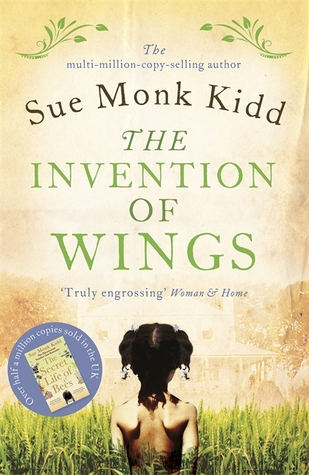
This week I’m featuring The Invention of Wings by Sue Monk Kidd, a book I’ll be reading this month for my book group.

The Invention of Wings

It begins:

There was a time in Africa the people could fly. Mauma told me this one night when I was ten years old. She said, Handful, your granny-mauma saw it for herself. She say they flew over trees and clouds. She say they flew like blackbirds. when we came here, we left the magic behind.

From the back cover:

Handful’s always been in trouble. A slave in the Grimké household like her beloved mother Charlotte, Handful knows the rules, in all their brutality, but no one can stop her pushing them to the limit. When, ten years old, she’s presented to the owner’s most difficult daughter, Sarah, as a birthday present, the sparks begin to fly …

I think I’m going to enjoy this book very much. It’s set in Charleston in the early nineteenth century and is based on the lives of sisters, Sarah and Angelina Grimké, the first female abolition agents and among the earliest American feminist thinkers.

What do you think? Would you carry on reading?

My Friday Post: All the Light We Cannot See

Book Beginnings Button

Every Friday Book Beginnings on Friday is hosted by Gillion at Rose City Reader where you can share the first sentence (or so) of the book you are reading, along with your initial thoughts about the sentence, impressions of the book, or anything else the opener inspires.

18143977

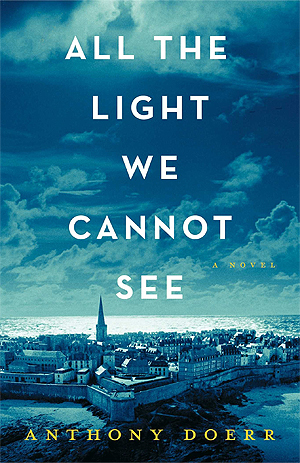
This morning I began reading All the Light We Cannot See by Anthony Doerr (one of the TBRs on my Kindle) and already I think I’m going to like it very much.

It begins:

Zero

7 August 1944

Leaflets

At dusk they pour from the sky. They blow across the ramparts, turn cartwheels over rooftops, flutter into the ravines between houses. Entire streets swirl with them, flashing white against the cobbles. Urgent message to the inhabitants of this town, they say. Depart immediately to open country.

A dramatic opening, immediately alerting me to the danger that is to come.

Also every Friday there is The Friday 56, hosted by Freda at Freda’s Voice.

Friday 56

These are the rules:

  1. Grab a book, any book.
  2. Turn to page 56, or 56% on your eReader.
  3. Find any sentence (or a few, just don’t spoil it) that grabs you.
  4. Post it.
  5. Add the URL to your post in the link on Freda’s most recent Friday 56 post.

Page 56:

All day Marie-Laure lies on her stomach and reads. Logic, reason, pure science: these Aronnax insists, are the proper ways to pursue a mystery. Not fables and fairy tales.

Synopsis:

A beautiful, stunningly ambitious novel about a blind French girl and a German boy whose paths collide in occupied France as both try to survive the devastation of World War II

Marie-Laure has been blind since the age of six. Her father builds a perfect miniature of their Paris neighbourhood so she can memorize it by touch and navigate her way home. But when the Nazis invade, father and daughter flee with a dangerous secret.

Werner is a German orphan, destined to labour in the same mine that claimed his father’s life, until he discovers a knack for engineering. His talent wins him a place at a brutal military academy, but his way out of obscurity is built on suffering.

At the same time, far away in a walled city by the sea, an old man discovers new worlds without ever setting foot outside his home. But all around him, impending danger closes in.

Doerr’s combination of soaring imagination and meticulous observation is electric. As Europe is engulfed by war and lives collide unpredictably, ‘˜All The Light We Cannot See’ is a captivating and devastating elegy for innocence.