Books from the Mobile Library: July 2021

I borrowed three more books from the Mobile Library last Tuesday, all by new-to-me authors. The first two books in the photo below are books I picked from the shelves at random, so they’re in the nature of a lucky dip – I may or may not enjoy them. The third book is one I reserved.
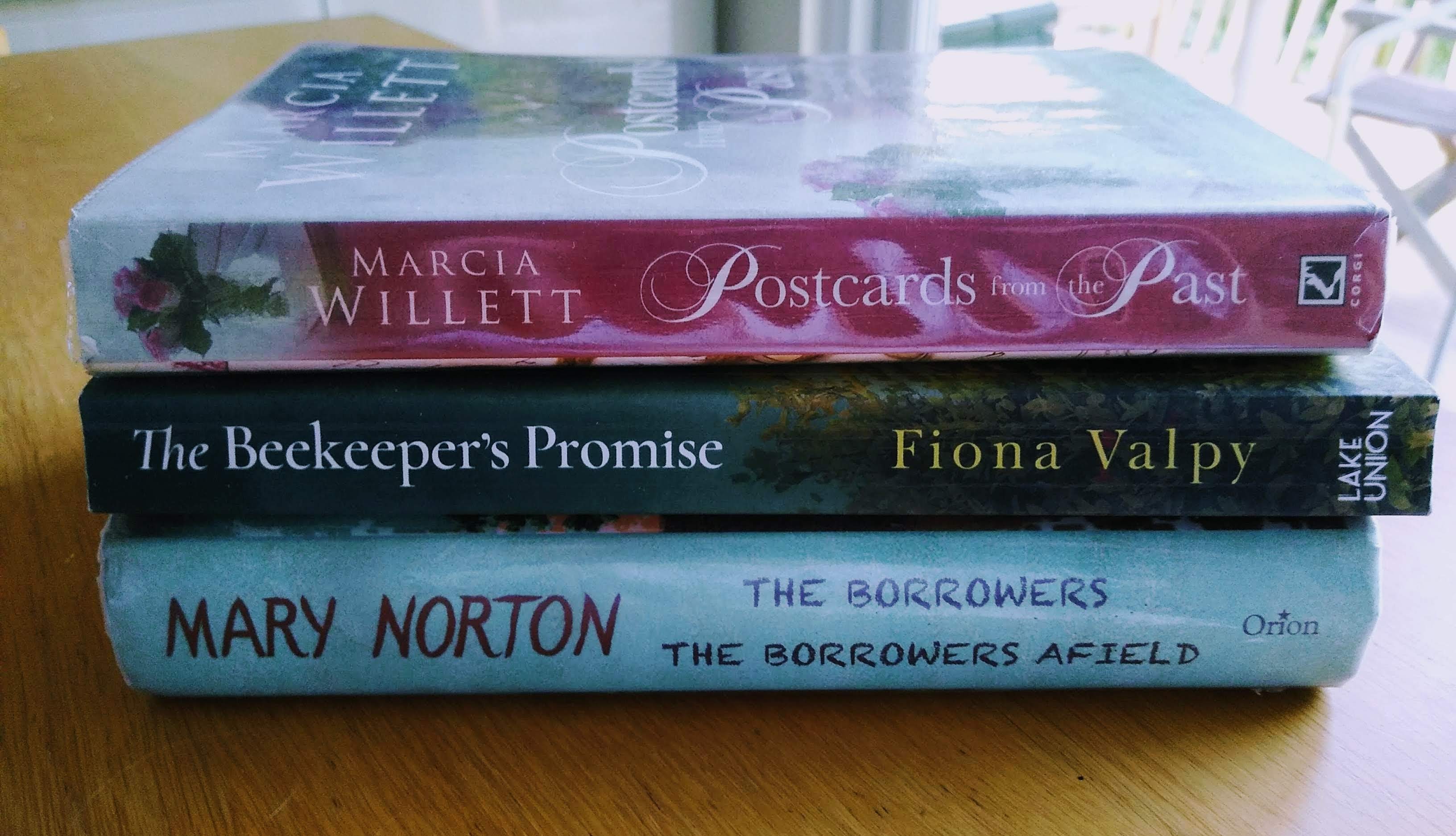
Postcards from the Past by Marcia Willett. I have never come across her books before, even though I see she has written many books. The description on the back cover of a family with a mysterious past appeals to me.

From the back cover:

Siblings Billa and Ed share their beautiful, grand old childhood home in rural Cornwall. Their lives are uncomplicated. With family and friends nearby and their free and easy living arrangements, life seems as content as can be.

But when postcards start arriving from a sinister figure they thought belonged well and truly in their pasts, old memories are stirred. Why is he contacting them now? And what has he been hiding all these years?

The Beekeeper’s Promise by Fiona Valpy. I don’t read much romantic fiction, so this book may not be for me, but the opening paragraph appealed to me. I wrote about this book in My Friday post.

The Borrowers and The Borrowers Afield by Mary Norton. I’ve never read these children’s stories, although I vaguely remember watching a TV adaptation years ago.

From the book jacket:

Deep within the floorboards in the nooks and crannies of a quiet old house, live the tiny Borrowers, Pod, Homily and Arrietty Clock. They own nothing and borrow everything from the human ‘beans’ above them. And they have just one rule: they must never be seen.

Have you read any of these books? Are you tempted?
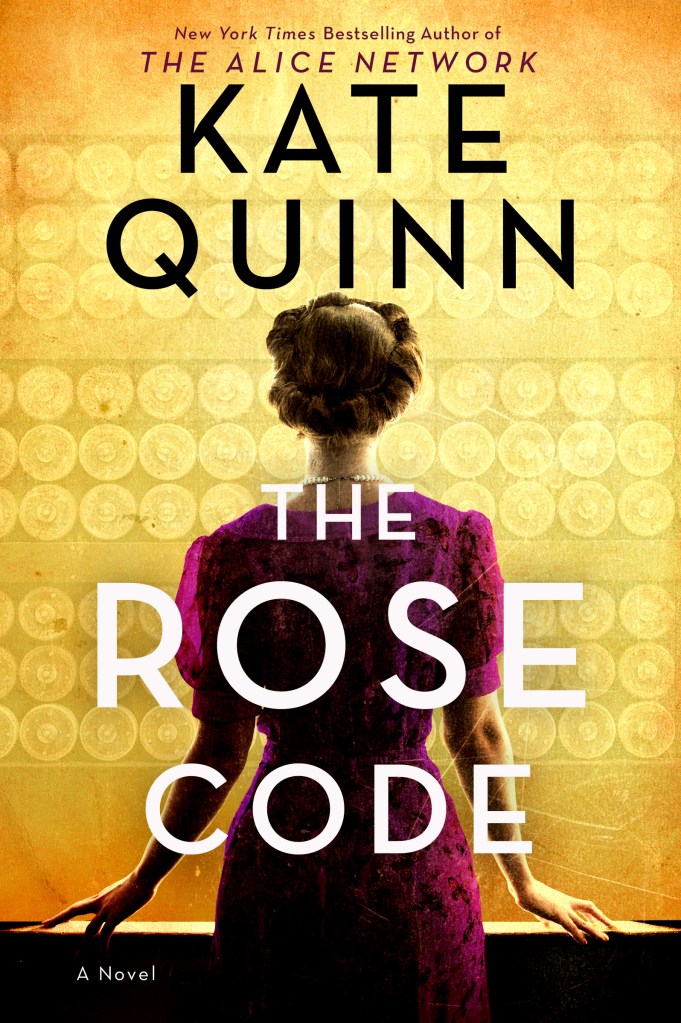
The Rose Code by Kate Quinn

Harper Collins| 18 March 2021| 645 pages| 3*

1940, Bletchley Park, Buckinghamshire.

Three very different women are recruited to the mysterious Bletchley Park, where the best minds in Britain train to break German military codes.

Vivacious debutante Osla has the dashing Prince Philip of Greece sending her roses – but she burns to prove herself as more than a society girl, working to translate decoded enemy secrets. Self-made Mab masters the legendary codebreaking machines as she conceals old wounds and the poverty of her East-End London upbringing. And shy local girl Beth is the outsider who trains as one of the Park’s few female cryptanalysts.

1947, London.

Seven years after they first meet, on the eve of the royal wedding between Princess Elizabeth and Prince Philip, disaster threatens. Osla, Mab and Beth are estranged, their friendship torn apart by secrets and betrayal. Yet now they must race against the clock to crack one final code together, before it’s too late, for them and for their country.

My Thoughts:

I have very mixed thoughts about The Rose Code. On the one hand it’s just the sort of book I love – historical fiction with a thrilling story and interesting characters that kept me wanting to read on and yet also made me want it to last as long as possible. On the other hand, it’s unevenly paced, with a slow start and a rushed ending that was somewhat of an anti-climax. My favourite character was Beth and I enjoyed reading how her character developed from a shy down trodden young woman into a brilliant cryptanalyst.

But when I first began reading it earlier this year I stopped after the opening pages and only picked it up again a couple of weeks or so ago. I initially stopped as the storyline involving Prince Philip made me very uncomfortable – Prince Philip was still alive when this book was written and when I first started to read it. He died in April this year.

The book begins in 1947 as Osla Kendall, a journalist working for the Tatler, is wondering what to wear for the Royal Wedding. She is in a ‘foul mood‘ as she wonders what to wear to the wedding of Princess Elizabeth and Lieutenant Philip Mountbatten.

Historical fiction mixes fact and fiction with both real and imaginary characters and I don’t have a problem with that. The character of Osla Kendall is based on a real person – in her Author’s Note Kate Quinn writes that she is ‘lightly fictionalized from the real-life Osla Benning, a beautiful, effervescent, Canadian-born heiress and Hut 4 translator who was Prince Philip’s long-term wartime girlfriend.‘ But by the time of the Royal Wedding Osla Benning was already married, not pining after Prince Philip. In writing their story Kate Quinn was not writing from facts but from her imagination as she put words in her characters’ mouths and described their emotions thoughts and feelings, which, of course, she could not have known.

However, I got over my dislike and read on – after all, this is fiction, not an accurate historical account. I like to know which is fact and which is fiction when I read historical fiction. So, after reading the review copy I received via NetGalley, I decided I needed to buy the published book and read the Author’s Note. And I’m glad did because I was relieved to find that Kate Quinn goes into a lot of detail to identify which characters are real and which fictional and how she has fictionalised them. She also reveals that she has also deviated from the historical records ‘to serve the story.’ I think this explains why I was uncomfortable with the book and why I don’t often read historical romances.

With thanks to NetGalley and to the publishers for my review copy.

My Friday Post: The Beekeeper’s Promise by Fiona Valpy

Every Friday Book Beginnings on Friday is hosted by Gillion at Rose City Reader where you can share the first sentence (or so) of the book you are reading. You can also share from a book you want to highlight just because it caught your fancy.

This week I’m featuring one of my library books, The Beekeeper’s Promise by Fiona Valpy.

Eliane; 2017

She knew this would be her last summer. The warm caress of the late-spring sunlight couldn’t roll back the fog-like weariness that crept through her bones these days. But then there had been so many summers. Almost a hundred.

Also every Friday there is The Friday 56, hosted by Freda at Freda’s Voice. *Grab a book, any book. *Turn to Page 56 or 56% on your  ereader . If you have to improvise, that is okay. *Find a snippet, short and sweet, but no spoilers!

Page 56:

That night, as the girls lay in their attic bedroom at the mill listening to the owls softly declaring their territory in the darkness, Mireille whispered, ‘Eliane? Are you awake?’

‘Yes,’ came the reply from across the room.

‘It’s been a good Easter, hasn’t it?’

There was a pause. ‘One of the best.’

Set in France at the Château Bellevue, this is the story of two remarkable women, generations apart, who must use adversity to their advantage and find the resilience deep within.

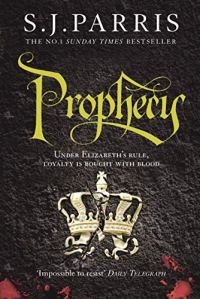
Prophecy by S J Parris

Harper Collins| 2011| 448p| Library book| 4*

Prophecy by S J Parris (a pseudonym of Stephanie Merritt) is the second book in her Giordano Bruno series of historical thrillers. Giordano Bruno was a 16th century heretic philosopher and spy. On her website Stephanie Merritt has written about how she first discovered him. Her version of Bruno is a fictional creation, though many of the situations he encounters are based on historical fact.

Bruno started out as a Dominican friar in Naples, but fled his order to escape the Inquisition, went on the run through Italy, found work as an itinerant teacher and within three years had ended up in Paris as personal tutor to the King of France. By 1583 he was in England, working for the Queen Elizabeth I’s spymaster Sir Francis Walsingham.

Prophecy begins in the autumn of 1583, when Elizabeth’s throne is in peril, threatened by Mary Stuart’s supporters scheme to usurp the rightful monarch. I wrote about the opening of the book together with an extract from page 56 in this post. After a young maid of honour is murdered, with occult symbols carved into her flesh, Bruno is assigned to infiltrate the plotters and secure the evidence that will condemn them to death.

I think this description on the Fantastic Fiction website summarises the book very well:

It is the year of the Great Conjunction, when the two most powerful planets, Jupiter and Saturn, align – an astrological phenomenon that occurs once every thousand years and heralds the death of one age and the dawn of another. The streets of London are abuzz with predictions of horrific events to come, possibly even the death of Queen Elizabeth.

When several of the queen’s maids of honor are found dead, rumors of black magic abound. Elizabeth calls upon her personal astrologer, John Dee, and Giordano Bruno to solve the crimes. While Dee turns to a mysterious medium claiming knowledge of the murders, Bruno fears that something far more sinister is at work. But even as the climate of fear at the palace intensifies, the queen refuses to believe that the killer could be someone within her own court.

Bruno must play a dangerous game: can he allow the plot to progress far enough to give the queen the proof she needs without putting her, England, or his own life in danger?

In this utterly gripping and gorgeously written novel, S. J. Parris has proven herself the new master of the historical thriller.

I thoroughly enjoyed this book. I felt I was back there in 1583, in the thick of the intrigue and danger that characterised the period. I loved all the details of the court life and the interaction between the various factions, with rivalry between Catholics and Protestants, whilst the involvement of Dr John Dee intrigued me. Bruno, himself, fascinated me and now I want to know more about him and also about Stephanie Merrick’s books as well as those written under her pen name, S J Parris.

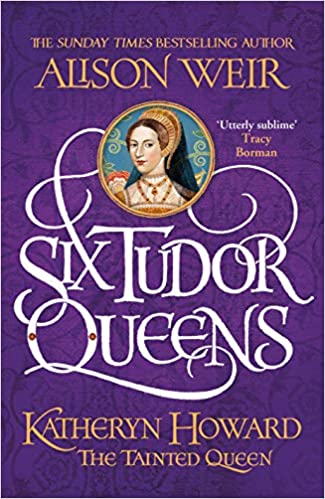
Six Queens: Katheryn Howard the Tainted Queen by Alison Weir

Headline Review| 20 August 2020| 479 pages| Review copy| 2*

I wanted to read this book because I knew very little about Henry VIII’s 5th wife, except that she was beheaded on the grounds that she had committed adultery and treason.

Description

A NAIVE YOUNG WOMAN AT THE MERCY OF HER AMBITIOUS FAMILY.

At just nineteen, Katheryn Howard is quick to trust and fall in love.

She comes to court. She sings, she dances. She captures the heart of the King.

But Henry knows nothing of Katheryn’s past – one that comes back increasingly to haunt her. For those who share her secrets are waiting in the shadows, whispering words of love… and blackmail.

Having read it, I don’t think I know much more, except that Katheryn Howard comes across as a very shallow character, obsessed with sex, with luxury in all its forms, naive and easily manipulated. Alison Weir excels in her descriptive writing, bringing the Tudor court to life in all of its settings, locations, clothes and jewellery.

It has glowing reviews on Amazon full of praise and it is based on extensive research. Clearly other people love this book, but I didn’t. For me it came across as a romance novel, primarily focused on Katheryn’s imagined thoughts, emotions, and sexual encounters. It is simply written, but with too many cliches and modernised text.

Alison Weir’s Author’s Note is much more interesting than her novel, in which she acknowledges her sources, including Dr. Nicola Tallis’ unpublished DPhil thesis, All the Queen’s Jewels, 1445 – 1548, and a number of biographies of Katheryn Howard. She refers to original sources she used as the basis of the book – contemporary writers and wills, portraits showing her rich clothes and jewellery – jewels that have been tentatively identified in Katheryn Howard’s inventory.

She used these sources for the narrative of the book, weaving them into the dialogue and modernising the speech ‘where Tudor English looks out of place in a modern text.’ She states that ‘apart from fictionalising the historical record’ she has invented very little.’ There is also a Dramatis Personae, usefully indicating which characters are fictional and a Timeline, which is also very useful.

I think the Author’s Note is the best part of the book. There is rather too much of ‘fictionalising the historical record’ for me in the novel. I don’t like writing about a book I didn’t enjoy when I know so much work has gone into it and clearly other people have loved it. But this is just my opinion, for what it is worth.

With thanks to NetGalley and to the publishers for my review copy.

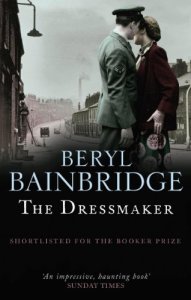
My Friday Post: The Dressmaker by Beryl Bainbridge

Every Friday Book Beginnings on Friday is hosted by Gillion at Rose City Reader where you can share the first sentence (or so) of the book you are reading. You can also share from a book you want to highlight just because it caught your fancy.

My book this week is The Dressmaker by Beryl Bainbridge, one of the books I’ve just started reading, and also one of my 20 Books of Summer. It’s not long – just 160 pages.

It begins:

Afterwards she went through into the little front room, the tape measure still dangling round her neck, and allowed herself a glass of port.

This opening sentence makes me wonder -after what?

Also every Friday there is The Friday 56, hosted by Freda at Freda’s Voice. *Grab a book, any book. *Turn to Page 56 or 56% on your  ereader . If you have to improvise, that is okay. *Find a snippet, short and sweet, but no spoilers!

These are the rules:

  1. Grab a book, any book.
  2. Turn to page 56, or 56% on your eReader. If you have to improvise, that is okay.
  3. Find any sentence (or a few, just don’t spoil it) that grabs you.
  4. Post it.
  5. Add the URL to your post in the link on Freda’s most recent Friday 56 post.
  1. Grab a book, any book.
  2. Turn to page 56, or 56% on your eReader. If you have to improvise, that is okay.
  3. Find any sentence (or a few, just don’t spoil it) that grabs you.
  4. Post it.
  5. Add the URL to your post in the link on Freda’s most recent Friday 56 post.

Page 56:

She didn’t know how to remedy the situation. Rather like her Aunt Nellie who could never say she was sorry. She twisted her hands together and gazed helplessly at his hostile back.

Description

Wartime Liverpool is a place of ration books and jobs in munitions factories. Rita, living with her two aunts Nellie and Margo, is emotionally naïve and withdrawn. When she meets Ira, a GI, at a neighbour’s party she falls in love as much with the idea of life as a GI bride as with the man himself. But Nellie and Margo are not so blind…

The Dressmaker was runner up for the 1973 Booker Prize and also for the Guardian Fiction Prize. The Sunday Times, is quoted on the back cover: ‘ Like the better Hitchcock films Miss Bainbridge suggests a claustrophobic horror … An impressive, haunting book.’