I think Cards on the Table is one of the best of Agatha Christie’s books. It was first published in 1936 and has been reprinted many times since then. My copy is a Pan Books edition published in 1951 with this cover:
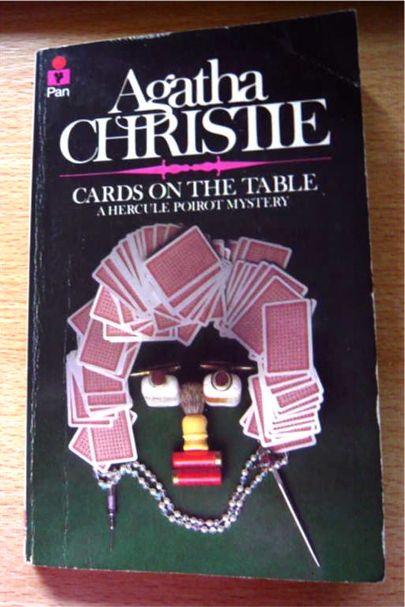
From the back cover:
Mr Shaitana is a collector. He collects snuff boxes, Egyptian antiquities … and … murderers.
His murderers are of the very finest. Not the second rate individuals who are caught and convicted. Delighting in his role as a modern Mephistopheles, Shaitana gathers his four murderers for an evening of cards.
Before the evening ends, Mr Shaitana will himself be a murder victim. How very fortunate that he invited a fifth guest to his gathering, M. Hercule Poirot.
One of the things that pleased me about this book is Agatha Christie’s Foreword in which she states that it is not the sort of detective story where the least likely person is the one to have committed the crime. This story has just four suspects and any one of them ‘given the right circumstances‘ might have committed the crime. She goes on to explain that there are four distinct types, the motives are peculiar to each person and each would employ a different method. She concludes:
The deduction must, therefore, be entirely psychological, but it is none the less interesting for that, because when all is said and done it is the mind of the murderer that is of supreme interest.
All of which suits Poirot down to the ground as he considers the psychology of each of the four suspects, Dr Roberts, a very popular doctor who may have killed a patient or two, Mrs Lorimer, a first-class bridge player and a widow who husband died under suspicious circumstances, Major Despard, a daring character, an explorer who possibly killed a botanist whilst on an expedition up the Amazon, and Anne Meredith, a young woman, a timid and careful bridge player, who may have poisoned her employer.
Poirot is not on his own, also at the bridge party were Superintendent Battle, a stolid officer from Scotland Yard (he first appeared in The Secret of Chimneys), Colonel Race, a Secret Service agent (he first appeared in The Man in the Brown Suit), and Mrs Ariadne Oliver, writer of popular detective fiction, (meeting Poirot for the first time). It helps if you can play bridge to understand how Poirot uncovered the murderer, but it’s not necessary – I managed with just a minimal memory of the card game, and it all hinges on the psychology of the characters anyway.
As Ariadne Oliver is used by Agatha Christie to convey some of her own opinions I wondered whether this description of her physical appearance was how she viewed herself:
… she was an agreeable woman of middle age, handsome in a rather untidy fashion with fine eyes, substantial shoulders and a large quantity of rebellious grey hair with which she was continually experimenting. One day her appearance would be highly intellectual – a brow with the hair scraped back from it and coiled in a large bun in the neck – on another Mrs Oliver would suddenly appear with Madonna loops, or large masses of slightly untidy curls. On this particular evening Mrs Oliver was trying out a fringe. (page 13)
I think there is no doubt that Ariadne’s views on writing and on the character of her detective are Agatha Christie’s own views. For ‘Finn’ in the extract quoted below read ‘Belgian’:
… I regret only one thing – making my detective a Finn. I don’t really know anything about Finns and I’m always getting letters from Finland pointing out something impossible that he’s said or done. (page 55)
And this must be from her own experience too:
I’m always getting tangled up in horticulture and things like that. People write to me and say I’ve got the wrong flowers all out together. As though it mattered – and, anyway, they are all out together in a London shop. (page 110)
And this about writing?:
One actually has to think, you know. And thinking is always a bore. And you have to plan things. And then one gets stuck every now and then, and you feel you’ll never get out of the mess – but you do! Writing’s not particularly enjoyable. It’s hard work, like everything else. …
Some days I can only keep going by repeating over and over to myself the amount of money I might get for my next serial rights. That spurs me on, you know. So does your bank-book when you see how much overdrawn you are. …
‘I can always think about things,’ said Mrs Oliver happily. ‘What is so tiring is writing them down. I always think I’ve finished, and then when I count up I find I’ve only written thirty thousand words instead of sixty thousand, and so then I have to throw in another murder and get the heroine kidnapped again. It’s all very boring.’ (pages 110 – 111)
But back to the mystery, Mr Shaitana is murdered whilst his guests are playing bridge. Two games were set up – one made up of the four people he considered were murderers and the other in a separate room made up of the four detectives or investigators of crime. Mr Shaitana sat by the fire in the room with the murderers. When the four detectives finished their game they return to the other room where they find the game still in progress and Mr Shaitana still sitting by the fire – stabbed in the chest with an ornamental dagger.
What follows is that each detective carries out their own investigations and as I read I swung from one suspect to the other, but I was never really sure who the culprit was. Poirot is his usual brilliant self even though at one point he is astonished and upset at the possibility that he might be wrong:
‘Always I am right. It is so invariable that it startles me. But now it looks as though I am wrong. And that upsets me. (page 163)
But was he wrong?
 Every Tuesday Diane at Bibliophile by the Sea hosts First Chapter First Paragraph Tuesday Intros, sharing the first paragraph or (a few) of a book she’s reading or thinking about reading soon.
 It begins with a Prologue:
 tonight on BBC1, maybe I should read it in tandem, or leave it for later? It’s the story of Elizabeth Woodville, the White Queen. A woman who won the love of a king and ascended to royalty by virtue of her beauty, Elizabeth fought tenaciously for the success of her family — her daughter who would one day unite the warring dynasties, and her two sons whose eventual fate has confounded historians for centuries: the Princes in the Tower.
 born Catalina, the Spanish Infanta, to parents who are both rulers and warriors. Aged four, she is betrothed to Arthur, Prince of Wales, and is raised to be Queen of England. She is never in doubt that it is her destiny to rule that far-off, wet, cold land.
 Queen Victoria’s death: two families visit neighbouring graves in a fashionable London cemetery. One is decorated with a sentimental angel, the other an elaborate urn. The Waterhouses revere the late Queen and cling to Victorian traditions; the Colemans look forward to a more modern society. To their mutual distaste, the families are inextricably linked when their daughters become friends behind the tombstones. And worse, befriend the gravedigger’s son.
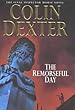 Thames Valley CID baffled. A year after the dreadful crime they are still no nearer to making an arrest. But one man has yet to tackle the case €“ and it is just the sort of puzzle at which Chief Inspector Morse excels. The final Morse book, which I bought after watching the TV version. I’ve just checked and this was way back in 2000! I decided at the time that I would read it later – I never meant it to be 12 years later!
  meaning to read them before now. I see from a bookmark that I did start
 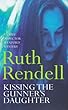 double shelve books that I forget I’ve got them. If I thought 12 years was a long time to have owned and not read a book, then I was astonished when I checked this book to find that I’ve had it since 1992! No!! It’s another book I bought after watching the TV version, which was broadcast in November 1992. I did start it – there’s a bookmark at the start of Chapter 6. I see from Amazon that the book has been reprinted several times since I bought my copy. The blurb is: The fifteenth book to feature the classic crime-solving detective, Chief Inspector Wexford. The thirteenth of May is famously the unluckiest day of the year. Sergeant Caleb Martin of Kingsmarkham CID had no idea just how terminally unlucky it would prove, as he embarked upon his last day on earth… Ten months later, Wexford is confronted with a murder scene of horrific brutality. At first the bloodbath at Tancred House looks like the desperate work of a burglar panicked into murder. The sole survivor of the massacre, seventeen-year-old Daisy Flory, remembers the events imperfectly, and her confused account of the fatal night seems to confirm this theory. But more and more, Chief Inspector Wexford is convinced that the crime lies closer to home, and that it has sinister links to the murder of Sergeant Martin…
 Reading
  I received

