Stowaway to Mars by John Wyndham

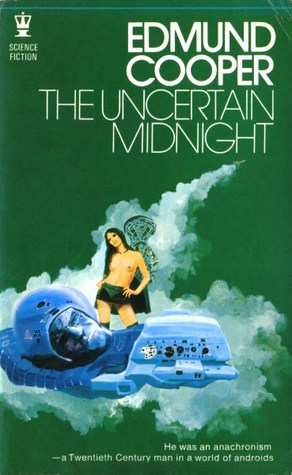
Stowaway to Mars by John Wyndham writing as John Beynon, was first published in 1936 as Planet Plane (Newnes Limited, London), then serialised in the periodical The Passing Show as Stowaway to Mars, where it was described as:

an epic serial of the greatest exploration of all … by the man who writes half a century ahead of all the others.

It is set in 1981 when an international prize of £1,000,000 was being offered to the first man to complete an interplanetary journey. Dale Curtance, a British millionaire adventurer takes up the challenge and builds a rocket, the Gloria Mundi. With his crew of four men he blasts off from Salisbury Plain, his destination the planet Mars. Once free of the Earth’s atmosphere they discover a stowaway, a woman, Joan Shirning, the daughter of a professor! She has a strange tale to tell of a machine that her father found, which they believe came from Mars. Having landed on Mars they encounter what appears to be a planet occupied by ‘intelligent self-contained machines’. They claim Mars to be part of the British Commonwealth of Nations, a claim later disputed by the Russians when a second rocket lands.

My copy was published in 1972, with a foreword  stating how right John Beynon was in anticipating the international rivalry for the space race.

Stowaway to Mars is a novel of its time, the male crew members discuss what should be done with their stowaway – they can’t just chuck her overboard, as they would a man! They have a condescending attitude to women thinking that her ‘highest duty is motherhood’. She can be creative, concentrate on producing children rather than machines, because women :

simply have not got the imagination to see the machines as we see them, but they have the power to be jealous of them. … There is nothing good they can say for it. It’s noisy, it’s dirty, it’s ugly, it stinks: and anyway it’s only a jumble of metal bits – what can be really interesting in that? (page 98)

There is a lot of discussion about The Machine and its relationship with Humanity, what it means and what use is made of it. Man’s survival depends on his adaptability and must be willing to break with the past. The reason to venture into space is thought to be to make us wiser, to seek knowledge. Wyndham refers to earlier science fiction writers, such as J J Astor’s Journey in Other Worlds, written in 1894 where he states that ‘the future glory of the human race lies in the exploration of at least the Solar System.’ And Dale and his companions speculate about what they will find on Mars:

It’ll be amusing … to see which of the story-tellers was nearest the truth. Wells, with his jelly-like creatures, Weinbaum, with his queer birds, Burroughs, with his menageries of curiosities, or Stapleton, with his intelligent clouds? And of the theorists, too. Lowell, who started the canal irrigation notion, Lutyen, who said that the conditions are just, but only just, sufficient for life to exist at all. (page 67)

Even though this book is so obviously dated and contains quite lengthy sections theorising about machines, and the existence of life on other planets, I did enjoy it immensely. I really liked the descriptions of Mars, including its history and the reason for the construction of the canals, and the interplay between the characters, although some of them are only sketchily drawn and I couldn’t distinguish between them very easily.

The book ends on an intriguing note, referring to a subsequent tale. To say more would spoil the ending, at least it would have done for me. I don’t think Wyndham actually wrote a sequel, although there is a short story, Sleepers of Mars which deals with the Russians left  stranded on Mars.

John Wyndham’s (1903 – 1969) full name was John Wyndham Parkes Lucas Beynon Harris, and he wrote under several different pseudonyms – John Beynon, John Beynon Harris,  Wyndham Parkes, Lucas Parkes and Johnson Harris.

I’ve had this book for a few years, so it qualifies for Bev’s Mount TBR Challenge and it is the second book I’ve read for Carl’s Science Fiction Experience. It was a really good read and it has got me so interested in finding out more about the history of science fiction itself!

A Year of Reading Agatha Christie: 2013

Agatha ChristieThe Agatha Christie Reading Challenge is run by Kerrie at Mysteries in Paradise. I don’t think of it as a Challenge €“ it’s really a reading project, as it is quite simply to read Agatha Christie’s books. I’m not reading them in order of publication but as I come across them.

As I wrote in a guest post on Alyce’s blog for her series of Best and Worst earlier this year, Agatha Christie has long been one of my favourite writers. I first read some of her books as a teenager, but over the last four years or so I’ve been reading as many of her books that I can find.

She wrote over 100 novels, short story collections and plays and she is one of the best-selling (if not the best-selling) novelists of all time, well known for her crime fiction featuring Hercule Poirot and Miss Marple and other detectives, both amateur and police.

I like many things about her writing. Her style is light, humorous at times, but her writing can be dark creating a tense and menacing atmosphere. Her plots are often ingenious, intricate, complicated puzzles, with the clues scattered throughout the texts. Some of her characters are clearly defined and fully rounded, some are lightly sketched, and others are comic characters, caricatures presented satirically or even farcically. Her settings are often country houses in idyllic English villages, but also in exotic locations in the Middle East as in her archaeological mysteries.

The full list of the 55 novels and short stories that I’ve read is on my Agatha Christie Reading Challenge page. This year I’ve read 9 of her books:

My favourite this year is Cards on the Table, but they all make fascinating reading.

Cards on the Table

  1. Cat Among the Pigeons  (Poirot)
  2. Mrs McGinty’s Dead (Poirot and Ariadne Oliver)
  3. Murder in the Mews (Poirot 4 short stories)
  4. Cards on the Table (Poirot)
  5. Third Girl (Poirot)
  6. Ten Little Niggers aka And Then There Were None
  7. A Murder is Announced (Miss Marple)
  8. N or M? (Tommy and Tuppence)
  9. Ordeal by Innocence

I’ve also read two biographies:

  1. Agatha Christie: an English Mystery by Laura Thompson
  2. Agatha Christie at Home by Hilary Macaskill

There are still plenty of Agatha Christie’s books for me to read. The following books are the ones I own and will be reading next year (not necessarily in this order):

  • They Do It With Mirrors (Miss Marple)
  • The Moving Finger (Miss Marple)
  • Miss Marple and Mystery: Complete Short Stories
  • Poirot Investigates (short stories)
  • The Golden Ball (short stories)
  • Complete Parker Pyne (short stories)
  • The Adventure of the Christmas Pudding (short stories)

The Cupboard by Rose Tremain

I’ve never read any of Rose Tremain’s books, but when I saw The Cupboard on the library van’s shelves the plainness of the title and the photo on the cover interested me, because they just didn’t seem to match.

The Cupboard 001

I took it off the shelf and read the back cover, where the newspaper critics’ quotations are glowing with praise for Rose Tremain: ‘one of the finest writers in English’ from the Daily Telegraph, ‘Rose Tremain’s fiction is my gold standard’, from The Independent on Sunday’, and ‘Miss Tremain has fashioned the totality of one life – and conveyed the evanescence of all human existence’ from the Sunday Telegraph. So I thought I should have a look inside the book, where I see that Rose Tremain has won many prizes for her books.

But it was the opening paragraph that really caught my attention and is the reason I borrowed the book:

At the age of eighty-seven, Erica March died in a cupboard. She wrapped her body in a chenille tablecloth, laid it out neatly under a few skirts and dresses that still hung on the clothes rail and put it to death very quietly, pill by pill.

Now that makes me want to read on to find out why she did that! Not the accolades or the awards, but the words.

For more Book Beginnings see Gilion’s blog Rose City Reader.

The Rendezvous and Other Stories by Daphne du Maurier

When I finished reading The Rendezvous and Other Stories I had absolutely no hesitation in giving it 5 stars – I loved it. This is most unusual for me as generally I’m not too keen on short stories because they often leave me feeling dissatisfied, thinking they are lacking in substance or characterisation. Not so with this book, even though some of the endings were predictable and some of the stories are very short I think they all worked well!

Daphne du Maurier wrote some of these stories before she wrote her first novel (The Loving Spirit, 1931), when she under 23, and the rest between 1937 and 1947, when she was a well established writer. The earlier stories are shorter than the later ones as they were written for magazines

There are 14 stories:

  • No Motive ~ this begins with the suicide of an apparently happy woman expecting her first child. Her husband desperate to discover what could have caused her to take her own life and that of their unborn child employs a private detective to investigate. What he discovers is just so sad and tragic.
  • Panic ~ This is one of the shorter stories about a casual love affair that ends in death and the panic that ensued.
  • The Supreme Artist ~ Another shorter story of an aging actor trying to fight off the years.
  • Adieu Sagesse ~ I loved this one about a hen-pecked husband who plans to escape his tedious life and have an adventure.
  • Fairy Tale ~ A gambler and his long-suffering wife face destitution – unless he wins the lottery!
  • The Rendezvous ~ Now this story really caught my imagination. It’s the story of an ageing writer, who meets a fan of his books whilst on a trip to Switzerland to lecture about his work. As in some of Du Maurier’s books this is about an unequal relationship and the exploitation of one of the partners. It is vividly written, the sense of disappointment, the misunderstandings and subsequent let down is brilliant.
  • La Sainte-Vierge ~ A very short and predictable story about a naive young wife.
  • Leading Lady ~ a beautiful actress manipulates the men around her.
  • Escort ~ Another of the really good stories, full of atmosphere set in set in World War II on board a merchant ship as it sails across the North Sea. Just what is the ship that offers to escort it as a submarine threatens  – and who is its captain?
  • The Lover ~ More sexual manipulation, this time by a young man.
  • The Closing Door ~ A young man is told of his terminal illness and the devastating effect it will have on his life.
  • Indiscretion ~ An amusing tale of what happens when you say something without knowing the consequences – a bit signalled but still enjoyable.
  • Angels and Archangels ~ A bitter and cynical look at religion and hypocrisy.
  • Split Second ~ A brilliant story to finish the book – about a woman who leaves her highly organised house for a walk and finds everything has changed when she returns.

This is one of a set of Du Maurier’s books that I bought at least seven years ago. It was well worth the wait! I still have one more of the set to read – I’ll Never Be Young Again, her second novel.  And there are more that I don’t own to enjoy in the future too.

St Mawr by D H Lawrence

I liked  St Mawr even though there is so much philosophising and repetition (why use a word just once when you can repeat it three times) that the story is rather swamped. It’s a short novel (147 pages in my copy), first published in 1925, set in the English countryside and then in America, on a ranch in the Rocky Mountains.

This is the story of Mrs Witt, an American, Lou her daughter and Rico, her daughter’s artist husband and the influence of the stallion St Mawr on their lives. Initially desperately in love with each other Lou and Rico react badly on each other and being together makes them ill – they sap each other’s vitality.

As soon as Lou sees St Mawr she knows she just has to buy him:

She laid her hand on his side and gently stroked him. Then she stroked his shoulder, and then the hard, tense arch of his neck. And she was startled to feel the vivid heat of his life come through to her, through the lacquer of red-gold gloss. So slippery with vivid hot life.

In St Mawr Lou finds the vitality that is lacking in Rico. St Mawr represents to her freedom, and wildness as well as masculinity. He cannot be tamed. Bored with life Lou goes to America with her mother, Phoenix, her mother’s Mexican-Indian servant, St Mawr and his groom Lewis. There too she is bored; she leaves St Mawr and Lewis behind and travels to the Rocky Mountains of New Mexico with her mother and Phoenix. Here she comes across a tumbledown ranch, Las Chivas, that she immediately loves, aligning herself to the wild spirit that she says wants her. (The ranch is based on Lawrence’ s Lobo Ranch (later called Kiowa) at Questa, seventeen miles fro Taos, where Lawrence wrote the novel.)

This a richly written story, with beautiful descriptions of the landscape and the characters, full of symbolism and Lawrence’s views on male/female relationships, life and death, and the power of nature. I think I may need to re-read it to understand it better.

Ordeal by Innocence by Agatha Christie

Agatha Christie wrote in An Autobiography that Ordeal by Innocence and Crooked House were the two books she’d written that satisfied her the best. Neither book features Poirot or Miss Marple, so maybe she had become rather tired of them and had enjoyed introducing completely new characters.

Ordeal by Innocence (The Christie€¦Summary from the back cover of my copy:

According to the courts, Jacko Argyle bludgeoned his mother to death with a poker. Sentenced to life imprisonment, he died behind bars following a bout of pneumonia. Tragically, it was not until two years later that Dr Arthur Calgary came forward with the testimony that could have acquitted Jacko. Worse the doctor’s revelations were about to re-open old wounds in the family, increasing the likelihood that the real murderer would strike again.

My view:

Ordeal by Innocence is thus a stand-alone novel, first published in 1958, unlike the TV adaptation that had Miss Marple (in the form of Geraldine McEwan), solving the mystery.

Dr Calgary was surprised by the reception he received from the family when he visited them to tell them that Jacko was innocent and why he hadn’t come forward at the time to confirm his alibi. Instead of relief he was met with wariness and suspicion as the family members realised that one of them could be the murderer. This is a cold case that they wish had never been re-opened; they had been happy to accept that Jacko, a thoroughly nasty character, was guilty. Only Philip the eldest daughter’s wheelchair-bound husband is keen to discover the murderer’s identity. So, it is up to him, Doctor Calgary, helped by the family solicitor and Superintendent Huish to carry out fresh investigations.

What I liked about Ordeal by Innocence was the way Agatha Christie delved into the family relationships and their characters. Mrs Argyle was one of those mothers who was always right and thought she knew best and at times all her children had rebelled or wanted to rebel against her authority, so all were suspects, along with her long-suffering husband, who since her death was planning to marry his secretary.

The novel is as much about protecting the innocent as punishing the guilty, and the fact that stating your innocence is not proof of it. Calgary has to find the murderer so that the innocent will not suffer from the taint of guilt. Without knowing who was guilty they would have all come under suspicion, destroying their love and trust.

I swung from believing first one, then another character, was the guilty person and was quite taken in by all the red herrings Agatha Christie threw into the book. All is made clear in the last chapter when Dr Calgary presents his findings and reveals the killer. Although I don’t think it is one of Agatha Christie’s best books, I still enjoyed its complexity and admired her skill in plotting this novel.