Days Without End by Sebastian Barry

Days Without End

Hardcover, 259 pages, published October 20th 2016 by Faber & Faber
 
Source: Library Book
 
My Rating: 5*


Blurb:

After signing up for the US army in the 1850s, aged barely seventeen, Thomas McNulty and his brother-in-arms, John Cole, fight in the Indian Wars and the Civil War. Having both fled terrible hardships, their days are now vivid and filled with wonder, despite the horrors they both see and are complicit in. Then when a young Indian girl crosses their path, the possibility of lasting happiness seems within reach, if only they can survive.

My thoughts:

This is without doubt one of the best books I’ve read this year. I was spellbound, the storytelling is superb, the characters are unforgettable, and the setting comes across so vividly that I had no difficulty in imagining the locations. Add to that the narration written in Thomas McNulty’s own uneducated voice, fluent and richly descriptive and so easy to read, despite the mix of Irish and American slang.

Thomas is writing, looking back on their lives, to a time when it seemed that years of their lives were endless:

Time was not something then we thought of as an item that possessed an ending, but something that would go on for ever, all rested and stopped in that moment. Hard to say what I mean by that. You look back at all the endless years when you never had that thought. I am doing that now as I write these words in Tennessee. I am thinking of the days without end of my life. (page 39)

He is a young Irish immigrant, 17 years old when he and his friend John Cole volunteered to join the US army. Thomas, had left Sligo, starved and destitute, for Canada and then made his way to America where he had met John under a hedge in a downpour and they became friends and secretly lovers for life. He describes John Cole as ‘my love, all my love.‘  They began their life together working in a saloon in Daggesville, dancing and dressed as girls, until they were seventeen and they could no longer pass as girls:

But nature will have his way and bit by bit the bloom wore off us, and we was more like boys than girls, and more like men than women. John Cole anyhow in particular  saw big changes in them two years. He was beginning to give giraffes a run for their money, height-wise. Mr Noone couldn’t find dresses to fit him and Mrs Carmody couldn’t stitch fast enough. It was the end of an era, God knowed. One of the happiest works I ever had. (Page 12)

The fact of their love underlies the whole book. But the next stage of their lives was so different, fighting in the Indian wars against the Native Americans as the settlers moved west and then in the Civil War. I’m not keen on reading about wars, battles or fights of any kind but I found the descriptions in this novel were exceptional, truly heart-rending, although I would have preferred fewer scenes of war and massacre. Barry doesn’t spare the details and clearly depicts the horror and waste of war, commenting in Thomas’s voice: Killing hurts the heart and soils the soil (page 225).

After the wars have come to an end they leave the army and the rest of the book follows their lives together with Winona, a young Indian girl, who they come to regard as their daughter. But danger is never far away …

In a way I thought it was odd how this book held my attention. I was surprised by a number of things – the very long paragraphs, sometimes extending to several pages  – the strange grammatical errors and figures of speech, and at times passages written in the present tense. And yet, Barry’s prose is so lyrical and poetic that I think this is what made the book so compelling to read. Each time I picked it up to read I became lost in its pages. It is not perfect, but then I often find that that doesn’t matter when I’m so totally captivated by the writing, which is why I’ve given this book 5 stars.

Amazon UK link
A – Z of TBRs: J, K and L

I’m now up to J, K, and L in my A – Z of TBRs, a series of posts in which I take a fresh look at some of my TBRs to inspire me to read more of them by the end of the year, or maybe to decide not to bother reading them after all. These TBRs are all physical books – I’ve not included e-books. Previously I’ve just chosen books for these posts by using the titles, but this time I’ve also chosen books by using the authors’ last names.

I’m enjoying searching my shelves – finding books I’d forgotten were there (the disadvantage of shelving books behind others).

TRBs jkl

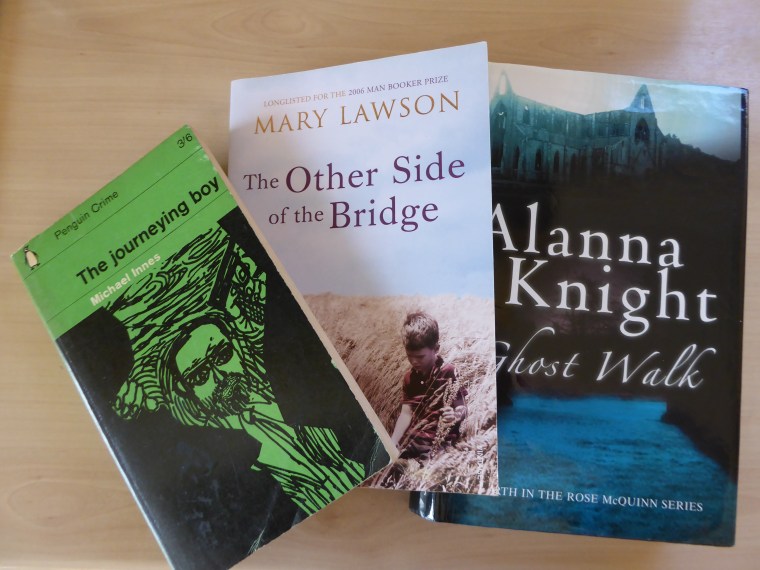
– is for The Journeying Boy by Michael Innesa book I’ve had for three years. This is a green Vintage Penguin, first published in 1949, and in this edition in 1961. Humphrey Paxton, the son of one of Britain’s leading atomic boffins, has taken to carrying a shotgun to ‘shoot plotters and blackmailers and spies’. His new tutor, the plodding Mr Thewless, suggests that Humphrey might be overdoing it somewhat. But when a man is found shot dead at a cinema, Mr Thewless is plunged into a nightmare world of lies, kidnapping and murder – and grave matters of national security.

I’m not sure now that I do want to read this book. It looks quite daunting, with lots of description and  literary allusions as shown in this extract – the cinema goers had been watching a film, Plutonium Blonde:

Another squalid crime … Circumstances had made Inspector Cadover a philosopher, and because he was a philosopher he was now depressed. This was the celebrated atom film. This was the manner in which his species chose to take its new command of natural law. Fifty thousand people had died at Hiroshima , and at Bikini ironclads had been tossed in challenge to those other disintegrating nuclei of the sun. The blood-red tide was loosed. And here it was turned to hog wash at five shillings the trough, and entertainment tax five shillings extra. That some wretched Londoner had met a violent death while taking his fill seemed a very unimportant circumstance. To track down the murderer – if murderer there was – appeared a revoltingly useless task. Mere anarchy was loosed upon the world – so what the hell did it matter? (page 51)

K – is for Ghost Walk by Alanna Knight (on my TBR shelves for four years), the fourth in the Rose McQuinn series. This is historical crime fiction set in 1897 in Edinburgh three years after Rose McQuinn’s husband, Danny, disappeared in Arizona. Believing him to be dead, she returned to Scotland to start her life afresh. Now a ‘Lady Investigator, Discretion Guaranteed‘, she is about to marry her lover, Detective Inspector Jack Macmerry of the Edinburgh Police when a nun from the local convent claims to have received a letter from Danny, and after two suspicious deaths, it seems that a ghost is about to walk back into her life…

I’ve read and liked the first book in this series, The Inspector’s Daughter, and am hoping it won’t matter that I’ve not read the second and the third books.

I had no idea what were the views of Edinburgh City Police on the subject of female detectives or the milder term ‘lady investigators’, but I could guess that that they regarded criminal investigation as a ‘men only’ province.

I felt so impatient with authority. Would a day ever dawn when women ceased to be regarded as playthings or breeding machines, when they would be given equal rights with men. My hackles rose in anger at the suffragettes’ gallant struggles as portrayed in a recent pamphlet which I had been at pains to keep concealed from Jack.  (page 34)

L – is for The Other Side of the Bridge by Mary Lawson, a book I’ve had for 10 years! I was so keen to read it when I first bought it after loving her first novel, Crow Lake. It’s about two brothers, Arthur and Jake.  Arthur is older, shy, dutiful, and set to inherit his father’s farm. Jake is younger and reckless, a dangerous man to know. When Laura arrives in their 1930s rural community, an already uneasy relationship is driven to breaking point…

Arthur’s earliest memory was of standing in the doorway of his parents’ room, looking at his mother as she lay in bed. It was the middle of the day but nonetheless she was in bed, and Arthur didn’t know what to make of it. The bed was very large and high and Arthur could only just see her. She had her face turned towards the window. Then Arthur’s father called from the bottom of the stairs that the doctor was coming, and she turned her head, and Arthur saw that she was crying. (page 25)

What do you think? Do you fancy any of them? Would you ditch any of them?

First Chapter First Paragraph: The Dry

eca8f-fistchapEvery Tuesday Diane at Bibliophile by the Sea hosts First Chapter First Paragraph Tuesday Intros to share the first paragraph sometimes two, of a book that she’s reading or is planning to read soon.

This week’s first paragraph is from The Dry  by Jane Harper, her debut novel, which has received many accolades and is shortlisted for the CWA Gold Dagger award. The Gold Dagger is awarded to the best crime novel of the year.

The Dry

Prologue

It wasn’t as though the farm hadn’t seen death before, and the blow flies didn’t discriminate. To them there was little difference between a carcass and a corpse.

The drought had left the flies spoiled for choice that summer. They sought out unblinking eyes and sticky wounds as the farmers of Kierwarra levelled their rifles at skinny livestock. No rain meant no feed. And no feed made for difficult decisions as the tiny town shimmered under day after day of burning blue sky.

Chapter One

Even those who didn’t darken the door of the church from one Christmas to the next could tell there would be more mourners than there were seats. A bottleneck of black and grey was already forming at the entrance as Aaron Falk drove up, trailing a cloud of dust and cracked leaves.

Blurb:

WHO REALLY KILLED THE HADLER FAMILY?

I just can’t understand how someone like him could do something like that.

Amid the worst drought to ravage Australia in a century, it hasn’t rained in small country town Kiewarra for two years. Tensions in the community become unbearable when three members of the Hadler family are brutally murdered. Everyone thinks Luke Hadler, who committed suicide after slaughtering his wife and six-year-old son, is guilty.

Policeman Aaron Falk returns to the town of his youth for the funeral of his childhood best friend, and is unwillingly drawn into the investigation. As questions mount and suspicion spreads through the town, Falk is forced to confront the community that rejected him twenty years earlier. Because Falk and Luke Hadler shared a secret, one which Luke’s death threatens to unearth. And as Falk probes deeper into the killings, secrets from his past and why he left home bubble to the surface as he questions the truth of his friend’s crime.

It’s not only shortlisted for the CWA Gold Dagger it has also received:

  • The Gold Australian Book Industry Award for Book of the Year
  • Australian Book Industry Award for Fiction Book of the Year
  • Waterstones Thriller of the Month
  • The Simon Mayo Radio 2 Book Club Choice
  • Sunday Times Crime Thriller of the Month

What do you think?  Would you continue reading? 

When a book receives so much praise I’m sometimes sceptical and avoid a book for a while at least. But with The Dry I think that I’d just be sticking my head in the sand. I’ll be reading it very soon.

My Week in Books: 18 October 2017

This Week in Books is a weekly round-up hosted by Lypsyy Lost & Found, about what I’ve been reading Now, Then & Next.

IMG_1384-0

A similar meme,  WWW Wednesday is run by Taking on a World of Words.

Now: I’m currently reading Days Without End by Sebastian Barry, a book I’ve borrowed from the library. It was awarded the Costa Book Award 2016 and won the 2017 Walter Scott Prize. It was also longlisted for the Man Booker Prize 2017.

Days Without End

Blurb:

After signing up for the US army in the 1850s, aged barely seventeen, Thomas McNulty and his brother-in-arms, John Cole, fight in the Indian Wars and the Civil War. Having both fled terrible hardships, their days are now vivid and filled with wonder, despite the horrors they both see and are complicit in. Then when a young Indian girl crosses their path, the possibility of lasting happiness seems within reach, if only they can survive.

I’m enjoying this book, narrated by Thomas McNulty in his own style of speech, grammatically incorrect and in Irish and American slang – surprisingly easy to read.

Then: I’ve recently finished reading The Last Hours by Minette Walters, which will be published on 2 November in hardback and as en e-book. My review will follow soon.

The Last Hours

Blurb:

June, 1348: the Black Death enters England through the port of Melcombe in the county of Dorsetshire. Unprepared for the virulence of the disease, and the speed with which it spreads, the people of the county start to die in their thousands.

In the estate of Develish, Lady Anne takes control of her people’s future – including the lives of two hundred bonded serfs. Strong, compassionate and resourceful, Lady Anne chooses a bastard slave, Thaddeus Thurkell, to act as her steward. Together, they decide to quarantine Develish by bringing the serfs inside the walls. With this sudden overturning of the accepted social order, where serfs exist only to serve their lords, conflicts soon arise. Ignorant of what is happening in the world outside, they wrestle with themselves, with God and with the terrible uncertainty of their futures.

Lady Anne’s people fear starvation but they fear the pestilence more. Who amongst them has the courage to leave the security of the walls?

And how safe is anyone in Develish when a dreadful event threatens the uneasy status quo..?

Next: I think I’ll read The Fear Index by Robert Harris. This is another book I’ve borrowed from the library and having dipped into it I’m itching to read it.

The Fear Index

Blurb:

His name is carefully guarded from the general public but within the secretive inner circles of the ultra-rich Dr Alex Hoffmann is a legend – a visionary scientist whose computer software turns everything it touches into gold.

Together with his partner, an investment banker, Hoffmann has developed a revolutionary form of artificial intelligence that tracks human emotions, enabling it to predict movements in the financial markets with uncanny accuracy. His hedge fund, based in Geneva, makes billions.

But then in the early hours of the morning, while he lies asleep with his wife, a sinister intruder breaches the elaborate security of their lakeside house. So begins a waking nightmare of paranoia and violence as Hoffmann attempts, with increasing desperation, to discover who is trying to destroy him.

His quest forces him to confront the deepest questions of what it is to be human. By the time night falls over Geneva, the financial markets will be in turmoil and Hoffmann’s world – and ours – transformed forever.

Have you read any of these books?  Do any of them tempt you? And what have you been reading this week?

Katharina: Deliverance by Margaret Skea

‘It is very shameful that children, especially defenceless young girls, are pushed into the nunneries. Shame on the unmerciful parents who treat their own so cruelly.’ Martin Luther

Katharina: Deliverance (Katharina #1)

Publication: Sanderling Books, 18 October 2017

Source: review copy from the author

My rating: 4*

Summary from Goodreads:

Germany 1505

Following the death of her mother and her father’s remarriage, five-year-old Katharina is placed in the convent at Brehna. She will never see her father again. 
Sixty-five miles away, at Erfurt in Thuringia, Martin Luder, a promising young law student, turns his back on a lucrative career in order to become a monk. 

The consequences of their meeting in Wittenberg, on Easter Sunday 1523, will reverberate down the centuries and throughout the Christian world.

A compelling portrayal of Katharina von Bora, set against the turmoil of the Peasant’s War and the German Reformation … and the controversial priest at its heart.

My thoughts:

I love historical fiction and Margaret Skea’s books about the Munro family, Turn of the Tide and A House Divided set in 16th century Scotland are two of the best I’ve read over the last few years. Her latest novel, Katharina: Deliverance is just as fascinating, also set in the 16th century, but this time in Germany. Katharina was the wife of Martin Luther and the book is written in the present tense from Katharina’s viewpoint and from two time periods. I like the dual aspect time line giving a glimpse of what is to come.

2017 marks the 500th anniversary of the start of the Reformation, which was set in motion when Martin Luther, a doctor of theology at the University of Wittenberg published his 95 theses, attacking papal abuses and the sale of indulgences. I remembered this from school history but it was only reading Katharina: Deliverance that the period and both Katharina and Martin really came to life for me.

It’s a most moving story that transported me back in time to the 16th century and I felt as though I was inside Katharina’s mind and could feel what she was feeling.  It covers the early years of her life from 1505 up to her wedding to Martin Luther in 1525 and includes, at intervals, scenes from the end of Katharina’s life in 1552. I was fascinated and so anxious for her right from the start when as a small child, she was taken from her home and unwillingly enters the convent at Brehna. Four years later, at the age of ten, she was transferred to the Marienthron convent at  Nimbschen where her aunt was the abbess. It was a difficult change for Katherina – to a silent order where communication was by sign language. She was consecrated as a nun in 1515.

Although isolated from the outside world news of Martin Luther’s teaching reached the nuns as the abbess says:

The wind of change is blowing in the outside world and will buffet us in due time. And perhaps sooner than we think, for it is our own provincial vicar, the Reverend Dr Martin Luther, who makes the challenge, and I find myself tempted to agree with his sentiment, if not his rhetoric.

Although the Church denounced Luther and his writings and ordered his books to be burnt some of the nuns, including Katharina, were inspired by his ideas and beliefs. They escaped from the convent at Easter 1523 and arrived at Wittenburg where several families helped them settle into life outside the convent. It was here that Katharina met Luther and the next phase of her life began.

Although written in the present tense, which can often be a stumbling block for me, I love Margaret Skea’s beautifully descriptive writing in passages such as this:

The year turns, the darkness of December giving way to the brilliance of a landscape cloaked in snow. The hollows on the hill behind us are smoothed out, the river below sluggish, swollen with slush. Wind blows through the valley, piling the snow in drifts, obliterating the track, neither workers nor visitors able to reach us. Within our walls, ice hangs in long fingers from roofs and windowsills, and crusts the tops of fences. Paths turn to glass and stray stems of plants snap like kindling when trodden on. In the orchard, branches bow under the weight of snow, sweeping the ground, so that we fear for their survival, and the root vegetables we would normally harvest as we needed them are set into ground so hard they are impossible to shift. Outside, the water in the troughs freezes solid, so that fresh supplies from the well must be drawn daily for the animals, and indoors, standing water forms a thick skin overnight.

In her Author’s Note Margaret Skea states that her ‘book is a work of fiction, and though based on extensive research, the Katharina depicted here is my own interpretation’. I think it works very well weaving the historical facts into this dramatic and emotional story.  I loved it and am looking forward to the next book, Katharina: Fortitude which will be published in 2018!

  • Format: Kindle Edition
  • File Size: 529 KB
  • Print Length: 384 pages
  • Publisher: Sanderling Books (18 Oct. 2017)

Conclave by Robert Harris


Conclave

I really didn’t expect to enjoy Conclave as much as I did, but then I’ve enjoyed all of his books that I’ve read, so I shouldn’t have been surprised. Conclave is about an election of a Pope and I found it absolutely fascinating as the process of the election unfolded. Harris describes the procedure as Cardinal Lomeli, the Dean of the College of Cardinals leads the 118 Cardinals through the voting stages. I felt as though I was a fly on the wall watching it throughout as the Cardinals are locked inside the Sistine Chapel, isolated from contact with the outside world.

There are quite a lot of characters involved, which at first was a bit confusing but soon their personalities became clearer and I began to have my favourites and hope that one of them would be elected. It’s all seen from Lomeli’s point of view, so my thoughts were coloured by what he reveals about each of the main candidates. As they progress through the stages of the election, whittling down the candidates to just a few, lots of secrets, scandals and disagreements are revealed. It becomes increasingly tense with each stage and Lomeli, who had been wanting to retire before the last Pope had died, finds that he too is one of the contenders – most reluctantly:

All he had ever desired in this contest was to be neutral. Neutrality had been the leitmotif of his career. (page 98)

And he realised that, whoever was elected Pope would never be able to wander around the city at will, could never browse in a bookstore or sit outside a café, but would remain a prisoner here! (page 142)

It’s also dramatic as events in the outside world impact on the Conclave.  I was completely engrossed and hoping that my favourite would be elected. Harris has thoroughly researched the subject and seamlessly woven the facts into the novel. He visited the locations used during a Conclave that are permanently closed to the public and interviewed a number of prominent Catholics including a cardinal who had taken part in a Conclave, as well as consulting many reports and books.

There is one point that I found hard to accept (I think that to say any more would spoil the book), although it is something I’d thought might happen but I’d dismissed as rather fanciful. Nevertheless I still think this is a 5* book as I enjoyed it so much – one of the best books I’ve read this year.

  • Format: Kindle Edition
  • File Size: 3282 KB
  • Print Length: 287 pages
  • Page Numbers Source ISBN: 0091959179
  • Publisher: Cornerstone Digital; 01 edition (22 Sept. 2016)
  • Source: I bought it
  • My rating: 5*