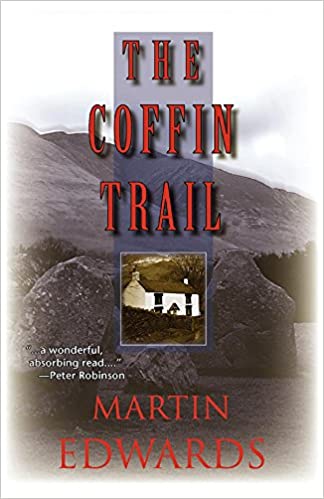
The Coffin Trail by Martin Edwards

A while ago I read The Arsenic Labyrinth by Martin Edwards, the third in his Lake District Mystery series of books, which I wrote about here. Now I’ve read The Coffin Trail,  the first in the series.

Daniel Kind and his partner Miranda have just moved to Tarn Cottage near Brackdale, a beautiful village in the Lakes in a hidden valley. The Cottage used to be the home of Barrie Gilpin, who was suspected of the brutal murder of Gabrielle Anders and Daniel had met Barrie, when as a boy he had spent a fortnight’s holiday at Brackdale. Barrie had died before he could be arrested and Daniel can’t imagine how the Barrie he knew could possibly have murdered anybody. He starts asking the locals questions about it.

So when the police set up a new team to investigate cold cases led by DCI Hannah Scarlett, who had been on the original team investigating the murder of Gabrielle, Daniel’s questions trigger a phone call to the team resulting in the revival of the case.

I was completely involved with the characters and swept along by the mystery. The setting is superb, the Lake District is vividly described, as is Daniel and Miranda’s renovation of the cottage, and the bookshop owned by Marc, Hannah’s partner. I liked all the detail in this book. I could see the coffin trail, the steep stony track that had been used years ago as the route mourners took to bury their dead at the chuch over the fells. It leads to the Sacrifice Stone, an ancient pagan site, where Gabrielle’s body had been found. I could see the bookshop in a section of a converted mill, with its creaking floorboards:

They creaked, just as Daniel believed, all floorboards in secondhand bookshops should creak. It was an essential part of the ambiance, like the giddy sense of claustrophobia that came from squeezing between tottering towers of books and clouds of dust that had to be blown from the ancient volumes lingering in the darkest recesses.

Daniel, an Oxford historian, is used to investgating the past and this leads to his meeting Hannah, partly because he is trying to find out more about his father, Ben who had been Hannah’s boss. Daniel had lost touch with his father after his parents’ divorce. Miranda meanwhile is becoming less enchanted with the idea of living in the cottage away from her job in London and as Daniel and Hannah spend some time together the potential for their relationship arises. I must admit that I took to Hannah rather more than I did to Miranda.

This is a nicely complicated book with complex relationships  and sub-plots. There are plenty of questions to be answered. Can Daniel and Miranda live happily in Tarn Cottage? Did Barrie kill Gabrielle? And if he didn’t who did? Ben Kind and Hannah were never convinced at the time of his guilt and as the cold case team investigate aided by Daniel’s persistence more secrets emerge. I was kept guessing right to the thrilling end of this book.


The Mirror Crack’d From Side to Side

 The Mirror Crack’d From Side To Side by Agatha Christie first published 1962.

 Miss Marple was feeling rather down and a bit weak after an attack of bronchitis. Her doctor prescribes ” a nice juicy murder” for her to unravel and not long after the ideal opportunity arose with the death of Heather Badcock. Heather had gone to a fete at Gossington Hall held by her idol, the glamorous movie star Marina Gregg. She died after drinking a poisoned cocktail, just after meeting Marina. The title is taken from Tennyson’s The Lady of Shalot, a convincing image of Marina’s reaction on meeting Heather – “… ‘the curse has come upon me’, cried the Lady of Shalott.” Heather was the sort of person no-one would want to murder, she was a very kind woman who always did things for other people. Her trouble was that she was sure she knew the best thing to do and she was only really interested in herself. Such people Miss Marple observed “live dangerously – though they don’t know it themselves.” So why was she killed and was Marina really the intended victim?

I remember seeing the TV adaptation of this book with my favourite Miss Marple – Joan Hickson – and although I did remember who had committed the murder I didn’t remember the motive, nor how it had happened. As I read on it all came back to me – just what the curse was.  As usual with Agatha Christie’s books,which are so deceptively easy to read, all is not straight forward and there are many complications and twists before the denoument. 

There was lots to enjoy in this book – not just the puzzle of the murder, but also the setting and the characterisation. The setting is St Mary Mead, once an idyllic English  village, now threatened by the “Development” of rows of new houses which at first didn’t seem real to Miss Marple – it “was like a neat model built with child’s bricks” and the people looked unreal to her. She thought it all looked “terribly depraved”. Then she realised that although everything and everyone looked and sounded different the human beings were the same as they always had been. It’s from her understanding of human nature that she is able to solve the crime.

I also liked the characterisation of Miss Marple, now an old lady thought incapable of looking after herself and the neat way she handles Miss Knight her live-in companion who talks to her as though she is a child. In fact all the characters have that touch of reality that brought them alive.  Their idiosyncracies are what makes them seem real people.

agatha_christie_rc

 For more reviews of Agatha Christie’s books have a look at the Agatha Christie Reading Challenge Carnival.

library-challenge

This is the ninth library book I’ve read this year so I’m well on target to read at least 25 library books by the end of December. Click on the logo for links to other bloggers reviews of  library books.

The Falls – Ian Rankin

The Falls (Inspector Rebus, #12)

I loved The Falls by Ian Rankin.  This is set in Edinburgh where a university student Philippa Balfour, known as ‘Flip’ to her friends and family has disappeared.  DI Rebus and his colleagues have just two leads to go on – a carved wooden doll found in a tiny coffin at The Falls, Flip’s home village, and an Internet game involving solving cryptic clues. Rebus concentrates on the tiny coffin and finds a whole series of them have turned up over the years dating back to 1836 when 17 were found on Arthur’s Seat, the extinct volcano within Holyrood Park, east of Edinburgh Castle. DC Siobhan Clarke meanwhile tries to solve the cryptic clues.

There are many things I liked about this book – the the interwoven plots, throwing up several suspects; the historical references to Burke and Hare, the 19th century resurrectionists; the spiky relationship between Rebus and his new boss Gill Templeton; Siobhan Clarke whose liking for doing things independently matches Rebus’s own maverick ways; and above all the setting in and around Edinburgh. All the way through I kept changing my mind about “who did it” and it was only just before the denoument that I worked it out.  This is a very satisfying book and I’m looking forward to reading more Rebus books very soon.

When Will There Be Good News?

When Will There Be Good News? (Jackson Brodie, #3)


Complex but so very satisfying!  This has had very mixed reviews on Amazon which just goes to show that you have to make up your own mind about a book. I read it very quickly because I loved it. I know I missed bits – just when did Jackson lose his jacket? I’ve tried to track it down but I can’t spot it, so I’m thinking of reading it again before I have to take it back to the library.

It really is a case of bad news all round. To start at the beginning – six year old Joanna witnesses the murder of her mother, older sister and baby brother.  It goes from bad to worse with several interlinking plots (some with convenient coincidences) to keep me guessing what disaster would happen next.Thirty years later the killer is about to be released. Joanna, is now Dr Hunter, and has a baby and an unlikeable husband Neil. She is helped by Reggie, an extremely likeable and resourceful sixteen year old girl. When Joanna goes missing Reggie is the one who insists the police in the form of Detective Chief Inspector Louise Monroe (not very likable) investigates. Louise has her own problems in the form of a likeable husband. Then there is Jackson Brodie, formerly a police officer and private investigator, who gets involved due to being in the wrong place at the wrong time.

At times the plots got so complicated that I couldn’t quite remember who did what – one problem of reading too quickly. Reggie had to leave school after the death of her mother. She is still doing her A-Levels and is tutored by her former teacher, Ms MacDonald who is suffering from cancer. Her brother Billy and his ‘friends’ threaten both Reggie and Ms MacDonald with unpleasant consequences. Then there is Alison living in dread of the return of  her homicidal maniac of a husband who is on the run, a train crash, and the unexplained murder of two men in a burnt down house – etc, etc.

It seems like a catalogue of disasters but it’s also funny and light at the same time and there are plenty of allusions to keep me working out where they come from. The easiest were the nursery rhymes Joanna sings to her baby and that Kate Atkinson works into the text. It’s set in Edinburgh, a place that is new to me, but as my son and family are now living nearby, of great interest and I could identify some of the locations. There is plenty of action, good  characterisation and dramatisation of how relationships work – or don’t work.

I’ve previously read Kate Atkinson’s Case Histories, also featuring Jackson Brodie and I thought I’d read One Good Turn, the second Jackson book – but I haven’t. It’s a toss-up now between re-reading When Will there Be Good News? and One Good Turn (which I own). I just hope no one has reserved the library book!

Sunday Salon – An Ordinary Couple?

Sunday Salon

After  ploughing my way through White Noise and feeling a bit jaded I turned to an old favourite – Agatha Christie and this week I read By the Pricking of My Thumbs. After such a rambling, verbose book as White Noise it was so refreshing to read this book, posing a mystery to be solved – what had happened in the house by the canal, whose child had died and how, and where was Mrs Lancaster?

pricking-of-my-thumbs

This is the first Tommy and Tuppence story I’ve read, but it’s not the first Agatha Christie wrote – there were earlier ones featuring Tommy and Tuppence, which I’m now going to look out for. Outwardly they are an ordinary couple, pleasant and past the prime of life, just like any other old couple. But appearances are deceptive and in By the Pricking of My Thumbs Tuppence in particular has no hesitation about getting mixed up in dangerous situations. Her daughter wishes that ‘her age she’d learn to sit quiet and not do things.’ There’s no chance of that after Tuppence met Mrs Lancaster in the nursing home where Tommy’s Aunt Ada had died. Seemingly incoherent and rambling Mrs Lancaster referred to ‘something behind the fireplace’ and a ‘poor child’ and when she disappeared after leaving behind a painting of a house by a canal Tuppence sets out to investigate.

As you would imagine from the title of the book (taken from Shakespeare’s Macbeth), ‘something wicked’ is afoot, there is evil about and Tuppence’s life is in danger. A dark and sinister tale.

I was still feeling like reading another mystery and picked up Kate Atkinson’s When Will There Be Good News? Jackson Brodie featured in the other book by Kate Atkinson that I’ve read – Case Histories – and I was pleased to find he’s in this one too. I read this in a couple of days, finishing it this morning as I just had to find out what happened. My faith in books has been fully restored as this is a very good book, and very satisfying – a complex and complicated plot with lots of action, good characterisation and drama.  More about that in a separate post.

Not Every Book’s a Winner

death-of-a-gossipI’ve read a lot of good books recently so I shouldn’t really be surprised to read one that’s not so good but I was a little disappointed with the last book I’ve read – Death of a Gossip by M C Beaton. I hadn’t read anything before by M C Beaton but I kept seeing her books on display at my local library. The New York Times Book Review quote  on the back cover made this book sound ok: “An enchanting series … M C Beaton has a foolproof plot for the village mystery”, so I thought I’d try it.

This is the first in her Hamish Macbeth Murder Mystery series and sadly it’s going to be the only one I’ll read. Despite the interesting quotes at the start of each chapter it’s a bit lightweight. The story is told mainly from one character’s perspective and that is the rather silly 19 year old secretary, Alice, who along with seven other people has enrolled in a fishing class at John and Heather Cartwright’s Lochdubh School of Casting: Salmon and Trout Fishing, staying at Lochdubh Hotel a remote village in the Scottish Highlands. The other “students” include a rich American couple, a “galloping major”, a twelve year old boy and a society widow, Lady Jane Winter. Hamish is the local bobby, apparently slow-witted and oafish, ambling aimlessly round the village.

Lady Jane is a most unpleasant woman who appears to know secrets that all the others would prefer to remain secret. So it is no surprise to find out that she is a gossip columnist and when, as the book title indicates, her strangled body is fished out of the river there is no shortage of suspects. Despite help from detectives from Strathbane CID it is Hamish who solves the case.

There was too much about the techniques of fishing for my my liking. I thought the characters were really just stereotypes, the descriptions of what everyone was wearing became quite tedious and the plot was rather simple. But it is a very quick read when you don’t want anything too challenging.

There is a quote on the inside of the front cover from Anne Robinson and I wondered if this  really was from the icy, sarcastic  presenter of the Weakest Link. It seemed too fulsome:

Sharp, witty, hugely intelligent, unfailingly entertaining, delightfully intolerant and oh so magnificantly non-pc.

Maybe the words “delightfully intolerant” and “magnificantly non-pc” are from the Anne Robinson who upset me by wanting to put the Welsh into Room 101! She’s not been my favourite ever since then, even though I used to like her Saturday morning radio show in the early 1990s.