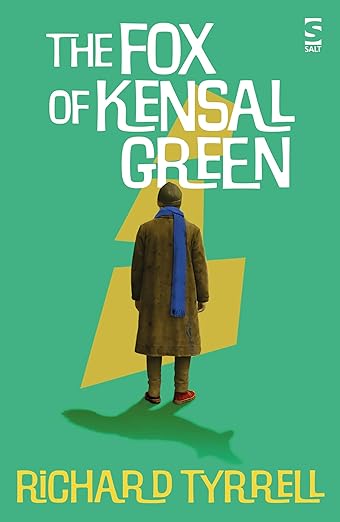
Salt Publishing| 7 January 2026| 240 pages| e-book| Review copy| 4*
Description
A quiet neighbourhood of London is about to be shattered.
Normally little happens in these mixed streets of families, retirees, podcasters and gossips. A little group create a community garden. An ageing journalist writes nature columns. A left-wing Scotsman longs for the glory days when he interviewed Castro. A disabled professor plans a book clearance. Supine Mario takes far too many drugs. And Wilf Kelly decides to get a fox as a pet.
Can a fox be tamed? Wilf sets out to do it. We follow his journey of self-discovery as he patiently befriends the animal.
When Wilf is accused of an awful crime, he becomes the target of a police and media firestorm. It’s a drama that galvanises not just the community but people from all around London to pour to Kensal Green’s streets. But can anyone prove Wilf’s innocence?
A superbly written debut novel with a big heart, that will make you laugh, cry and remind you of the joy of community spirit.
My thoughts:
I thought I’d enjoy The Fox of Kensal Green by Richard Tyrrell, based on the description above, so I was delighted to find that I loved it. It is an in-depth study of Wilf Kelly, who at the beginning of the book is a young man living on his own after his mother died. He’s a neurodivergent loner, with his own comforting routines, one of which was walking in a wild old cemetery. He loved its memorials, trees and bushes, a place where birds nested and where the brambles had overgrown the graves. It was there he spotted a big red dog fox and decided to make him a pet. His mum used to chant ‘To get love, you give love’ and love meant gifts. So, he brought him gifts of meat hiding it in a thicket under a bush.
He found life confusing and clung to his routines. But he knew he had to change and wondered if he could overcome his fears of people by forcing himself to speak to more people. Could he build bonds with people at the same time as with his fox, and be socially acceptable. Another one of his routines was delivering the Metro newspaper to his neighbours through their letter boxes and he decided to extend his round and actually talk to people. They recognise him as an eccentric and try to support him in their different ways. But then a terrible crime occurs and Wilf becomes the centre of a police investigation, and is besieged by the media.
I was very impressed by this debut novel. I loved all the characters, each one coming across as a real person with their own individuality, and the setting in a quiet London neighbourhood is vividly depicted. I’ve never been to Kensal Green but I could easily visualise the locations, the Victorian terrace houses, the tree streets neighbourhood and the local cemetery, the Kensal Green Cemetery in West London. I found this website fascinating, giving the history of the cemetery. It opened in 1833, in 72 acres of grounds, including two conservation areas, adjoining a canal, and home to at least 33 species of bird and other wildlife. Anthony Trollope and Wilkie Collins, are just two of very many famous people who are buried there.
I loved Wilf. He’s an eccentric character portrayed with empathy. And it is the local community, and in particular Felicia, his childhood friend, who quietly provide him with support, emotionally and practically with gifts, and they rally to defend him when he is suspected of a violent crime. To go into any more would only give away spoilers. This is an original novel that will linger in my mind for quite a while.
Thank you to the publishers, Salt for my review copy of this book via NetGalley.
 BooksPlease