Bookshelf Travelling: 13 June 2020

Judith at Reader in the Wilderness hosts Bookshelf Travelling for Insane Times. I’ve got several bookcases of unread novels and most of them are in alphabetical author order and are double shelved.

Today I’m focusing on a few of the books on the second shelf down in the photo, containing books beginning with Gone Girl by GilIan Flynn. These are the books that were at the back of the shelf. I’ve removed the front row of books and pulled these forward. They are books that I haven’t seen for some time and I’d forgotten about them.
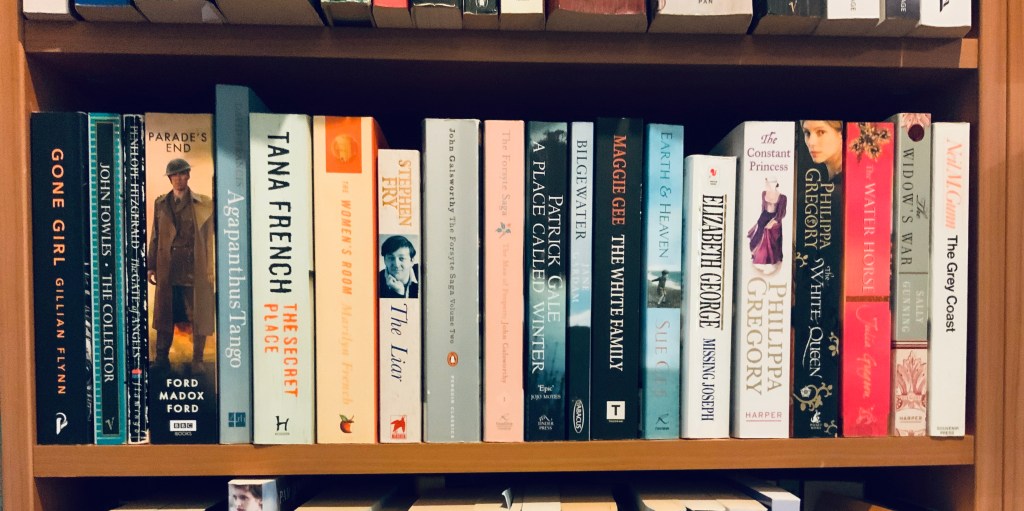
First of all, Gone Girl. This is a secondhand book I bought 6 years ago from the local village hall when I went there to vote. It’s a book that lots of book bloggers had written about and I thought I’d like to read it – but haven’t yet!

The blurb on the back describes it as ‘The addictive No.1 US bestseller that everyone is talking about’. Nick Dunn discovered on the morning of his fifth wedding anniversary that his wife Amy had disappeared. The police suspect Nick and friends reveal that Amy was frightened of him.

Parade End by Ford Madox Ford has been on my shelves for seven years. I bought it after watching the BBC series and the front cover shows Benedict Cumberbatch as English aristocrat Christopher Tietjens. This edition of the novel includes all four parts, originally published separately between 1924 and 1928. A novel about the First World War it was based on his personal experiences of war. I loved the TV series – and I’m hoping to love the book!

The next one is The Secret Place by Tana French. I bought this five years ago at Barter Books in Alnwick (a large secondhand book shop that is run on an exchange basis) because I’ve enjoyed a couple of her books in the past. It’s crime fiction set in an exclusive girls’ boarding school in Dublin. Detective Stephen Moran investigates the death of Christopher Harper, a boy from the neighbouring boys’ school, who was found murdered on the grounds. It’s a long book in a small font, which is probably why I haven’t read it yet.

And finally, Missing Joseph: An Inspector Lynley Novel by Elizabeth George is another book I bought from Barter Books in November last year. I haven’t read any of the Inspector Lynley novels, although I’ve watched the TV adaptations. This is the sixth in the series, telling the story of a woman’s quest to solve the mystery of the death of her friend, an Anglican priest. Deborah and her husband, Simon, turn to their old friend, Inspector Lynley.

I really like the look of this book, set mainly in Lancashire and in her Aknowledgements Elizabeth George refers to Mist Over Pendle by Robert Neill, one of my favourite books. But it is very long and yet again in a small font.

I’m going to keep these books on display (moving the books that were previously in front of them to the back of the shelf) so that I don’t forget about them again. And I might focus on some of the other books on this shelf in a future Bookshelf Travelling post.

Sword by Bogdan Teodorescu

I haven’t read anything set in Romania before and so when fellow blogger Marina Sofia, who has translated Sword from Romanian, told me about this book by Bogdan Teodorescu, a journalist and political analyst, I was keen to read it. Unusually it is crime fiction in which a serial killer is on the loose, but with a difference – it’s a complex novel, a political thriller focusing on the political and social dimensions of the racial conflict between the Romanians and the Roma or ‘gypsies’. The killer is hunting down his victims from the minority Roma community. As the racial conflict continues the ethnic tension rises highlighting the corruption and manipulation by the politicians and by the mass media in particular.

The book opens with a scene in Bucharest’s Obor Market as The Fly, a con man, playing his card and shell games, is killed by a person who suddenly appeared, brandishing a sword which he then plunged into his throat. This is followed by more killings – all of them of gypsies. Despite the number and method of the murders it is not gory or too graphic.

Written in a clear, journalistic style, there is a large cast of characters, listed at the end of the book including politicians and their advisors, journalists and media moguls, victims and police. The narrative moves between them as they give speeches, discuss the situation in numerous meetings, phone calls and media broadcasts. It reveals how Romania had moved on since Ceaușescu‘s Communist reign overthrown by the 1989 Revolution. In places I found the amount of dialogue and speeches slowed the narrative down more than I preferred.

At 272 pages it is not long, but it is not a quick read, partly because of the large cast and partly because it took me a while to sort out the unfamiliar names and partly because of the number of speeches. That said, I throughly enjoyed Sword, especially the setting and the unique (for me at least) focus on the political and cultural scene in Romania – and the murder mystery.

  • Format: Kindle Edition
  • File Size: 908 KB
  • Print Length: 272 pages
  • Publisher: Corylus Books Ltd (8 May 2020)
  • Source: I bought my copy
  • My Rating: 4*

Six Degrees of Separation: from Normal People to The Inheritance of Loss

It’s time again for Six Degrees of Separation, a monthly link-up hosted by Kate at Books Are My Favourite and Best. Each month a book is chosen as a starting point and linked to six other books to form a chain. A book doesn’t need to be connected to all the other books on the list, only to the one next to it in the chain.

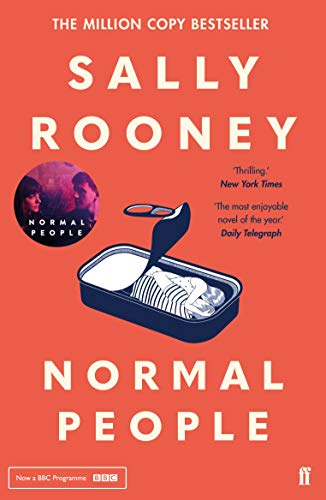
This month the chain begins with Normal People by Sally Rooney. This is one of my TBRs. I did begin it but it didn’t appeal to me. I’m in the minority, though, as I know it is very popular, many people love both the book and the TV series and it  has won several awards. It’s the story of two people who try to stay apart but find they can’t.

Normal People

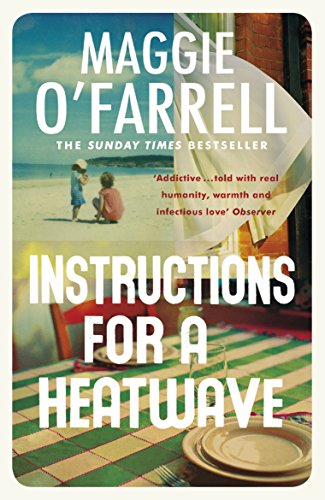
Sally Rooney is an Irish author, as is Maggie O’Farrell, whose book Instructions for a Heatwave was shortlisted for the 2013 Costa Novel Award. Robert Riordan tells his wife Gretta that he’s going round the corner to buy a newspaper. He doesn’t come back. The search for Robert brings Gretta’s children – two estranged sisters and a brother on the brink of divorce – back home, each with different ideas as to where their father might have gone.

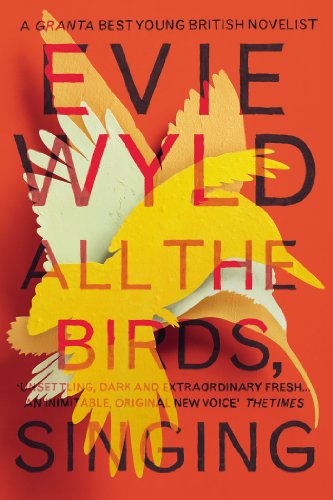
Also shortlisted for the 2013 Costa Novel Award was All the Birds, Singing by Australian author Evie Wyld, a book I would like to read. This is a novel, using reverse chronology techniques, telling the story of Jake Whyte who lives on an unnamed island off the coast of Britain, tending her flock of sheep with her dog, Dog. Someone, or something, is killing her sheep, and her investigations lead her and the reader back to her time in Australia to the ‘original sin’ that sets everything in motion.

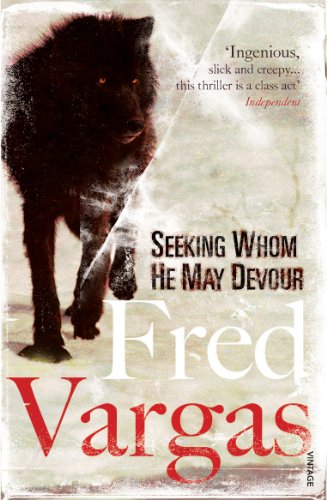
Another novel featuring the killing of sheep is Seeking Whom He May Devour by French author, Fred Vargas. It’s set in the French mountains. Johnstone, a Canadian is living there whilst he films a documentary about wolves. The problems start when more and more sheep are found with their throats torn out. This is the second in her Commissaire Adamsberg series. I thought it was quite quirky with touches of humour.

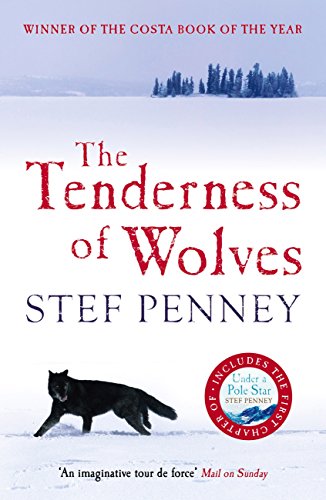
Thinking about wolves reminded me of Stef Penny’s novel, The Tenderness of Wolves, another Costa Award winning book. It’s set in Canada in 1867 beginning in a small place called Dove River on the north shore of Georgian Bay, narrated in part by Mrs Ross. It begins as she describes the last time she saw the French-Canadian trapper, Laurent Jammet alive.  He was the Ross’s closest neighbour and the next time she saw him was in his cabin, lying dead on his bed, his throat cut and he had been scalped.

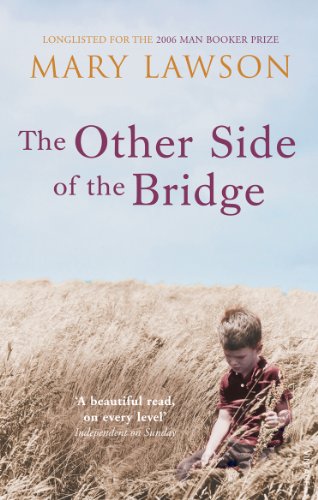
Next I thought of another book set in Canada, The Other Side of the Bridge by Mary Lawson. This is a beautiful book set in  in Northern Canada about two brothers, Arthur and Jake Dunn who grow up on a small farm near Struan (a fictional town) in the 1930s. Arthur is older, shy, dutiful, and set to inherit his father’s farm. Jake is younger and reckless, a dangerous to know. When Laura arrives in their 1930s rural community, an already uneasy relationship is driven to breaking point. It was longlisted for the Man Booker Prize in 2006.

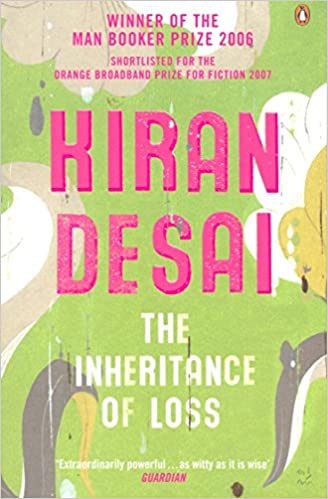
And that brings me to the last book in the chain – the winner of the Man Booker Prize in 2006 was Kiran Desai’s The Inheritance of Loss. This is set in the Himalayas where a judge and his granddaughter live in a dilapidated mansion. The judge, broken by a world too messy for justice, is haunted by his past. His orphan granddaughter has fallen in love with her handsome tutor, despite their different backgrounds and ideals. The cook’s heart is with his son, who is working in a New York restaurant, mingling with an underclass from all over the globe as he seeks somewhere to call home.

~~~

The books in my chain are linked either by the authors’ nationality, prize winning books and books about the killing of sheep! 

Next month (July 6, 2020), the chain begins with What I Loved by Siri Hustvedt – a book I loved!

An Air that Kills by Andrew Taylor

An Air That Kills is the first book in Andrew Taylor’s in his Lydmouth crime series. I’ve read several of his other books and thoroughly enjoyed them, but none in this series.  It has a slow beginning but once it had established the characters and set the scene the pace picks up. The setting is Lydmouth, a small market town on the Welsh/English border just after the end of the Second World War.

It begins as journalist, Jill Francis arrives to stay with her friends, Philip and Charlotte in Lydmouth, to recover from a bad experience – the details are are only revealed later in the book.  Also new to the town is Inspector Richard Thornhill, who is finding it difficult to adjust to working in the local police force. There’s been a spate of burglaries and there are whispers that a black marketeer is heading to their area. So there is plenty going on and then workmen digging out a drain discover a wooden box containing baby’s bones, an old brooch and some scraps of yellowed newspaper. When Major Harcutt, the local historian was consulted he found that there could be a connection to an old murder trial. 

Harcutt is elderly, living on his own and estranged from his daughter, Antonia. But when he is involved in a road accident and is then burgled Charlotte contacts Antonia and she reluctantly returns home to help him. Meanwhile, Jill is persuaded to help Inspector Thornhill in his investigation into the mystery of the baby’s bones.

It’s a good mix of police investigation, and personal stories, including those of Richard and Jill, of Jill and Philip and Charlotte, of Harcutt and his daughter, and the burglar and the black marketeer.  There is a strong sense of time and place – I thought the 1950s setting was well done. I enjoyed the interaction between the characters and and will definitely read on in the series to see how the relationship between Jill and Richard develops.

  • Format: Kindle Edition
  • File Size: 1382 KB
  • Print Length: 384 pages
  • Publisher: Hodder & Stoughton; New Ed edition (13 Sept. 2012)
  • Source: I bought it
  • My Rating 4*

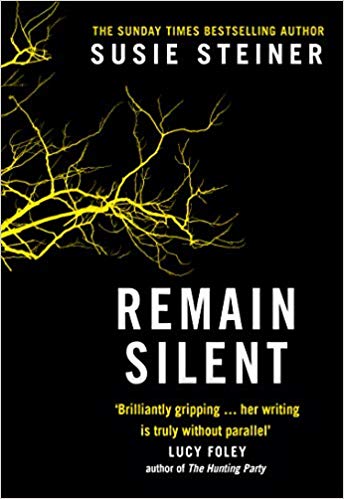
Remain Silent by Susie Steiner

‘The dead cannot speak. But they still have a story to tell.’

I’ve enjoyed two of Susie Steiner’s earlier books so I was keen to read her latest book, Remain Silent and once more I was totally immersed in the story. It’s the 3rd Manon Bradshaw book and I loved it.

Remain silent

The Borough Press | 28 May 2020 | 368 pages | review copy | 4*

‘By turns warm and witty, gripping and terrifying, heartbreaking and uplifting, Susie Steiner’s fourth book is both a literary tour de force and one of the finest crime novels of recent years.’ (extract from the publishers’ blurb)

My thoughts:

This is not just a police procedural and a gripping mystery it is a tragedy, a scathing look at modern life, centred on the exploitation of immigrant labour, racism and abuse that some of the foreign workers have to endure.

Manon Bradshaw is a Detective Inspector, a working mother with a young toddler, Teddy, her adopted teenage son, Fly and her partner, Mark Talbot who has recently been diagnosed with cancer. She is working in the Major Crime Unit on cold cases on a part-time basis and is not getting on well with her new boss, Detective Superintendent Gloria McBain. Despite that when she finds the body of Lukas Balsys hanging from a tree with a note attached saying ‘The dead cannot speak’,  McBain puts her in charge of the investigation into his death – did he commit suicide or was he murdered?

The story, as in the earlier books, has a complicated plot. This one revolves around the plight of a group of Lithuanian immigrants living and working in terrible conditions under a cruel gang master, Edikas. There is a large cast of characters –  as well as the Lithuanians and the police there is a local racist group leading a campaign of hatred with protest marches and the threat of violence.  All come over as incredibly real people, with the star characters being Manon, Lukas, his friend Matis and Elise who falls in love with Lukas, despite her racist father’s hatred of the immigrants.

This has all the ingredients of a successful crime novel for me. Although it starts off slowly building up a picture of the characters and their situation, it is gripping and intense, dealing with problems of prejudice and downright hatred and xenophobia – a most thought-provoking and shocking novel.

The Author

Susie Steiner is a novelist and freelance journalist. She began her writing career as a news reporter first on local papers, then on the Evening Standard, the Daily Telegraph and The Times. In 2001 she joined The Guardian, where she worked as a commissioning editor for 11 years. In May 2019 she was diagnosed with a brain tumour (Grade 4 Glioblastoma) and spent most of 2019 undergoing treatment: six hours of brain surgery, chemo radiation, and six cycles of chemotherapy. My best wishes for her recovery. For more information see her website, susiesteiner.co.uk

WWW Wednesday: 27 May 2020

IMG_1384-0

WWW Wednesday is run by Taking on a World of Words.

The Three Ws are:

 What are you currently reading?
What did you recently finish reading?
What do you think you’ll read next?

Currently reading:

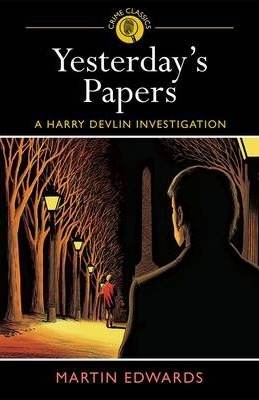
I’m reading Yesterday’s Papers by Martin Edwards – On Leap Year Day in 1964, an attractive teenager called Carole Jeffries was strangled in a Liverpool park. The killing caused a sensation: Carole came from a prominent political family and her pop musician boyfriend was a leading exponent of the Mersey Sound. When a neighbour confessed to the crime, the case was closed. Now, more than thirty years later, Ernest Miller, an amateur criminologist, seeks to persuade lawyer Harry Devlin that the true culprit escaped scot free. Although he suspects Miller’s motives, Harry has a thirst for justice and begins to delve into the past. But when another death occurs, it becomes clear that someone wants old secrets to remain buried – at any price.

Recently Finished: I’ve just finished Sword by Bogdan Teodorescu, translated by fellow blogger Marina Sofia – A shadowy killer stalks the streets of Bucharest, seeking out victims from among the Roma minority. But this is not the usual police procedural as it focuses on the effect the serial killings have on the political scene. I’ll write more about it later on.

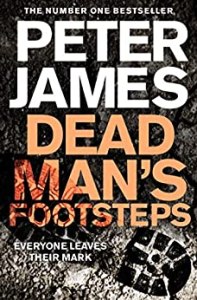
Reading Next: I’m never really sure, but it could be Dead Man’s Footsteps by Peter James. I’m reading his Superintendent Grace books in order and this is the 4th one.

Amid the tragic unfolding mayhem of the morning of 9/11, failed Brighton businessman and ne’er-do-well Ronnie Wilson sees the chance of a lifeline: to shed his debts, disappear and reinvent himself in another country. Six years later the discovery of the skeletal remains of a woman’s body in a storm drain in Brighton leads Detective Superintendent Roy Grace on an enquiry spanning the globe, and into a desperate race against time to save the life of a woman being hunted down like an animal in the streets and alleys of Brighton.

What do you think – which one would you read next?

This post has taken me hours to write using the new Block Editor which I find most confusing. I’m wondering how other WordPress users are getting on – any tips that would help me would be most welcome!