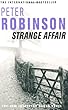
Strange Affair by Peter Robinson: a Book Review

Peter Robinson has written a series of Inspector Banks books. Strange Affair is the first one I’ve read but not the first in the series. I borrowed this one from the library as it was the earliest in the series available on the shelves. Although it’s one of the later ones in the series it does work on its own, as enough information is given about earlier events for me to get the gist of Banks’s history, but I would like to read the novels in the order they were written.

As soon as I started reading it I was hooked. It’s a great read – I didn’t want to stop reading. Detective Chief Inspector Alan Banks receives an urgent phone call from his brother asking for his help. He has never been close to his brother Roy, but alarmed by the message on his answerphone he sets off from the Yorkshire Dales for London to see exactly what the problem is. But on his arrival he finds his brother’s house empty and no-one knows where he is.

Meanwhile back in Yorkshire DI Annie Cabbott is investigating the death of a young woman found in her car. She had Banks’s name and address scribbled on a piece of paper in her pocket. Unaware that Banks has gone to London, Annie tries to find him to discover the link between them. Although officially on leave from work Banks, who is still recovering from his depression after the fire that destroyed his house and possessions, immediately gets involved in delving into Roy’s life whilst trying to find out what has happened to him. Just how has Roy made his money, what shady deals has he done, who are his connections? The more Banks discovers the worse it gets, until he fears for his parents’ safety, not just his brother’s.

A tense and gripping novel – I loved it and can’t wait to read more by Peter Robinson.

The Hound of Death by Agatha Christie: a Book Review

Hound of deathI borrowed The Hound of Death by Agatha Christie from the library. It’s a collection of twelve short stories, stories of unexplained phenomena, in most cases tales of the supernatural rather than detective stories.

Of the twelve stories I think The Witness for the Prosecution is the best. Agatha Christie later wrote a play based on this story which has subsequently been adapted for film and television. It’s the story of Leonard Vole, a young man who has been arrested for the murder of an elderly lady, Miss Emily French. He befriended this rich lonely old woman who left him everything in her will. He protests his innocence and is astounded when Romaine (who lives with him as his wife) refuses to back up his story at the trial. It is up to his lawyer Mr Mayherne to get to the truth.

I also liked the more supernatural stories – those with no explanation and those where the supernatural either have natural, scientific explanations or are plain con tricks. The narrator in The Hound of Death is unsure of how to view the events during the First World War where a Belgian nun, Sister Marie Angelique is said to have caused her convent to explode when it was invaded by German soldiers. He reflects:

But of course it is all nonsense! Everything can be accounted for quite naturally. That doctor believed in Sister Marie Angelique’s hallucinations merely proves that his mind too, was slightly unbalanced.

Yet sometimes I dream of a continent under the seas where men once lived and attained to a degree of civilization far ahead of ours …

… Nonsense – of course the whole thing was merely hallucination! (p36)

There are stories of premonitions, intuition or a sixth sense, stories of seances, haunted houses, nightmares, amnesia and a very strange tale The Call of Wings in which a millionaire hears a tune, played by man with no legs.

It was a strange tune – strictly speaking, it was not a tune at all, but a single phrase, not unlike the slow turn given out by the violins of Rienzi, repeated again and again, passing from key to key, from harmony to harmony, but always rising and attaining each time to a greater and more boundless freedom. (p269)

The music makes him feel he is being released from all his burdens as he is carried higher and higher. This story, with its mystical overtones reveals the power of music to transport the soul.

Years ago I read as many of Agatha Christie’s books as I could find, but they were all the detective stories – Poirot or Miss Marple. I was unaware that she wrote anything else, so these collections of short stories are a bonus for me. She really was a superb storyteller.

This year’s Agatha Christie Week is being celebrated at The Southbank Centre in September and on the English Riveria too, along with new radio productions and publications of previously unpublished stories – see the Agatha Christie website.

Tuesday Teaser – Tooth and Nail

teaser-tuesday

It‘s Tuesday again. Teaser Tuesdays is a weekly bookish meme, hosted by MizB of Should Be Reading.

Share a couple or more sentences from the book you’re currently reading. You also need to share the title of the book that you’re getting your ‘teaser’ from €¦ that way people can have some great book recommendations if they like the teaser you’ve given!

And please avoid spoilers!

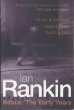
rebus-early-yearsToday’s teaser is from Tooth and Nail by Ian Rankin, which I’ve just started to read. Rebus is on his way to London to investigate four murders that had happened in the space of three months:

He was a busy little man this killer they had named the Wolfman and then they had sent word to Rebus’s boss. Lend us your man, they had said. Let’s see what he can do. (page 396 in the omnibus Rebus the Early Years)


Hide and Seek by Ian Rankin:Book Notes

I finished reading Hide and Seek a few weeks ago and didn’t take any notes whilst reading it. That was  a mistake because now I come to write about it my memory of it is a bit vague. As the main point of my blog is to record what I think about the books I’ve read and to remind me of them, this is not good.

Hide and Seek is Rankin’s second book featuring Rebus. It begins with a junkie in a squat in Pilmuir, Edinburgh shrieking “Hide!” and in fear of his life. Pilmuir is a run-down housing estate, with boarded-up terraced houses, ruptured drainpipes, broken fences and missing gates. “Edinburgh’s army of squatters” had made it their den and it is here that the junkie’s body is found:

Two large candles had burnt down to the shapes of fried eggs against the bare floorboards, and between them lay the body, legs together, arms outstretched. A cross without the nails, naked from the waist up. Near the body stood a glass jar, which had once contained something as innocent as coffee, but now held a selection of disposable syringes. Putting the fix into crucifixion, Rebus thought with a guilty smile. (p196 in the compilation volume Rebus the Early Years)

In Hide and Seek Rankin makes use of word-play, with puns on R L Stevenson’s Dr Jekyll and Mr Hyde and other literary references – the characters of Watson and Holmes for example. Superintendent “Farmer” Watson has assigned Rebus to help with the anti-drugs campaign, which brings him into contact with wealthy businessmen who prove to be just as evil as Mr Hyde. But this is no straight forward contrast between good and evil and Rebus himself is no angel.

It was interesting to see the development of Rebus’s character and the prickly relationship between him and Brian Holmes, a young officer Rebus ropes in to help him. Rebus treats him as a message boy, a dogsbody. Holmes is more than that and is offended when Rebus tells him he is the  “one with the shoeleather”, but it is only by working together that they discover the killer’s identity.

The Gardens of the Dead by William Brodrick: Book Review

The Gardens Of The Dead

The Gardens of the Dead by William Brodrick is his second novel. Although this book is a page turner I felt it was rather disjointed in parts. I had to backtrack a few times to make sure I was following the plot and the timeline is occasionally confusing. But on the whole I thought the book was pretty good.

Elizabeth Glendenning QC dies of a weak heart at the start of the book. Ten years earlier she had successfully defended a guilty man, Graham Riley. Just before her death she devised a scheme to bring Graham Riley back to court and to implement this scheme she had enlisted the help of Father Anselm, the barrister turned monk and her son Nick. She left a safety deposit box key with Father Anselm along with instructions that he should open it in the event of her death. Once he does this a sequence of events is triggered as Father Anselm and Nick follow the trail laid out by Elizabeth.

Part of me, the cynical part, wondered why she did this – it would have been much simpler to simply leave a written account rather than set what turns out to be a puzzle to be solved. But another part of me enjoyed seeing the mystery unfold. There are several surprising and some not so surprising elements to this story of good and evil, of revenge, family loyalties, justice and morality.

I liked the character of Anselm. He is kind and patient, well versed in analysing information and questioning people from his work at the Bar and also a good listener. My favourite character though is Father Andrew, the Prior, who was fond of a saying from a Desert Father:

Don’t use wise words falsely.

So he didn’t talk much and was always cautious when he spoke, but throughout the book he has several conversations with Anselm which are always perceptive and wise.

I borrowed this book from the library and at the time I thought the author’s name was familiar to me but couldn’t remember reading anything by him or reading any reviews of his books. Later I realised that I have the first novel he wrote The Sixth Lamentation, languishing somewhere in my to-be-read piles. Now I really must dig it out to read more about Anselm.

The Thirteen Problems by Agatha Christie

agatha_christie_rcIn The Thirteen Problems by Agatha Christie a group of friends, including Miss Marple meet on a Tuesday night and tell sinister stories of unsolved mysteries. It was first published in the UK in 1933, collecting together short stories previously published in various magazines. The first story The Tuesday Night Club introduces the character of Miss Marple.

The members of the Tuesday Night Club are Miss Marple, her nephew Raymond West a writer, Joyce Lempriere an artist, Sir Henry Clithering the ex-Commissioner of Scotland Yard, Dr Pender a clergyman and Mr Petherick a solicitor. Raymond wonders what type of person succeeds best at unravelling mysteries and puts forward that the ‘art of writing gives one an insight into human nature’, but Miss Marple questions him thinking that ‘so many people seem to me not to be either bad or good, but simply, you know, very silly.’ Mr Petherick thinks imagination is dangerous and that it needs a legal mind to sift through the evidence looking only at facts to arrive at the truth. Whereas Joyce believes it takes a woman’s intuition, such as hers – an artist who has ‘knocked about among all sorts and conditions of people’. She discounts Miss Marple thinking she cannot possibly know about life only having lived in St Mary Mead.thirteen-problems

So they each tell a tale and are amazed when it is Miss Marple, sitting primly, ‘knitting something white and soft’ who comes up with the right solution each time by using her knowledge of human nature gleaned from observing similar cases in St Mary Mead. She sees similarities and makes connections the others overlook.

The second set of stories are told at Colonel and Mrs Bantry’s house, when the guests tell their after-dinner stories. Sir Henry is visiting them and suggests they invite Miss Marple to make a sixth guest at dinner, along with Jane Helier the beautiful and popular actress, and the elderly Dr Lloyd.  Again Miss Marple correctly solves the mysteries, seeing through the red herrings to discover even the crimes that no one even knew had been committed. As she says

a lot of people are stupid. And stupid people get found out, whatever they do. But there are quite a number of people who aren’t stupid, and one shudders to think of what they might accomplish unless they had very strongly rooted principles.

The Thirteen Problems is an easy read and the short stories are ideal for reading quickly and in isolation. They are not complicated and once Miss Marple starts her explanations the crimes are easily solved.

I particularly liked the first description of Miss Marple, sitting erect in a big grandfather chair she

wore a black brocade dress, very much pinched in round the waist. Mechlin lace was arranged in a cascade down the front of her bodice. She had on black lace mittens, and a black lace cap surmounted the piled up masses of her snowy hair.

Kerrie recently ran a poll asking Who is the Best Miss Marple? My answer was Joan Hickson because I liked her portrayal, and the way she spoke and behaved seemed to me to be Miss Marple. But even though she looked nothing like this description I still prefer to ‘see’ Joan Hickson as Miss Marple. A strange case (for me) of a TV portrayal taking precedence over a book.