Library Loot

Library Loot:

From top to bottom they are:

  • A Detective at Death’s Door by H R F Keating. I haven’t read anything by H R F Keating, so I’m not sure what to expect. There’s a long list of his books at the front of the book and a brief summary of his work. He was the crime reporter for The Times for 15 years and a Fellow of the Royal Society of Literature, Chairman of the Crime Writers’ Association and the Society of Authors as well as President of the Detection Club. With such credentials I’m hoping to like this book, the fifth Detective Superintendent Harriet Martens novel. Martin Edwards’ page has much more information about Keating.
  • The Last Dickens by Matthew Pearl. I’ve recently read Dickens’ The Mystery of Edwin Drood and am keen to read more of Dicken’s books and books about Dickens (both fiction and non-fiction). So, even though I wasn’t too keen on Pearl’s novel about Edgar Allan Poe, I thought it was worth borrowing this book to try it. From the back cover this novel seems to be about Dickens’ final instalment of his last manuscript that disappeared after his death in 1870.
  • The Turning of the Tide by Reginald Hill. This was originally published under the pseudonym Patrick Ruell in 1971 called The Castle of the Demon. It looks as though it’s a sinister thriller when Emily discovers a body lying in the water at a sleepy coastal town. I like Hill’s Dalziel and Pascoe books and am hoping his earlier book won’t disappoint.
  • Frozen Moment by Camilla Ceder. ‘Move over Wallander‘ it says on the front cover. Camilla Ceder is a Swedish writer who also works in counselling and social work. This is her first novel; a murder mystery featuring Inspector Christian Tell, a world-weary detective with a chequered past. I picked this book off the new book stand attracted by its cover.
  • The Rain Before It Falls by Jonathan Coe. I’ve never read anything by Coe but I keep seeing his name on various blogs, so my eyes were drawn to this book in the library. The book’s blurb attracted me, describing the book as ‘intensely lyrical in its evocations of rural Shropshire and post-war London, and extremely moving in its portrayal of the nature of love and happiness.’ It looks like my sort of book.

Quite Ugly One Morning by Christopher Brookmyre: Book Review

Quite Ugly One Morning by Christopher Brookmyre begins with a graphic description of a particularly nasty murder scene, which is normally guaranteed to make me stop reading. But it would have been a great shame if I’d let it put me off this book, because I thoroughly enjoyed it. It was published in 1998 when it won the First Blood Award for best crime novel of that year.

The dead man is Dr Ponsonby, a well- respected doctor working for the Midlothian NHS Trust in Edinburgh. Investigative journalist, Jack Parlabane gets involved as he lives in the flat above Ponsonby and the terrible smell (think blood, poo and sick) coming up from below leads him into the murder scene. It soon becomes apparent to the reader who did the murder and it is the motive behind it that needs to be ferreted out.

The book alternates between current events and the back stories of the characters – Dr Ponsonby, his ex-wife Sarah, Stephen Lime, the Chief Executive of the Midlothian NHS Trust and above all Jack Parlabane. This is not a police procedural, and Inspector McGregor, in charge of the investigation, has just a little input. It’s fast, full of action, and surprisingly funny. There are some really despicable characters and Jack himself is not a shrinking violet – but I liked him.

I went to see Christopher Brookmyre this week at an author event in Livingston. He’s an excellent speaker and very funny too.  He read an extract from his latest book, Pandaemonium, but he’s written quite a lot more which I want to read first. Fortunately my son has all his books, so I’ve borrowed a few.

Heartstone by C J Sansom: Book Review

Mantle (Macmillan) 2010
Pages 640
ISBN 9781405092739
Dimensions 234mm x 153mm   Weight 0.95 kg

Publisher’s blurb:

Summer, 1545. England is at war. Henry VIII’s invasion of France has gone badly wrong, and a massive French fleet is preparing to sail across the Channel . . .

Meanwhile, Matthew Shardlake is given an intriguing legal case by an old servant of Queen Catherine Parr. Asked to investigate claims of ‘monstrous wrongs’ committed against his young ward, Hugh Curteys, by Sir Nicholas Hobbey, Shardlake and his assistant Barak journey to Portsmouth. There, Shardlake also intends to investigate the mysterious past of Ellen Fettiplace, a young woman incarcerated in the Bedlam.

Once in Portsmouth, Shardlake and Barak find themselves in a city preparing for war. The mysteries surrounding the Hobbey family and the events that destroyed Ellen’s family nineteen years before, involve Shardlake in reunions both with an old friend and an old enemy close to the throne. Soon events will converge on board one of the king’s great warships gathered in Portsmouth harbour, waiting to sail out and confront the approaching French fleet. . .

This is the fifth novel in the Matthew Shardlake series and to my mind although it’s good, I think it’s not quite as good as the others. Compared to the earlier books it’s a bit plodding as Shardlake goes on numerous journeys. But that aside it’s great on detail about life in Tudor times. There’s the war against the French, details about how the troops were recruited and trained, about the French attack on Portsmouth and the sinking of the Mary Rose. Actually I found that more interesting than the mystery surrounding Hugh Curteys, which I’d guessed quite early on, although it began well with Shardlake out of his usual area of expertise, going through the records at the Court of Wards.

The story about Ellen Fettiplace is more intriguing. Ellen had been an inmate in the Bedlam for 19 years and Shardlake discovered that there was no order of lunacy to authorise her imprisonment. His searches lead him to Rolfswood, the place where Ellen had lived. There he eventually discovers the terrible truth. Shardlake is dedicated to protecting the underdog, championing those unable to help themselves and above all to justice and truth, disregarding his own safety. But his dedication has become obsessive and there were times when I agreed with Barak that he should let go and return to London.

As usual, reading Sansom’s historical novels there is the echo of the past repeating itself. In this one I found myself thinking of the nature of war, the power that national leaders have in making decisions and the effects it has on ordinary people who get dragged into the battles willy-nilly. His research is excellent, his characters are well drawn and the atmosphere and sense of place are convincing. Whilst I was reading I was transported to Tudor England at a time of war.

Blood Safari by Deon Meyer: Book Review

Blood Safari by Deon Meyer, originally written in Afrikaans, translated by K L Seegers is set in South Africa. It’s a tense thriller/detective story.

Lemmer was demolishing a wall between the kitchen and bathroom on Christmas Day when the phone rang. It was his boss at Body Armour, a company specialising in personal security. Lemmer is a professional bodyguard and is hired by Emma Le Roux after she was attacked in her home by three men wearing balaclavas. Her brother, Jacobus had disappeared twenty years previously, but she thinks she saw him on the news, suspected of killing four poachers near the Kruger National Park and she is convinced by an anonymous phone call,  that the attack is connected to her brother.

Desperate to know whether Jacobus de Villiers is in fact her brother, Emma and Lemmer travel to the Lowveld to find out. This leads them into all sorts of dangers and Lemmer, who has a short fuse, doesn’t know who can be trusted, including Emma herself. Lemmer, an ex-con is the strong silent type. His First Law is: Don’t get involved and his second is Trust nobody. Despite that when someone tries to murder both him and Emma he has no choice.

This isn’t just crime fiction, however. It’s also a novel about South Africa, the countryside and its people. I found that just as fascinating, although at times the environmental issues came over as lectures and maybe would have been better if they were shorter – I now know quite a bit about African vultures amongst other things. But that is just a minor criticism as the book as a whole is totally engaging, with a satisfying plot, convincing characters and a colourful and well-drawn setting.

The ABC Murders by Agatha Christie: Book Review

As I’ve written an ABC of Agatha Christie for the Agatha Christie Blog tour and found the ABC Wednesday site, I thought I’d carried on with the alphabet theme and read Agatha Christie’s The ABC Murders. I’m so glad I did because it’s one of her best, or at least I think it is.

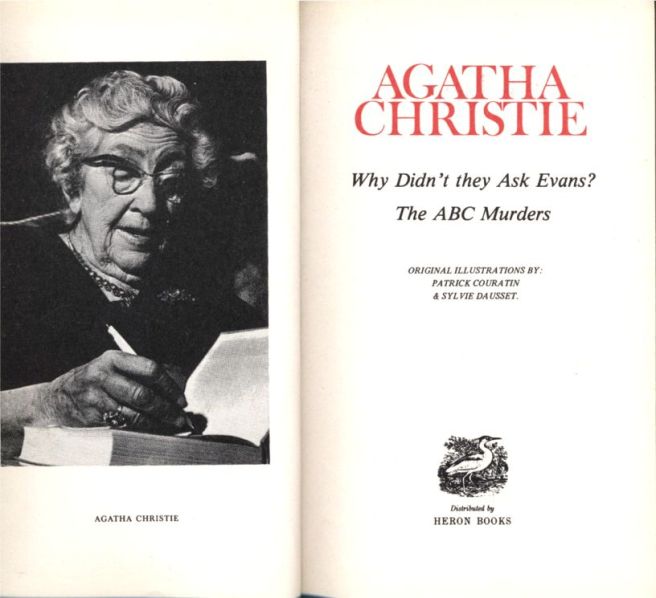
My copy is in a compilation volume along with Why Didn’t They Ask Evans. The ABC Murders was first published in 1936.

It’s narrated by Captain Hastings, for the most part, interspersed by chapters written in the third person, which Hastings assures us are accurate and have been ‘vetted’ by Poirot himself. I thought that was interesting and it alerted me to read those chapters carefully. What follows is a series of murders advertised in advance by letters to Poirot, and signed by an anonymous ‘ABC’. An ABC Railway is left next to each of the bodies. So the first murder is in Andover, the victim a Mrs Alice Ascher; the second in Bexhill, where Betty Barnard was murdered; and then Sir Carmichael Clarke in Churston is found dead. The police are completely puzzled and Poirot gets the victims’ relatives together to see what links if any can be found.

The only thing that seems to link them is that they were killed by the same person and that in each case there is a person who be the obvious suspect as the murderer if it hadn’t been for the ABC murderer. Poirot was convinced that one or possibly all of the relatives ‘knows something that they do not know they know.’ And indeed that was so. In Poirot’s final explanation of the case he admitted that all along he had been worried over the why? Why did ABC commit the murders and why did he select Poirot as his adversary?

Quite early on the book I had my suspicions about the identity of ABC but Agatha Christie was an expert at providing plenty of red herrings and twist and turns, and of course I was actually just as baffled as the police (quite an array of police, including a Chief Constable and an Assistant Commissioner, were involved from different forces around the country as well as Inspector Japp) and Doctor Thompson, a ‘famous alienist’. It was only right at the end that I worked out this ingenious mystery.

4.50 from Paddington by Agatha Christie: Book Review

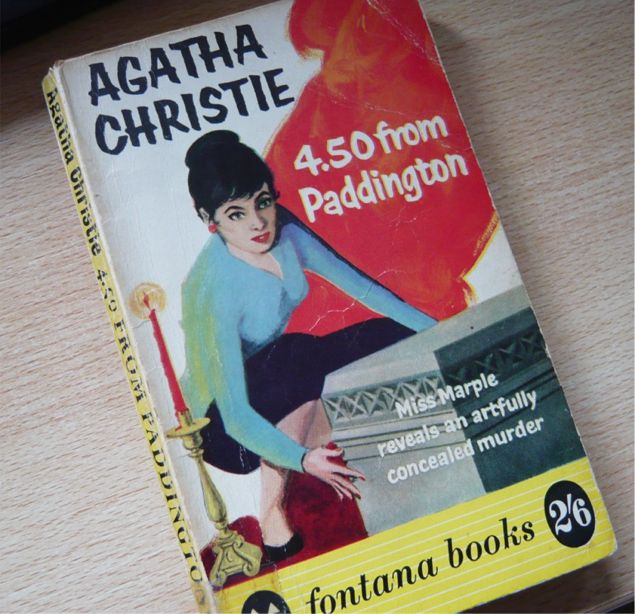
4.50 from Paddington 1

I’d expected the 4.50 from Paddington (first published in 1957) to be set on a train going by its title, but actually it just begins on the train. Train timetables and routes feature quite highly though. Mrs McGillicuddy was going home from Christmas shopping in London when she saw from the window of her train a murder being committed in a train travelling on a parallel line. But nobody believes her because there is no trace of a body and no one is reported missing. Nobody, that is except for her friend Miss Marple.

Miss Marple is getting older and more feeble and she hasn’t got the physical strength to get about and do things as she would like. But she has a theory about the whereabouts of the woman’s body, having worked out the most likely place that a body could have been pushed or thrown out of the train and she enlists the help of Lucy Eyelesbarrow to find it. This takes Lucy to Rutherford Hall, the home of the Crackenthorpe family, a family with many secrets and full of tension.

It’s an intriguing puzzle because you know there has been a murder, that the victim was a woman but her identity is not known, until much later in the book. You also know that the murderer is a man and there are plenty of male suspects to consider. Even though Miss Marple explains it all at the end of the book and says that it was very, very simple – the simplest kind of crime, I didn’t find it simple at all and had no idea who the killer was or even the victim. How Miss Marple worked it out is down to intuition and she tricks the murderer into confessing his crime.