Blood Safari by Deon Meyer: Book Review

Blood Safari by Deon Meyer, originally written in Afrikaans, translated by K L Seegers is set in South Africa. It’s a tense thriller/detective story.

Lemmer was demolishing a wall between the kitchen and bathroom on Christmas Day when the phone rang. It was his boss at Body Armour, a company specialising in personal security. Lemmer is a professional bodyguard and is hired by Emma Le Roux after she was attacked in her home by three men wearing balaclavas. Her brother, Jacobus had disappeared twenty years previously, but she thinks she saw him on the news, suspected of killing four poachers near the Kruger National Park and she is convinced by an anonymous phone call,  that the attack is connected to her brother.

Desperate to know whether Jacobus de Villiers is in fact her brother, Emma and Lemmer travel to the Lowveld to find out. This leads them into all sorts of dangers and Lemmer, who has a short fuse, doesn’t know who can be trusted, including Emma herself. Lemmer, an ex-con is the strong silent type. His First Law is: Don’t get involved and his second is Trust nobody. Despite that when someone tries to murder both him and Emma he has no choice.

This isn’t just crime fiction, however. It’s also a novel about South Africa, the countryside and its people. I found that just as fascinating, although at times the environmental issues came over as lectures and maybe would have been better if they were shorter – I now know quite a bit about African vultures amongst other things. But that is just a minor criticism as the book as a whole is totally engaging, with a satisfying plot, convincing characters and a colourful and well-drawn setting.

The ABC Murders by Agatha Christie: Book Review

As I’ve written an ABC of Agatha Christie for the Agatha Christie Blog tour and found the ABC Wednesday site, I thought I’d carried on with the alphabet theme and read Agatha Christie’s The ABC Murders. I’m so glad I did because it’s one of her best, or at least I think it is.

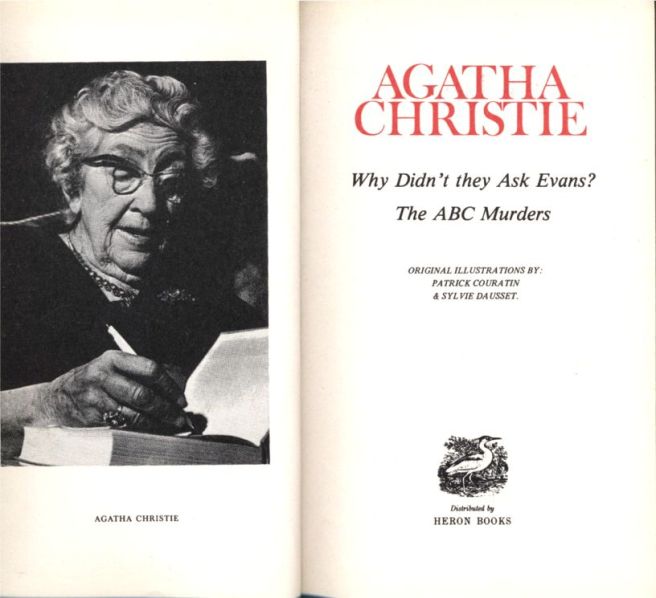
My copy is in a compilation volume along with Why Didn’t They Ask Evans. The ABC Murders was first published in 1936.

It’s narrated by Captain Hastings, for the most part, interspersed by chapters written in the third person, which Hastings assures us are accurate and have been ‘vetted’ by Poirot himself. I thought that was interesting and it alerted me to read those chapters carefully. What follows is a series of murders advertised in advance by letters to Poirot, and signed by an anonymous ‘ABC’. An ABC Railway is left next to each of the bodies. So the first murder is in Andover, the victim a Mrs Alice Ascher; the second in Bexhill, where Betty Barnard was murdered; and then Sir Carmichael Clarke in Churston is found dead. The police are completely puzzled and Poirot gets the victims’ relatives together to see what links if any can be found.

The only thing that seems to link them is that they were killed by the same person and that in each case there is a person who be the obvious suspect as the murderer if it hadn’t been for the ABC murderer. Poirot was convinced that one or possibly all of the relatives ‘knows something that they do not know they know.’ And indeed that was so. In Poirot’s final explanation of the case he admitted that all along he had been worried over the why? Why did ABC commit the murders and why did he select Poirot as his adversary?

Quite early on the book I had my suspicions about the identity of ABC but Agatha Christie was an expert at providing plenty of red herrings and twist and turns, and of course I was actually just as baffled as the police (quite an array of police, including a Chief Constable and an Assistant Commissioner, were involved from different forces around the country as well as Inspector Japp) and Doctor Thompson, a ‘famous alienist’. It was only right at the end that I worked out this ingenious mystery.

4.50 from Paddington by Agatha Christie: Book Review

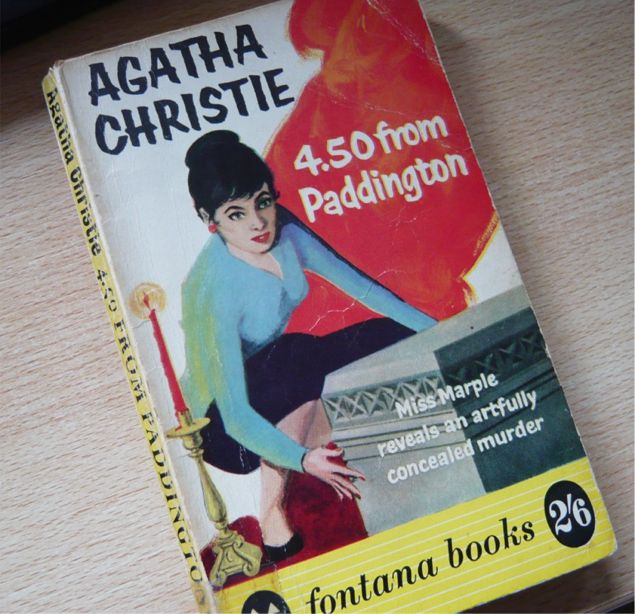
4.50 from Paddington 1

I’d expected the 4.50 from Paddington (first published in 1957) to be set on a train going by its title, but actually it just begins on the train. Train timetables and routes feature quite highly though. Mrs McGillicuddy was going home from Christmas shopping in London when she saw from the window of her train a murder being committed in a train travelling on a parallel line. But nobody believes her because there is no trace of a body and no one is reported missing. Nobody, that is except for her friend Miss Marple.

Miss Marple is getting older and more feeble and she hasn’t got the physical strength to get about and do things as she would like. But she has a theory about the whereabouts of the woman’s body, having worked out the most likely place that a body could have been pushed or thrown out of the train and she enlists the help of Lucy Eyelesbarrow to find it. This takes Lucy to Rutherford Hall, the home of the Crackenthorpe family, a family with many secrets and full of tension.

It’s an intriguing puzzle because you know there has been a murder, that the victim was a woman but her identity is not known, until much later in the book. You also know that the murderer is a man and there are plenty of male suspects to consider. Even though Miss Marple explains it all at the end of the book and says that it was very, very simple – the simplest kind of crime, I didn’t find it simple at all and had no idea who the killer was or even the victim. How Miss Marple worked it out is down to intuition and she tricks the murderer into confessing his crime.

Dame Agatha Christie: An A-Z

This is my contribution to The Agatha Christie blog tour to celebrate the 120th anniversary of Agatha Christie’s birth in September, in which each participant focuses on some aspect of Agatha Christie’s life and work. As I’m reading her books and writing about them already I thought I’d concentrate more on her life. I’ve listed the books I’ve read on my Agatha Christie Reading Challenge page.

This is a mixture of quotations and Agatha’s thoughts and observations that I noted whilst reading her book An Autobiography (I’m reading the paperback version). First of all a quotation which I think sums up her attitude so well:

I like living. I have sometimes been wildly, despairingly, acutely miserable, racked with sorrow, but through it all I still know quite certainly that just to be alive is a grand thing. (An Autobiography, page 11)

Here is an A-Z of miscellaneous information relating to Agatha Christie, all found in An Autobiography, except for the letters G, X and Z. For many letters I could have chosen many different subjects, so this is really just a sketchy look at Agatha’s life. I have tried not to use the titles of her books or the characters, but there are one or two:

A is for An Autobiography. She started to write this in April 1950 when she was 60 and stopped writing it 15 years later. She didn’t include everything and there is no mention of her disappearance in 1926.  In the Epilogue she wrote:

I have remembered, I suppose, what I wanted to remember; many ridiculous things for no reason that makes sense. That is the way humans are made. (page 548)

B is for Baghdad. When Agatha first met her second husband, Max Mallowan he took her on a tour of Baghdad. She accompanied Max on many of his archaeological expeditions, staying in different places. Agatha’s house in Baghdad was an old Turkish house on the west bank of the Tigris. It was cool, with a courtyard and palm-trees coming up to the balcony rail, in front of palm-gardens and a tiny squatter’s house made out of petrol tins. (page 546-7)

C is for Crime and Criminals. Agatha was interested in reading books by people who had been in contact with criminals, especially those who had tried to help them, or ‘reform’ them. (page 452)

D is for Divorce. She wrote:

I had been brought up, of course, like everyone in my day to have a horror of divorce, and I still have it. (page 365)

E is for Earliest Memory. Agatha had  a happy childhood. Her first memory is of her 3rd birthday and having tea in the garden at Ashfield. There was  a birthday cake with sugar icing and candles and what was exciting to her was a tiny red spider that ran across the white tablecoth, which her mother told her was ‘a lucky spider, Agatha, a lucky spider for  your birthday’. (page 19)

F is for her First short story written when she was a child:

It was in the nature of a melodrama, very short, since both writing and spelling were a pain to me. It concerned the noble Lady Madge (good) and the bloody Lady Agatha (bad) and a plot that involved the inheritance of a castle. (page 55)

G is for Grave. Agatha died on 12 January 1976 at Winterbrook, her home in Wallingford. Her grave is in St Mary’s Parish Church in Cholsey, a village near Wallingford. I wrote about it last September (including photos).

H is for Houses. Agatha’s love of houses stemmed from her childhood dolls’ house. She enjoyed buying all the things to put in it – not just furniture, but all the household implements such as brushes and dustpans, and food, cutlery and glasses. She also liked playing at moving house, using a cardboard box as a furniture van.

I can see quite plainly now that I have continued to play houses ever since. I have gone over innumerable houses, bought houses, exchanged them for other houses, furnished houses, decorated houses, made structural alterations to houses. Houses! God bless houses! (page 62)

I is for Imagination and Ideas. Sometimes Agatha’s ideas just came into her head, and she jotted them down in her notebooks, which she invariably then lost. Sometimes she devised plots that teased her mind and she liked to think about and play with them before fixing the details. (pages 451-2) She liked the light-hearted thriller and the intricate detective story with an involved plot, which required a great deal of work, but was always rewarding.(page 453)

J is for Jane Marple. When Miss Marple first appeared she was about 65 -70 years old. Agatha envisaged her as ‘the sort of old lady who would have been rather like some of my grandmother’s Ealing cronies’. But she was not like Agatha’s grandmother at all – being ‘far more fussy and spinsterish‘. People suggested that Miss Marple and Poirot should meet, but Agatha dismissed that idea because she didn’t think they would enjoy it at all and wouldn’t be at home in each other’s world. In one way Miss Marple was like her grandmother – in her powers of prophecy and kindness. (pages 447 -50)

K is for Nancy Kon. Nancy and Agatha met when Madge, her sister, married James Watts, Nancy’s brother. They were friends from then on. They both liked to drink cream by the half-pint.

L is for Life. She wrote that life seemed to fall into three parts: the present, absorbing and rushing by, the future, dim and uncertain, and the past ‘the memories and realities that are the bedrock of one’s present   life…’ (page 10)

M is for Memories. She thought that:

one’s memories represent those moments, which insignificant as they may seem, nevertheless represent the inner self and oneself as most really oneself.  (page 11)

N is for Nimrud where Agatha was living when she started writing her autobiography, on an expedition with her second husband, Max Mallowan, who was leading the British School of Archaeology in Iraq team’s excavations of the ancient city. They lived in the Expedition House, built of mud-brick. She wrote in a room added to the House, a room measuring about three metres square, with rush mats and rugs. Through the window she looked out east towards the snow-topped mountains of Kurdistan. (page 9)

O is for Orient Express. It was Agatha’s ambition to travel on the Orient Express, which she achieved in 1928. She went on her own on a journey on the Simpleton-Orient Express from Calais to Stamboul, and from there to Damascus. Her account of her journey is in pages 374 – 9. After a three-day stay in Damascus she travelled to Baghdad across the desert, a forty-eight-hour trip in a bus operated by two Australian brothers Gerry and Norman Nairn.

P is for Poetry. As well as her fiction works Agatha also wrote poetry and in her teens won several prizes in The Poetry Review. A collection of her poems was published in 1924 – The Road of Dreams and a later collection entitled Poems in 1973.

Q is for Quin. Mr Quin was one of Agatha’s favourite characters;

Mr Quin was a figure who just entered into a story – a catalyst, no more – his mere presence affected human beings. There would be some little fact, some apparently irrelevant phrase, to point him out for what he was: a man shown in a harlequin-coloured light that fell on him through a glass window; a sudden appearance or disappearance. Always he stood for the same thing: he was a friend of lovers, and connected with death. (page 447)

R is for Rosalind. Agatha’s daughter was born in 1919. When she was born Agatha thought that ‘she seemed from an early age both gay and determined.’ (page 274) Later in their lives AgathA wrote that Rosalind had ‘had the valuable role in life of eternally trying to discourage me without success.’ (page 489)

S is for Siblings. As a child Agatha remembered little of her older brother and sister, Monty and Madge, as they were away at school. Madge also wrote stories, many of which were accepted for Vanity Fair, a literary achievement (page 128). Agatha thought she wrote very well. Monty was a source of family trouble and worry. He was intensely musical, very charming and always had someone who would lend him money and do things for him (page 83).

T is for Travel. Agatha loved travelling and longed to see the world, which she did with her first husband, Archie Christie (pages 298 – 317). Later she travelled extensively with her second husband, Max.

U is for Ur. Agatha also visited the archaeological dig at Ur for the first time after her trip on the Orient Express. She went as a guest of the Woolleys (Sir Charles was the leader of the expedition). She was given VIP treament because Sir Charles’s wife, Katherine had just read and enjoyed Agatha’s book, The Murder of Roger Ackroyd. (page 386-9)

V is for VAD. Agatha was a Voluntary Aid Detachment nurse. She had taken First Aid and Home Nursing classes before the outbreak of war in 1914. She like nursing:

From the beginning I enjoyed nursing. I took to it easily, and found it, and have always found it, one of the most rewarding professions that anyone could follow. I think if I had not married, that after the war I should have trained as a real nurse. (page 236)

W is for Writing. Throughout her autobiography Agatha writes about writing, how she wrote, where she wrote and so on. Just one quote:

… I knew that writing was my steady, solid profession. I could go on inventing my plots and writing my books until I went gaga.

There is always, of course, that terrible three weeks, or a month, which you have to get through when you are trying to get started on a book. There is no agony like it. You sit in a room, biting pencils, looking at a typewriter, walking about, or casting yourself on a sofa, feeling you want to cry your head off. (page 490)

X is an interesting letter. As Dr Thompson thinking about the murderer in The ABC Murders, said:

Interesting to know how he’d have dealt with the letter X.

Y is for Yugoslavia. Agatha and Max went to Dubrovnik and Split for their honeymoon, where they ‘had enormous fun with the menus‘; written in Yugoslavian they didn’t know what they were ordering and none of the restaurants ever wished them to pay the bill.

Z is for Zero Hour. I haven’t come across anything in the autobiography for Z. Towards Zero is both a play and a novel in which Agatha asserts that destiny manipulates us, moving us towards a decisive zero hour. (The Life and Crimes of Agatha Christie by Charles Osborne, page 172)

The Mystery of Edwin Drood by Charles Dickens

Edwin Drood 001It’s been a few weeks now since I finished reading The Mystery of Edwin Drood by Charles Dickens, his last and unfinished book. I was surprised that it took so long before the mystery actually began to emerge and that it’s more the story of Edwin Drood’s uncle, John Jasper, than it is of Drood himself.   I was also surprised that much of it is written in the present tense, a style that I’m not too keen on. I haven’t read a Dickens novel for a few years and found the difference in style between this and modern mystery novels interesting. The build up to the mystery is so much more leisurely and descriptive than in modern novels, and I had to tone down my impatience for something mysterious to happen. Once I’d passed these hurdles I enjoyed the book immensely, even though I knew that the mystery is left open.

It begins dramatically with a scene in an opium den where Jasper lies under the influence of several pipes of opium, trembling and almost incoherent from the visions that came to him. According to the introduction to the book, Dickens took great care to make the scenes in the opium den authentic and had visited one in the east end of London, under police guidance. The mystery only becomes apparent when Drood has disappeared and cannot be found.

He had been engaged to Rosa Bud from their childhood days and both had realised that they didn’t want to get married. Before that Neville Landless and Edwin had come to blows over Rosa, but made up their differences just before Edwin disappears, but Jasper spreads suspicion that Neville may have killed him.

The novel abounds with wonderful characters – Canon Crisparkle, Neville’s mentor; Durdles a stonemason and his assistant, Deputy, whose tasks include making sure the drunken Durdles gets home safely, by the unlikely means of throwing rocks at him; and my favourite character, Mr Grewgious, a lawyer and Rosa’s guardian. Over and above these characters is the setting of Cloisterham (Rochester), with its Cathedral and sinister and dark background, ideal for secrecy and crime:

… a certain awful hush pervades the ancient pile, the cloisters, and the churchyard, after dark, which not many people care to encounter.

The inhabitants of Cloisterham feel

the innate shrinking of dust with the breath of life in it, from dust out of which the breath of life has passed. (page 105)

The mystery remains unsolved. What did happen to Edwin Drood? Was he killed and if so was it by John Jasper, his uncle, obsessed with his passion for Rosa? Who is Datchery, a stranger who arrives in Cloisterham six months after Edwin’s disappearance and what is his part in the story? And what is ‘Er Royal Highness the Princess Puffer’, the opium den woman’s connection with Jasper? I suppose it’s up to each reader to decide, although there is an account given by Forster, Dickens’s friend, in which he wrote that Dickens had intended it to be a story of the murder of a nephew by his uncle, but we’ll never know if that was so.

Also reviewed by A Library of My Own.

Borrowed Books

The mobile library came last week. I wasn’t going to borrow many, if any books, but there were some on the shelves that looked interesting and the van isn’t coming again until 21 October so I thought, why not borrow them. Then we went to our granddaughter’s 10th birthday party on Saturday and our son lent me a book too. It’s the top one in the pile shown below. Finally we went into town yesterday and as I returned a book to the library there I had a quick look round and borrowed the book at the bottom of the pile.

Borrowed Books

From top to bottom they are:

  • The Tent, the Bucket and Me: My Family’s Disastrous Attempts to go Camping in the 70s by Emma Kennedy. Apparently (I say this because I haven’t got that far in the book) they go to Carnac where we also went camping (well in a caravan) in the 80s. I checked on Amazon and this book has widely different reviews – some love it and think it very funny and others think it’s dreadful and not at all funny. I wonder which ‘camp’ I’ll be in.
  • Borrower of the Night: a Vicky Bliss Murder Mystery by Elizabeth Peters. I haven’t read anything by Elizabeth Peters, but as I’ve seen some reviews on a few blogs, I thought I’d have a look at this one. I haven’t started it yet. Vicky Bliss is an art historian, beautiful and brainy, according to the back cover. This one is about a search for a missing masterwork in wood by a master carver who died in Germany in the 16th century.
  • The Fall by Simon Mawer. I’ve read one other by by Simon Mawer – The Gospel of Judas, which I’d enjoyed. The Fall is the story of Rob and Jamie, friends from childhood, with a passion for mountaineering and climbing. From just a quick look at it, I see that it begins in Snowdon (another place where went on holiday and have camped and climbed (well D climbed, I just walked). Jamie and Rob take on greater challenges, culminating in the Eiger’s North Face. The jacket description appealed to me: ‘a story that captures nature at its most beautiful and most brutal, and which unlocks the intricacies at the heart of human relationships.’
  • A Change in Altitude by Anita Shreve. I’ve not been too keen on the latest books by Anita Shreve, although I loved her earlier ones, so I thought I’d borrow this one rather than buy it. I have started to read it, but just a few pages in it hasn’t ‘grabbed’ me yet. It’s about two couples on a climbing expedition to Mount Kenya when a horrific accident occurs.
  • Sepulchre by Kate Mosse. I read Labyrinth a few years ago (before I began this blog) and at the time I noted that it was ‘OK but too long’. So this is another book I decided not to buy, but if I saw it in the library I’d borrow it. It is enormously long! So far I’ve read a few chapters, set in 1891 in Paris and I’m not sure whether I’ll ever finish it. It’s a time-split book, divided 1891 and 2007, ‘the story of a tragic love, a missing girl, a unique set of tarot cards and the strange events of a cataclysmic night.’ (from the back cover)
  • The Casebook of Victor Frankenstein by Peter Ackroyd. I’ve always enjoyed Peter Ackroyd’s books and this one looked like a candidate for the RIP Challenge (as does Sepulchre). So far I’ve read about Victor Frankenstein’s love of learning and his desire to know the secrets of nature and the source of life. He has met Shelley at Oxford University, attended lessons at the dissecting room of St Thomas’s Hospital in London and is fascinated by Humphrey Davy’s experiments with electrical experiments. So far, so good. This book also has very mixed reviews on Amazon and in the press – the Guardian, ‘disappointing‘ and the Telegraph, ‘a brilliant jeu d’esprit.’

The links are to Amazon.co.uk (except for the press reviews). The only book to get consistent reviews on Amazon is The Fall. I don’t take much notice of these reviews, unless I know the reviewer, but I find it interesting to read such varying responses.