Crime Fiction Alphabet – O is for One Good Turn

letter OWe have reached the letter O in Kerrie’s Crime Fiction Alphabet and my book this week is:

One Good Turn (Jackson Brodie #2)

One Good Turn by Kate Atkinson

This is the second of her Jackson Brodie series. I read Case Histories, the first one, a few years ago and the third one, When Will There be Good News? just over 2 years ago, both of which I thought were excellent. So I had great expectations that this would be equally as good. Maybe it’s me, but I don’t think it is. It is good and I enjoyed it but I thought it was over complicated, especially at the beginning with so many different seemingly unrelated characters being introduced. It’s only near the end that you find out the connections and interactions between them all. And the ending did take me by surprise – a neat twist.

My problem with this book that I’d just get interested in one strand of the story and want to find out what happened next, when the action shifted to another set of characters. There is also too much detail, background information and flashbacks holding up the action for me to say it’s an excellent book.

But it is still a book that I had to finish; I had to find out what happened and work out the puzzle, because it is a puzzle. Like the Russian dolls within dolls (which also feature in this book), there is a thread connecting it all together. Set over four days an awful lot happens changing the characters lives for ever.

It’s summer in Edinburgh at Festival time when people queuing for a lunchtime show witness a road rage incident after Paul Bradley brakes suddenly to avoid hitting a pedestrian. The driver of the Honda behind him attacks his car with a baseball bat and then attacks Paul himself.  The one good turn comes from Martin Canning, the author of the Nina Riley mysteries, who stops the attack by throwing his laptop bag at the Honda driver hitting him on the shoulder.

One of the people in the queue is Jackson Brodie, who doesn’t want to get involved but who nevertheless gives Martin his mobile number and noted the Honda’s registration number. Amongst other witnesses are Gloria, the wife of an unscrupulous property developer, and her friend Pam. I got to like Gloria, a very sympathetically drawn character. Numerous other characters are involved – Jackson’s actress girlfriend, a failing comedian, exploited Eastern European workers for a housecleaning/escort agency called Favours, and Sergeant Louise Monroe and her teenage son, Archie, amongst others.

It’s complicated and full of coincidences, a very cleverly plotted book and as Jackson says:

A coincidence is just an explanation waiting to happen.

One Good Turn is also my entry in Beth’s What’s In a Name Challenge – a book with a number in the title.

  • Paperback: 544 pages
  • Publisher: Black Swan; Reprint edition (22 July 2010)
  • Language English
  • ISBN-10: 0552772445
  • ISBN-13: 978-0552772440

My Sunday Selection – Reading Today

I probably won’t be reading very much today as the sun is shining, the sky is a cloudless blue – and the garden needs lots of attention. At the moment I’m having a rest from mowing the lawn.

But there will be time to look at newbooks magazine – the latest copy of newbooks magazine arrived here a couple of days ago. This issue is full of interesting articles and a Crime Supplement, with short extracts from a number of books and author interviews.

Some that look interesting from the Crime Supplement are:

  • The Whispers of Nemesis by Anne Zouroudi – Hermes Diaktoros, ‘the inimitable Greek Detective’ in a story of long-kept secrets and of pride coming before the steepest of falls.
  • The House at Seas End by Elly Griffiths – the third Ruth Galloway investigation. In this one the mystery goes back to the Second World War with Britain threatened with invasion.
  • 1222 by Anne Holt – ‘a snowbound mountain pass, a derailed train, a mysterious carriage, an apocalyptic storm, an ancient hotel, murder and state secrets.’ Phew!!

The main magazine has as usual longer extracts from the free books (you have to pay the postage though) on offer. The one that takes my fancy is:

  • Death Instinct by Jed Rubenfeld, about a deadly attack on Wall Street in 1920. this begins: ‘Death is only the beginning; afterward comes the hard part.’

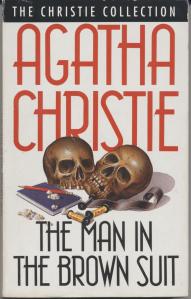
The Man in the Brown Suit by Agatha Christie: Book Review

The Man in the Brown Suit 001Agatha Christie wrote The Man in the Brown Suit whilst on a world tour with Archie Christie, her first husband, in 1922 and it was first published as a serial in The Evening News in 1923 in 50 instalments under the title of Anna the Adventurous. I think that’s an apt title as Anne Beddingfield, one of the two narrators of this book, longs for adventure, enjoying the cinema films of The Perils of Pauline. Agatha Christie, though thought it was ‘as silly a title as I had ever heard‘. But as The Evening News were prepared to pay her £500 for the serial rights she said nothing and bought a Morris Cowley with the proceeds.

She had the idea for the story from Major Belcher, a friend of Archie’s who had invited him to go with him on a grand tour of the British Empire to organise an Empire Exhibition. The Christies dined with Belcher at his house, the Mill House at Dorney and he had urged Agatha to write a detective story about it. He suggested the title The Mystery of the Mill House and wanted her to put him in it.

Agatha sketched the plot whilst she was in South Africa when there was a revolutionary crisis and decided that the book was to be more of a thriller than a detective story, with the heroine as ‘a gay, adventurous, young woman, an orphan, who started out to seek adventure.‘ But she found it hard to make the character she had chosen based on Belcher to come alive, until she hit upon the idea of writing it in the first person and making the Belcher character (Sir Eustace Pedler), Anne’s co-narrator.

I found this information in Agatha Christie’s An Autobiography, but I haven’t added the details she also added that give away who the murderer is (for of course there is a murder) – maybe she thought anyone reading her autobiography would have read all her books.

Anne’s adventure begins when she sees a man fall to his death on the live rails at Hyde Park tube station. He had a terrified look on his face and turning round Anne sees a man in a brown suit, who quickly becomes The Man in the Brown Suit both to her and the newspapers. He announced he was a medical man and that the man was dead, and as he left the station he dropped a piece of paper with some figures and words scrawled on it in pencil, which Anne picked up. A second death follows, this time a young woman is found strangled at Mill House, the home of Sir Eustace Pedler, MP. She was thought to be a foreigner. Anne decides to investigate and the trail takes her on board the Kilmorden Castle sailing to Cape Town.

The action takes place mainly on board ship and in South Africa which Agatha Christie describes so well from her own experiences.  Like Agatha, Anne suffers terribly from sea-sickness; both stayed in their cabins for three days until the ship reached Madeira and like Agatha, Anne just wanted to go ashore and be a parlourmaid. At that point in her life, Agatha had told Archie: ‘I would quite like to be a parlourmaid’. (An Autobiography page 300)

This book features the first appearance of Colonel Race, who appears in three more of Agatha Christie’s books. Anne describes him as ‘one of the strong, silent men of Rhodesia‘ and was very taken with him – ‘easily the best-looking man on board.‘ (page 54)

The novel is a mix of murder mystery and international crime organised by an arch-villain known as ‘the Colonel’, involving violence (but not graphic) and suspense. As usual there are a number of suspects and Anne has to work out who she can trust and who to believe. I found it a bit too drawn out for my liking, too many time lapses and coincidences to convince me of the plot’s credibility, but it held my interest to the end even though I knew the culprit’s identity.

Happy Birthday BooksPlease!

BooksPlease is 4 years old today!

I find it hard to believe that I’ve been writing this blog for 4 years. It seems like it was only yesterday I tentatively clicked on ‘publish’  for the first time.

Over these last 4 years I’ve read almost 400 books and have written about the  majority of them. I’ve also written about places I love to visit but my blog has stayed mainly about books.

The greatest change in my reading has come about gradually over the last two years or so, in that I now read a lot more crime fiction than I ever did before and that’s down to other bloggers, but also because I find crime fiction books are about so much more than crime. There is such variety in crime fiction – dealing with contemporary issues, historical crime (true and fictional), moral and ethical issues, personal and psychological crimes, and organised crime and so on. There are police procedurals, private detectives, amateur sleuths, serial killers and racial and political crime thrillers. And I love variety in my reading.

Books Please Me

I’ve also found that blogging isn’t a solitary pursuit, although it can be if you want. I’ve ‘met’ so many kindred spirits on book blogs and other blogs too. There are numerous reading challenges and memes to join and the opportunity to discuss books with people world wide. I’m very happy that I ventured into the book blogosphere. Thanks to everyone who reads my blog and especially to those who’ve taken the time and effort to make comments.

Crime Fiction Alphabet – Letter N

This week we’ve reached the letter N in Kerrie’s Crime Fiction Alphabet. My choice is a medley of ‘N‘s.

  • I had thought I would review Peter James’s Not Dead Enough, and I started it a while back but put it down to read other books. Not because I didn’t like it, but it’s a very long book – 610 pages of very small font, which is difficult for me to read, especially late at night when my eyes get tired quickly. From the back cover:

On the night Brian Bishop murdered his wife he was sixty miles away, asleep in bed at the time. At least that’s the way it looks to Detective Superintendent Roy Grace, who is called to investigate the kinky slaying of beautiful young Brighton socialite, Katie Bishop.

  • Another choice for the letter N that I considered is A Necessary End, an Inspector Banks mystery by Peter Robinson but I haven’t finished that book either. From the back cover:

In the usually peaceful town of Eastvale, a simmering tension has now reached breaking point. An anti-nuclear demonstration has ended in violence, leaving one policeman stabbed to death. Fired by professional outrage, Superintendent ‘Dirty Dick’ Burgess descends with vengeful fury on the inhabitants of ‘Maggie’s Farm’, an isolated house high on the daleside.

  • My third choice is Not the End of the World by Christopher Brookmyre. I started reading this after enjoying Quite Ugly One Morning. The bookmark shows I’m up to page 30. I think I didn’t finish this book because I was expecting it to be set in Scotland like Quite Ugly One Morning and was put off by it being in Los Angeles – silly I know!


  • Then there is Agatha Christie’s Nemesis, which is the last Miss Marple mystery. I only bought it recently and I’m itching to read it soon. Mr Rafiel, an old acquaintance (see A Caribbean Mystery), has died and left Miss Marple instructions for her to investigate a crime after his death.


  • And finally the book I’m currently reading is Janet Neel’s Ticket to Ride, which so far is making very interesting reading. But I don’t want to write much about it before I’ve finished it. Ticket to Ride features Jules Carlisle a newly qualified solicitor. She takes on the case of Mirko Dragunoviç, an illegal immigrant who claims that one of the eight dead bodies, found on the beach west of King’s Lynn, is that of his brother.

Janet Neel is the nom de plume of Baroness Cohen of Pimlico who sits as a Labour peer in the House of Lords. She started out as a solicitor, then went to the Board of Trade and then to Charterhouse Bank. She has written several crime fiction novels. The first, Death’s Bright Angel won the John Creasey Prize and both Death of a Partner and Death Among the Dons were shortlisted for the CWA Gold Dagger.

Teaser Tuesday

Teaser Tuesday is a weekly event hosted by MizB of Should be Reading.

I’ve just finished reading Agatha Christie’s The Man in the Brown Suit, which is one of her earliest books. It has a very complicated plot about a diamond robbery, an accidental death at a London tube station and a murder in a remote country mansion. I’ll write about in more detail about in a later post, but for now here is a teaser:

For in each suspicious instance Pagett had been shown as the directing genius. It was true that his personality seemed to lack the assurance and decision that one would suspect from a master criminal – but after all, according to Colonel Race, it was brain-work only that this mysterious leader supplied , and creative genius is often allied to a weak and timorous physical constitution. (page 148)

And the last few sentences in the book show Agatha Christie’s interest in anthropology:

‘Congratulations and love to the latest arrival on Lunatics’ Island. Is his head dolichocephalic or brachycephalic?’

I wasn’t going to stand that from Suzanne. I sent her a reply of one word, economical and to the point:

‘Platycephalic!’ (page 238)