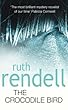
The Crocodile Bird by Ruth Rendell: a Book Review

I posted the opening sentences of The Crocodile Birdlast Friday. It really grabbed my attention and got me wondering what had caused Liza’s world fall apart. The cause is revealed when Eve, Liza’s mother tells her she has to leave home because Eve is liable to be booked for murder in the morning. Liza is nearly seventeen but has been brought up with practically no knowledge of the world outside the little gatehouse to Shrove House, where she has lived in seclusion, never having been on a bus or train or having any contact with other children. As Liza explained, Eve had wanted to protect her:

The world had treated her so badly, it was so awful out there, that I wasn’t to be allowed to go through any of that. I was to be sheltered from the world, hence no school and no visits to town, no meeting other people, other people kept down to a minimum, a totally protected childhood and youth. (page 116)

Liza, however, has a secret lover, Sean and when she leaves home she to goes to live with him in his caravan. She tells him the story of her life in a series of tales each night, just like Scheherazade in One Thousand and One Nights, culminating in how her mother is now on trial for murder. It seems, moreover, that she has killed more than once. Eve’s passion and obsession is for Shrove House, owned by Jonathan Tobias. Eve and Jonathan had grown up together and she had once thought they would marry and Shrove House would be hers. She would do anything to stay there.

This really a psychological study, rather than a straightforward crime fiction novel. It’s written in a simple style matching Liza’s childlike naivety.  To some extent, I thought that reduced the tension, although as Liza’s eyes were opened and she realised the meaning of events she had witnessed as a child, the tension mounted. It seemed that she might be following in her mother’s murderous footsteps!

The Crocodile Bird is an easy book to read and one that I enjoyed. The title intrigued me for most of the book, as I wondered where the bird comes into the story. The explanation is as Liza explains to Sean that just as the crocodile bird is able to feed safely from the mouth of a crocodile, so whatever Eve did to others (and she did some terrible things) Liza, like the bird, was always safe with her.

  • Paperback: 368 pages
  • Publisher: Arrow; New edition edition (29 Sep 1994)
  • Language English
  • ISBN-10: 0099303787
  • ISBN-13: 978-0099303787
  • Source: I bought the book
  • My Rating: 3.5/5

Book Beginnings on Friday

I began reading The Crocodile Bird by Ruth Rendell last night for no reason other than it has been on the top of a pile by my bedside for a while.

It begins well:

 The world began to fall apart at nine in the evening. Not at five when it happened, nor at half-past six when the policemen came and Eve said to go into the little castle and not show herself, but at nine when all was quiet again and it was dark outside.

I had to read on, even though I was falling asleep. It grabbed my attention – what had happened? It must have been something bad, because the policemen came. Who is Eve? Who did she tell to go into the little castle and why? The little castle … what is that? If the thing that happened was so bad, why hadn’t the world begun to fall apart at five? Whatever happened at nine must have been much worse – or was it?

This is a Ruth Rendell book, so I expect it to be mysterious and creepy. I’ve read further on and it’s full of secrets that are slowly being revealed and so far I’m enjoying the experience.

Book Beginnings is run by Kathy at A Few More Pages.

How to participate: Share the first line (or two) of the book you are currently reading on your blog or in the comments. Include the title and the author so we know what you’re reading. Then, if you would like, let us know what your first impressions were based on that first line, and let us know if you liked or did not like the sentence. The link-up will be at  every Friday and will be open for the entire week.

Much in Evidence by Henry Cecil

I’ve been reading quite a few long books recently and fancied something shorter, and more amusing. I also noticed that I’ve not been reading much crime fiction lately, so I looked at my bookshelves and took down Much in Evidence by Henry Cecil (published in the US as The Long Arm). My copy is a secondhand book, with this great cover.

I haven’t read any of Cecil’s other books, but after reading this one I certainly will look out for more. there is a list of his books on Fantastic Fiction. It’s no surprise to me to find out that Henry Cecil, real name Henry Cecil Leon (1902 -1976), was a judge and I loved the way he pokes fun at the law and the legal system in this book. The dialogue is masterful, and the characters are hilarious, from the drunken solicitor, Mr Tewkesbury, to the barrow boy, Mr Brown. The plot is farcical, which I found fascinating and highly entertaining.

To summarise the plot very briefly – Mr Richmond, bald and lame was attacked in his home and robbed of £100,000. The insurance company reluctantly paid up, but then they discover that a series of bald, lame men had been making dubious claims on insurance companies and he is charged with fraud.

Coincidences abound in this book, until you just don’t know what to believe. Is there just once coincidence too many … ? It was with relief that I read the last chapter, where my suspicions were confirmed.

My rating: 4/5

Details of a new copy of Much in Evidence (from Amazon UK):

  • Paperback: 212 pages
  • Publisher: House of Stratus; New edition edition (16 Oct 2000)
  • Language English
  • ISBN-10: 1842320572
  • ISBN-13: 978-1842320570

White Nights by Ann Cleeves: a Book Review

White Nights (Shetland Island, #2)

White Nights by Ann Cleeves is the second in her Shetland Quartet, featuring Detective Jimmy Perez. The first book is Raven Black, which I read and wrote about last year. I enjoyed this one just as much as the first and, although I think it stands well on its own, I think it best to read them in order as some of the characters appear in both and you can follow the development of their relationships.

White Nights is set mainly in Biddista, a fictional village of a few houses, a shop, an art gallery and restaurant called the Herring House, and an old Manse. Kenny Thomson finds a man’s body hanging in the hut where the boat owners of the village of Biddista keep their lines and pots. Perez recognises the dead man – he’s the mystery man who had caused a scene the previous evening at the opening of Bella Sinclair’s and Fran Hunter’s art exhibition. At first it looks as though the man, his face covered by a clown’s mask, has committed suicide, but he’d been dead before he was strung up and the murder team from Inverness, headed up by Roy Taylor, are called in. It takes quite some time before they can identify the dead man and even longer before the motive for killing him is revealed. And that is only after more deaths have occurred.

This is a most satisfying book for me. It’s not only full of believable characters, each one an individual in their own right, it also has a nicely complicated plot and a great sense of location. As well as the mystery of who killed the man in the clown mask and why, there is also the disappearance 15 years earlier of Kenny’s older brother Lawrence. It was thought that he left the island after Bella had broken his heart. Kenny hadn’t heard from him since and at first thought the dead man could be him.

It’s the place, itself, that for me conveyed the most powerful aspects of the book. The ‘white nights’ are the summer nights when the sun never really goes down. They call it the ‘summer dim’, the dusk lasts all night, and in contrast to the bleak, black winters, fills people with ‘a kind of frenzy‘. The landscape and the climate certainly play a great part in people’s lives.Taylor feels very much an outsider, almost too impatient to cope with what he thinks is Perez’s hesitant approach, until it occurred to him that

here in this bizarre, bleak, treeless community, Perez’s strange methods might actually get results. (page 263)

I could see the landscape and the sea, and I could hear the birds, the kittiwakes on the cliffs, the puffins and skuas. The Shetland Islands are part of theBritish Isles, but are so far north of the mainland that they are on about the same latitude as the southern point of Greenland.

However, I did think that the ending came rather suddenly after the careful build up to the mystery. The tension just gradually faded away as it became obvious who the culprit was. But I still think it’s a very good book, that held my interest, one that made me want to get back to it each time I had to put it down.

  • Paperback: 340 pages
  • Publisher: Pan (5 Jun 2009)
  • Language English
  • ISBN-10: 0330448250
  • ISBN-13: 978-0330448253
  • Source: Library Book
  • My Rating: 4/5

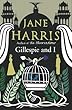
Gillespie and I by Jane Harris: a Book Review

Gillespie and I by Jane Harris is a cleverly told story, narrated by Harriet Baxter, alternating between events in 1888-90 (in Glasgow) and those in 1933 (in London). In 1888 Harriet moved to Glasgow where she got to know the painter, Ned Gillespie and his family. At first I liked Harriet but as I read on I became increasingly doubtful about her character, even though she comes across as an honest, reliable person. But, as she relates what her life is like in 1933 my impression of her began to change.

All is well at first but than a tragedy occurs which forms the major part of the book. It’s signalled in advance, when Harriet refers to the ‘horrible events’ that lay in the future. To say any more would be too much of a spoiler.

The setting of the book in Glasgow of the late 19th century is well described, helped by plans in the front of the book. The characters are also convincing, even some of the minor ones and her portrayal of Ned’s disturbed daughter, Sybil is quite chilling. This is a very detailed book, both about the place, artists and, through the account of a trial, the Scottish legal system of that period. It’s a book that lingered in my mind after I finished reading and if it wasn’t so long I’d like to re-read it in the light of what I now know.

  • Hardcover: 528 pages
  • Publisher: Faber and Faber (5 May 2011)
  • Language English
  • ISBN-10: 0571275168
  • ISBN-13: 978-0571275168
  • Source:an uncorrected proof from the publishers (via LibraryThing Early Reviewers)
  • My rating 3.5/5

I haven’t read Jane Harris first book, The Observations, although I’ve owned it for a while. It’s probably time I read that one too.

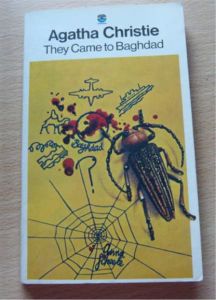
They Came to Baghdad by Agatha Christie: a Book Review

They came to Baghdad

I made copious notes as I read Agatha Christie’s They Came to Baghdad because it’s such a complex plot and there seemed to be so many significant events and people that I wanted to clarify what was happening. This is not one of Agatha Christie’s detective novels – no Miss Marple or Hercule Poirot,-  just Victoria Jones, a short-hand typist, a courageous girl with a ‘natural leaning towards adventure’ and a tendency to tell lies. Set in 1950 this is a story about international espionage and conspiracy. The heads of the ‘great powers‘ are secretly meeting in Baghdad, where if it all goes wrong ‘the balloon will go up with a vengeance.’ And an underground criminal organisation is out to make sure it does go wrong, aiming at ‘total war – total destruction. And then – the new Heaven and the new Earth.’

Victoria gets involved after one meeting with a young man, Edward, who is going out to Baghdad the following day to join an archaeological dig. She thinks he’s an incredibly good-looking man and considering herself an excellent judge of character is immediately attracted to him. As she has just been fired from her job, impulsively she decides to follow him to Baghdad, claiming to be the niece of Dr Pauncefoot Jones, Richard’s boss .

At the same time a British secret agent, Carmichael, is trying to get to Baghdad with important information, and is his life is in great danger. Will he get there? Anna Scheele, a mysterious character is also on her way to Baghdad and there are hints that she is at the centre of things. Just who is she and what side is she on?

Alongside the mystery, Agatha Christie’s descriptions of the locations, local people and of the archaeological dig are superb, no doubt taken from her experience of her own visits to Baghdad and Iraq. I enjoyed it for its entertaining plot, the authenticity of the background and its great characters, in particular I grew very fond of the amazing Victoria Jones.

  • First published in 1951 by William Collins & Co Ltd
  • My copy a secondhand paperback Fontana Books, 1980
  • My Rating: 4/5