Crime Fiction Alphabet 2012: Letter A

Kerrie’s Crime Fiction Alphabet begins this week with the letter A.Letter A
Here are the rules:

By Friday of each week participants try to write a blog post about crime fiction related to the letter of the week.

Your post MUST be related to either the first letter of a book’s title, the first letter of an author’s first name, or the first letter of the author’s surname, or even maybe a crime fiction “topic”. But above all, it has to be crime fiction.
So you see you have lots of choice.
You could write a review, or a bio of an author, so long as it fits the rules somehow.
(It is ok too to skip a week.)

My choice for the letter A is Arthur Conan Doyle and The Sign of Four, sometimes called The Sign of the Four. Set in 1888 this is the second Sherlock Holmes book written by Sir Arthur Conan Doyle, published in 1890.

Description from Goodreads:

Yellow fog is swirling through the streets of London, and Sherlock Holmes himself is sitting in a cocaine-induced haze until the arrival of a distressed and beautiful young lady forces the great detective into action. Each year following the strange disappearance of her father, Miss Morstan has received a present of a rare and lustrous pearl. Now, on the day she is summoned to meet her anonymous benefactor, she consults Holmes and Watson.

My thoughts:

Although I have a copy of this book on my Kindle, I listened to an audiobook of the novel, narrated by Derek Jacobi. Holmes is bored, hence the cocaine and Dr Watson is concerned about the effect on his health, although he hesitates to protest at his use of the drug because:

Again and again I had registered a vow that I should deliver my soul upon the subject, but there was that cool, nonchalant air of my companion which made him the last man with whom one could care to take anything approaching to a liberty. His great powers, his masterly manner, and the experience of his many extraordinary qualities, all made me diffident and backward in crossing him.

So they are both keen to investigate the mystery Mary Morstan presents to them. Holmes is intrigued by the mystery, involving the murder of Bartholomew Sholto, the Agra treasure stolen during the Indian Mutiny of 1857 and a secret pact between the four thieves – the ‘Four’ of the title, resulting in a chase down the River Thames in a super-fast steam launch.

It’s narrated by Dr Watson, who falls in love with Mary during the course of the investigation, but it is only at the end of the novel that he plucks up his courage to propose to her. Derek Jacobi does an admirable job, with easily distinguishable voices and reasonable versions of the women’s voices. The story is complex and fast-paced, with Holmes seemingly solving the mystery from clues which he then explains to Watson. But I thought the last chapter was too long, explaining Jonathan Small’s involvement in the theft of the treasure and his attempts to retrieve it, but as Dr Watson is the narrator and he didn’t know any of this I suppose it was the only way of including it.

There are a number of minor characters that stand out, even though they have minimal involvement and are only sketched in. I’m thinking of the Scotland Yard Inspector, Athelney Jones, who Holmes describes as ‘not a bad fellow’. He arrests the whole of Sholto’s household, even his brother. There is also Toby, the dog, described as an ‘ugly long haired, lop-eared creature, half spaniel and half lurcher, brown and white in colour, with a very clumsy waddling gait.’ Also notable are the Baker Street Irregulars, a gang of ‘dirty and little street-Arabs‘ Holmes employs to chase down the criminals. He pays them a shilling a day, with a guinea prize for the first boy to find the vital clue.

All in all, an enjoyable ‘read’ and as I was listening I could visualise the scenes. It begins and ends with Holmes reaching for his cocaine.
Sunday Selection

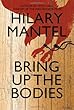
It’s not often that I buy a book and start reading it straight away, mainly because I’ll be already reading one or more and also because I have a huge stack of unread books. But Bring Up the Bodies arrived in the post at just the right time, as I’d just finished reading one book and was ready for the next.

Bring Up the Bodies by Hilary Mantel is the sequel to Wolf Hall, which I read and loved in 2010.  I’ve been looking forward to reading it ever since I finished reading Wolf Hall. So, even with a large backlog of books to be read, I just had to start Bring Up the Bodies straight away. It’s like catching up with friends you haven’t seen for a while – it begins in September 1535, just a few days after Wolf Hall finished. Thomas More was executed and now Henry VIII and his retinue are staying at Wolf Hall, the home of the Seymour family. And so, the story continues. This book covers the fall of Anne Boleyn, but like Wolf Hall, it’s about the career of Thomas Cromwell, Secretary to the king, Master of the Rolls, Chancellor of Cambridge University, and deputy to the king as head of the church in England.

I’m now on page 101, a quarter of the book read, and am trying to read it as slowly as possible, soaking up the atmosphere and Hilary Mantel’s richly descriptive words. Interestingly, I’ve noticed that every now and then, she qualifies who ‘he‘ is: ‘he, Cromwell‘, removing the ambiguity found in Wolf Hall. I hadn’t realised until I read the Author’s Note that this is not the end of Thomas Cromwell or the end of Hilary Mantel’s efforts to write about him:

This book is of course not about Anne Boleyn or about Henry VIII, but about the career of Thomas Cromwell, who is still in need of attention from biographers. Meanwhile, Mr Secretary remains sleek, plump and densely inaccessible, like a choice plum in a Christmas pie; but I hope to continue my efforts to dig him out. (page 410)

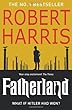
But I’ve also realised that I need to read Fatherland by Robert Harris, because this is the book we’ll be discussing at my face-to-face book group at the end of May and I hadn’t started it yet. So this morning I began to read it.

Whilst Bring Up the Bodies is most definitely historical fiction, Fatherland is more difficult to categorise. It’s set in Germany in 1964, but not the historical Germany of that date, because Hitler is approaching his 75th birthday, and Germany had won the Second World War – it’s historical fiction that never was – an alternative history. And yet many of the characters actually existed, their biographies are correct up to 1942 and Harris quotes from authentic documents in the book. The Berlin of the book is the Berlin that Albert Speer planned to build. What is definite is that this is a murder mystery, beginning with the discovery of the naked body of an old man, lying half in a lake on the outskirts of Berlin. The homicide investigator is Xavier March of the Kriminalpolizei and the victim is a member of the Nazi Party. It promises to be a thrilling page-turner.

I don’t think I’ll have any trouble reading the two books in tandem, as there’s no chance that I’ll mix up the characters or plots. :)

Books of the Month: April

I’ve finished reading 8 books this month, 7 of them fiction and 1 non-fiction. Three of them are books from my to-be-read shelves (TBR), one is a library book, one borrowed from a friend and one is an e-book.
They are (listed in the order I finished them), with links to my posts:
  1. My Cousin Rachel by Daphne du Maurier 4/5 (from TBR bks)
  2. The Murder on the Links by Agatha Christie 3/5 (Poirot)
  3. Agnes Grey by Anne Bronte 3/5 (Kindle)
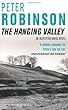
  4. The Hanging Valley by Peter Robinson 3/5 (from TBR books)
  5. The Village by Marghanita Laski 5/5 (borrowed from a friend)
  6. Daphne du Maurier: a Daughter’s Memoir by Flavia Leng (library book) 3.5/5
  7. Ninepins by Rosy Thornton (author review copy) 4.5/5
  8. A Place of Greater Safety by Hilary Mantel 4/5 (post to follow)

So, going off my ratings (which are purely subjective) my pick of the month is The Village by Marghanita Laski, with Ninepins by Rosy Thornton a close second.

Kerrie at Mysteries in Paradise is hosting the Crime Fiction Pick of the Month. My crime fiction reading this month has been less than usual, with just two books:

The Murder on the Links by Agatha Christie and The Hanging Valley by Peter Robinson

and I’ve rated them both 3/5 – so a dead heat.

Book Beginnings

Some books sit unread on my bookshelves for quite a long time before I read them. Then when I do pick them up I wonder why on earth I’ve left them so long – they look so good.

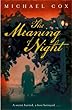
The Meaning of Night by Michael Cox is one of these many unread books of mine. I am shocked to see from my LibraryThing catalogue that I’ve had this book since August 2007, not long after I started writing this blog – no doubt I’d read about it on another book blog.

It begins:

After killing the red-haired man, I took myself off to Quinn’s for an oyster supper.

It had been surprisingly – almost laughably – easy.

The first chapter is called Exordium and a footnote explains that this means ‘an introduction to a treatise or discourse’. A second footnote tells me that ‘Quinn’s’ is a shell fishmonger and supper house at 40, Haymarket. So, not only is this a dramatic opening the first few lines tell me this is an historical murder mystery set in London, most likely to be in the Victorian period, all of which makes me want to read on.

Reading the back cover it seems that this book is following on in the tradition of Wilkie Collins and Charles Dickens, described as a ‘tale of obsession, love and revenge, played out amid London’s swirling smog’, an ‘extraordinary story of Edward Glyver, book lover, scholar and murderer.’

I think one of the reasons I haven’t read it before now is that not only is it nearly 600 pages long, my copy is printed in a small font!

Book Beginnings ButtonSee more Book Beginnings on Friday at Gilion’s blog Rose City Reader.


The Hanging Valley by Peter Robinson: a Book Review

There are 20 books in Peter Robinson’s Inspector Banks series (listed at Fantastic Fiction). I’ve read a few of them, completely out of order, but it doesn’t seem to matter too much as each one stands alone, although I suspect I’d get a better idea of Banks’s personal life if I had read them in order!

The Hanging Valley is the fourth one in the series.

Synopsis (from the back cover):

A faceless corpse is discovered in a tranquil, hidden valley below the village of Swainshead. And when Chief Inspector Alan Banks arrives, he finds that no-one is willing to talk. Banks’s frustration only grows when the identity of the body is revealed. For it seems that his latest case may be connected with an unsolved murder in the same area five years ago. Among the silent suspects are the Collier brothers, the wealthiest and most powerful family in Swainsdale. When they start use their influence to slow down the investigation, Inspector Alan Banks finds himself in a race against time…

My view:

As well as the Collier brothers, there are other suspects, including John Fletcher, a taciturn farmer, Sam Greenock and his wife Katy who own the local Bed and Breakfast guest house. There’s something not quite right about Katy, she’s obviously troubled and hiding something, and she is dominated by Sam. As I read on I thought the killer was first one character, then another and never really worked out who it was until quite near the end. I enjoyed the puzzle.

Detective Chief Inspector Alan Banks had been transferred to Eastvale from London two years earlier and is still getting to know the area. He’d moved from London because of the sheer pressure of the job and the growing confrontation between the police and citizens in the capital had got him down. Crime in Eastvale had been slack until this murder happened. And it’s complicated, the locals close ranks and Banks has to work hard to get information, first of all to discover who the victim was and why he had been killed. The trail leads him abroad to Toronto before Banks discovers the truth.

The Hanging Valley is rich in description, both of the Yorkshire Dales and of Toronto. (Peter Robinson was born in Yorkshire and now lives in Toronto.) The hanging valley sounds a beautiful spot, a small, secluded wooded valley with unusual foliage:

… the ash , alders and sycamores … seemed tinged with russet, orange and earth brown. It seemed … like a valley out of Tolkien’s ‘Lord of the Rings’.

… the valley clearly had a magical quality. It was more luxuriant than the surrounding area, its ferns and shrubs more lush and abundant, as if, Neil thought, God had blessed it with a special grace. (page 5)

All of which makes the discovery of the corpse so shocking, with its flesh literally crawling. So, I enjoyed this book on two levels – the mystery and the writing itself. I did think, though, that it could have been shorter and more concise, and some of the characters were rather indistinguishable which is why I rated it 3/5.

  • Paperback: 324 pages
  • Publisher: Pan; New edition (8 Nov 2002)
  • Language English
  • ISBN-10: 0330491644
  • ISBN-13: 978-0330491648
  • Source: I bought it

Wondrous Words

Reading Agatha Christie’s books I often come across words or phrases that I’m either not sure what they mean but can get the gist of the meaning from the context, or have never come across before.

I found an example of each type whilst reading The Murder on the Links, an early Poirot mystery first published in 1923:

Traps as in this sentence: ‘I had made a somewhat hurried departure from the hotel and was busy assuring myself that I had duly collected all my traps, when the train started.(page 5)

Captain Hastings is the narrator and is returning to London on the Calais train, so I thought he couldn’t be taking animal traps with him on the train and it was more likely to be his luggage. According to the Chambers Dictionary that is the meaning of the word: ‘personal luggage or belongings’. 

I didn’t know what the Bertillon system was. Poirot referred to it when talking about the lack of fingerprints on the murder weapon and remarked that ‘The veriest amateur of an English Mees knows it – thanks to the publicity the Bertillon system has been given in Paris.’ (page 35)

The Bertillon system is described in Wikipedia in the article on Anthropometry. Simple put it is a system for identifying criminals based on a series of their physical measurements introduced by Alphonse Bertillon in 1883. In 1894 England had adopted the system and had added the partial use of fingerprints. By 1900 England relied on finger prints alone.

(Click on the image to enlarge)

Wondrous Words Wednesday is hosted by Kathy at Bermuda Onion.