Crime Fiction Alphabet: Letter R

This week I’ve chosen Peter Robinson‘s Bad Boy to illustrate the letter R in Kerrie’s Crime Fiction Alphabet.

Bad Boy is Peter Robinson’s 19th book in his Inspector Banks series, but I don’t think you have to have read the previous 18 because it functions OK as a stand-alone, as quite a lot of the back-story is included.
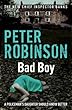
Description from the back cover:

Banks isn’t back, and that’s the problem.

If DCI Alan Banks had been in his office when his old neighbour came calling, perhaps it would have turned out differently.

Perhaps an innocent man would still be alive.

And perhaps Banks’s daughter wouldn’t be on the run with a wanted man.

But Banks is on holiday, blissfully unaware of the terrible chain of events set in motion by the discovery of a loaded gun in a young woman’s bedroom, and his daughter’s involvement with the ultimate bad boy . . .

My thoughts:

There’s not much more for me to write about this book. I didn’t think it was as interesting as the earlier ones of his that I’ve read. For one thing there’s not much of a mystery for Banks to solve and for another I didn’t like the graphic descriptions of violence it contains. It’s a police procedural to a certain extent, except of course, that Banks doesn’t actually always follow the set procedures.

Banks does come back from his holiday, down to earth with a vengeance as he sets out to rescue Tracy, his daughter from the wanted man, Jaff, the ‘bad boy’.

DI Annie Cabot obligingly gives a definition of a ‘bad boy’:

A bad boy is unreliable, and sometimes he doesn’t show up at all, or if he does, he’s late and moody, he acts mean to you and he leaves early. He always has another fire in the iron, somewhere else to be. But always while you’re waiting for him you can’t really concentrate on anything else, and you have at least one eye on the door in case he’s the next one to walk in the room, even though you might be seeing someone else, and when you’re with him your heart starts to beat a little faster and your breath catches in your chest. (page 163)

As for Banks, there are some interesting insights into his personality. He realises that he is ‘a stranger‘ to happiness, and that he has a restless nature which precluded happiness. If he wasn’t restless he either felt a vague sadness which was occasionally punctured with anger or irritation. He also realises that he hadn’t been a good parent, but he had felt inadequate and awkward with Tracy as she was growing up, not knowing how to communicate with her.

But, Banks is on the side of law and order, despite not always sticking to procedure:

If there was one part of the job Banks hated more than any other, it was that feeling of impotence and ineffectiveness he often felt by having dedicating himself to upholding the law, following the rules. He cut corners from time to time, like everyone, had occasionally acted rashly and even, perhaps, illegally, but on the whole, he was on the side of the virtuous and the good. (page 322)

And are there hints at the end about Banks’s future? He says he is ‘getting a bit tired of it all, to be honest.’ Do I sense that Peter Robinson is getting a bit tired of Banks too?

  • Paperback: 448 pages
  • Publisher: Hodder Paperbacks; 1st edition (28 April 2011)
  • Language: English
  • ISBN-10: 0340836970
  • ISBN-13: 978-0340836972
  • Source: Library book
  • My Rating: 3/5

Crime Fiction Alphabet: Q

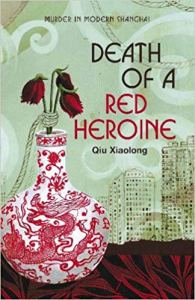
For the letter Q in Kerrie’s Crime Fiction Alphabet I’ve chosen Death of a Red Heroine by Qiu Xiaolong.

Death of a red heroineQX

I  ‘discovered’ Qiu Xiaolong in 2010 during a previous series of the Crime Fiction Alphabet when I wrote about his second book, A Loyal Character Dancer. Death of Red Heroine is his first book featuring Chief Inspector Chen. It won the Anthony Award for Best First Crime Novel in 2001.

Synopsis from the back cover

Shanghai in 1990. An ancient city in a Communist country: looking to the future for its survival. Chief Inspector Chen, a poet with a sound instinct for self-preservation, knows the city like few others. 

When the body of a prominent Communist Party member is found, Chen is told to keep the party authorities informed about every lead. And he must keep the young woman’s murder out of the papers at all costs. When his investigation leads him to the decadent offspring of high-ranking officials, he finds himself instantly removed from the case and reassigned to another area.

Chen has a choice: bend to the party’s wishes and sacrifice his morals, or continue his investigation and risk dismissal from his job and from the party. Or worse . . .

My thoughts:

I think this is as much historical fiction as it is crime fiction. There is so much in it about China, its culture and its history before 1990 – the Communist regime and then the Cultural Revolution in the 1960s – as well as the changes brought about in the 1990s after the massacre of Tiananmen Square. This does interfere with the progress of the murder investigation as Chen has to cope with the political ramifications and consequently there are several digressions and the pace is slow and lacking tension. As Chen is a poet as well as a policeman there are also references to Chinese literature which although interesting, don’t move the murder mystery forward. A fair amount of concentration is needed both to understand the background and work out the plot.

Chen is a reluctant policeman, he has a degree in  English literature and is a published poet and translator. However, he is a good detective and helped by Detective Yu begins to unravel the mystery. Having found a suspect it is really the motive that provides a stumbling block, that and the constant need to keep in mind the ‘interests of the Party’ that prevents a quick resolution.

I like the characterisation, Chen and Yu in particular are clearly drawn, distinctive characters, and the setting is superb. I also like the many descriptions of food (as there are in A Loyal Character Dancer), such as this dinner menu Chen lays on for a party in his new apartment:

For the main dishes, there were chunks of pork stomach on a bed of green napa, thin slices of smoked carp spread on fragile leaves of jicai, and steamed peeled shrimp with tomato sauce. There was also a plate of eels with scallions and ginger, which he had ordered from a restaurant. He had opened a can of Meiling steamed pork and added some green vegetables to make it another dish. On the side, he placed a small dish of sliced tomatoes, and another of cucumbers. When the guests arrived, a soup would be made from the juice of the canned pork and canned pickle. (page 12)

It’s a fascinating book on several levels and one I enjoyed reading. I’m a bit late catching up with reading Qiu Xiaolong’s books as there are now seven Inspector Chen books:

1. Death of a Red Heroine (2000)
2. A Loyal Character Dancer (2002)
3. When Red Is Black (2004)
4. A Case of Two Cities (2006)
5. Red Mandarin Dress (2007)
6. The Mao Case (2009)
7. Don’t Cry, Tai Lake (2012)

August’s Books and Crime Fiction Pick of the Month

Most of my reading time in August was taken with reading Charles Dickens’s Our Mutual Friend, but I did read 7 other books too, all 7 of them crime fiction, although you could consider Our Mutual Friend as a type of crime fiction too. They are (in the order I finished reading them):

  1.  Lord Edgware Dies by Agatha Christie
  2. Started Early, Took my Dog by Kate Atkinson
  3. Postern of Fate by Agatha Christie
  4. Guilty Consciences a collection of short stories edited by Martin Edwards
  5. A Room Full of Bones by Elly Griffiths – post to follow
  6. The Girl on the Stairs by Louise Welsh
  7. Our Mutual Friend by Charles Dickens
  8. The Old Man in the Corner by Baroness Orczy

The links are to my posts on the books.

My Crime Fiction Pick of the Month is The Girl on the Stairs by Louise Welsh. Actually with the exception of Postern of Fate and The Old Man in the Corner it’s a close call between the other books.

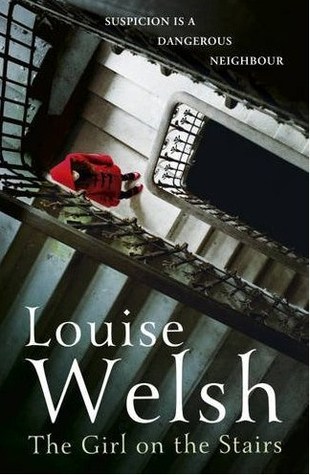
The Girl on the Stairs is Louise Welsh’s latest book. It’s a tense psychological thriller about Jane, who is pregnant and living in Berlin, suspicious about her neighbours, as she hears screams from the next apartment, sees shadows on the stairs and feels she is being watched. Are her suspicions justified or is she paranoid? Read more …

Kerrie has a round-up post of bloggers’ book choices for the month, so for more recommendations, go to Mysteries in Paradise.

Crime Fiction Alphabet: Letter P

It’s the letter P this week in Kerrie’s Crime Fiction Alphabet and I have another of Agatha Christie’s books to illustrate the letter.

If you haven’t read any of Agatha Christie’s books don’t begin with Postern of Fate. It’s the last novel she wrote, published in 1973, and it’s rambling and repetitive, with very little in the way of mystery. It’s the fourth of the Tommy and Tuppence Beresford mysteries and it begins with the ageing couple, now retired and living in a new home. I read it because I like Tommy and Tuppence and wanted to know what they were doing in this final book.

I liked the opening pages in which Tuppence is bemoaning the fact that they have so many books and there isn’t enough room to shelve them. They’d sorted out their books before they moved house, only bringing with them the ones they couldn’t bear to part with, but they had bought books from the previous owners of the house. Tuppence is sorting through them and in Robert Louis Stevenson’s The Black Arrow she sees that some of the letters are underlined in red ink, spelling out an intriguing message: ‘Mary Jordan did not die naturally. It was one of us. I think I know which one.’

Naturally the Beresfords have to find out more and after talking to some of the local people Tuppence discovers that Mary Jordan had lived in the house during the First World War and there are rumours that she was a German secret agent. It appeared she had died from accidental poisoning. But they aren’t satisfied and want to know more. Whilst Tuppence continues talking to the locals, Tommy goes to London and talks to Captain Pikeaway, ex-head of Special Branch and the enigmatic Mr Robinson (who appeared in Agatha Christie’s thriller Passenger to Frankfurt). They discover some facts, and have lots of meandering discussions, but the denouement is very vague (at least I found it so).

Its interest for me lies in what the book reveals about Agatha Christie. Clearly she is remembering her own childhood when Tuppence is reminiscing about the books she had read as a child, listing them and exclaiming how much she liked them – books such as The New Treasure Seekers, lots of Stanley Weyman books (he wrote historical romances), The Prisoner of Zenda, Treasure Island and Kidnapped.

Throughout her life she was an avid reader and her books include many references to a variety of sources from Shakespeare to T S Eliot. The title of this book derives from a poem Gates of Damascus by John Elroy Flecker, quoted as an epigraph and by Tommy as he worries about keeping Tuppence out of danger:

Four great gates has the city of Damascus …

Postern of Fate, the Desert Gate, Disaster’s Cavern, Fort of Fear …

Pass not beneath, O Caravan, or pass not singing.

Have you heard

That silence where the birds are dead, yet something pipeth like a bird?

I think when Tommy and Tuppence are complaining about the difficulties of getting tradesmen to complete work on their new house Agatha Christie was writing from experience:

Electricians arriving in a kindly tangle of optimism and efficiency had stated work. “Coming along fine now, not much more to do,” they said. “We’ll be back this afternoon.” But they hadn’t been back that afternoon. Tommy was not precisely surprised. He was used, now, to that general pattern of labour in the building trade, electrical trade, gas employees and others. They came, they showed efficiency, they made optimistic remarks, they went away to fetch something. They didn’t come back. One rang up numbers on the telephone but they always seemed to be the wrong numbers. If they were the right numbers, the right man was not working at this particular branch of the trade, whatever it was. (pages 35-36)

Then there are her misgivings about the state of the country:

England was in a funny state, a different state from what it had been. Or was it really always in the same state? Always underneath the smooth surface there was some black mud. There wasn’t clear water down to the pebbles, down to the shells, lying on the bottom of the sea. There was something moving, something sluggish somewhere, something that had to be found, suppressed. (page 138)

But there is rather too much of this sort of digression in Postern of Fate and Agatha Christie comes across as disillusioned with modern life. Here, for example, she has Colonel Pikeaway complaining about the worship of money:

…big fortunes made out of drugs, drug pushers, drugs being sent all over the world, being marketed, a worship of money. Money not just for buying yourself a big house and two Rolls Royces, but money for making more money and doing down, doing away with the old beliefs. Beliefs in honesty, in fair trading. (page 249)

Although there are things I like in this book and I am glad I’ve read it, I think it must be my least favourite of Agatha Christie’s books that I’ve read.

The Girl on the Stairs by Louise Welsh: a Book Review

The Girl on the Stairs

The Girl on the Stairs is Louise Welsh’s latest book. It’s a book that once I started reading it I just had to finish it. It’s full of suspense and increasing tension as Jane moves to an apartment in Berlin to join her partner, Petra. Everything is new to her, she only speaks a little German, she doesn’t know the area and has no friends there. And she’s pregnant.

It begins slowly and calmly, with Jane alone in the flat. Whilst Petra is out at work, she explores the neighbourhood, the streets, the church and the forbidding, derelict building (the backhouse) that overlooks their apartment building at the back.

She meets some of the other residents of the apartment building, their neighbour Dr Mann and his daughter Anna – the girl on the stairs. She hears them arguing and fears Dr Mann is abusing Anna. She ventures out at 3.00am one dark morning drawn by a flickering light in the backhouse, worried that Anna was hiding in there:

Jane looked up towards the looming bulk of the backhouse, hearing the sound of her own breath, shallow and uneven. the light was gone from the window. This was her cue to turn back, but she stepped on, into the dimness of the courtyard, tensing against the cold and the sensation of unseen eyes. The backhouse door gaped; beyond it, nothing but blackness. (page 55)

Then there are the Beckers, who live in the ground-floor flat. Heike Becker is suffering from dementia and insists that Dr Mann had killed his wife and buried her beneath the floorboards in the backhouse.

Jane’s suspicions about her neighbours grow, and her sense of isolation mounts when Petra has to go to Vienna for a week for her work. The book is narrated by Jane, which means that there is only Jane’s perspective on events and as more secrets are revealed I began to wonder just how paranoid Jane was and how much was down to her imagination. Jane tries to befriend Anna, who regards her with suspicion and contempt – are Jane’s fears justified or is she delusional? The uncertainties and ambiguities kept me guessing to the end.

The Girl on the Stairs is a dark, psychological thriller, full of atmosphere and claustrophobic tension. I really enjoyed it.

  • Hardcover: 288 pages
  • Publisher: John Murray (2 Aug 2012)
  • Language: English
  • ISBN-10: 1848546483
  • ISBN-13: 978-1848546486
  • Source: Review copy from the publishers
  • My rating: 4.5/5

Started Early, Took My Dog by Kate Atkinson: Book Notes

Started Early, Took My Dog by Kate Atkinson is the fourth book featuring Jackson Brodie and one in which he doesn’t have a major role. It’s a complex book with several plots and sub-plots. The narrative moves between the past and the present day – sometimes not too clearly and is told from various characters’ perspective.

Jackson Brodie is working for Hope McMaster, who was adopted as a very young child in the 1970s and wants to find out about her birth family. Tracy Waterhouse, an ex-police officer is working as a security post in a shopping centre and can’t forget about a particular murder that had happened when she was a young detective. Detective Superintendent Barry Crawford,Tracy’s ex-colleague, with now just two weeks to go before retirement is also haunted by past events. Tilly is an elderly actress, suffering from the early stages of dementia. Add in to this mix a small child, Courtney and a little dog, called The Ambassador.

The book begins slowly and gradually builds to a tremendous pace. Brodie’s past keeps surfacing as he travels around in his search for Hope’s family roots, staying at Travel Lodges at Premier Inns, and in Bed and Breakfasts. He’s tired:

And truth be told he was tired of his vagrant life. He wanted a home. He would like a woman in that home. Not all the time, he had grown too used to his own company. (page 103)

There’s a lot in this novel about grief and loss, parenthood and responsibility and it paints a grim picture. The characters are well-drawn – the ex-copTracy, the child Courtney and the actress Tilly stand out in my mind as memorable characters, not forgetting The Ambassador, a small scruffy dog, who is ‘big inside‘.

It’s very much a book about consequences, full of regrets and lost opportunities as it moves, seemingly without reason from one character to another and from the past to the present. It’s a book you have to read with thought and concentration. I think It would benefit from re-reading, but my copy is a library book, due back today. Maybe I’ll re-read it one day.

  • Paperback: 496 pages
  • Publisher: Black Swan (17 Feb 2011)
  • Language: English
  • ISBN-10: 0552772461
  • ISBN-13: 978-0552772464
  • Source:  library book
  • My Rating: 4/5