Crime Fiction Alphabet: Q

For the letter Q in Kerrie’s Crime Fiction Alphabet I’ve chosen Death of a Red Heroine by Qiu Xiaolong.
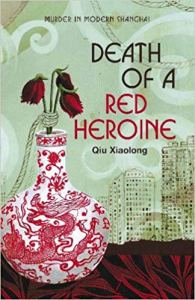
Death of a red heroineQX

I  ‘discovered’ Qiu Xiaolong in 2010 during a previous series of the Crime Fiction Alphabet when I wrote about his second book, A Loyal Character Dancer. Death of Red Heroine is his first book featuring Chief Inspector Chen. It won the Anthony Award for Best First Crime Novel in 2001.

Synopsis from the back cover

Shanghai in 1990. An ancient city in a Communist country: looking to the future for its survival. Chief Inspector Chen, a poet with a sound instinct for self-preservation, knows the city like few others. 

When the body of a prominent Communist Party member is found, Chen is told to keep the party authorities informed about every lead. And he must keep the young woman’s murder out of the papers at all costs. When his investigation leads him to the decadent offspring of high-ranking officials, he finds himself instantly removed from the case and reassigned to another area.

Chen has a choice: bend to the party’s wishes and sacrifice his morals, or continue his investigation and risk dismissal from his job and from the party. Or worse . . .

My thoughts:

I think this is as much historical fiction as it is crime fiction. There is so much in it about China, its culture and its history before 1990 – the Communist regime and then the Cultural Revolution in the 1960s – as well as the changes brought about in the 1990s after the massacre of Tiananmen Square. This does interfere with the progress of the murder investigation as Chen has to cope with the political ramifications and consequently there are several digressions and the pace is slow and lacking tension. As Chen is a poet as well as a policeman there are also references to Chinese literature which although interesting, don’t move the murder mystery forward. A fair amount of concentration is needed both to understand the background and work out the plot.

Chen is a reluctant policeman, he has a degree in  English literature and is a published poet and translator. However, he is a good detective and helped by Detective Yu begins to unravel the mystery. Having found a suspect it is really the motive that provides a stumbling block, that and the constant need to keep in mind the ‘interests of the Party’ that prevents a quick resolution.

I like the characterisation, Chen and Yu in particular are clearly drawn, distinctive characters, and the setting is superb. I also like the many descriptions of food (as there are in A Loyal Character Dancer), such as this dinner menu Chen lays on for a party in his new apartment:

For the main dishes, there were chunks of pork stomach on a bed of green napa, thin slices of smoked carp spread on fragile leaves of jicai, and steamed peeled shrimp with tomato sauce. There was also a plate of eels with scallions and ginger, which he had ordered from a restaurant. He had opened a can of Meiling steamed pork and added some green vegetables to make it another dish. On the side, he placed a small dish of sliced tomatoes, and another of cucumbers. When the guests arrived, a soup would be made from the juice of the canned pork and canned pickle. (page 12)

It’s a fascinating book on several levels and one I enjoyed reading. I’m a bit late catching up with reading Qiu Xiaolong’s books as there are now seven Inspector Chen books:

1. Death of a Red Heroine (2000)
2. A Loyal Character Dancer (2002)
3. When Red Is Black (2004)
4. A Case of Two Cities (2006)
5. Red Mandarin Dress (2007)
6. The Mao Case (2009)
7. Don’t Cry, Tai Lake (2012)

Crime Fiction Alphabet: Letter P

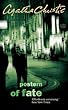
It’s the letter P this week in Kerrie’s Crime Fiction Alphabet and I have another of Agatha Christie’s books to illustrate the letter.

If you haven’t read any of Agatha Christie’s books don’t begin with Postern of Fate. It’s the last novel she wrote, published in 1973, and it’s rambling and repetitive, with very little in the way of mystery. It’s the fourth of the Tommy and Tuppence Beresford mysteries and it begins with the ageing couple, now retired and living in a new home. I read it because I like Tommy and Tuppence and wanted to know what they were doing in this final book.

I liked the opening pages in which Tuppence is bemoaning the fact that they have so many books and there isn’t enough room to shelve them. They’d sorted out their books before they moved house, only bringing with them the ones they couldn’t bear to part with, but they had bought books from the previous owners of the house. Tuppence is sorting through them and in Robert Louis Stevenson’s The Black Arrow she sees that some of the letters are underlined in red ink, spelling out an intriguing message: ‘Mary Jordan did not die naturally. It was one of us. I think I know which one.’

Naturally the Beresfords have to find out more and after talking to some of the local people Tuppence discovers that Mary Jordan had lived in the house during the First World War and there are rumours that she was a German secret agent. It appeared she had died from accidental poisoning. But they aren’t satisfied and want to know more. Whilst Tuppence continues talking to the locals, Tommy goes to London and talks to Captain Pikeaway, ex-head of Special Branch and the enigmatic Mr Robinson (who appeared in Agatha Christie’s thriller Passenger to Frankfurt). They discover some facts, and have lots of meandering discussions, but the denouement is very vague (at least I found it so).

Its interest for me lies in what the book reveals about Agatha Christie. Clearly she is remembering her own childhood when Tuppence is reminiscing about the books she had read as a child, listing them and exclaiming how much she liked them – books such as The New Treasure Seekers, lots of Stanley Weyman books (he wrote historical romances), The Prisoner of Zenda, Treasure Island and Kidnapped.

Throughout her life she was an avid reader and her books include many references to a variety of sources from Shakespeare to T S Eliot. The title of this book derives from a poem Gates of Damascus by John Elroy Flecker, quoted as an epigraph and by Tommy as he worries about keeping Tuppence out of danger:

Four great gates has the city of Damascus …

Postern of Fate, the Desert Gate, Disaster’s Cavern, Fort of Fear …

Pass not beneath, O Caravan, or pass not singing.

Have you heard

That silence where the birds are dead, yet something pipeth like a bird?

I think when Tommy and Tuppence are complaining about the difficulties of getting tradesmen to complete work on their new house Agatha Christie was writing from experience:

Electricians arriving in a kindly tangle of optimism and efficiency had stated work. “Coming along fine now, not much more to do,” they said. “We’ll be back this afternoon.” But they hadn’t been back that afternoon. Tommy was not precisely surprised. He was used, now, to that general pattern of labour in the building trade, electrical trade, gas employees and others. They came, they showed efficiency, they made optimistic remarks, they went away to fetch something. They didn’t come back. One rang up numbers on the telephone but they always seemed to be the wrong numbers. If they were the right numbers, the right man was not working at this particular branch of the trade, whatever it was. (pages 35-36)

Then there are her misgivings about the state of the country:

England was in a funny state, a different state from what it had been. Or was it really always in the same state? Always underneath the smooth surface there was some black mud. There wasn’t clear water down to the pebbles, down to the shells, lying on the bottom of the sea. There was something moving, something sluggish somewhere, something that had to be found, suppressed. (page 138)

But there is rather too much of this sort of digression in Postern of Fate and Agatha Christie comes across as disillusioned with modern life. Here, for example, she has Colonel Pikeaway complaining about the worship of money:

…big fortunes made out of drugs, drug pushers, drugs being sent all over the world, being marketed, a worship of money. Money not just for buying yourself a big house and two Rolls Royces, but money for making more money and doing down, doing away with the old beliefs. Beliefs in honesty, in fair trading. (page 249)

Although there are things I like in this book and I am glad I’ve read it, I think it must be my least favourite of Agatha Christie’s books that I’ve read.

Crime Fiction Alphabet: Letter O

Kerrie’s Crime Fiction Alphabet has reached the letter O.

I was surprised quite recently to discover that Baroness Orczy had not only written books about the Scarlet Pimpernel, but had also written crime fiction.

Emmuska Orczy (1865 – 1947) was born in Hungary and she and her family moved to London in 1880, where she went to the West London School of Art and then Heatherley’s School of Fine Art.  Several of her paintings were exhibited at the Royal Academy. She married Montague MacLean Barstow in 1894 and encouraged by him, she began writing in 1900. As well as the Scarlet Pimpernel stories she wrote mysteries for the Royal Magazine and Cassell’s Magazine. She created one of the earliest female detectives in a collection of short stories about Molly Robertson-Kirk – Lady Molly of Scotland Yard in 1910.

The Old Man in the Corner
The Old Man in the Corner, Greening & Co. 1910, Design by H. M. Brock. From Flickr

Her book of short stories, The Old Man in the Corner features one of the earliest armchair detectives. It was first published in 1909, although she had written the stories before that and published them in magazines. The ‘Old Man’ sits in the corner of an A. B. C. (Aerated Bread Company) tearoom and relates the mysteries to Polly Burton of the Evening Observer. She was amused by his appearance:

Polly thought to herself that she had never seen anyone so pale  so thin, with such funny light-coloured hair, brushed very smoothly across the top of a very obviously bald crown. He looked so timid and nervous as he fidgeted incessantly with a piece of string; his long, lean and trembling fingers tying and untying it into knots of wonderful and complicated proportions. (Location 47 of 2760)

Tying knots in a piece of string seems to be essential to his deductive powers, for as he unravels the knots so he solves the mysteries. His philosophy is:

There is no such thing as a mystery in connection with any crime, provided intelligence is brought to bear upon its investigation.  (Location 29)

Very like Hercule Poirot, I thought, but the resemblance ends there. The Old Man’s sympathies are with the criminal rather than the police; he solves the mysteries just for the love of doing it, to discover the motive and method. He doesn’t pass his information onto the police and in most of the cases there is still an element of doubt.

The mysteries included in The Old Man in the Corner are:

The Fenchurch Street Mystery
The Robbery in Phillimore Terrace
The York Mystery
The Mysterious Death on the Underground Railway
The Liverpool Mystery
The Edinburgh Mystery
The Theft at the English Provident Bank
The Dublin Mystery
An Unparalleled Outrage (The Brighton Mystery)
The Regent’s Park Murder
The De Genneville Peerage (The Birmingham Mystery)
The Mysterious Death in Percy Street

They seem to be the most baffling cases that the police had been unable to solve, involving murder, blackmail, forgeries and puzzling crimes. I enjoyed reading them, although they don’t overtax the brain.

  • Format: Kindle Edition
  • File Size: 302 KB
  • Print Length: 186 pages
  • Sold by: Amazon Media EU S.à r.l.
  • Language: English
  • ASIN: B0084BMM6W
  • Source: my own copy
  • My Rating 3/5


Crime Fiction Alphabet: N is for …

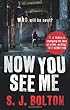
 … Now You See Me by S J Bolton

I’ve enjoyed S J Bolton’s earlier books, but I hesitated several times before deciding to read Now You See Me, because it begins with such a brutal killing. I’d read the opening pages on Amazon using the ‘Click to Look Inside‘ feature and didn’t like it. I usually steer clear of books with such graphic descriptions of murder, but I knew that I liked S J Bolton’s writing and that others had given it good reviews, so eventually I read further on.

I’m glad I did because, despite the brutal murders, it is compelling reading, with a complex plot and convincing characters.

Summary from S J Bolton’s website:

Despite her life-long fascination with Jack the Ripper, young detective constable Lacey Flint has never worked a murder case or seen a corpse up close. Until now ‘¦

As she arrives at her car one evening, Lacey is horrified to find a woman slumped over the door. She has been brutally stabbed, and dies in Lacey’s arms.

Thrown headlong into her first murder hunt, Lacey will stop at nothing to find this savage killer. But her big case will also be the start of a very personal nightmare.

When Lacey receives a familiar letter, written in blood, pre-fixed Dear Boss, and hand delivered, it is clear that a Ripper copycat is at large. And one who is fixated on Lacey herself. Can this inexperienced detective outwit a killer whose infamous role model has never been found?

I don’t have a fascination with Jack the Ripper and began to be a bit  weary about the copycat nature of the killings, but then the scenario changed and it became clear that there was more to the killings than just copying the Ripper. It’s narrated by Lacey, a strong character, one who thinks for herself, is a loner, and is not content to merely follow police procedure. But I didn’t warm to her until near the end of the book. She knows more than she is letting on to her fellow police officers and I was very suspicious of her motives and conscious that she was not a reliable narrator.

S J Bolton is very skilled in leading the reader up the garden path, providing plenty of hints that could be significant or be dead ends. This book (like her others) is fast-paced, full of suspense and tension, with a chilling and dramatic ending.

  • Paperback: 512 pages
  • Publisher: Corgi (26 April 2012)
  • Language: English
  • ISBN-10: 0552159816
  • ISBN-13: 978-0552159814
  • Source: My own copy
  • My Rating: 3.5/5

For more Crime Fiction Alphabet posts see Kerrie’s blog Mysteries in Paradise. The posts must be related to either the first letter of a book’s title, the first letter of an author’s first name, or the first letter of the author’s surname, or even maybe a crime fiction “topic”. But above all, it has to be crime fiction.

Crime Fiction Alphabet: M is for …

… M R Hall

Biography summarised from M R Hall’s website:

Matthew Hall was born in London in 1967, he was educated at Hereford Cathedral School and Worcester College, Oxford,where he graduated in law. He lives and works in the Wye valley in South Wales. He spends much of his spare time looking after his sixteen acres of woodland and working for the conservation of the countryside.

After working as a barrister, mostly in the field of criminal law he then went on to become a screen writer and producer, including writing episodes of such dramas as  Kavanagh QC starring John Thaw and Dalziel and Pascoe. His first season of writing the Channel 5 series, Wing And A Prayer earned him a BAFTA nomination in the best series category.

Novels:

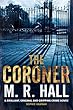
I’ve read his debut novel, The Coroner, which was published in 2009 and was nominated for the Crime Writer’s Association Gold Dagger in the best novel category. In this book Jenny Cooper, a newly appointed Coroner, divorced, and recovering from a nervous breakdown gets involved in investigating the deaths of several teenagers at local detention centres. Has her predecessor neglected some crucial information in this area? As Jenny digs deeper, she encounters a solid wall of bureaucratic resistance. But Jenny just won’t give in until she gets to the truth.

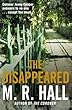
The second novel in the Jenny Cooper series, The Disappeared, was published in the USA by Simon and Schuster on December 1st 2009 and in the UK by Pan Macmillan in January 2010. I’ve yet to read this book in which Jenny investigates the disappearance of a British student, Nazim Jamal. She is beginning to settle into her role as Coroner for the Severn Valley. But as the inquest gets under way, a code of silence is imposed on the inquest and events begin to spiral out of all control, pushing Jenny to breaking point.

I thoroughly enjoyed the third novel in the same series, The Redeemed, which was published in April 2011 in the UK and May 2011 in the USA. With an accusation of murder hanging over Jenny’s head her lone quest for justice takes her to the heart of the fight between good and evil, sex and the supernatural, and on a dark inner journey to confront ghosts that have haunted her for a lifetime.

The fourth in the series, The Flight was published in the UK on 2 February 2012. I’ve recently read this one and have to say that I don’t think it’s as good as the other two I’ve read.

Flight 189 has plunged into the Severn Estuary, an area outside Jenny Cooper’s jurisdiction, but she is handling the cases of a sailor, washed up on her side of the river and that of a 10 year old girl, who was a passenger on the flight. Jenny is never one to back away from handling sensitive issues and when the authorities want her cases to be dealt with by Sir James Kendall, a recently retired High Court judge,the coroner for the inquest into the crash, she resists and insists she carries out her own investigations. Each time they try to halt her inquest she finds ways of carrying on.

My problem with this book wasn’t Jenny’s role.  I like the way Jenny perseveres, her sympathies for the bereaved parents, her own fragile psychological make-up and how she deals with her problems with her father. These elements are in the other books too, but in The Flight I thought they were overwhelmed by all the technical details of the aircraft and how it came to crash. I prefer the smaller scale inquests, rather than this ‘disaster film’ genre – but, I think, it would make a good disaster film.

If you’re nervous about flying, (which I’m not, although I did feel glad I’m not booked on a flight soon as I was reading it) it is definitely a scary book, even though M R Hall in his Author’s Note at the end of the book says this about the safety of flying:

Next time you fly – or perhaps you are in a plane right now? – remember that a short drive through town remains statistically far more dangerous than your flight by a factor of many thousands to one. The most perilous parts of your journey are the ones to and from the airport. I am reliably informed that you are precisely eighty-seven times more likely to choke on the ice cube in your gin and tonic than to perish in a crash. So sit back and enjoy the movie – the numbers say it’ll never happen to you.

Mmm – do I really find that comforting?

A Crime Fiction Alphabet post for the letter M. For more posts see Kerrie’s blog Mysteries in Paradise.

Crime Fiction Alphabet: L is for …

Lord Edgware Dies by Agatha Christie. This was first published in the UK in 1933 and later the same year in the USA as Thirteen for Dinner. It’s the eighth book featuring Hercule Poirot, narrated by Captain Hastings. Agatha Christie had written it in the autumn of 1931 at her house in Ninevah, whilst with her husband, Max Malloran on his expedition in the Middle East sponsored by the British Museum.

Lord Edgware Dies is set far from Ninevah, in London’s West End. Poirot is having supper at the Savoy with Hastings after they had been to the theatre to see the celebrated American impressionist, Carlotta Adams. At the next table is Jane Wilkinson, Lady Edgware, also a celebrated actress, who Carlotta had impersonated during her show. Jane implores Poirot to help her to ‘get rid of her husband’ – to convince him to agree to a divorce. Poirot agrees to go and see Lord Edgware. Much to Poirot’s surprise, Lord Edgware readily agrees to a divorce, but as Poirot and Hastings leave the house, Hastings is surprised to see an astonishing change in Lord Edgware’s face:

That suave smiling face was transformed. The lips were drawn back from the teeth in a snarl, the eyes were alive with fury and an almost insane rage. (page 33 0f my copy)

The next morning Lord Edgware was found dead, stabbed in the back of the neck. Jane was seen at the house the night before, but there are witnesses who can testify that she was at a dinner party with twelve other guests.  Could Jane have been in two places at once and killed him? She had boasted to her friends that if Poirot couldn’t help her that she would

‘have to call a taxi to go round and bump him off myself. (page 17)

Or was it Carlotta Adams impersonating Jane?

It’s not a simple mystery and there is a second murder which complicates matters. Poirot is at his best, relying on his knowledge of psychology, the ‘employment of the little grey cells‘, which gives him such mental pleasure. There are small personal touches such as this where Poirot compares his moustache to that of Hastings in this conversation between the two of them:

‘You have made a hit, Poirot. The fair Lady Edgware can hardly take her eyes off you.’

‘Doubtless she had been informed of my identity’, said Poirot, trying to look modest and failing.

‘I think it is the famous moustaches’, I said. ‘She is carried away by their beauty.’

Poirot caressed them surreptitiously.

‘It is true that they are unique,’ he admitted. ‘Oh, my friend, the ‘tooth-brush’ as you call it, that you wear – it is a horror – an atrocity – a wilful stunting of the bounties of nature. Abandon it, my friend, I pray of you.’ (pages 12-13)

Yet again, another baffling case solved by Hercule Poirot – a very entertaining book.

The Crime Fiction Alphabet 2012 is a meme hosted by Kerrie at Mysteries in Paradise.