Crime Fiction Alphabet: N is for Not Safe After Dark

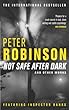
My choice this week for the Crime Fiction Alphabet meme is N for Not Safe After Dark by Peter Robinson.

This is a collection of twenty short crime stories, including three Inspector Banks stories and an Inspector Banks novella (90+ pages). The title story Not Safe after Dark is just six pages long and yet those six pages are full of tension and suspense as an unnamed man enters a park after dark, even though he knows that such big city parks are dangerous places.
Peter Robinson’s introduction is interesting for me in that he explains how he writes and compares writing a novel to writing short stories. He’s used to thinking in terms of the novel, with it’s ‘broad canvas’ and finds it hard to ‘work in miniature’. Short stories don’t come easily to him.

I carry a novel around in my head for a long time – at least a year, waking and sleeping – and this gives me time to get under the skin of the characters and the story. Also, plotting is probably the most difficult part of writing for me, and being asked to write a short story, which so often depends on a plot twist, a clever diversion or a surprising revelation, guarantees that I’ll get the laundry done and probably the ironing too.

In short stories there is no space to develop the characters or the plot, nor to give different points of view as in a novel. But, as far as I’m concerned, with the stories I’ve read so far in this book Robinson has succeeded in creating convincing stories with believable characters in real settings.

Often reading short stories I’m left wanting more, which is what happened to Robinson with one of these stories. Innocence is a haunting tale of a man accused of murduring a teenage girl. After writing Innocence, which won the Crime Writer of Canada’s Best Short Story Award in 1991, he couldn’t let the story go and went on to write a whole novel expanding on the events of the story. This eventually became Innocent Graves, featuring Inspector Banks (who is not in the short story).

The other stories include a private-eye story set in Florida, a romantic Parisian mystery, a historical story inspired by Robinson’s interest in Thomas Hardy and the place where he was born, and stories about such varied topics as American Football and Shakespeare.

Note: Peter Robinson’s website is here.
Crime Fiction Alphabet: M is for Mortal Causes

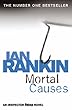
crime_fiction_alphabetThis week’s letter in the Crime Fiction Alphabet series is M and I’ve chosen Ian Rankin’s Mortal Causes, which is the one book I finished reading in December.

Mortal Causes is the sixth book in the Inspector Rebus series. In his introduction Ian Rankin explains that ‘mortal’ in the Scots vernacular means ‘drunk’ so Mortal Causes

 evoked, in his mind, the demon drink, just as surely as it did any darker and more violent imagery. (page xii)

And there is a fair amount of violence in this dark book, starting with the discovery of a brutally tortured body in Mary King’s Close, an ancient Edinburgh street now buried beneath the High Street. It’s August in Edinburgh during the Festival.

Next time I visit Edinburgh I’d like to see Mary King’s Close. It’s open to the public and according to this website you can “experience the sights, sounds and maybe even smells of an amazing street that time forgot.  Where everyday people went about their day to day lives and where you can now walk in their footsteps.” Just the place for a murder, away from the busy streets, undisturbed by the festival goers and soundproofed so no one would hear any gunshots or screams.

There are links to the Northern Ireland ‘troubles’, the IRA, the Catholic/Protestant conflict, the Secret Service and organised crime. Rebus works his way through this mix, seconded to the SCS (the Scottish Crime Squad) because he’d been in the Army and had served in Ulster in the 1960s. The relationship between Rebus and Big Ger Caffety, Edinburgh’s gangster boss, develops in this book as the victim is none other than Big Ger’s son and he insists Rebus finds his killer. He tells Rebus he wants revenge. His men

… are out there hunting, understood? And they’ll be keeping an eye on you. I want a result Strawman. … Revenge, Strawman, I’ll have it one way or the other. I’ll have it on somebody. (page 74)

Rebus’s personal life is no better, his relationship with Dr Patience Aitken is  difficult. They quarrel, she tries to civilise him, giving him poetry books and tickets for ballet and modern dance:

Rebus had been there before, other times, other women. Asking for something more, for commitment beyond the commitment.

He didn’t like it. (page 81)

Their relationship is also threatened by Rebus’s involvement with Caroline Rattray, from the Procurator Fiscal’s office, who ‘is mad about him’.

This book, like the other Rebus books I’ve read, is more than crime fiction. It’s a complex story exploring the psychology of guilt, revenge and fear.

Reading Challenges

 I’ve been thinking about reading challenges and seen that many bloggers are signing up to lots of interesting-looking challenges. I’m always attracted to them and enjoy thinking about the books I could read to complete the challenges … and then I find they become a chore. I find myself thinking “what have I got to read next for a challenge?”, not looking forward with pleasure at the thought of reading the next book. So this year I’m easing off them.

The challenges I am taking part in this year are:

  • Attacking the TBR Tome Challenge. Last year I listed 14 books as my own To-Be-Read Challenge and only read 1 of them, so for 2010 I’ll be taking part in this challenge – the books are shown on my sidebar, in the hope that this will encourage me to read them soon. The idea is to read at least 20 of your tbr books before buying any new books.
  • The Agatha Christie Reading Challenge – this fits in well with my reading as I love AC’s books.
  • Alphabet in Crime Fiction – this is now up to the letter L (which I haven’t done). The letter M next week.

Alphabet in Crime Fiction: J and K

Whilst I’ve been busy moving house Kerrie’s A-Z Crime Fiction meme has featured the letters J and K. Now that I have the computer up and working (well D actually did that for me) I’m having a little break from unpacking boxes to add to the series. I’ve written about the following books earlier in this blog and have adapted my reviews for this post.

the letter JJ is for A Judgment in Stone by Ruth Rendell.

This portrays Eunice, an illiterate woman and a psychopath who does anything to stop anyone from finding out that she can’t read or write.  Her ingenuity and resourcefulness is amazing. She blackmails people and killed her father. I found the whole premise of such a damaged person apparently functioning normally in society scary.

She is employed by the Coverdales as their housekeeper and in the interests of having their house kept clean and tidy they tried to make her comfortable. But part of the problem was that they looked on her as little more than a machine, not as a person. They meant well, wanting to make other people happy, but they were interferers and things went from bad to worse. Then Eunice met Joan, who was completely unstable, in fact she was insane. Joan is a religious fanatic, a sinner who delights in telling people of her past sins and wanting them to seek God’s forgiveness.  Their friendship ends in tragedy.

I felt helpless whilst reading this, desperately wanting the Coverdales to realise Eunice’s problems, but they were blind to the fact that Eunice was illiterate and although they tried to prevent her meeting Joan they were unaware of the danger they were in.  This inflamed Eunice and pushed her into taking the actions she did.

Although Eunice’s crime is known right from the start, that does not detract from the suspense. It actually makes it worse – you know that the murder is going to happen and as  the reasons why it happens become clear, the tension builds relentlessly.

letter Kis for King of the Streets by John Baker.

I read this over two years ago. It depicts violent murder in graphic detail, which I found hard to stomach and the subject matter of the abuse and murder of children is neither easy nor pleasant to contemplate, but it’s a quick read. This was the third book I’d read by Baker, all set in York and featuring the private detective, Sam Turner and his assistant Geordie (naive, but street-wise). Sam is investigating the murder of a blackmailer and the death of a teenage runaway, hampered by a gangster and his “minders”.

It’s well written, giving insight into the minds of both the detective and the criminal characters. I particularly liked the nickname ‘Gog’ for one of the ‘minders’, who trashes Sam’s office. Gog is, as the name suggests, a huge giant of a man, with little reasoning power, but plenty of brawn, looked after (not very successfully) by his brother, Ben. Baker also refers to Gulliver’s Travels in describing Gog as ‘Brobdingnagian’. At times I even felt sorry for Gog.

I enjoyed this book immensely, despite the violence it portrays.

Crime Fiction Alphabet: I

Continuing with the Crime Fiction Alphabet,  I is for Ian Rankin and Inspector Rebus.

Earlier this year I decided to read Rankin’s Inspector Rebus books in order, starting with the first, Knots and Crosses, published in 1987. Recently I finished the fifth – The Black Book, published in 1993. In all there are 17 in the series, so I’ve a few to go yet. I have read a couple out of sequence – Set in Darkness (2000) and The Falls (2001).

My copy of The Black Book is packed away with our belongings in storage, so this is going to be a bit brief. This is the first book in which both Big Ger Cafferty the ruthless gangster boss, organiser of crime in Edinburgh and DC Siobhan Clarke appear as main characters. DS Brian Holmes has been mugged and is in a coma in hospital, so Rebus with the help of Siobhan, is investigating his attack in the carpark of the Heartbreak Cafe.  (I liked the references to Elvis in this book, with dishes such as ‘Love Me Tenderloin”.) When Rebus finds Brian’s little black book, with his coded notes on various criminals and old cases he is drawn back to investigate the fire that five years earlier had destroyed an Edinburgh hotel leaving an unidentified dead body. His team are also running Operation Moneybags, aimed at busting Big Ger’s moneylending  business.

Rebus has plenty of personal problems in this book. His girlfriend, fed up with his unreliable hours has locked him out of her flat and his brother and ex-con Michael has turned up in Edinburgh, sleeping in the box room in Rebus’s flat. So Rebus, who has let his flat to students has to sleep on the sofa in the living room. As usual with the Rebus books there are a number of twists and turns, with different sub-plots running at the same time as the main plot.

You don’t have to read the books in order as they each stand alone, but I think it helps to see Rebus’s character as it develops. The next book in the series is Mortal Causes, and as I have kept this handy (not in storage) I’ll be reading this next.

Crime Fiction Alphabet: H is for Hercule Poirot’s Christmas

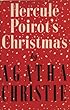
This week’s letter in the Crime Fiction Alphabet series is H for Hercule Poirot’s Christmas by Agatha Christie.

I think this is one of the best Agatha Christie crime_fiction_alphabetbooks I’ve read recently. Poirot investigates the death of Simeon Lee, the head of the Lee family. None of his family like him, in fact most of them hate him and there are plenty of suspects for his murder. He is found dead with his throat cut in a locked room – locked from the inside.
He lived with Alfred his eldest son and his daughter-in-law Lydia. Their lives are dominated by him and they agree to his every demand. He has invited his other two sons and their wives to stay for Christmas – David and Hilda and George and Madeleine. Then Simeon annouces he has invited two more guests, who happen to be another son Harry, who left home years ago, a disreputable character who is at loggerheads with Alfred, and Pilar his granddaughter, his daughter Jennifer’s child. Jennifer had recently died in Spain where she had married a Spanish artist.  Pilar quickly gains her grandfather’s favour and when he annouces he is going to remake his will she hopes she will be included. Another unexpected guest turns up – Stephen Farr, the son of Simeon’s former partner in a diamond mine in South Africa.

The mystery is just how was Simeon killed? The family are dispersed through the house and on hearing a blood curdling scream they all rush to Simeon’s room. Pilar finds a small piece of rubber and a peg on the floor – just what do they signify? And the uncut diamonds Simeon kept locked in a safe in his room have gone missing – who has stolen them?

This story kept me guessing all the way through, with lots of red herrings and Tressilian, the butler’s confusion about the identity of the guests. He is old with poor eyesight and can’t be sure who is who. Poirot who is staying nearby with Colonel Johnson, the Chief Constable, unravels the mystery with the aid of a false moustache and then gathers the family together to go through the evidence and reveal the identity of the murderer.

There are a variety of themes, including the psychological hold Simeon has over his family, the effect of heredity, the distortion of the past through holding on to obsessions, jealousy amongst the siblings, and the effect of holding grudges for many years. Lydia and Hilda are level headed women, both of them suspicious of Simeon’s motives and supporting their husbands. Lydia maintains that evil exists and Hilda believes that it is the present that matters and not the past.  But the past has cast a long and evil shadow over the present.

NB see more Christmas titles here – Suggest a Christmas Title.