Sunday Salon – This Year’s Books

It seems  a good day to look back over my reading in  the first two months of the year. I’ve read 15 books – 8 in January and 7 this month.

Titles marked * are crime fiction, underlined are non-fiction and in italics are library books. The rest are my own books acquired from various booksellers.

  1. Drood by Dan Simmons
  2. Invisible by Paul Auster
  3. Be Near Me by Andrew O’Hagan
  4. Let it Bleed by Ian Rankin *
  5. Black and Blue by Ian Rankin *
  6. Losing You by Nicci French *
  7. The Pale Horse by Agatha Christie *
  8. The Music Room by William Fiennes
  9. Can any Mother Help Me? By Jenna Bailey
  10. Fallen Gods by Quintin Jardine *
  11. The Hanging Garden by Ian Rankin *
  12. The Hollow by Agatha Christie *
  13. Not Safe After Dark & other works by Peter Robinson * (short stories)
  14. The Warrior’s Princess by Barbara Erskine
  15. Dead Souls by Ian Rankin *

Of these 15 books 9 are crime fiction, which is partly because I’m taking part in Agatha Christie Reading Challenge and also Kerrie’s Crime Fiction Alphabet series. This means writing about a book  related to the letter of the week. It can either be the first letter of a book’s title, the first letter of an author’s first name, or the first letter of the author’s surname. Tomorrow it’s the letter T and I’m currently reading The Franchise Affair by Josephine Tey. I’ve read about half the book and may finish it later today and write about it Monday or Tuesday.

I think the best of these 15 books is Black and Blue by Ian Rankin.

The only challenge I’m doing this year is Emily’s To-Be-Read challenge which is to read at least 20 books from your to-be-read piles before buying any more books. I’m doing this with the proviso that I’m actually allowing myself to buy a few books as it would be too hard otherwise.

 I’ve bought four books this year – one of them being Dead Souls by Ian Rankin. I “had” to buy this because I’m reading his Rebus books in chronological order and didn’t have this one and it was the next one to read. So far then, I’ve read 10 books off my to-be-read piles in two months – not bad!

As well as reading The Franchise Affair I’m also reading Poetic Lives: Shelley by Daniel Hahn and The Girl with the Dragon Tattoo by Stieg Larsson.

Books I’ll be reading next are:

  • Being Shelley: The Poet’s Search for Himself by Anne Wroe
  • The next Rebus book – Set in Darkness by Ian Rankin
  • Crime Fiction Alphabet: S is for C J Sansom

    For this week’s letter, S my contribution to Kerrie’s Crime Fiction Alphabet series is  Sansom and Shardlake, more specifically C J Sansom’s Matthew Shardlake  historical crime fiction series.

    Chris J Sansom trained and worked as a solicitor before he wrote the Tudor murder mystery series featuring lawyer Matthew Shardlake. There are currently four books:

    Dissolution – set in 1537 – Shardlake investigates the death of a Commissioner during the dissolution of the monasteries.

    Dark Fire – set in 1540 – Shardlake is assigned to find the formula for Greek Fire, whilst defending a young girl accused of brutal murder.

    Sovereign – set in 1541 – Shardlake investigates a number of murders whilst on a secret assignment  from Archbishop Cranmer.

    Revelation – set in 1543 – Shardlake investigates the murder of his old friend Roger Elliard,and also works on the case of a teenage boy, imprisoned in the Bedlam hospital for the insane.

    A fifth book – Heartstone (set in 1545) will be published later this year. Dark Fire won the 2005 CWA Ellis Peters Historical Dagger and Sansom was “Very Highly Commended” in the 2007 CWA Dagger in the Library award, for the Shardlake series.

    Matthew Shardlake, the main character, is a hunchback, an outsider, scorned by society, but prized by Thomas Cromwell for his intelligence and persistence.  As the story progresses through the books he begins to question both his religous and political beliefs. He is a fascinating character.

    The books all have a rich historical background. The 16th century was a time of great change – changes in thought, belief and social control. The books have a wonderful sense of time and place – Tudor England from the gutter to the court. The historical characters include Thomas Cromwell, the King’s Chief Minister, Thomas Cranmer, the Archbishop of Canterbury, and  Henry VIII. They had me turning the pages to see what happens next and find out who committed the murders, and there was enough commentary on the political, religious and social scene for me to grasp what it was like living in Tudor England. They are written in a  fluent, readable style with a good balance between dialogue and description and the characters are well-defined and believable. I loved all of them.

    I read the first three books before I began this blog, so I’ve only written about Revelation – see here. There is a BBC4 Bookclub broadcast interview with Sansom talking about his first book, Dissolution.

    I’ve seen reports that Kenneth Branagh was in discussions about playing Shardlake for the BBC, but I don’t know how true this is and after seeing him as Wallender I can’t imagine him playing Matthew Shardlake. Does anyone have any more information?

    Sansom  has also written Winter in Madrid, an action packed thrilling war/spy story about the Spanish Civil War. It is tense and gripping  but it’s also a moving love story and historical drama. I wrote more about it here.

    Crime Fiction Alphabet: R is for Ian Rankin

    letter_RThis week the letter in the Crime Fiction Alphabet Community Meme is R, so of course it just had to be Ian Rankin, who is fast becoming my favourite crime writer.

    I’ve previously written a bit about Ian Rankin after I went to a talk he gave in January – see here.

    R is also for Rebus. There are 17 Inspector Rebus books (a a book of short stories) and I’m reading them in sequence starting with the first one Knots and Crosses. Currently I’m reading the tenth book, Dead Souls. As well as the Rebus books Rankin has written a few others, the latest being The Complaints, featuring a new cop Inspector Malcom Fox. The complete list of Rebus books is on Ian Rankin’s website and on Wikipedia. Both places give more information about the man and his books. Just as a taster the author details on the latest book I read  The Hanging Garden reveal that after graduating from the University of Edinburgh he  had been employed as

    a grape picker, swine-herd, taxman, alcohol researcher, hi-fi journalist and punk musician.

    The Hanging Garden is full of characters, sub-plots and plenty of crime from the local gang leader Tommy Telford, vying for supremacy over crime boss, Big Ger Cafferty, currently imprisoned in Barlinnie but still in control of his empire through his second in command, the Weasel, to Chechian and Yakuza villains. Then there is Mr Pink-Eyes, a Newcastle gangleader to contend with. It’s a mix of prostitutes, drug running, money laundering and attacks on Cafferty’s territory and associates, with retaliations on Telford’s strongholds.

    Rebus is struggling to keep off the alcohol, aided by his friend Jack Morton, when his daughter, Sammy is the victim of a hit and run. Who is trying to warn off Rebus and is he in the pay of Big Ger?  At the same time he is investigating a suspected Nazi War Criminal and helping a Bosnian prostitute, Candice who looks so like his own daughter and who pleads with him for safety. Added to all this his ex-wife Rhona and his lover Patience meet over Sammy’s hospital bed.

    It’s grim and tough and as Rebus involves Jack in an undercover operation it all goes wrong – dramatic and tense right to the end.

    Crime Fiction Alphabet: Q is for Quintin Jardine

    letter QThis week in the Crime Fiction Alphabet meme hosted by Kerrie at Mysteries in Paradise we’re up to the letter Q. My contribution is:

    Quintin Jardine. I found his books in my local library – the one in Scotland, which is most appropriate as Quintin Jardine is Scottish. He was born in Motherwell, Lanarkshire and has homes in both Gullane, East Lothian and Trattoria La Clota, L’Escala, Spain. He has been a journalist, government information officer, political spin-doctor and media relations consultant before becoming a crime fiction writer with two  series of detective novels – the Bob Skinner novels set in Edinburgh where Skinner is a Deputy Chief Constable and the Oz Blackstone mysteries, in which Oz is a movie actor trying to forget that he was ever a “private inquiry agent”.

    For more biographical details and list of books see his website.

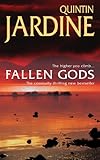
    Fallen Gods is the 13th in the Bob Skinner books. It’s set in both Scotland and  America. The beginning of this book is quite confusing, which is down to me and not the author as I’ve jumped into the Bob Skinner books mid-stream as it were. It’s confusing because at the beginning of the book it appears that Bob is dead, ‘dropping in his tracks’ at his wife’s parents’ funeral. Sarah, his wife, says

    His heart stopped, just like that. Makes you think, doesn’t it. There is no Superman; there is no Planet Krypton. Not even the great Deputy Chief Constable Bob Skinner was invulnerable. (page 6)

    I had to double check.  I’d  read  the blurb before I started to read Fallen Gods and that stated that Bob’s career is ‘hanging by a thread’; that his brother’s body has been found in the detritus of a flood – a brother whose existence he has kept a secret for many years;  and that a valuable painting was burnt in the Royal Scottish Academy in Edinburgh. Whilst he and his team are investigating these events, his wife, Sarah is left in America with their children, recovering from the death of her parents. She finds comfort in the arms of an old college lover and then is faced with ‘a seemingly inevitable murder conviction’.

    So how could Bob Skinner be dead? All was revealed as I read on and what a tangled web Quintin Jardine has woven (as Sir Walter Scott would say).

    So, I have found another detective series to read. This is a complex book, with believable characters and it switches seemlessly between the crimes in  Scotland and America with ease. I was never unsure where I was or who I was with and there are a lot of characters to get your head round. It kept me guessing throughout as to the culprits and is really more about the characters and their personal lives than about the crimes.

    I enjoyed this book and will be reading more of Bob Skinner in the future – there are 19 in total so far.

    Crime Fiction Alphabet: P is for …

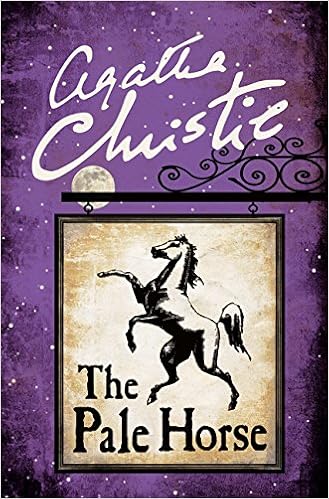
    The Pale Horse by Agatha Christie. My copy is a hardback published in 1961 for The Crime Club.

    Neither Hercule Poirot, nor Miss Marple feature in this novel and Mrs Ariadne Oliver has only a small part. Detective Inspector Lejeune is in charge of the investigation into the murder of Father Gorman who was killed one night on his way home. A list of names is found on Father Gorman’s body, seemingly unconnected in any way. The title,  a reference from the Book of Revelation  to a pale horse ridden by Death suggested to me from the beginning that what they had in common was death.

    Mark Easterbrook, an historian and friend of Mrs Oliver, is drawn into the mystery when he meets an old friend Dr Corrigan, a police doctor, who shows him the list. Mark recognises two of the named people, both of whom are now dead. His cousin Rhoda lives in Much Deeping where he meets Ginger, a young red-haired woman and a friend of Rhoda. They visit The Pale Horse, an old house  which was formerly an inn in the village and is now the home of three weird women, thought by the locals to be witches. The Pale Horse is also the name of a sinister organisation that arranges murders based on black magic. Together, Mark and Ginger set out to unravel the mystery of the Pale Horse, but it is down to Inspector Lejeune to find the killer.

    The book is a study of evil. Some of the characters are together discussing witchcraft and the nature of evil. Venables, a man crippled with polio says:

    ‘I can’t really go along with this modern playing down of evil as something that doesn’t really exist. There is evil. And evil is powerful. Sometimes more powerful than good. It’s there. It has to be recognised – and fought. Otherwise -‘ he spread out his hands.’We go down to darkness.’ (page 70)

    It’s a fascinating book conveying a feeling of real menace. As usual with Agatha Christie’s books there are several suspects and various red herrings. However, I began to suspect who the culprit was quite early on in the book and this time I was right. This did not detract at all from my enjoyment and I hadn’t worked out the method until right at the end. I liked the various references to previous crimes that Agatha Christie dropped into the narrative, and also the portrait of Mrs Oliver as an author who liked her own privacy and disliked the embarrassing questions, always the same, that people asked her every time:

    What made you first think of taking up writing? How many books have you written? How much money do you make? (page 17)

    Reading about The Pale Horse in John Curran’s book Agatha Christie’s Secret Notebooks I discovered that this novel was mentioned during the trial in 1972 when Graham Young was convicted of murder, using the same method as detailed in the book, although he denied having read The Pale Horse. Still, it’s a disturbing thought, one that often occured to me when I used to watch TV programmes such as Wire in the Blood (I can’t watch it any more, it’s far too gory for me).

    Crime Fiction Alphabet: O is for …

    letter OThis week my choice for the Crime Fiction Alphabet meme is Oscar Wilde and the Candlelight Murders by Gyles Brandreth (published in the USA as Oscar Wilde and a Death of No Importance), John Murray Publishers Ltd, 2008, 355 pages). I read this in April 2008 and these were my thoughts about it at the time.

    This is an ‘historical whodunit’ set in 1889 €“ 1890, fin-de-siècle London and Paris. The mystery begins with Oscar Wilde finding the naked body of Billy Wood, a 16 year old boy in the candle-lit room in a small terraced house in Westminster, close to the Houses of Parliament. Billy’s throat has been cut and he is laid out as though on a funeral bier, surrounded by candles, with the smell of incense still in the air. It’s a combination of fiction and fact, with both real and imaginary characters. Wilde with the help of his friends Arthur Conan Doyle and Robert Sherard sets out to solve the crime. Sherard (the great grandson of William Wordsworth) who wrote poems, novels, biographies (including five of Oscar Wilde) and social studies is the narrator.

    The story reads quickly and is full of colourful characters such as Gerard Bellotti, who runs an ‘informal luncheon club for gentlemen’. Bellotti is

    ‘grossly corpulent’ giving the impression of ‘a toad that sits and blinks, yet never moves’ wearing ‘an orange checked suit that would have done credit to the first comedian at Collins’ Music Hall and on the top of his onion-shaped head of oily hair, which was tightly curled and dyed the colour of henna, he sported a battered straw boater.’

    Wilde is a fan of Conan Doyle’s Sherlock Holmes stories so much so that as the mystery is unravelled he picks up clues in the manner of Holmes, observing and deducing, exclaiming when questioned by Conan Doyle ‘Come, Arthur, this is elementary stuff €¦ Holmes is where my heart is.’ I think it is this combination of fact and fiction that I enjoyed most in reading the book. I knew little about Wilde or Doyle and nothing about Sherard before reading it, but I think I learned a lot about all three people, about their characters, their views on life and love, and their works, as well as about the society in which they lived.

    According to The Oscar Wilde Murder Mysteries website the book is peppered through with quotes from Wilde, or Brandreth’s versions of Wilde’s words, together with Brandreth’s own inventions. I couldn’t tell which was which, as I’ve only read Wilde’s The Picture of Dorian Gray and seen a TV production of The Importance of Being Ernest, but it all seemed perfectly in character to me. I found the details of Wilde’s love for his wife Constance particularly interesting in contrast to his trial for gross indecency in 1895. In fact I came away from the book really liking Wilde and wanting to read more about him and by him. Fortunately the biographical notes at the end of the book give more details of works by and about Wilde, Conan Doyle and Sherard.

    I didn’t find the mystery too difficult to work out, with lots of clues throughout the book, but that didn’t detract from my enjoyment. On the contrary it made it all the more pleasurable. There are two more books in the series Oscar Wilde and the Ring of Death and Oscar Wilde and the Dead Man’s Smile.