Five Red Herrings by Dorothy L Sayers

Five Red Herrings by Dorothy L Sayers  was first published in 1931, the seventh Lord Peter Wimsey murder mystery. Wimsey is on holiday in Kirkcudbright and Gatehouse of Fleet in Galloway, Scotland, in a fishing and painting community where he is known and where he is

… received on friendly and even affectionate terms. He could make a respectable cast, and he did not pretend to paint, and therefore, although English and an ‘incomer’, gave no cause of offence. The Southron is tolerated in Scotland on the understanding that he does not throw his weight about, and from this peculiarly English vice Lord Peter was laudably free. True, his accent was affected and his behaviour undignified to a degree, but he had been weighed in the balance over many seasons and pronounced harmless, and when he indulged in any startling eccentricity, the matter was dismissed with a shrug and a tolerant, ‘Christ, it’s only his lordship.’ (page 2)

When Campbell, a local landscape painter and fisherman is found dead in a burn near Newton Stewart, it seems he must have slipped whilst painting near to the edge of a ravine, a steep and treacherous granite slope. At first it looks as though it was an accident, but  Wimsey is convinced it was murder and an autopsy reveals that Campbell was dead before he fell into the burn. Campbell was not a popular man, described as ‘ a devil when he is drunk and a lout when he is sober.’ There are 6 possible suspects – all of whom had quarrelled with or been assaulted by Campbell, all of them artists.

What follows is an intricately plotted story as Wimsey and the police investigate the mystery. It is complicated by immense detail about train times, routes, bicycles, moving the body, alibis, and varying styles of painting – I gave up trying to understand it all and just read along enjoying the puzzle.

The five red herrings are, of course, the five innocent suspects, and Wimsey introduces another possibility that it might not be any of the six suspects, when having heard the case against each of them, he announces that all the theories are wrong, before he gives his verdict. And then he sets in motion a re-enactment of the crime from beginning to end to show how it was carried out, down to the most minute detail.

Sayers doesn’t play fair with the reader in not revealing a clue Wimsey noticed at the scene of the crime whilst he was searching through the contents of Campbell’s pockets and satchel and announced something was missing. In an added note Sayers explained that Wimsey

… told the Sergeant what he was look for and why, but as the intelligent reader will readily supply these details for himself, they are omitted from this page. (page 21)

I didn’t ‘readily supplied the details’  for myself but eventually I guessed what it was. But overall, that is just a minor complaint and I thoroughly enjoyed this mystery, the characters are striking and the setting is well grounded.

Five red herrings map 001

There is a map at the beginning of the book that helped me follow the action and in the Foreword Sayers explained that

All the places are real places and all the trains are real trains, and all the landscapes are correct, except that I have run up a few new houses here and there.

and goes to clarify that

… none of the people are in the least like real people, and that no Galloway artist would ever think of getting intoxicated or running away from his wife or bashing a fellow citizen over the head. All that is just for fun and to make it more exciting.

The Gateway of Fleet website has an interesting page on ‘Dorothy L Sayers in Galloway‘, which states that she and her husband Mac Fleming first visited  Galloway in 1928 when they stayed at the Anwoth Hotel (mentioned in Five Red Herrings) in Gatehouse of Fleet and from 1929 they rented a studio in The High Street, Kirkcudbright next door to the well-known artist Charles Oppenheimer. They got to know Galloway well, especially the artistic community in Kirkcudbright and Gatehouse, on which her detective novel Five Red Herrings is based.http://Dorothy L Sayers in Galloway

I realised after I’d read Five Read Herrings that it fits into a couple of reading challenges – the Colour Coded Challenge (a book with ‘red’ in the title) and the Read Scotland Challenge (a book set in Scotland).

Gray Mountain by John Grisham

Years ago, well before I began this blog, I read many of John Grisham’s books and loved them. Then, somehow, he went off my radar, but when I saw Gray Mountain on display in the library I remembered how much I used to enjoy his books and borrowed it.

Gray Mountain


I don’t think he has changed much – this book is just as much a campaign against injustice and the misuse of power, about the good little guys against the big bad guys as his earlier books are. In this case it’s the big coal companies that come under the microscope, companies that are  ruining the environment by strip-mining in the Appalachian mountains. I was amazed to read the details – clear-felling the forests, scalping the earth and then blasting away the mountain tops to get at the coal. All the trees, topsoil and rocks are then dumped into the valleys, wiping out the vegetation, wildlife and streams. Gray Mountain is one of the mountains destroyed in this way.

But this is running ahead in the book. It begins in 2008 when Samantha Kofer has lost her job as a highly paid third-year associate with New York’s largest law firm following the bankruptcy of the Lehman Brothers bank. One of the options open to her is to work for free for twelve months as an intern at the Mountain Legal Aid Clinic in Brady, Virginia, run by Mattie Wyatt.  After that there is the possibility that she could get her old job back.

Up until then Samantha had only worked in corporate law and had never been in a courtroom, but she soon became immersed in a variety of  cases, including meths dealers and people suffering from black lung disease.

Gray Mountain is owned by Mattie’s nephew, Donovan Gray, also a lawyer, who is taking on cases against the Big Coal companies.  One of the cases involves the Tate family, two little boys who were killed when a boulder from the rock clearance crashed into the trailer where they were sleeping.  Although Samantha is horrified by the situation and wants to help Donovan and his brother Jeff in their search for justice, she feels reluctant to get involved as Donovan’s  methods are sometimes not strictly legal – and she doesn’t feel she belongs in Brady. And there is still the opportunity for her to work in New York, when a former colleague offers her a job.

But she gets emotionally involved with the people and their problems and begins to like litigation:

This was the rush, the high, the narcotic that pushed trial lawyers to the brink. This was the thrill that Donovan sought when he refused to settle for cash on the table. This was the overdose of testosterone that inspired men like her father to dash around the world chasing cases. (page 197)

She has to decide whether to stay with the Clinic or take the job in New York, and she loves the city life. It’s not an easy decision, and it is not revealed until right at the very end of the book.

Although Gray Mountain doesn’t quite match up to my memories of Grisham’s earlier books, I still enjoyed it. At first I thought he was introducing too much detail about the coal companies’ mining practices, but I soon realised how essential it is to understanding the issues. At times it’s like reading a series of short stories, but the main theme is well maintained. I liked the view of the small town community, the mountain scenery, the legal cases large and small and the tension created by the danger of opposing the big coal companies.

Reading Challenge: Color Coded Reading Challenge, with the word ‘Gray’ in the title and the cover being mainly grey in colour it qualifies for the category a book with ‘Black’or any shade of black in the title/on the cover.

Green Darkness by Anya Seton

I finished reading Green Darkness a couple of weeks ago and have been wondering what to write about it or whether to write anything at all. I thought I’d read the book years ago, not long after it came out, but as soon as I began what I thought was a re-read I realised that this was completely new to me – I just thought I’d read it because I’d visited Ightham Mote, a beautiful 14th century moated manor house in Kent where part of Green Darkness is set.

A brief synopsis from Goodreads:

This story of troubled love takes place simultaneously during two periods of time: today and 400 years ago. We meet Richard and Celia Marsdon, an attractive young couple, whose family traces its lineage back to medieval England. Richard’s growing depression creates a crisis in Celia, and she falls desperately ill. Lying unconscious and near death, Celia’s spirit journeys backward to a time four centuries earlier when another Celia loved another Marsdon.

I wasn’t enthralled by it and nearly abandoned it after the first few chapters set in 1968, because the characters didn’t come over as real and the writing in accents was awful. But once I got on to the historical part, set in the 16th century it was better, so I read on.

There are some books that are easy to write about – this isn’t one of them so this is a brief post. Green Darkness is written around the premise of reincarnation, so the characters/personalities feature in both time periods. I didn’t think this was successful, but seemed contrived. For me the book would have been better as straight historical fiction.

Reading Challenges: Color Coded Challenge – green (I don’t know why this book is called Green Darkness – if the book explains the title I missed it). What’s In a Name – a book with a colour in its title. Historical Fiction challenge – 16th century England. My Kind of Mystery Challenge.

Color Coded Challenge 2014 – Completed

Color Coded Challenge

For a while this year I thought I would not complete this Challenge, hosted by Bev at My Reader’s Block – but I have!

It’s a simple challenge – to read nine books in the following categories – the links are to my posts on the books:

1. A book with ‘Blue’ or any shade of Blue (Turquoise, Aquamarine, Navy, etc) in the title – Blue Heaven by C J Box.

2. A book with ‘Red’ or any shade of Red (Scarlet, Crimson, Burgundy, etc) in the title – A Study in Scarlet by Arthur Conan Doyle.

3. A book with ‘Yellow’ or any shade of Yellow (Gold, Lemon, Maize, etc.)in the title – The Yellow Wallpaper by Charlotte Perkins Gilman.

4. A book with ‘Green’ or any shade of Green (Emerald, Lime, Jade, etc) in the title –  Christmas at Thrush Green by Miss Read.

5. A book with ‘Brown’ or any shade of Brown (Tan, Chocolate, Beige, etc) in the title – Portrait in Sepia by Isabel Allende.

6. A book with ‘Black’ or any shade of Black (Jet, Ebony, Charcoal, etc) in the title – Black Dogs by Ian McEwan.

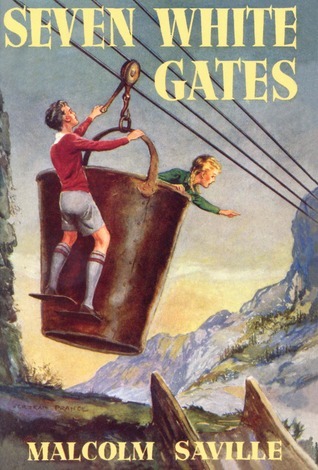
7. A book with ‘White’ or any shade of White (Ivory, Eggshell, Cream, etc) in the title – Seven White Gates by Malcolm Saville.

8. A book with any other color in the title (Purple, Orange, Silver, Pink, Magneta, etc.) – Purple Hibiscus by Chimamanda Ngozi  Adichie

9. A book with a word that implies color (Rainbow, Polka-dot, Plaid, Paisley, Stripe, etc.) —Dying in the Wool by Frances Brody

Christmas at Thrush Green by Miss Read

I was in the library a few days ago and Christmas at Thrush Green caught my eye with its sparkly, snowy front cover. Years ago I read as many of Miss Read’s books that I could find in the library, but I didn’t think I’d read this one. ‘Miss Read’ is a pseudonym for Dora Saint (1913 – 2012) who wrote over 40 books for adults and children.
Christmas at Thrush Green was first published in 2009 and the title page reveals that it was written by Miss Read with Jenny Dereham. In the Acknowledgements at the front of the book Miss Read explained that she and Jenny Dereham, her long-time editor had:

… discussed the initial idea, developed the unfolding story-line and then I left her to put that into words, based on the Thrush Green characters. I am more than happy with the result and hope those people who enjoyed all the other Thrush Green books will enjoy this as much.

So, not exactly by Miss Read, but still an enjoyable book and as it was so many years ago that I read some of the Thrush Green books I can’t compare this with the other books. And I’d read more of her Fairacre books than the Thrush Green ones. It’s comfort reading, nearly 350 pages that kept me entertained, with a few memorable characters amongst its many characters. There are so many characters that I began to get confused, as some of them just melded together in my mind. Each character is introduced with a brief biography and history, which helped me sort out some of them.

Preparations for the Christmas Nativity play are under way when some of the children come down with chicken pox. Ella Bembridge is losing her sight and behaving strangely, Nelly Piggott, the owner of The Fucshia Bush Tea Shop is thrilled at winning an award, there are newcomers to Thrush Green who haven’t settled in and have upset some of the locals. I particularly liked the episodes feating the vicar, Charles Henstock and his wife Dimity, affectionately called ‘Dim’. It’s a nostalgic read about village life at Christmas time – snow, parties, and church services.

As a result of reading this I’ve decided I want to re-read/read more of Miss Read’s books, and have started Village Diary.

Seven White Gates by Malcolm Saville

Once more I’m behind with writing reviews – I blame it on the season! So to catch up I’m going to write some shortish posts with just a few thoughts on the books I’ve been reading.

Seven White Gates by Malcolm Saville is the second in his Lone Pine series. I first read some of his books when I was a child, but none of this series. But even so this was a nostalgic read for me and I would have really loved it if I’d read it years ago. It was first published in 1944. The Lone Pine books are about a group of children who formed a secret society in wartime Shropshire.

I particularly like the setting of Seven White Gates, in Shropshire not far from the border with Wales, an area rich in folklore and legend. It begins at the beginning of the Easter holidays, when Peter (Petronella) Stirling, who is fifteen, discovers that she cannot spend them at home with her father at Hatchholt, as he has to go away. Instead she is to stay with her unknown aunt and uncle, near Barton Beach, whose farm is under the Stiperstones mountain crested by the Devil’s Chair. The Stiperstones range lies within the Shropshire Hills Area of Outstanding Natural Beauty and is now on my wishlist of places to visit and the Devil’s Chair is really there:

The Devil’s Chair – Photo from Wikimedia Commons

She invites the other members of the Lone Pine club, David Morton, aged sixteen and his younger brother and sister, the annoying twins, Dickie and Mary, who are nine to stay at the farm with her. She meets a family of gypsies and makes a new friend, Jenny at Barton Beach, who all tell her the terrifying legends about the Stiperstones and the Devil’s Chair. Reuben warns her:

Remember, Petronella, our friend, never to be seen near the Stiperstones on the longest night of the year, for then all the ghosts in Shropshire and all the counties beyond meet on the summit – right on and around the Chair they meet – to choose their king … And any who venture out on that night and see the ghosts of all the years dead from hereabouts are stricken with fear and often do not live the year … (page 31)

What follows is an exciting adventure story. Peter’s Uncle Micah is a strange character, a forbidding. gloomy, unhappy man missing his son Charles who had left home some years earlier. It’s fast paced and full of danger for Peter and her friends as they explore the Stiperstones and its secrets.

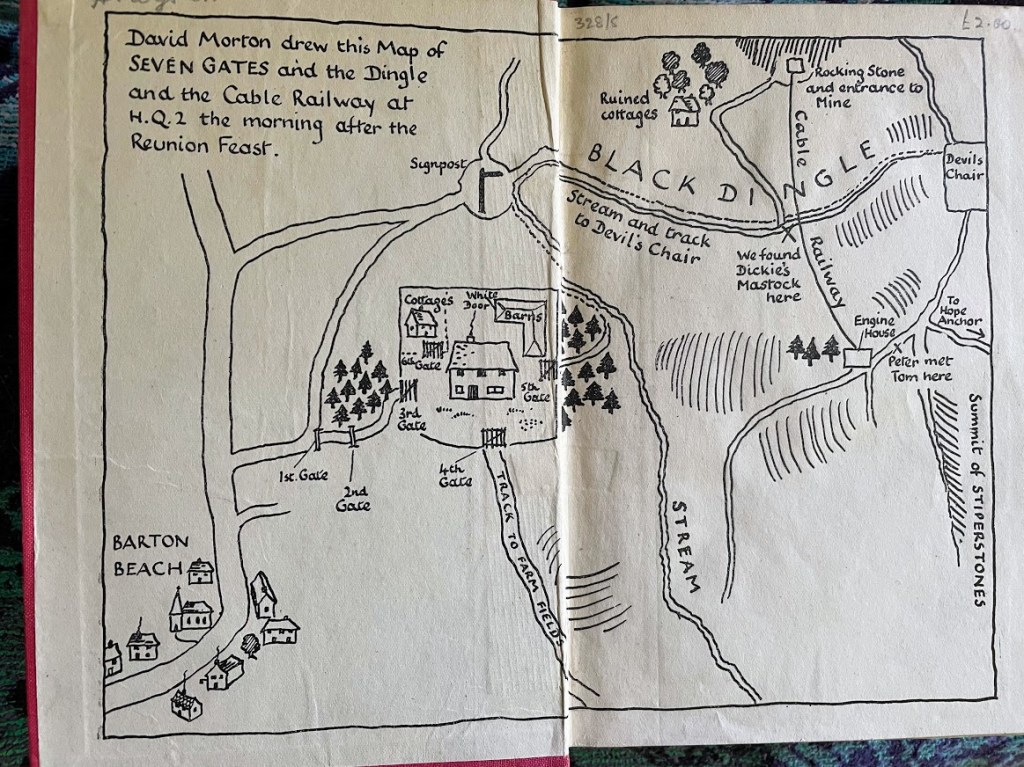
The book is illustrated with full page black and white drawings and a plan of Seven Gates, which I found very useful in following the action!